
AGRICULTURAL BANK OF CHINA(01288)

Search documents
商人送钱10年让官员主动给办事
Xin Lang Cai Jing· 2026-01-13 14:35
Group 1 - The article discusses the long-term relationship between a businessman, Li Yuanguang, and a bank official, Jiang Chaoliang, highlighting how the businessman provided support to the official over many years, leading to a sense of obligation on the part of the official [1] - Jiang Chaoliang, who eventually became the head of the Agricultural Bank of China, facilitated a significant procurement contract for Li Yuanguang's company, which involved the purchase of a large number of ATMs in 2011 [1] - The narrative illustrates the dynamics of corruption and favoritism within the banking sector, where personal relationships can lead to substantial financial benefits for certain companies [1]
港股央企红利ETF(159333)涨0.64%,成交额5481.82万元
Xin Lang Cai Jing· 2026-01-13 14:03
Core Viewpoint - The Wanjiac Zhongzheng Hong Kong Stock Connect Central State-Owned Enterprises Dividend ETF (159333) has shown a slight increase in its closing price and has experienced a decrease in both share count and total assets since the beginning of the year [1][2] Group 1: Fund Performance - As of January 13, 2024, the ETF closed with a gain of 0.64% and a trading volume of 54.82 million yuan [1] - The fund's management fee is 0.50% annually, and the custody fee is 0.10% annually [1] - The ETF's performance benchmark is the China Securities Hong Kong Stock Connect Central State-Owned Enterprises Dividend Index return rate, adjusted for valuation exchange rates [1] Group 2: Fund Size and Liquidity - As of January 12, 2024, the ETF had a total of 365 million shares and a total size of 522 million yuan, reflecting a decrease of 7.83% in shares and 6.91% in size since December 31, 2023 [1] - Over the past 20 trading days, the ETF's cumulative trading amount reached 275 million yuan, with an average daily trading amount of 13.76 million yuan [1] - In the current year, the ETF has recorded a cumulative trading amount of 128 million yuan over 7 trading days, with an average daily trading amount of 18.33 million yuan [1] Group 3: Fund Management and Holdings - The current fund manager is Yang Kun, who has managed the ETF since its inception on August 21, 2024, achieving a return of 44.33% during his tenure [2] - The ETF's top holdings include COSCO Shipping Holdings (6.02%), China Nonferrous Mining (3.22%), China National Offshore Oil (2.51%), and Agricultural Bank of China (2.27%), among others [2]

2026首份银行增持公告来了!顶流银行ETF(512800)上探1%,机构:历次春节前银行胜率最高,值得重视
Xin Lang Cai Jing· 2026-01-13 11:44
Core Viewpoint - The banking sector shows resilience with significant stock price increases, driven by executive buybacks and insurance capital inflows, indicating strong confidence in the sector's fundamentals and long-term value [3][12]. Group 1: Market Performance - On January 13, the market experienced a pullback, but the banking sector remained active, with notable gains: Ningbo Bank up over 4%, Hangzhou Bank up over 3%, and several others including CITIC Bank and Chongqing Rural Commercial Bank up over 2% [1][9]. - The top-tier banking ETF (512800) saw an intraday price increase of over 1%, closing up 0.37% and surpassing the 5-day moving average [1][10]. Group 2: Executive Buybacks - The first executive buyback announcement of 2026 was made by Chongqing Rural Commercial Bank, where some directors and executives purchased 192,000 shares from the secondary market, with a maximum investment of 1.23 million yuan [3][12]. - Nanjing Bank reported that its major shareholder, Zijin Group, increased its stake by 123,472,060 shares, representing 1.00% of the total share capital, continuing from previous increases since September 2025 [3][12]. Group 3: Insurance Capital Inflows - Insurance capital has been actively purchasing bank stocks, with Ping An Life announcing it reached a 20% stake in China Merchants Bank H-shares, triggering a mandatory bid [3][12]. - In 2025, insurance capital made 41 stake increases, the highest in nearly a decade, with bank stocks accounting for about 40% of these actions, highlighting their dominance in this area [3][12]. Group 4: Seasonal Trends - Historically, the banking sector has performed well before the Spring Festival, with the Shenwan Banking Index showing over 80% win rate in the past decade, except for 2020 [4][16]. - The average absolute return of the Shenwan Banking Index before the Spring Festival is 4.4%, with an average excess return of 4.9% compared to the Shanghai Composite Index, making it the highest among 31 industry indices [4][16]. Group 5: Future Outlook - Factors expected to drive the banking sector's performance leading up to the Spring Festival in 2026 include continued growth policies, ongoing insurance asset scarcity, and increased market volatility [7][16]. - The banking ETF (512800) is noted for its efficiency in tracking the banking sector, with a current scale of 11.95 billion yuan and an average daily trading volume exceeding 800 million yuan since 2025, making it the largest and most liquid banking ETF in A-shares [7][16].






农业银行(601288) - 农业银行H股公告
2026-01-13 11:15
香港交易及結算所有限公司及香港聯合交易所有限公司對本公告的內容概不負責,對其準確性或完整性亦不發表任 何聲明,並明確表示,概不對因本公告全部或任何部分內容而產生或因倚賴該等內容而引致的任何損失承擔任何責 任。 本公告僅供參考,並不構成收購、購買或認購本公告所提述證券的邀請或要約。 本公告不得直接或間接在或向美國分發。本公告並不構成在美國境內或在任何其他司法管轄區提呈出售要約或招攬 購買任何證券的要約,倘未根據任何該等司法管轄區的證券法辦理登記或未獲批准而於上述地區進行上述要約、招 攬或出售即屬違法。本公告所述的證券將不會根據經修訂的1933年美國證券法(「證券法」)登記,亦不得在美國境內 或向任何美國人士(如證券法S規例定義)或為美國人士的利益作出要約或出售,惟根據證券法登記規定獲豁免或毋 須遵守證券法的登記規定進行的交易除外。於美國公開發售任何證券將須以招股章程形式作出。該招股章程將載有 關於提呈發售的公司以及其管理及財務報表的詳細資料。本公告所述的證券並未也無意在美國進行公開發售。 | 中國農業銀行股份 | 農銀國際 | 花旗 | | --- | --- | --- | | 有限公司香港分行 | | | ...
农业银行(01288) - 中国农业银行股份有限公司纽约分行於中国农业银行股份有限公司15,000,...
2026-01-13 10:49
香港交易及結算所有限公司及香港聯合交易所有限公司對本公告的內容概不負責,對其準確性或完整性亦不發表任 何聲明,並明確表示,概不對因本公告全部或任何部分內容而產生或因倚賴該等內容而引致的任何損失承擔任何責 任。 1288 中國農業銀行股份有限公司紐約分行 於2031年到期600,000,000美元浮動利率票據 (股份代號:40041)(「票據」) 根據15,000,000,000美元中期票據發行計劃(「票據發行計劃」)項下發行 本公告僅供參考,並不構成收購、購買或認購本公告所提述證券的邀請或要約。 本公告不得直接或間接在或向美國分發。本公告並不構成在美國境內或在任何其他司法管轄區提呈出售要約或招攬 購買任何證券的要約,倘未根據任何該等司法管轄區的證券法辦理登記或未獲批准而於上述地區進行上述要約、招 攬或出售即屬違法。本公告所述的證券將不會根據經修訂的1933年美國證券法(「證券法」)登記,亦不得在美國境內 或向任何美國人士(如證券法S規例定義)或為美國人士的利益作出要約或出售,惟根據證券法登記規定獲豁免或毋 須遵守證券法的登記規定進行的交易除外。於美國公開發售任何證券將須以招股章程形式作出。該招股章程將載有 關 ...
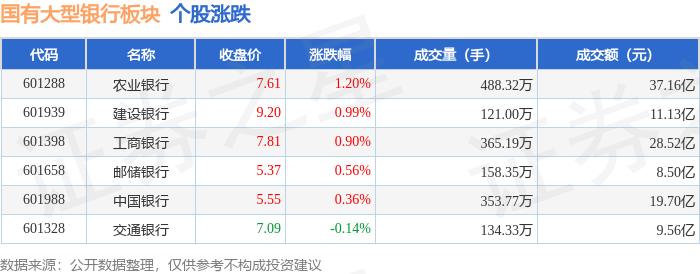
国有大型银行板块1月13日涨0.87%,农业银行领涨,主力资金净流入3.86亿元
Zheng Xing Xing Ye Ri Bao· 2026-01-13 09:06
Group 1 - The core viewpoint of the news is that the state-owned large bank sector experienced a rise of 0.87% on January 13, with Agricultural Bank leading the gains, while the overall stock indices showed declines [1] - The Shanghai Composite Index closed at 4138.76, down 0.64%, and the Shenzhen Component Index closed at 14169.4, down 1.37% [1] - The trading performance of individual state-owned banks showed varied results, with Agricultural Bank rising by 1.20% to a closing price of 7.61, while China Communications Bank saw a slight decline of 0.14% to 7.09 [1] Group 2 - The net inflow of main funds into the state-owned large bank sector was 386 million yuan, while retail investors saw a net outflow of 12.61 million yuan [1] - The detailed fund flow for individual banks indicated that Agricultural Bank had a main fund net inflow of 158 million yuan, while Industrial and Commercial Bank also saw a significant inflow of 138 million yuan [2] - In contrast, China Bank experienced a net outflow of 30.41 million yuan from main funds, indicating a negative sentiment among investors [2]



中国农业银行取得保管柜控制方法专利
Sou Hu Cai Jing· 2026-01-13 06:00
Core Insights - China Agricultural Bank has obtained a patent for a "control method, device, and electronic equipment for a safe deposit box," with authorization announcement number CN115600957B, applied for on October 2022 [1] Company Overview - China Agricultural Bank, established in 1986 and located in Beijing, primarily engages in monetary financial services [1] - The company has a registered capital of 34,998,303.3873 thousand RMB [1] - According to data analysis, China Agricultural Bank has invested in 16 enterprises, participated in 5,000 bidding projects, and holds 1,311 trademark records and 5,000 patent records, along with 119 administrative licenses [1]
中国农业银行取得室内平面区域指引方法专利
Sou Hu Cai Jing· 2026-01-13 05:24
Group 1 - The core point of the article is that Agricultural Bank of China has obtained a patent for an indoor area guidance method, device, system, and medium, with the patent number CN115640372B, applied for on October 2022 [1] - Agricultural Bank of China was established in 1986 and is located in Beijing, primarily engaged in monetary financial services [1] - The registered capital of Agricultural Bank of China is approximately 34.998 billion RMB [1] Group 2 - According to data analysis, Agricultural Bank of China has invested in 16 enterprises and participated in 5,000 bidding projects [1] - The bank has 1,311 trademark information entries and 5,000 patent information entries [1] - Additionally, the company holds 119 administrative licenses [1]
“资产提升战”打响!工行、农行、中行、建行等齐下场,已有人薅到上万元“羊毛”
Xin Lang Cai Jing· 2026-01-12 12:05
Core Viewpoint - The banking industry has initiated a new round of "asset enhancement battles" in the retail sector, with some banks offering rewards exceeding 3,000 yuan. Retail AUM (Assets Under Management) is now seen as a key indicator of a bank's competitive strength and future profitability. The phenomenon of customers frequently switching banks for short-term incentives indicates that short-term activities fail to create long-term customer loyalty. To effectively enhance retail AUM, banks need to abandon short-term thinking and focus on building comprehensive capabilities centered around professional services and long-term trust [1][23][41]. Group 1: Asset Enhancement Activities - Multiple banks have launched new "asset enhancement activities" at the beginning of the year, allowing customers to earn points and benefits by meeting certain criteria. This includes major state-owned banks like ICBC, ABC, BOC, and CCB, with rewards such as 240,000 "small beans" convertible to over 3,790 yuan in JD E-cards for qualifying customers [2][24]. - Agricultural Bank of China has announced that from January 1 to January 31, customers can earn up to 600 million exclusive points if their average financial assets increase by 10,000 yuan or more [5][27]. - Nanjing Bank and other city commercial banks have also introduced similar activities, with Nanjing Bank offering 1,000 comprehensive points for every 10,000 yuan increase in average financial assets, with a maximum of 80,000 points per month [6][28]. Group 2: Market Dynamics and Challenges - The current "asset enhancement battle" reflects a tactical "New Year rush" and a strategic shift in the banking sector, driven by the need to adapt to changing interest rate environments. Retail AUM has become a critical measure of a bank's competitive edge and future profitability [9][31]. - The phenomenon of customers switching banks for incentives highlights two major challenges: the superficial nature of customer relationships ("high flow, low retention") and the lack of differentiation in service offerings, which makes it difficult to establish long-term trust [17][39]. - The "sheep shearing" phenomenon, where customers exploit short-term incentives, indicates a lack of customer loyalty and reveals weaknesses in banks' customer relationship management strategies [11][40]. Group 3: Recommendations for Improvement - To effectively enhance retail AUM, banks should shift from short-term activity thinking to a focus on professional services and long-term trust. This includes transitioning from product sales to asset allocation, integrating financial services with everyday life, and implementing refined customer segmentation and operations [19][41]. - Banks should strengthen their investment advisory capabilities to transition from merely selling products to providing comprehensive asset management solutions, thereby building a "moat" around their services [20][42]. - Digital transformation should evolve from being a mere outreach tool to empowering an ecosystem that enhances customer engagement and retention, creating a complete service loop that turns short-term activity flows into long-term customer relationships [21][43].


农业银行入选“2025中国企业ESG百强”榜单
Xin Lang Cai Jing· 2026-01-12 10:04
新浪财经ESG评级中心提供包括资讯、报告、培训、咨询等在内的14项ESG服务,助力上市公司传播ESG理念,提升ESG可持续发展表现。点 击查看【 ESG评级中心服务手册】 附:"2025中国企业ESG百强"榜 | 排名 | 公司名称 | 公司标识 | 得分星级 行业分类 | | | --- | --- | --- | --- | --- | | | 建设银行 (HK0939) | ▲ 山国建设城门 | ★★★★★ | 金融 | | | 中国移动 (HK0941) | STAN FILL COLL | ★★★★★ | 电信服务 | | | 农业银行 (HK1288) | 1 / 中国 花 机 银 / | ★★★★★ | 金融 | | 4 | 腾讯容投 HK0700 | Tencent 腾讯 | ★★★★★ | 信息技术 | | 5 | SH601988 中国银行 (HK3988) | 中国银行 | ★★★★★ | 金融 | | 6 | 阳光电源 SZ300274 | SUNGROW | 文文文文文文 | T W | | --- | --- | --- | --- | --- | | 7 | 理想汽车 HK201 ...
