
零售AUM

Search documents
AUM突破17万亿!招商银行营收净利双增长成绩单成色几何
Nan Fang Du Shi Bao· 2026-03-27 21:51
Core Viewpoint - The bank reported a slight increase in revenue and net profit for 2025, indicating resilience in its operations despite industry challenges [1][2]. Revenue and Profit - In 2025, the bank's revenue grew by 0.01% to 337.53 billion RMB, while net profit increased by 1.21% to 150.18 billion RMB [1]. - The bank's net interest income reached 215.59 billion RMB, up by 2.04% year-on-year, despite a narrowing net interest margin [2][4]. Dividend Distribution - The bank announced a cash dividend of 2.016 RMB per share, with a payout ratio of 35.34%, amounting to approximately 25.30 billion RMB [1]. Non-Interest Income - Non-interest income totaled 121.94 billion RMB, a decrease of 3.38% year-on-year, with net fee and commission income rising by 4.39% to 75.26 billion RMB [5]. - Wealth management fees increased by 21.39% to 26.71 billion RMB, contributing significantly to the fee income growth [6]. Asset Quality - The bank's total assets reached 13,070.52 billion RMB, a growth of 7.56% year-on-year, with a non-performing loan (NPL) ratio of 0.94%, down by 0.01 percentage points [7]. - The NPL balance was 68.21 billion RMB, with a coverage ratio of 391.79% [7]. Retail Business Performance - The bank's retail financial business generated a pre-tax profit of 87.42 billion RMB, a slight decline of 0.65% year-on-year, while retail AUM surpassed 17 trillion RMB, marking a 14.44% increase [10][11]. - The number of private banking clients grew by 17.87% to 199,326 [11].

“年前取钱过年,年后存钱理财”,银行力推“资产配置礼”
Xin Lang Cai Jing· 2026-02-26 10:21
Core Insights - After the Spring Festival, banks are experiencing a surge in deposits as individuals and businesses return funds to the banking system, creating a significant growth period for deposits [2][10] - To capitalize on this influx, many banks are shifting their marketing strategies from traditional deposit attraction to asset management, launching campaigns like "Asset Allocation Gifts" to enhance retail AUM (Assets Under Management) [2][5] Group 1: Marketing Strategies - Recent marketing activities by banks focus on "asset allocation" rather than solely increasing deposit interest rates, with various banks offering rewards linked to the increase in financial assets held by customers [3][11] - For example, Ping An Bank's "Asset Allocation Surprise" campaign rewards customers for increasing their holdings of recommended financial products within a week [3][11] - Agricultural Bank of China's "Asset Enhancement Gift" program incentivizes customers to increase their average financial assets, with rewards based on the amount of increase [4][12] Group 2: Industry Trends - The first quarter is viewed as a critical period for banks to achieve strong performance for the year, leading to a preference for "asset allocation gifts" over simple interest rate hikes due to the low and declining deposit rates [5][13] - The shift towards asset management is driven by the need to enhance non-interest income and to adapt to the challenges posed by market interest rate liberalization [6][14] - Banks are increasingly focusing on retail AUM as a strategy to deepen customer relationships and prevent funds from flowing to other financial institutions or capital markets [6][14] Group 3: Customer Engagement - Banks face the challenge of retaining funds after promotional activities end, emphasizing the need for long-term customer relationship management rather than short-term marketing tactics [7][15] - Recommendations for banks include enhancing the professionalism of asset allocation services, improving customer education, and developing a tiered customer management system to provide differentiated products and services [7][15] - Strengthening digital operations and focusing on brand reputation are also crucial for maintaining customer loyalty beyond promotional incentives [7][15]




总资产破3万亿!南京银行2025年利息净收入增超30%
Nan Fang Du Shi Bao· 2026-01-23 02:18
Core Insights - Nanjing Bank reported a total operating income of 55.54 billion yuan for 2025, marking a year-on-year increase of 10.48% [2][4] - The net profit attributable to shareholders reached 21.807 billion yuan, reflecting an 8.08% growth compared to the previous year [2][4] - Total assets exceeded 3 trillion yuan for the first time, reaching 3.0224 trillion yuan, with a year-on-year growth of 16.63% [3][6] Financial Performance - Operating profit for the year was 26.174 billion yuan, up 6.02% from the previous year [3] - Total profit amounted to 26.094 billion yuan, an increase of 5.85% year-on-year [3] - Basic earnings per share decreased by 3.83% to 1.76 yuan [3] Income Sources - Net interest income surged by 31.08% to 34.902 billion yuan, with its share of total revenue rising from 52.96% to 62.8% [5] - Non-interest income accounted for 47% of total revenue in 2024, indicating a strong performance in financial investments [5] Asset and Loan Growth - Total deposits reached 1.67 trillion yuan, growing by 11.67% year-on-year [5] - Total loans amounted to 1.42 trillion yuan, reflecting a 13.37% increase [5] - The bank's retail customer financial assets (AUM) surpassed 1 trillion yuan, reaching 1.0025 trillion yuan, a growth of 21.23% [6] Market Position and Client Base - The bank expanded its corporate client coverage, with a 19.04% increase in valuable corporate clients [6] - The bank maintained its leading market share in Jiangsu province for non-financial corporate debt financing tools, with an underwriting scale of 271.35 billion yuan [6] Asset Quality - The non-performing loan ratio remained stable at 0.83%, unchanged from the previous year [6] - The provision coverage ratio was 313.31%, down 21.96 percentage points year-on-year [6] - The core Tier 1 capital adequacy ratio was 9.31%, a slight decrease of 0.05 percentage points [6]

多家银行开年推出资产提升活动
Zheng Quan Ri Bao Zhi Sheng· 2026-01-15 16:41
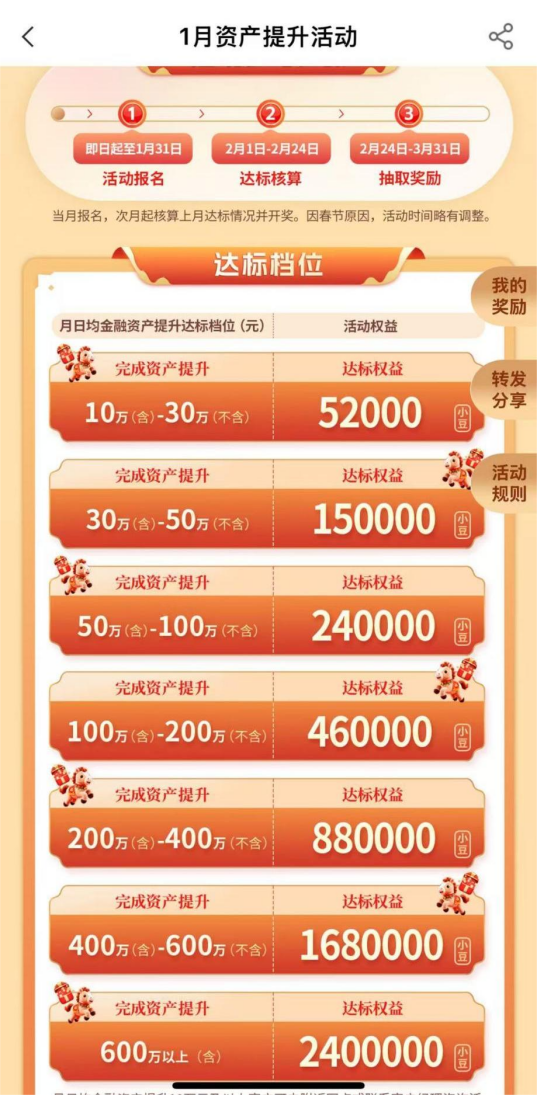
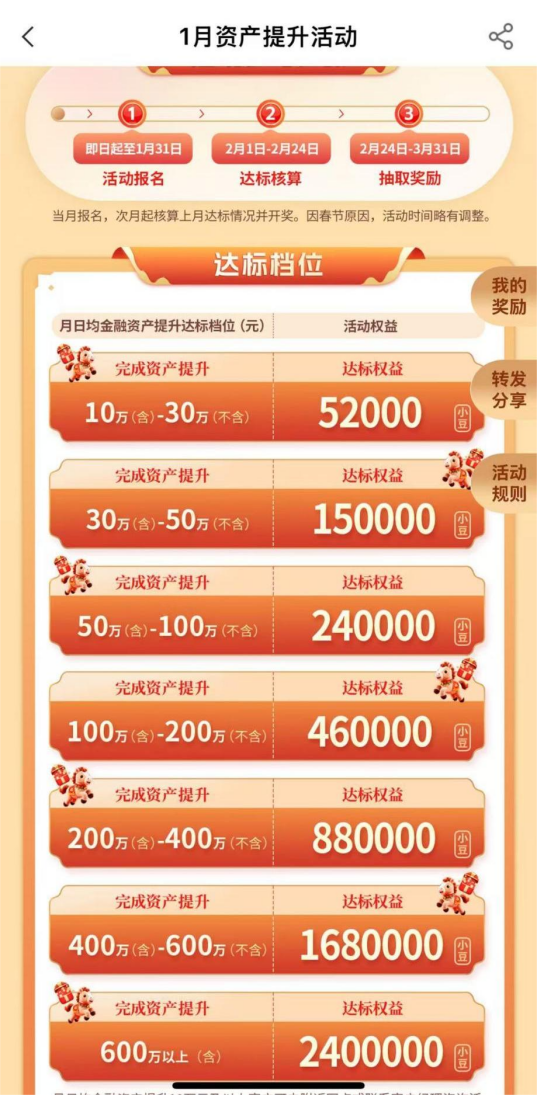
Core Insights - Banks are shifting focus from deposit acquisition to asset management growth, aiming to enhance wealth management services and diversify client asset allocation [1][3] - The launch of asset enhancement activities is driven by the need to stabilize liabilities and expand retail client asset scales amid narrowing net interest margins [1][3] - Retail AUM (Assets Under Management) has become a key indicator of retail business competitiveness and profitability [1][3] Group 1 - Agricultural Bank of China launched an "Asset Enhancement Reward" program, offering rewards based on monthly average financial asset increases, with a minimum threshold of 100,000 yuan and potential rewards up to 2.4 million small beans for increases over 6 million yuan [1] - Industrial and Commercial Bank of China introduced the "Golden Upgrade" program, providing dual rewards for asset enhancement and maintenance, with a maximum reward of 4 million IC beans for qualifying clients [2] - Smaller banks like Shanghai Bank and Nanjing Bank are also implementing similar asset enhancement initiatives, capitalizing on the seasonal increase in retail client income due to year-end bonuses [3] Group 2 - The asset enhancement activities are a response to three main factors: the seasonal increase in retail client income, the pressure on net interest margins, and the need to optimize liability structures by shifting funds from deposits to diversified financial products [3] - The banking sector is experiencing three major trends: a shift in assessment criteria from deposit metrics to total client asset evaluations, a move towards differentiated services based on client asset tiers, and deeper integration of digital operations [3] - Experts suggest that banks should move beyond simple "reward subsidy" models and focus on differentiated services and professional capabilities to avoid potential pitfalls in client retention [4]

鏖战零售资产管理规模,开年银行资产提升活动密集上线
Mei Ri Jing Ji Xin Wen· 2026-01-12 13:13
Core Insights - Multiple banks, including major state-owned banks and city commercial banks, have launched asset enhancement activities to increase retail AUM (Assets Under Management) and enhance customer loyalty [1][4]. Group 1: Asset Enhancement Activities - Agricultural Bank of China has initiated an "Asset Enhancement Gift" activity from January 6 to March 31, where users can win rewards based on their average financial assets [2]. - Industrial and Commercial Bank of China has introduced the "升金有礼" activity, rewarding customers based on the increase in their average financial assets compared to the previous month, with rewards reaching up to 4 million beans for significant increases [2]. - City commercial banks like Shanghai Bank are also participating, offering rewards for customers who meet specific asset thresholds and increases [3]. Group 2: Impact on Retail AUM - The surge in asset enhancement activities is expected to stimulate AUM growth significantly, particularly by activating dormant customers and attracting short-term funds [4]. - Successful activities can lead to increased customer dependency on banks, enhancing customer loyalty and potentially improving overall profitability through cross-selling opportunities [4]. - Retail AUM for several A-share banks has been expanding, with notable growth rates reported, such as Postal Savings Bank reaching 17.89 trillion yuan, a growth of over 7% compared to the previous year [5].
“资产提升战”打响!工、农、中、建等齐下场,有人薅到上万元“羊毛”
Zhong Guo Ji Jin Bao· 2026-01-12 12:29
Core Insights - The banking industry has initiated a new round of "asset enhancement wars" in the retail sector, with some banks offering rewards exceeding 3000 yuan, indicating a competitive push to increase retail AUM (Assets Under Management) as a key metric for future profitability [1][2][3] Group 1: Asset Enhancement Activities - Major banks, including state-owned banks like ICBC, ABC, BOC, and CCB, have launched asset enhancement activities, with rewards such as points and cash benefits for customers who meet certain asset thresholds [2][3] - Agricultural Bank of China offers rewards up to 3790 yuan in JD E-card value for customers who increase their average monthly financial assets to specified levels [2] - Nanjing Bank and other city commercial banks have also introduced similar initiatives, with Nanjing Bank providing up to 80,000 comprehensive points for asset increases [5][6] Group 2: Market Dynamics and Customer Behavior - The phenomenon of customers frequently switching banks to take advantage of promotional offers highlights the short-term nature of these incentives, which fail to build long-term customer loyalty [8][14] - Customers have reported significant gains from participating in multiple banks' asset enhancement activities, with one individual claiming to have earned over 20,000 yuan in rewards in a year [11][12] Group 3: Strategic Implications for Banks - Experts suggest that banks need to move beyond short-term promotional strategies and focus on building comprehensive capabilities centered around professional services and long-term trust [16][17] - Recommendations include shifting from a product sales approach to asset allocation, enhancing customer engagement through lifestyle integration, and optimizing performance metrics to prioritize customer relationship value over mere asset size [17][18]
资产提升战”打响!工行、农行、中行、建行等齐下场,已有人薅到上万元“羊毛
Zhong Guo Ji Jin Bao· 2026-01-12 12:09
Core Viewpoint - The banking industry has initiated a new round of "asset enhancement wars" in the retail sector, with some banks offering rewards exceeding 3,000 yuan, indicating a shift towards enhancing retail AUM (Assets Under Management) as a key metric for competitiveness and future profitability [1][2][7]. Group 1: Asset Enhancement Activities - Multiple banks, including major state-owned banks like ICBC, ABC, BOC, and CCB, have launched asset enhancement activities, offering rewards such as points and cash benefits for customers who increase their average financial assets [2][3]. - Agricultural Bank of China is offering rewards of up to 3,790 yuan in JD E-cards for customers who meet specific asset thresholds by the end of January [2]. - Nanjing Bank and other city commercial banks have also introduced similar initiatives, with Nanjing Bank offering up to 80,000 comprehensive points for asset increases [5]. Group 2: Market Dynamics and Challenges - The surge in asset enhancement activities is driven by narrowing net interest margins, prompting banks to shift focus from deposit assessments to comprehensive management of total customer assets [7]. - The phenomenon of customers frequently switching banks to take advantage of promotional offers highlights a challenge in customer retention and loyalty, as short-term incentives do not translate into long-term engagement [8][14]. - The competitive landscape is characterized by a lack of differentiation in service offerings, leading to a "flow without retention" dilemma, where banks struggle to maintain customer loyalty despite attracting new funds [14][15]. Group 3: Strategic Recommendations - To effectively enhance retail AUM, banks should abandon short-term activity thinking and focus on building comprehensive capabilities centered around professional services and long-term trust [16]. - Recommendations include transitioning from product sales to asset allocation services, deepening engagement in financial and lifestyle scenarios, and implementing refined customer segmentation and operational strategies [16][17]. - Banks are encouraged to optimize performance evaluation mechanisms to prioritize long-term customer relationships over short-term metrics, thereby fostering a more sustainable business model [17][18].

“资产提升战”打响!工行、农行、中行、建行等齐下场,已有人薅到上万元“羊毛”
中国基金报· 2026-01-12 12:06
Core Viewpoint - The banking industry in China has initiated a new round of "asset enhancement battles" in the retail sector, with some banks offering rewards exceeding 3,000 yuan to attract customers and increase retail AUM (Assets Under Management) [2][3]. Group 1: Asset Enhancement Activities - Multiple banks, including major state-owned banks and city commercial banks, have launched asset enhancement activities at the beginning of the year, offering rewards such as points and cash discounts for customers who meet certain asset thresholds [4]. - Agricultural Bank of China has announced that customers can earn up to 240,000 points, equivalent to over 3,790 yuan in JD E-card rewards, if their average financial assets increase to specified levels by January 31 [4]. - Other banks, such as Bank of China and Nanjing Bank, have also introduced similar activities with varying rewards, including cash discounts and points for asset increases [8][10]. Group 2: Market Dynamics and Challenges - The phenomenon of customers frequently switching banks to take advantage of promotional offers indicates a lack of long-term customer loyalty, as short-term incentives do not translate into sustained engagement [14][23]. - The competitive landscape is characterized by a "flow without retention" dilemma, where banks attract funds but fail to maintain customer relationships due to a lack of deep service and value creation [23]. - The similarity in promotional activities among banks leads to a homogenization of services, making it difficult to establish differentiated value perceptions among customers [24]. Group 3: Strategic Recommendations for Banks - To effectively enhance retail AUM, banks should abandon short-term activity thinking and focus on building comprehensive capabilities centered on professional services and long-term trust [25][26]. - Recommendations include shifting from product sales to asset allocation, deepening engagement in financial and lifestyle scenarios, and implementing refined customer segmentation and operations [26][27]. - Banks should optimize performance evaluation mechanisms to prioritize long-term customer relationships over short-term metrics, ensuring a focus on customer retention and value creation [27][28].

“资产提升战”打响!工行、农行、中行、建行等齐下场,已有人薅到上万元“羊毛”
Xin Lang Cai Jing· 2026-01-12 12:05
Core Viewpoint - The banking industry has initiated a new round of "asset enhancement battles" in the retail sector, with some banks offering rewards exceeding 3,000 yuan. Retail AUM (Assets Under Management) is now seen as a key indicator of a bank's competitive strength and future profitability. The phenomenon of customers frequently switching banks for short-term incentives indicates that short-term activities fail to create long-term customer loyalty. To effectively enhance retail AUM, banks need to abandon short-term thinking and focus on building comprehensive capabilities centered around professional services and long-term trust [1][23][41]. Group 1: Asset Enhancement Activities - Multiple banks have launched new "asset enhancement activities" at the beginning of the year, allowing customers to earn points and benefits by meeting certain criteria. This includes major state-owned banks like ICBC, ABC, BOC, and CCB, with rewards such as 240,000 "small beans" convertible to over 3,790 yuan in JD E-cards for qualifying customers [2][24]. - Agricultural Bank of China has announced that from January 1 to January 31, customers can earn up to 600 million exclusive points if their average financial assets increase by 10,000 yuan or more [5][27]. - Nanjing Bank and other city commercial banks have also introduced similar activities, with Nanjing Bank offering 1,000 comprehensive points for every 10,000 yuan increase in average financial assets, with a maximum of 80,000 points per month [6][28]. Group 2: Market Dynamics and Challenges - The current "asset enhancement battle" reflects a tactical "New Year rush" and a strategic shift in the banking sector, driven by the need to adapt to changing interest rate environments. Retail AUM has become a critical measure of a bank's competitive edge and future profitability [9][31]. - The phenomenon of customers switching banks for incentives highlights two major challenges: the superficial nature of customer relationships ("high flow, low retention") and the lack of differentiation in service offerings, which makes it difficult to establish long-term trust [17][39]. - The "sheep shearing" phenomenon, where customers exploit short-term incentives, indicates a lack of customer loyalty and reveals weaknesses in banks' customer relationship management strategies [11][40]. Group 3: Recommendations for Improvement - To effectively enhance retail AUM, banks should shift from short-term activity thinking to a focus on professional services and long-term trust. This includes transitioning from product sales to asset allocation, integrating financial services with everyday life, and implementing refined customer segmentation and operations [19][41]. - Banks should strengthen their investment advisory capabilities to transition from merely selling products to providing comprehensive asset management solutions, thereby building a "moat" around their services [20][42]. - Digital transformation should evolve from being a mere outreach tool to empowering an ecosystem that enhances customer engagement and retention, creating a complete service loop that turns short-term activity flows into long-term customer relationships [21][43].

鏖战零售AUM 开年银行资产提升活动密集上线
Mei Ri Jing Ji Xin Wen· 2026-01-09 15:19
Group 1 - Major banks, including ICBC and ABC, have launched asset enhancement activities to increase retail AUM (Assets Under Management) and customer loyalty [1][4] - The activities involve rewards for customers who increase their average financial assets over a specified period, with minimum thresholds set for participation [1][2] - Various banks have different criteria for what constitutes financial assets, including deposits, wealth management, funds, insurance, and government bonds [1][3] Group 2 - The asset enhancement activities are seen as effective short-term tactics to stimulate AUM growth, particularly in attracting dormant customers and short-term funds [4] - Retail banking has faced challenges due to declining interest rates and regulatory changes affecting fee income, prompting banks to focus on increasing AUM to boost revenue [5] - As of Q3 2023, several A-share banks reported significant growth in retail AUM, with Postal Savings Bank reaching 17.89 trillion yuan, an increase of over 7% year-on-year [5]