PICC(01339)

Search documents
一份写满民生温度的长护答卷
Jin Rong Shi Bao· 2026-01-14 03:02
在浙江嘉兴嘉善县一家医院的病房里,80多岁的章大伯刚从急性胃炎、肺炎的病情中稳定下来,可 行动不便的他,让家人犯了难:怎么安全出院回家?正当一筹莫展之时,他们想起了人保财险浙江嘉兴 嘉善支公司长护险业管中心提醒过,长护险参保人员可预约"善诚护送"服务。"以前出院转运要自己花 钱,现在两次转运下来,160元费用直接减免,体贴入微的政策真是帮到了心坎上!"章大伯的儿子告诉 记者。 据人保财险相关人士介绍,党中央作出"健全基本公共服务体系,提高公共服务水平"决策部署,推 动非急救转运服务纳入长护险保障范围。当地人保财险工作人员深入社区、医院、养老机构,与失能家 庭、医护人员面对面座谈,全面梳理群众在出院转运环节的急难愁盼问题。2024年10月,嘉善县成为浙 江省首个非急救转运惠民机制试点城市。一年下来,这项服务已使用106次,为不少失能患者解决了出 院回家的实际困难。 "多亏了黄医生,她精神好多了,孩子们终于能喘口气奔事业了!"在河北邢台清河县葛仙庄,张阿 姨的老伴摩挲着护理日志上的"红勾",向人保财险的长护险专员道谢。此前,张阿姨突发脑出血后僵卧 在床,儿女们分身乏术无法及时照料,直到村医黄医生定期上门服务,为张 ...

保险板块持续下探
Jin Rong Jie· 2026-01-14 01:58
Group 1 - The insurance sector continues to decline, with China Pacific Insurance and China Life Insurance both dropping over 2%, while New China Life Insurance fell by more than 1% [1]


保险板块持续下探,中国人保、中国人寿跌超2%
Xin Lang Cai Jing· 2026-01-14 01:53
Group 1 - The insurance sector is experiencing a downward trend, with major companies such as China Life Insurance and China Pacific Insurance seeing declines of over 2% [1] - New China Life Insurance has also reported a decrease, falling by more than 1% [1]
港股央企红利ETF(159333)涨0.64%,成交额5481.82万元
Xin Lang Cai Jing· 2026-01-13 14:03
Core Viewpoint - The Wanjiac Zhongzheng Hong Kong Stock Connect Central State-Owned Enterprises Dividend ETF (159333) has shown a slight increase in its closing price and has experienced a decrease in both share count and total assets since the beginning of the year [1][2] Group 1: Fund Performance - As of January 13, 2024, the ETF closed with a gain of 0.64% and a trading volume of 54.82 million yuan [1] - The fund's management fee is 0.50% annually, and the custody fee is 0.10% annually [1] - The ETF's performance benchmark is the China Securities Hong Kong Stock Connect Central State-Owned Enterprises Dividend Index return rate, adjusted for valuation exchange rates [1] Group 2: Fund Size and Liquidity - As of January 12, 2024, the ETF had a total of 365 million shares and a total size of 522 million yuan, reflecting a decrease of 7.83% in shares and 6.91% in size since December 31, 2023 [1] - Over the past 20 trading days, the ETF's cumulative trading amount reached 275 million yuan, with an average daily trading amount of 13.76 million yuan [1] - In the current year, the ETF has recorded a cumulative trading amount of 128 million yuan over 7 trading days, with an average daily trading amount of 18.33 million yuan [1] Group 3: Fund Management and Holdings - The current fund manager is Yang Kun, who has managed the ETF since its inception on August 21, 2024, achieving a return of 44.33% during his tenure [2] - The ETF's top holdings include COSCO Shipping Holdings (6.02%), China Nonferrous Mining (3.22%), China National Offshore Oil (2.51%), and Agricultural Bank of China (2.27%), among others [2]

中国人保入选“2025中国企业ESG百强”榜单
Xin Lang Cai Jing· 2026-01-13 05:36
附:"2025中国企业ESG百强"榜单 | 排名 | 公司名称 | 公司标识 | 得分星级 行业分类 | | | --- | --- | --- | --- | --- | | | 建设银行 SH601939 | ▲ 山国建设报订 | ★★★★★ | 美部 | | | 中国移动 (HK0941) | > China Mobile | ★★★★★ | 电信服务 | | | 农业银行 SH601288 | 1 中国农业银行 | ★★★★★ | 金融 | | 4 | 腾讯控股 HK0700 | Tencent 腾讯 | ★★★★★ | 信息技术 | | 5 | 中国银行 SH601988 | 中国银行 | ★★★★★ | 金融 | | 6 | 阳光电源 SZ300274 | SUNGROW | 文文文文文文 | T W | | --- | --- | --- | --- | --- | | 7 | 理想汽车 HK2015 | 一理想 | ★★★★★ | 可选消费 | | 8 | 工商银行 (HK1398) | 中国工商银行 | 文文文文文文 | 金融 | | 9 | 宁德时代 (HK3750) | | 文文文文文 ...


保险板块短线拉升,中国人保涨超2%
Mei Ri Jing Ji Xin Wen· 2026-01-13 02:12
每经AI快讯,1月13日,保险板块短线拉升,中国人保、新华保险、中国人寿、中国平安均涨超2%。 每日经济新闻 ...
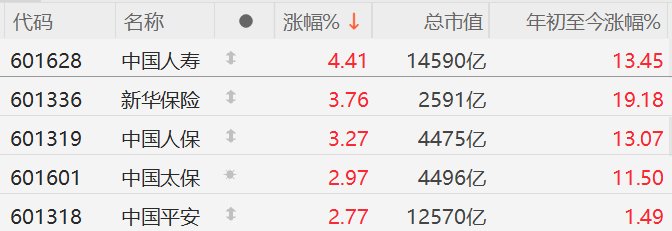
保险股集体走强,中国人寿涨超4%
Ge Long Hui· 2026-01-13 02:10
Core Viewpoint - The A-share market saw a collective rise in insurance stocks on January 13, with notable increases in major companies' stock prices [1] Group 1: Company Performance - China Life Insurance experienced a stock price increase of over 4% [1] - New China Life Insurance and China Pacific Insurance both saw stock price rises of over 3% [1] - China Insurance and Ping An Insurance recorded stock price increases of nearly 3% [1]
保险板块短线拉升,中国人保等股涨超2%
Xin Lang Cai Jing· 2026-01-13 01:53
1月13日金融一线消息,保险板块短线拉升,中国人保、新华保险、中国人寿、中国平安均涨超2%。 责任编辑:王馨茹 1月13日金融一线消息,保险板块短线拉升,中国人保、新华保险、中国人寿、中国平安均涨超2%。 责任编辑:王馨茹 ...
银保渠道锁定26年新单增长主阵地
Ge Long Hui· 2026-01-13 00:08
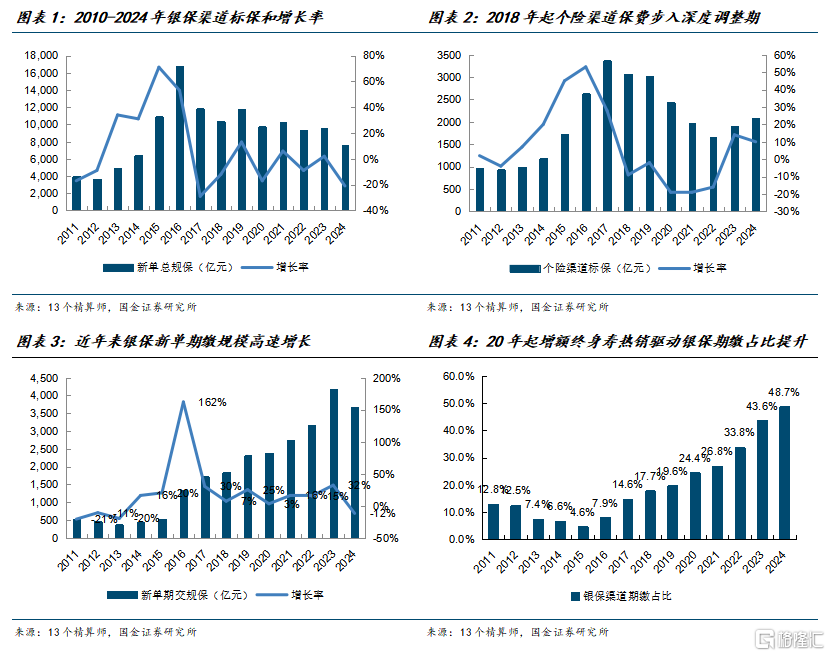
Investment Logic - The core view is that new individual insurance premiums for listed insurance companies are expected to achieve double-digit growth by 2026, primarily driven by the bancassurance channel [1][18] - The individual insurance channel is anticipated to maintain steady growth, while the bancassurance channel will benefit from the migration of deposits, leading to an increase in market share for large insurance companies [1][18] - The growth in the bancassurance channel is expected to dilute fixed costs, significantly enhancing overall profitability [1][18] Bancassurance Channel - Since 2020, leading insurance companies have refocused on the bancassurance channel, transitioning from scale compensation to value pursuit, resulting in a rise in market share [2][8] - The bancassurance channel has seen a compound annual growth rate (CAGR) of 16.2% from 2019 to 2023, while individual insurance premiums have declined [9] - The "reporting and banking integration" policy implemented in August 2023 has significantly reduced costs, enhancing the value rate of the bancassurance channel [14][9] Customer Deposit Analysis - A survey of 88 frontline bank wealth managers indicates that a significant portion of residents' deposits will mature in 2026, with expectations of low renewal rates due to the withdrawal of high-yield time deposits [3][25] - The majority of maturing depositors are aged 45 and above, indicating a lower risk appetite, with insurance products being the second choice for reallocating maturing deposits [4][30] - Wealth managers believe that bank wealth management products will be the most accepted option for maturing deposits, followed by insurance products [30][27] Sales Logic for Insurance Products - Wealth managers prioritize customer returns and the brand of insurance companies when recommending insurance products [5][33] - The core advantages of participating in dividend insurance sales include stable returns, capital safety, and alignment with long-term financial planning [36][40] - Challenges in selling dividend insurance include uncertainty in returns and the long duration of products, which may deter potential customers [40][36] Market Forecast - The insurance industry is projected to see new single premium growth exceeding 25% in 2026, driven by the bancassurance channel [42][44] - The expected influx of maturing deposits into insurance products will be significant, with estimates of new funds in the bancassurance channel reaching 11,150 billion by the end of 2026 [44][44] - The concentration trend among leading insurance companies is expected to continue, with larger firms benefiting from improved profitability in the bancassurance channel [47][48]


2025上半年财险公司“13精”综合竞争力排名榜:平安、人保、太保均为AAA!(2026年第一期 总第六十六期)
13个精算师· 2026-01-12 14:21
Core Viewpoint - Analyzing an insurance company requires a comprehensive approach that considers multiple indicators such as risk, profitability, development, and scale, rather than focusing solely on premiums or profits [1]. Group 1: Comprehensive Strength of Insurance Companies - The "13精" comprehensive competitiveness ranking has been published for six consecutive years, evaluating companies based on six key indicators [1][4]. - The ranking aims to guide insurance companies to prioritize consumer rights protection by adjusting the evaluation system to include service capability [1]. Group 2: Top Competitors in 2025 - In the first half of 2025, the top 30 companies in the "13精" comprehensive competitiveness ranking included five AAA-rated companies: Ping An Property & Casualty, PICC Property & Casualty, Taiping Property & Casualty, China Life Property, and Yingda Property [5][6][14]. - The ranking reflects the ongoing "Matthew Effect" in the insurance industry, where leading companies maintain their competitive edge [14]. Group 3: Financial Performance and Trends - In the first half of 2025, the net profit of 84 property insurance companies reached 52.5 billion, marking a continuous growth for five years and nearing the total net profit of 60.5 billion for 2024 [11]. - The profitability of property insurance companies has improved due to better underwriting capabilities and a favorable investment environment, with many companies experiencing significant year-on-year profit increases [12][19]. Group 4: Individual Company Analysis - Ping An Property & Casualty demonstrated strong growth in both scale and profitability, with a double-digit growth rate in non-auto insurance premiums [16][19]. - PICC Property & Casualty achieved a comprehensive cost ratio of 94.72%, down 0.81 percentage points from the previous year, with a return on equity (ROE) exceeding 9% [20][22]. - Taiping Property & Casualty improved its net asset return to 8.9%, benefiting from a reduction in comprehensive cost ratios [24]. Group 5: Industry Dynamics and Challenges - The transition towards non-auto insurance has led to increased differentiation among insurance companies, with some small and medium-sized firms improving profitability while others struggle [12][28]. - The industry continues to experience a "Matthew Effect," where larger firms outperform smaller ones in both scale and profitability, despite overall improvements in cost ratios across the sector [25][28]. Group 6: Industry Metrics and Comparisons - The average premium growth rate in the industry was 4.04%, with an average ROE of 6.86% and a comprehensive solvency adequacy ratio of 239.30% [30]. - The ranking system has been refined over time to better reflect the industry's focus on high-quality development, including adjustments to the scoring of premium growth and the introduction of service capability metrics [52][54].