
HUA HONG SEMI(01347)

Search documents
港股半导体股盘初拉升,华虹半导体涨近3%
Mei Ri Jing Ji Xin Wen· 2025-11-18 02:09
每经AI快讯,11月18日,港股半导体股盘初拉升,华虹半导体涨近3%,中芯国际涨2%。 (文章来源:每日经济新闻) ...


智通港股通持股解析|11月18日
智通财经网· 2025-11-18 00:32
Core Insights - The top three companies by Hong Kong Stock Connect holding ratios are China Telecom (00728) at 72.14%, COSCO Shipping Energy (01138) at 69.18%, and GCL-Poly Energy (01330) at 69.09% [1][2] - Xiaomi Group-W (01810), Pop Mart (09992), and Industrial and Commercial Bank of China (01398) saw the largest increases in holding amounts over the last five trading days, with increases of +34.20 billion, +12.67 billion, and +11.24 billion respectively [1][2] - The largest decreases in holding amounts were observed in the Tracker Fund of Hong Kong (02800) at -58.33 billion, Alibaba Group-W (09988) at -40.89 billion, and Hang Seng China Enterprises Index (02828) at -18.98 billion [1][3] Group 1: Top Holding Ratios - China Telecom (00728) has a holding ratio of 72.14% with 10.013 billion shares [2] - COSCO Shipping Energy (01138) has a holding ratio of 69.18% with 0.897 billion shares [2] - GCL-Poly Energy (01330) has a holding ratio of 69.09% with 0.279 billion shares [2] Group 2: Recent Increases in Holdings - Xiaomi Group-W (01810) increased by +34.20 billion with a change of +81.51 million shares [2] - Pop Mart (09992) increased by +12.67 billion with a change of +5.83 million shares [2] - Industrial and Commercial Bank of China (01398) increased by +11.24 billion with a change of +172.61 million shares [2] Group 3: Recent Decreases in Holdings - Tracker Fund of Hong Kong (02800) decreased by -58.33 billion with a change of -219.93 million shares [3] - Alibaba Group-W (09988) decreased by -40.89 billion with a change of -26.39 million shares [3] - Hang Seng China Enterprises Index (02828) decreased by -18.98 billion with a change of -19.89 million shares [3]


南向资金今日成交活跃股名单(11月17日)
Zheng Quan Shi Bao Wang· 2025-11-17 13:57
Core Viewpoint - The Hang Seng Index fell by 0.71% on November 17, with southbound capital totaling HKD 913.76 billion in trading volume, resulting in a net inflow of HKD 84.48 billion [1] Trading Activity Summary - Southbound trading included a total of HKD 351.89 billion from the Shenzhen Stock Connect and HKD 561.86 billion from the Shanghai Stock Connect, with net inflows of HKD 41.13 billion and HKD 43.35 billion respectively [1] - The most actively traded stock was Alibaba-W, with a total trading volume of HKD 101.70 billion, followed by the Tracker Fund of Hong Kong and SMIC, with trading volumes of HKD 39.03 billion and HKD 38.54 billion respectively [1][2] - The top net buying stocks included the Tracker Fund of Hong Kong with a net inflow of HKD 37.27 billion, Alibaba-W with HKD 20.71 billion, and Xiaomi Group-W with HKD 2.80 billion [1][2] Continuous Net Buying Stocks - Three stocks experienced continuous net buying for more than three days, with Xiaomi Group-W leading at 14 days, followed by Alibaba-W and Huahong Semiconductor at 3 days each [2] - The total net buying amounts during this period were HKD 98.07 billion for Xiaomi Group-W, HKD 57.02 billion for Alibaba-W, and HKD 1.81 billion for Huahong Semiconductor [2]

港股通(深)净买入41.13亿港元





Zheng Quan Shi Bao Wang· 2025-11-17 13:54
Market Overview - On November 17, the Hang Seng Index fell by 0.71%, closing at 26,384.28 points, while southbound funds through the Stock Connect recorded a net purchase of HKD 8.448 billion [1][3] - The total trading volume for the Stock Connect on the same day was HKD 91.376 billion, with a net purchase of HKD 8.448 billion [1] Trading Activity - In the Shanghai Stock Connect, the trading volume was HKD 56.186 billion with a net purchase of HKD 4.335 billion, while in the Shenzhen Stock Connect, the trading volume was HKD 35.189 billion with a net purchase of HKD 4.113 billion [1] - The most actively traded stock in the Shanghai Stock Connect was Alibaba-W, with a trading volume of HKD 6.484 billion, followed by the Tracker Fund of Hong Kong and SMIC, with trading volumes of HKD 3.356 billion and HKD 2.080 billion, respectively [1][2] Net Buying and Selling - In terms of net buying, the Tracker Fund of Hong Kong led with a net purchase of HKD 3.180 billion, despite its closing price dropping by 0.75% [1] - Tencent Holdings recorded the highest net selling amount of HKD 180 million, with its closing price also down by 0.70% [1] - In the Shenzhen Stock Connect, Alibaba-W again topped the trading volume with HKD 3.686 billion, and a net purchase of HKD 1.202 billion, closing flat [2]
智通港股通活跃成交|11月17日
智通财经网· 2025-11-17 11:01
Core Insights - On November 17, 2025, Alibaba-W (09988), the Tracker Fund of Hong Kong (02800), and SMIC (00981) were the top three stocks by trading volume in the Southbound Stock Connect, with trading amounts of 6.484 billion, 3.356 billion, and 2.080 billion respectively [1] - In the Southbound Stock Connect for the Shenzhen-Hong Kong Stock Connect, Alibaba-W (09988), SMIC (00981), and Tencent Holdings (00700) led the trading volume, with amounts of 3.686 billion, 1.774 billion, and 1.599 billion respectively [1] Southbound Stock Connect (Shanghai-Hong Kong) - Top active companies by trading amount: - Alibaba-W (09988): 6.484 billion, net buy of 868 million - Tracker Fund of Hong Kong (02800): 3.356 billion, net buy of 3.180 billion - SMIC (00981): 2.080 billion, net sell of 29.1529 million - Tencent Holdings (00700): 1.735 billion, net sell of 1.8 billion - Xiaomi Group-W (01810): 1.577 billion, net buy of 435 million - Huahong Semiconductor (01347): 1.571 billion, net buy of 85.3433 million - Ganfeng Lithium (01772): 1.209 billion, net sell of 88.1303 million - Horizon Robotics-W (09660): 842 million, net buy of 60.0033 million - Pop Mart (09992): 824 million, net buy of 219 million - Jingtaik Holdings (02228): 806 million, net buy of 60.6432 million [2] Southbound Stock Connect (Shenzhen-Hong Kong) - Top active companies by trading amount: - Alibaba-W (09988): 3.686 billion, net buy of 1.202 billion - SMIC (00981): 1.774 billion, net sell of 44.1418 million - Tencent Holdings (00700): 1.599 billion, net buy of 258 million - Xiaomi Group-W (01810): 1.372 billion, net sell of 15.5 million - Huahong Semiconductor (01347): 1.054 billion, net sell of 74.6878 million - Ganfeng Lithium (01772): 708 million, net buy of 4.5961 million - Meituan-W (03690): 612 million, net buy of 248 million - Tracker Fund of Hong Kong (02800): 547 million, net buy of 546 million - XPeng Motors-W (09868): 532 million, net sell of 52.5404 million - China Mobile (00941): 491 million, net sell of 18.3796 million [2]
恒生科技指数收跌近1%,携程联想领跌超3%



Cai Jing Wang· 2025-11-17 08:38
Core Viewpoint - The Hang Seng Index closed down approximately 0.71%, while the Hang Seng Tech Index fell by about 0.96%, indicating a negative trend in the Hong Kong stock market [1] Group 1: Company Performance - Lenovo Group and Trip.com Group both experienced declines of over 3% [1] - Baidu Group and Li Auto saw declines exceeding 2% [1] - Bilibili and Tongcheng Travel dropped by more than 1% [1] - Semiconductor Manufacturing International Corporation (SMIC) and Tencent Holdings had slight decreases [1] - Hua Hong Semiconductor and Meituan experienced slight increases [1]
本周小米、快手、百度等将披露业绩,机构:关注港股财报季,看好港股科技估值持续提升
Mei Ri Jing Ji Xin Wen· 2025-11-17 02:57
Group 1 - The Hong Kong stock market experienced a slight decline, with the Hang Seng Tech Index dropping over 0.5% on November 17, 2023 [1] - Major ETFs, particularly the Hang Seng Tech Index ETF (513180), followed the index's downward trend, with leading stocks like Trip.com, Lenovo, Baidu, and BYD Electronics underperforming, while Hua Hong Semiconductor, SMIC, and Alibaba showed gains [1] - A number of technology companies, including Baidu, Xiaomi, Kuaishou, Netease, and Xpeng Motors, are set to release their latest financial results this week, with key earnings announcements scheduled for November 17 and 18 [1] Group 2 - According to Minsheng Securities, the recent earnings reports from leading internet companies like Tencent and Bilibili exceeded market expectations, and there is a recommendation to focus on the upcoming financial results from Xiaomi, Trip.com, Kuaishou, and Netease [1] - The report highlights a positive outlook on the revaluation of AI in China, suggesting attention to platform-based internet companies with synergistic advantages in computing resources, model capabilities, and application scenarios, such as Tencent, Kuaishou, Alibaba, Xiaomi, Baidu, and Meituan [1] - As of November 14, the Hang Seng Tech Index ETF (513180) had a latest valuation (PETTM) of 22.47 times, which is lower than other major global tech indices, indicating that the index remains in a historically undervalued range [2]

芯片股逆市走高 上海复旦(01385.HK)涨6.09%
Mei Ri Jing Ji Xin Wen· 2025-11-17 02:21
Core Viewpoint - Chip stocks are rising against the market trend, indicating a potential positive sentiment in the semiconductor sector [1] Company Summaries - Shanghai Fudan (01385.HK) increased by 6.09%, reaching HKD 41.48 [1] - Hua Hong Semiconductor (01347.HK) rose by 3.69%, trading at HKD 80.1 [1] - Jingmen Semiconductor (02878.HK) saw a 2.17% increase, priced at HKD 0.47 [1] - SMIC (00981.HK) gained 1.43%, with a share price of HKD 74.55 [1]
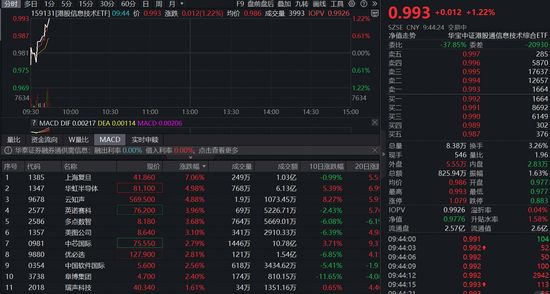
芯片反攻!首只聚焦港股芯片产业链的港股信息技术ETF(159131)直线拉涨1%,机构:国产A...
Xin Lang Cai Jing· 2025-11-17 02:17
Core Viewpoint - The launch of the first Hong Kong stock ETF focusing on the semiconductor industry chain has led to significant price increases in related stocks, indicating a bullish sentiment in the market for domestic AI chips and semiconductor companies [1][3]. Group 1: Market Performance - The Hong Kong information technology ETF (159131) saw a price increase of 1.22% in early trading on November 17, with significant gains in constituent stocks such as Shanghai Fudan, which rose over 7%, and Huahong Semiconductor and Cloud Wisdom, which increased nearly 5% [1]. - The ETF is designed to track the performance of the semiconductor and technology sectors, with a composition of 70% hardware and 30% software, covering 42 Hong Kong-listed technology companies [3]. Group 2: Industry Trends - The domestic AI chip market is expected to experience a high growth rate, driven by the increasing commercialization of applications and a shift in orders towards domestic chips due to U.S. sanctions on NVIDIA products [2][3]. - As domestic advanced manufacturing processes mature, the competitiveness of low-end NVIDIA chips in China is declining, leading to a significant increase in market share for domestic chips [3]. Group 3: ETF Composition and Strategy - The ETF's index includes major players such as SMIC with a weight of 20.27%, Xiaomi Group-W at 9.11%, and Huahong Semiconductor at 5.64%, excluding large-cap internet companies like Alibaba and Tencent to focus on high-tech sectors [3]. - The index is designed to adjust its sample weights every six months, with a cap of 15% on individual stock weights, allowing for dynamic adjustments based on market conditions [4].
智通港股通持股解析|11月17日
智通财经网· 2025-11-17 00:31
Core Insights - The top three companies by Hong Kong Stock Connect holding ratios are China Telecom (00728) at 72.08%, Green Power Environmental (01330) at 69.17%, and COSCO Shipping Energy (01138) at 68.32% [1][2] - Xiaomi Group-W (01810), CNOOC (00883), and Pop Mart (09992) saw the largest increases in holding amounts over the last five trading days, with increases of +2.869 billion, +2.096 billion, and +1.690 billion respectively [1][2] - Alibaba-W (09988), Hua Hong Semiconductor (01347), and Xpeng Motors-W (09868) experienced the largest decreases in holding amounts, with decreases of -5.993 billion, -1.618 billion, and -1.248 billion respectively [1][3] Hong Kong Stock Connect Holding Ratios - The latest holding ratios for the top 20 companies show that China Telecom leads with 100.04 million shares and a holding ratio of 72.08% [2] - Other notable companies include China Shenhua (01088) with 23.05 billion shares at 68.23% and Da Zhong Gong Yong (01635) with 3.64 billion shares at 68.19% [2] Recent Increases in Holdings - The top three companies with the largest increases in holdings over the last five trading days are: - Xiaomi Group-W (01810): +2.869 billion with an increase of 67.73 million shares - CNOOC (00883): +2.096 billion with an increase of 93.55 million shares - Pop Mart (09992): +1.690 billion with an increase of 7.81 million shares [2] Recent Decreases in Holdings - The top three companies with the largest decreases in holdings over the last five trading days are: - Alibaba-W (09988): -5.993 billion with a decrease of 38.68 million shares - Hua Hong Semiconductor (01347): -1.618 billion with a decrease of 20.94 million shares - Xpeng Motors-W (09868): -1.248 billion with a decrease of 12.64 million shares [3]
