HUA HONG SEMI(01347)

Search documents
上市公司重大资产重组、股权激励计划月度跟踪(2026年2月):并购深化产业协同,增强公司核心竞争优势-20260324
Shenwan Hongyuan Securities· 2026-03-24 03:48
Group 1: Major Asset Restructuring Overview - In February 2026, a total of 9 major asset restructuring plans were announced, primarily in the automotive sector, with over half currently in the board proposal stage. The majority of these restructurings aim for horizontal integration [10][17]. - From March 2025 to February 2026, there were 133 disclosed major asset restructuring cases, with the electronics, machinery, and automotive industries being the most represented [7][10]. - Notable cases include Dongyangguang's acquisition of Dongshu Yihua and Tongwei's acquisition of Qinghai Lihua Qingneng, both aimed at enhancing their core business capabilities and market positions [20][22]. Group 2: Equity Incentive Plans Overview - In February 2026, 33 new equity incentive plans were announced, with the machinery equipment sector leading in the number of plans. Most incentives are concentrated in the range of less than 2% of total share capital [30][40]. - Approximately 92% of the equity incentive plans published in the past year have begun implementation, indicating a strong commitment to aligning employee interests with company performance [25][30]. - Companies with significant equity incentives include Anche Detection (5.70%), Jiepte (4.73%), and Weining Health (4.47%), highlighting a trend towards incentivizing key talent [40][41].


芯片涨价潮,来势汹汹
半导体芯闻· 2026-03-23 10:24
Core Viewpoint - The global semiconductor industry is experiencing a significant price increase driven by supply-demand imbalances and rising costs, with major companies like Texas Instruments, Infineon, NXP, and others leading the charge [1][5]. Group 1: Price Increases by Major Companies - Texas Instruments (TI) announced a price increase of 15%-85% across all product lines, with the highest increases in industrial control and automotive electronics, reflecting tight capacity and rising costs [2][3]. - Infineon is raising prices for power switches and related chips by 5%-15%, driven by surging demand from AI data centers and increased manufacturing costs [3][4]. - NXP has also announced price adjustments due to significant increases in costs across the supply chain, although specific product categories and price ranges were not disclosed [4][5]. Group 2: Broader Industry Trends - Other companies such as ON Semiconductor, Analog Devices, and Vishay are also implementing price increases, indicating a widespread trend across the semiconductor industry [5][6]. - The price adjustments are largely attributed to rising costs of raw materials, energy, and logistics, which have become unsustainable for manufacturers [10][11]. - The semiconductor industry is witnessing a shift from a price war to a value war, as companies seek to maintain profitability amid rising costs [9][21]. Group 3: Supply Chain Dynamics - The semiconductor supply chain is under pressure due to rising costs of key materials, particularly precious metals, which are critical for chip production [10][11]. - The demand for semiconductors is surging in sectors such as AI, electric vehicles, and industrial automation, exacerbating supply shortages and enabling manufacturers to raise prices [12][13]. - The collective price increases from semiconductor manufacturers are expected to have a cascading effect throughout the supply chain, impacting downstream industries [20][21]. Group 4: Foundry Price Increases - Foundries are also raising their prices, with major players like TSMC and Samsung adjusting their pricing strategies due to increased operational costs and capacity constraints [15][16]. - The price hikes in wafer fabrication are further tightening the profit margins for chip designers, reinforcing the necessity for price adjustments across the board [15][19]. - The shift in focus from mature to advanced process nodes by leading foundries is contributing to a structural shortage in 8-inch wafer capacity, which is critical for many semiconductor applications [18][19].






A股低开,黄金板块大跌
第一财经· 2026-03-23 01:42
Market Overview - The A-share market opened lower with all three major indices declining: the Shanghai Composite Index fell by 1.32% to 3904.95 points, the Shenzhen Component Index dropped by 1.78% to 13619.94 points, and the ChiNext Index decreased by 1.54% to 3300.56 points [4][5]. - The market saw significant declines in sectors such as gold and basic metals, with the computing hardware industry chain, including storage and CPO sectors, leading the losses [6]. Company Movements - *ST Bosen resumed trading with a limit-up, as the company's controlling shareholder is set to change to Yan Feng Digital [7]. - Xuelang Environment also resumed trading with a limit-up after signing a restructuring investment agreement, which will result in Helixing Wanlian becoming the controlling shareholder post-restructuring [8]. Commodity Performance - The main contract for liquefied petroleum gas (LPG) hit the limit-up with an increase of 11%, reaching 7281 yuan per ton [9]. Hong Kong Market - The Hong Kong market opened lower, with the Hang Seng Index down by 1.93% to 24789.14 points and the Hang Seng Tech Index falling by 1.90% to 4780.04 points. Notable declines included NIO down over 7%, Zijin Mining down over 5%, and Baidu down over 4% [10][11].



芯片,涨价潮!
半导体行业观察· 2026-03-22 02:42
Core Viewpoint - The global semiconductor industry is experiencing a significant price increase driven by supply-demand imbalances and rising costs, with major companies like Texas Instruments, Infineon, and NXP leading the charge [2][3][4]. Group 1: Price Increases by Major Companies - Texas Instruments (TI) announced a price increase of 15%-85% across all product lines, with the highest increases in industrial control and automotive electronics, reflecting tight capacity and rising costs [3]. - Infineon is raising prices for power switches and related chips due to surging demand from AI data centers, with increases expected to be 5%-15% for mainstream models and potentially higher for premium products [4][5]. - NXP is also adjusting prices due to significant cost increases across the supply chain, although specific product categories and price ranges have not been disclosed [6]. Group 2: Broader Industry Trends - Other companies such as ON Semiconductor, Analog Devices, and Vishay are joining the price increase trend, indicating a widespread adjustment across the semiconductor sector [6][7]. - The price adjustments are largely attributed to rising costs of raw materials, energy, and logistics, which are affecting all players in the industry [8][12]. Group 3: Cost Pressures and Supply Chain Dynamics - The surge in prices is primarily driven by skyrocketing costs of key raw materials, particularly precious metals, which are essential for semiconductor manufacturing [12][13]. - The semiconductor industry is facing a structural shift in demand, particularly from AI servers and electric vehicles, which is exacerbating supply constraints and allowing manufacturers to raise prices [15][16]. Group 4: Impact of Foundry Price Increases - The collective price increases from wafer foundries are further pressuring chip manufacturers to adjust their pricing strategies, as foundries raise their rates due to increased operational costs [18][19]. - Major foundries like TSMC and Samsung are shifting focus to advanced processes, leading to a reduction in capacity for older nodes, which is tightening supply for essential components [21][22]. Group 5: Domestic Market Response - Domestic semiconductor companies in China are also raising prices in response to global trends, with many following suit to address rising costs and maintain profitability [9][10]. - The price adjustments among domestic firms reflect a shift from a price war to a value-driven approach, indicating a potential recovery in profit margins [11][24].


产业经济周报:社零增速超预期,全球晶圆代工保持高景气-20260319
Tebon Securities· 2026-03-19 10:19
Consumption Sector - In January-February 2026, the total retail sales of consumer goods reached 86,079 billion yuan, with a year-on-year growth of 2.8%, the highest increase since October 2025[6] - The retail sales of essential goods, such as tobacco and alcohol, grew by 19.1%, significantly higher than the overall retail sales growth[11] - Automotive retail sales saw a decline of 7.3% year-on-year, marking five consecutive months of negative growth, primarily due to the impact of the Spring Festival holiday and policy adjustments[12] Health Sector - On March 13, 2026, the National Medical Products Administration approved the registration of the first invasive brain-machine interface medical device, marking a significant milestone in clinical applications[14] - The domestic brain-machine interface market is projected to grow, with a forecasted market size of 3.83 billion yuan in 2025, reflecting a year-on-year growth of 20%[20] Hard Technology Sector - The global wafer foundry industry is expected to generate approximately 169.5 billion USD in revenue in 2025, a year-on-year increase of 26.3%[25] - TSMC's revenue is projected to reach 122.54 billion USD in 2025, with a year-on-year growth of 36.1%, increasing its market share from 64.4% to 69.9%[26] High-end Manufacturing Sector - In February 2026, a total of 17,226 excavators were sold, a year-on-year decrease of 10.6%, with domestic sales down by 42%[32] - For January-February 2026, total excavator sales reached 35,934 units, showing a year-on-year growth of 13.1%, driven by strong export performance[32]


301428,20%涨停!两大板块大涨!
证券时报· 2026-03-18 04:21
Market Overview - The A-share market showed mixed performance on March 18, with the communication and electronics sectors experiencing significant gains, becoming the highlights of the morning session [1][4]. - By the close of the morning session, the Shanghai Composite Index fell by 0.40%, while the Shenzhen Component Index rose by 0.05%, the ChiNext Index increased by 0.89%, and the Sci-Tech Innovation Index gained 0.6% [4]. Sector Performance - The communication sector led the gains with an increase of nearly 3%, featuring stocks like Century Hengtong (301428) hitting the daily limit with a 20% rise, and Pingzhi Information (300571) soaring nearly 15% [4][5]. - The electronics sector also saw a rise of over 1.4%, with multiple stocks reaching their daily limit, including Aohong Electronics and Aosikang [6][7]. - Other sectors such as computers and defense industries also showed strong performance, while oil, steel, and real estate sectors faced declines [8]. ETF Market - The ETF market remained stable overall, but the ChiNext Composite ETF (159287) experienced a sharp decline of over 18% upon resuming trading [2][10]. - This ETF had previously shown strong performance, closing with a 20% increase the day before its drop [12]. Company Highlights - Notable stocks in the communication sector included: - Century Hengtong (301428) at 39.79, up 19.99% - Pingzhi Information (300571) at 33.77, up 14.98% - Ruisi Kanda (603803) at 13.13, up 9.97% [5]. - In the electronics sector, key performers included: - Lian Dong Technology (301369) at 150.78, up 13.20% - Anlu Technology (688107) at 33.00, up 12.63% - Aibisen (300389) at 19.65, up 11.33% [7].





腾讯、百度、阿里,集体下跌
第一财经· 2026-03-18 01:38
Market Overview - On March 18, the Hong Kong Hang Seng Index opened up by 0.21% at 25,923.03, while the Hang Seng Tech Index increased by 0.1% to 5,112.97 [1][2]. Sector Performance - The biotechnology sector showed a slight increase, with the Hang Seng Biotechnology Index rising by 0.16% to 14,472.25 [2]. - The Hang Seng China Enterprises Index also saw a minor gain of 0.08%, reaching 8,833.95 [2]. Stock Movements - Mixed performance was observed among tech stocks, with Bilibili and Hua Hong Semiconductor both rising over 2% [2]. - Tencent Music experienced a significant drop of 15%, closing at 48.620, while XPeng Motors fell by 3.45% to 75.500 [3]. - Other notable declines included Tencent Holdings down by 0.64% to 546.500, Baidu Group down by 0.25% to 118.900, and Alibaba down by 0.15% to 134.400 [3]. Semiconductor Sector - The semiconductor sector rebounded, with notable gains from companies such as Lanqi Technology and Zhaoyi Innovation, which rose over 3% [2]. - Specific stock performances included Lanqi Technology up by 3.74% to 186.000 and Zhaoyi Innovation up by 3.12% to 416.000 [4].



南下资金净买入腾讯、阿里和比亚迪
Ge Long Hui· 2026-03-16 10:34
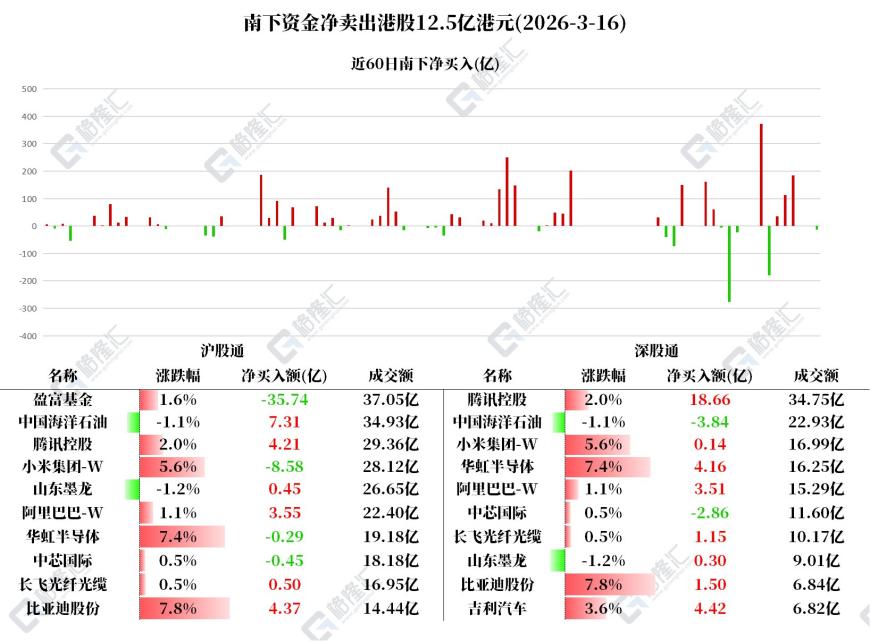
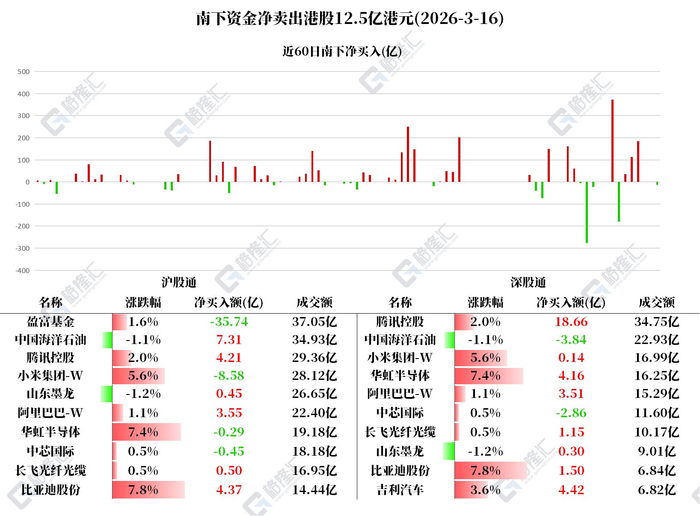
Group 1 - Southbound funds recorded a net sell of HKD 1.25 billion in Hong Kong stocks on March 16, with notable net purchases in Tencent Holdings (HKD 2.287 billion), Alibaba-W (HKD 706 million), BYD Company (HKD 586 million), and Geely Automobile (HKD 442 million) [1] - The net sell was primarily driven by the iShares Asia 50 ETF, which saw a net sell of HKD 3.574 billion, and Xiaomi Group-W with HKD 844 million [1][3] - Southbound funds have consistently net bought China National Offshore Oil Corporation (CNOOC) for four consecutive days, totaling HKD 3.38424 billion [1] Group 2 - Tencent Holdings experienced a price increase of 2.0% with a net buy of HKD 4.21 billion, while Alibaba-W saw a 1.1% increase with a net buy of HKD 3.55 billion [3] - BYD Company had a significant price increase of 7.8% with a net buy of HKD 4.37 billion, and Geely Automobile increased by 3.6% with a net buy of HKD 4.42 billion [3] - The overall trading volume for the stocks mentioned indicates a mixed performance, with some stocks like Xiaomi Group-W and SMIC showing negative net buy figures [3]


图解丨南下资金净买入腾讯、阿里和比亚迪
Ge Long Hui A P P· 2026-03-16 10:01
Group 1 - Southbound funds recorded a net sell of HKD 1.25 billion in Hong Kong stocks today [1] - Notable net purchases included Tencent Holdings at HKD 2.287 billion, Alibaba-W at HKD 706 million, BYD Company at HKD 586 million, Geely Automobile at HKD 442 million, Hua Hong Semiconductor at HKD 387 million, China National Offshore Oil Corporation at HKD 347 million, and Yangtze Optical Fibre and Cable at HKD 165 million [1] - Significant net sells were observed in the Tracker Fund of Hong Kong at HKD 3.574 billion, Xiaomi Group-W at HKD 844 million, and Semiconductor Manufacturing International Corporation at HKD 330 million [1] Group 2 - Southbound funds have continuously net bought China National Offshore Oil Corporation for four consecutive days, totaling HKD 3.38424 billion [2]
港股科网股,集体大涨
第一财经· 2026-03-16 04:19
Market Performance - The Hang Seng Index rose over 1% and the Hang Seng Tech Index increased by more than 2% as of the midday close on March 16 [1] - The Hang Seng Index closed at 25,756.27, up by 290.67 points (1.14%), while the Hang Seng Tech Index reached 5,089.53, gaining 111.45 points (2.24%) [2] Sector Highlights - Technology stocks showed strong performance, with BYD Co. and NIO both rising over 5%, while Xiaomi Group and JD Health increased nearly 5% [2] - Tencent Music rose over 4%, and Tencent Holdings, JD Group, and Trip.com increased by more than 2% [2] - Alibaba and Baidu also saw their stock prices rise [2] Semiconductor Sector - The semiconductor sector experienced significant gains, with Zhaoyi Innovation rising over 10% and Hua Hong Semiconductor increasing by 5.28% [3][4] - Other notable performers included Horizon Robotics and Hongguang Semiconductor, both rising over 3% [3] Precious Metals Sector - The precious metals sector was underperforming, with Chifeng Jilong Gold Mining falling nearly 7% and Shandong Gold dropping close to 6% [5][6] - Other companies in the sector, such as Lingbao Gold and China Gold International, also saw declines exceeding 5% [5]