
HUA HONG SEMI(01347)

Search documents
半导体设备&代工 - 需求景气、扩展加速
2025-11-16 15:36
Summary of Semiconductor Equipment & Foundry Conference Call Industry Overview - The global semiconductor industry experienced unexpected growth in Q3, driven by increased capital expenditure overseas, with expectations for continued high growth into 2026. AI demand is a key driver, but its sustainability will determine how long this semiconductor cycle remains elevated [1][2][3] Key Company Insights TSMC - TSMC's Q3 performance significantly outpaced the industry average, with revenue growth around 40% and gross margin nearing 60%. The strong demand for AI has led TSMC to increase its capital expenditure. The High-Performance Computing (HPC) segment now accounts for over 50% of its revenue, indicating that AI has become a dominant force in the high-end market. If AI growth continues, TSMC's revenue and profit margins have room for further increases [3][4] UMC and SMIC - The consumer electronics sector remains weak, with UMC and other overseas foundries underperforming. In contrast, SMIC benefits from domestic opportunities, achieving high capacity utilization and exceeding expected gross margins. Q4 revenue is projected to grow sequentially, with a year-on-year growth rate close to 10% [5][6] Hua Hong - Hua Hong focuses on industrial and automotive sectors, experiencing rapid growth due to accelerated domestic production. Its growth rate exceeds that of SMIC at around 20%, with high capacity utilization and significant margin improvements. As the largest power analog MCU foundry in China, Hua Hong's future outlook is positive [6][7] Semiconductor Equipment Industry - The semiconductor equipment sector is lagging behind the industry cycle, but capacity shortages are driving increased investment in equipment. Companies like TSMC have raised capital expenditures, and memory manufacturers are expected to expand further next year, enhancing the industry's outlook. Equipment growth is projected to exceed 20% starting in the second half of 2024 [8][9] Market Dynamics - The global foundry and semiconductor equipment markets performed well in Q3, driven by AI investment demand in overseas markets and strong demand for mature process foundries in the domestic market. The overall semiconductor growth in Q3 was again above expectations, with rising capital expenditures anticipated for 2026 [2][10] Storage Industry Insights - The storage industry is currently facing a supply-demand imbalance, primarily due to strong sales from Apple and rapid growth in the AI market, leading to a shortage of storage chips. This situation is expected to persist until at least the second half of 2026, despite potential acceleration in domestic production [13][14] Future Trends - The semiconductor equipment industry's growth is expected to continue, with historical cycles indicating a 50% increase in demand following each expansion phase. The current industry size is over $120 billion, with projections for growth to $150 billion in the next cycle [9][12] Conclusion - The semiconductor industry is experiencing a robust cycle driven by AI demand, with key players like TSMC and SMIC capitalizing on domestic opportunities. The equipment sector is poised for growth, and the storage market is currently constrained, indicating a complex but promising landscape for investors [1][2][3][4][5][6][7][8][9][10][11][12][13][14]


NAND市场供不应求趋势有望持续
2025-11-16 15:36
Summary of Conference Call Notes Industry Overview - The NAND market is expected to remain in a state of supply shortage until 2026, indicating that the storage market growth cycle is not over [1][2] - The DRAM market is characterized by high levels of monopoly, with downstream manufacturers like Xiaomi, OPPO, and vivo having low inventory levels, suggesting potential price increases in mobile terminals [4] Key Companies and Performance - **Kioxia**: Reported Q2 2025 revenue of 448.3 billion JPY, a 30% increase year-over-year; non-GAAP operating profit of 87.2 billion JPY, exceeding company guidance but falling short of market expectations [2][6] - **SanDisk**: Q1 2025 revenue of $2.3 billion, a 20% year-over-year increase; Q2 revenue expected between $2.55 billion and $2.65 billion, with gross margin rising from 29.9% to 41-43% [2][6] - **Samsung**: Suspended pricing in October and raised memory prices by 30-60% [6] - **Domestic Companies**: Notable mentions include De Ming Li, Jiang Bo Long, Bai Wei Storage, and Shannon Chip Creation, which are expected to benefit from the upcoming price increase cycle due to strong inventory and procurement capabilities [5] Market Dynamics - Data centers are a significant growth driver for the NAND market, with AI development significantly increasing demand for data centers [6][7] - Companies like Hon Hai Precision and AMD are performing well, with Hon Hai's cabinet numbers increasing by 300% year-over-year and AMD expecting revenue growth exceeding 35% due to collaboration with OpenAI [8] Investment Recommendations - Focus on the LAND, D-LAN, and Norflash markets due to ongoing supply shortages; recommended companies include module-related firms [11] - Anticipate a tenfold increase in general AI computing power demand over the next decade, with opportunities across design, manufacturing, and testing sectors; key players include SMIC and Huahong Semiconductor [11] - AIPCB industry chain stocks are recommended as demand is expected to recover, with companies like Shenghong Technology and Hu Dian Co. being highlighted [11] Additional Insights - Tencent is increasing its capital expenditure in AI for 2025, indicating a robust investment strategy despite economic uncertainties; AI training model iterations are contributing to growth in gaming and advertising [9] - Domestic computing power development is lagging behind international counterparts, particularly in large voice service providers [10]

华虹半导体(01347):3Q25业绩超指引,总产能利用率环比提升1.2pct
Guoxin Securities· 2025-11-16 12:16
Investment Rating - The investment rating for the company is "Outperform the Market" [5][19]. Core Views - The company reported 3Q25 results that exceeded guidance, with sales revenue of $635.2 million, a year-over-year increase of 20.7% and a quarter-over-quarter increase of 12.2%. The gross margin was 13.5%, up 1.3 percentage points year-over-year and 2.6 percentage points quarter-over-quarter. The guidance for 4Q25 anticipates sales revenue of approximately $650-660 million and a gross margin of 12%-14% [1][3]. - The company’s capacity utilization rate improved, with a monthly capacity equivalent to 468 thousand 8-inch wafers, representing a year-over-year increase of 19.7% and a quarter-over-quarter increase of 4.7%. The capacity utilization rate reached 109.5%, up 4.2 percentage points year-over-year and 1.2 percentage points quarter-over-quarter [1][2]. - Capital expenditures for 3Q25 were $261.9 million, with a focus on optimizing product structure to enhance average selling prices (ASP). The company is targeting the GaN field for power products and upgrading the Nor Flash process [3][4]. Summary by Sections Financial Performance - 3Q25 sales revenue was $635.2 million, with a gross margin of 13.5%. The company expects 4Q25 sales revenue to be around $650-660 million and gross margin to be 12%-14% [1][3]. - The company’s capital expenditures for 3Q25 totaled $261.9 million, with significant investments in manufacturing capacity [3][4]. Capacity and Utilization - The company’s monthly capacity equivalent to 8-inch wafers was 468 thousand, with a capacity utilization rate of 109.5% [1][2]. - The 12-inch capacity is steadily being released, contributing to revenue growth [1]. Market Demand - Demand for flash products is increasing, with significant growth in consumer electronics (QoQ +14.0%), communications (QoQ +11.5%), and computing (QoQ +25.6%) [2]. - The demand for analog and power management products remains strong, with a year-over-year increase of 34.1% and a quarter-over-quarter increase of 17.9% [2].
华虹半导体(01347) - 月度更新内容有关(1)主要及关连交易 - 收购协议(2)建议非公开发行...
2025-11-16 10:01
香港交易及結算所有限公司及香港聯合交易所有限公司對本公告的內容概不負責,對其準確性 或完整性亦不發表任何聲明,並明確表示,概不就因本公告全部或任何部分內容而產生或因依 賴該等內容而引致的任何損失承擔任何責任。 本公告僅供參考,並不構成收購、購買或認購本公司證券的邀請或要約。 HUA HONG SEMICONDUCTOR LIMITED 華虹半導體有限公司 (於香港註冊成立之有限公司) (股份代號:01347) 月度更新 內容有關 (1)主要及關連交易-收購協議 (2)建議非公開發行人民幣股份以募集配套資金 (3)申請清洗豁免 1 警告 完成建議收購事項及建議非公開發行人民幣股份須待若干條件獲達成後方可作 實,且未必會進行。執行人員可能會也可能不會授出清洗豁免,清洗豁免倘獲授 出將分別受(其中包括)有關清洗豁免須於股東特別大會上獲收購守則獨立股東以 投票表決方式至少75%票數批准,有關建議收購事項須於股東特別大會上獲收購 守則獨立股東以投票表決方式超過50%票數批准的條件所限。完成建議收購事項 須待(其中包括)執行人員授出清洗豁免並獲收購守則獨立股東批准,完成建議非 公開發行人民幣股份須待完成建議收購事項後,方 ...
华虹公司(688347) - 港股公告:月度更新
2025-11-16 08:00
本公告僅供參考,並不構成收購、購買或認購本公司證券的邀請或要約。 HUA HONG SEMICONDUCTOR LIMITED 華虹半導體有限公司 (於香港註冊成立之有限公司) (股份代號:01347) 月度更新 香港交易及結算所有限公司及香港聯合交易所有限公司對本公告的內容概不負責,對其準確性 或完整性亦不發表任何聲明,並明確表示,概不就因本公告全部或任何部分內容而產生或因依 賴該等內容而引致的任何損失承擔任何責任。 承董事會命 華虹半導體有限公司 董事會主席兼執行董事 白鵬先生 中國上海 二零二五年十一月十六日 內容有關 (1)主要及關連交易-收購協議 (2)建議非公開發行人民幣股份以募集配套資金 (3)申請清洗豁免 茲提述(i)本公司日期為二零二五年八月三十一日之公告,內容有關(其中包括) (a)建議收購事項、(b)建議非公開發行人民幣股份及(c)清洗豁免;(ii)本公司日期 為二零二五年九月十九日之公告(「延期公告」),內容有關(其中包括)延遲寄發 通函;及(iii)本公司日期為二零二五年十月十六日之月度更新公告(統稱「該等公 告」)。除另有界定者外,本公告所用詞彙與該等公告所界定者具有相同涵義。 本 ...
港股开盘 | 恒生指数低开1.52% 科网股领跌 华虹半导体(01347)跌近4%
智通财经网· 2025-11-14 01:43
Market Overview - The Hang Seng Index opened down 1.52%, with the Hang Seng Tech Index falling 2.22%, led by declines in tech stocks such as Hua Hong Semiconductor down nearly 4%, Alibaba down over 3%, and Tencent Holdings down over 1% post-earnings [1] - Despite recent adjustments, the foundation for a bull market in Hong Kong stocks remains intact, with expectations of a "volatile upward trend" rather than a rapid increase [1][2] Investment Strategy - A barbell strategy is recommended, focusing on stable value assets, particularly H-shares with high AH premium, as a long-term base, while also considering growth assets in high-prosperity sectors [1] - The internet and high dividend sectors are highlighted as areas of interest, with the internet sector's valuation entering an attractive range after prolonged adjustments [2][4] Valuation Insights - The Hang Seng Internet Technology Index's latest PE ratio is 21.45, placing it in the 16.09% historical low range, indicating significant valuation recovery potential [2][3] - Hong Kong stocks are currently below the average PE ratio of the past decade, making it one of the cheapest markets in the Asia-Pacific region outside of ASEAN [5] Market Sentiment and Future Outlook - The market is expected to focus on policy implementation and interest rate trends, with potential for a rebound in the Hong Kong market if U.S. interest rates confirm a downward trend and domestic economic recovery signals become clearer [2] - Analysts maintain a cautiously optimistic view on the market's mid-term trajectory, despite short-term volatility, due to strong fundamentals and ongoing policy support [2][3][4]


华虹公司(688347):利润率持续修复 工艺平台不断丰富
Ge Long Hui· 2025-11-14 00:15
Core Insights - Company reported a record high revenue for Q3 2025, achieving 12.583 billion yuan, a year-on-year increase of 19.82%, while net profit attributable to shareholders decreased by 56.52% to 251 million yuan [1] - Q3 2025 revenue reached 4.566 billion yuan, up 21.10% year-on-year, with a gross margin of 13.5%, exceeding guidance expectations [1] - The company anticipates Q4 2025 revenue between 650-660 million USD, with a gross margin of 12-14% [1] Revenue Breakdown - Embedded non-volatile memory sales reached 159.7 million USD, a 20.4% increase, driven by MCU product demand [2] - Standalone non-volatile memory sales surged to 60.6 million USD, a 106.6% increase, primarily due to flash memory demand [2] - Power device sales increased by 3.5% to 169 million USD, supported by demand for super junction products [2] - Logic and RF sales grew by 5.3% to 81.13 million USD, driven by logic product demand [2] - Analog and power management sales reached 164.8 million USD, a 32.8% increase, due to rising demand for other power management products [2] Strategic Developments - The acquisition of Huali Microelectronics is nearing completion, which is expected to enhance the resource capabilities of the listed company [2] - Huali Microelectronics operates the first fully automated 12-inch integrated circuit foundry in mainland China, with a monthly design capacity of 38,000 wafers [2] - The company has developed a diverse product portfolio, including proprietary 55/40nm logic process technology, enhancing its competitive position [2] Financial Forecast - Revenue projections for 2025-2027 are estimated at 17 billion, 20.6 billion, and 23.3 billion yuan, respectively, with net profits of 631 million, 1.137 billion, and 1.558 billion yuan [3] - Corresponding price-to-earnings ratios are projected at 326.93x, 181.40x, and 132.38x for the respective years [3] - The company is initiating coverage with a "buy" rating [3]
创新基因加速转化为增长动能 科创板公司前三季度整体业绩重拾升势
Shang Hai Zheng Quan Bao· 2025-11-13 17:55
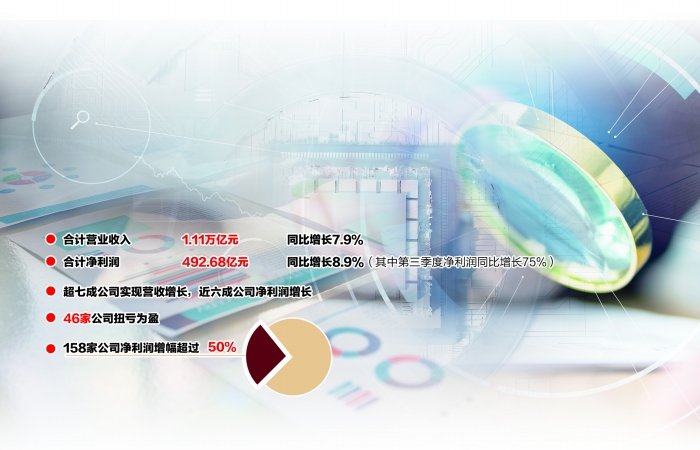
Core Insights - The overall performance of companies listed on the Sci-Tech Innovation Board (STAR Market) has shown a strong rebound in the first three quarters, with a significant year-on-year net profit growth of 75% in Q3 [2] - The focus on "hard technology" has led to increased R&D investments, particularly in key industries such as integrated circuits, artificial intelligence, and biomedicine, contributing to the foundation for high-level technological self-reliance [2] Performance Overview - In the first three quarters, STAR Market companies achieved a total revenue of 1.11 trillion yuan, a year-on-year increase of 7.9%, and a net profit of 49.268 billion yuan, up 8.9% [2] - Excluding four leading photovoltaic companies, overall revenue and net profit growth rates were 14.6% and 30.6%, respectively, indicating an amplified growth momentum [2] - Over 70% of companies reported revenue growth, and nearly 60% saw net profit increases, with 158 companies experiencing net profit growth exceeding 50% [2] Industry Highlights - The STAR Market's top enterprises and growth-oriented companies complement each other well, with the Sci-Tech 50 Index companies accounting for 46% of revenue and 50% of net profit [3] - The Sci-Tech 100 Index companies demonstrated high growth elasticity, with revenue and net profit increasing by 12% and 134%, respectively, becoming the "vanguard" of performance growth [3] R&D Investment - Total R&D investment by STAR Market companies reached 119.745 billion yuan, 2.4 times the net profit, with a median R&D intensity of 12.4%, leading A-share sectors [4] - The biomedicine sector saw revenue growth of 11% and net profit growth of 48%, driven by the rapid commercialization of innovative drugs [4] - Nine first-class new drugs were approved for market entry during the reporting period, with significant international business development transactions totaling over 13 billion USD [4] Growth of Emerging Companies - 35 unprofitable companies in the Sci-Tech Growth Layer reported a revenue increase of 39% and a significant reduction in net losses by 65% [5] - These companies are focusing on R&D with a median R&D intensity of 44.3%, indicating a promising development trend [5] Competitive Advantages in Key Industries - The integrated circuit industry, crucial for technological self-reliance, saw 121 related companies achieve a revenue growth of 25% and a net profit growth of 67% [6] - Major players like SMIC and Huahong Semiconductor maintained high capacity utilization rates, with record sales revenue [6] - The AI industry has emerged as a new growth pillar, with significant revenue increases across the supply chain, particularly in computing and data transmission sectors [7] Renewable Energy Sector - In the photovoltaic sector, 17 related companies significantly reduced their net losses by 28% [7] - The lithium battery industry experienced a revenue growth of 7% and a net profit of 1.02 billion yuan, marking a return to profitability [7]



港股通(深)净卖出13.93亿港元
Zheng Quan Shi Bao Wang· 2025-11-13 14:01
Group 1 - The Hang Seng Index rose by 0.56% to close at 27,073.03 points on November 13, with a total net sell of 3.52 billion HKD through the southbound trading channel [1] - The total trading amount for the southbound trading on November 13 was 124.97 billion HKD, with a net sell of 3.52 billion HKD [1] - The Shanghai Stock Exchange's southbound trading had a total trading amount of 75.99 billion HKD and a net sell of 2.13 billion HKD, while the Shenzhen Stock Exchange had a total trading amount of 48.98 billion HKD and a net sell of 1.39 billion HKD [1] Group 2 - In the top ten active stocks for the Shanghai Stock Exchange's southbound trading, Alibaba-W had the highest trading amount of 9.91 billion HKD, followed by the Tracker Fund of Hong Kong and SMIC with trading amounts of 4.27 billion HKD and 3.44 billion HKD respectively [2] - Alibaba-W had a net buy amount of 1.70 billion HKD, with its stock price increasing by 3.32% [2] - The Tracker Fund of Hong Kong had the highest net sell amount of 4.26 billion HKD, while its stock price increased by 0.52% [2] Group 3 - In the Shenzhen Stock Exchange's southbound trading, Alibaba-W also led with a trading amount of 5.99 billion HKD, followed by SMIC and Tencent Holdings with trading amounts of 2.61 billion HKD and 2.27 billion HKD respectively [2] - The highest net buy amount was for Huahong Semiconductor at 196 million HKD, with its stock price rising by 5.64% [2] - The highest net sell amount was again for the Tracker Fund of Hong Kong at 196 million HKD, with its stock price increasing by 0.52% [2]


单季净利润同比增长75% 科创板公司三季度业绩重拾升势
Zheng Quan Shi Bao Wang· 2025-11-13 13:33
Core Insights - The overall performance of the Sci-Tech Innovation Board (STAR Market) has shown a significant recovery, with a 75% year-on-year increase in net profit for the third quarter, indicating strong resilience and growth quality among "hard tech" companies [1][3]. Financial Performance - In the first three quarters of 2025, STAR Market companies achieved operating revenue of 1,105.01 billion yuan, a year-on-year increase of 7.9%, and net profit of 49.27 billion yuan, up 8.9% [2]. - Excluding four leading photovoltaic companies, the overall revenue and net profit growth rates for the STAR Market were 14.6% and 30.6%, respectively, indicating an amplified growth momentum [2]. Growth Characteristics - Over 70% of companies on the STAR Market reported revenue growth, and nearly 60% saw net profit increases, with 158 companies experiencing net profit growth exceeding 50% [3]. - The STAR 50 Index companies accounted for 46% of the board's revenue and 50% of net profit, while the STAR 100 Index companies demonstrated high growth elasticity, with revenue and net profit increasing by 12% and 134%, respectively [3]. R&D Investment - The total R&D investment of STAR Market companies reached 119.75 billion yuan, which is 2.4 times the net profit, with a median R&D intensity of 12.4%, leading A-shares in R&D efforts [3]. Sector Performance - The integrated circuit industry saw a 25% year-on-year revenue increase and a 67% net profit increase among 121 related companies, with major players like SMIC and Hua Hong maintaining high capacity utilization [5]. - The artificial intelligence (AI) sector emerged as a new growth pillar, with significant revenue increases in various segments, including a nearly 24-fold increase for Cambrian and a 55% increase for Haiguang Information [6]. - The biopharmaceutical sector reported an 11% revenue increase and a 48% net profit increase, driven by the approval of new drugs and accelerated commercialization [7]. Policy Impact - The ongoing "1+6" reform and the establishment of the Sci-Tech Growth Layer have provided targeted support for unprofitable tech companies, with 35 companies in this layer reporting a 39% revenue increase and a significant reduction in net losses [3].