ICBC(01398)

Search documents
贴心服务暖夕阳 真诚守护赢信赖
Jiang Nan Shi Bao· 2025-12-15 13:38
得知客户的实际情况后,朱师傅内心满是触动,在办理完业务后,当即向客户郑重承诺:"大爷,您以 后办理业务不用再这么辛苦跑了,只要提前给网点打个电话,我们去养老院接您过来,办完再送您回 去,您不用操心出行的事。"听到这番暖心话语,客户先是略显诧异,随即眼中泛起暖意,连忙摆手推 辞:"不用不用,这多麻烦你啊,哪能耽误你们工作,实在不好意思。"推辞间,客户不停夸赞朱师傅贴 心周到,这份主动关怀让他倍感温暖。 感动之余,客户主动向朱师傅提及,自己在招商银行有100万元存款,将于明年到期。此次业务办理中 的贴心服务,他对工行的信任愈发坚定,直言资金到期后会全额转存工行,用实际行动支持我们。朱师 傅连忙向客户表达感谢,并再三叮嘱客户,后续有任何需求都可随时联系网点,我们会全力提供便捷暖 心的服务,切实为他解决难题。 一句承诺承载真诚,一次服务凝聚信赖。长期以来,南通如东华荣支行始终聚焦老年客户等特殊群体的 金融服务需求,不断细化适老服务举措,以耐心、细心、暖心的服务,为老年客户搭建便捷安全的金融 服务通道,让金融服务既有专业精度,更有民生温度,用实际行动守护客户的信赖,传递服务的温暖与 力量,书写为民服务的暖心篇章。 江南 ...
姓名难题急煞人,工行服务暖人心
Jiang Nan Shi Bao· 2025-12-15 13:38
Core Viewpoint - The article highlights the importance of personalized and empathetic customer service in the banking industry, showcasing how a bank employee's dedication and problem-solving skills made a significant difference in a customer's urgent situation [1][2][3]. Group 1: Customer Service Experience - A customer, Ms. Dan, was able to withdraw 80,000 yuan urgently needed for her child's medical expenses, demonstrating the bank's commitment to customer needs [1][2]. - The bank employee provided immediate support and solutions when faced with a documentation issue regarding the child's name change, showcasing the bank's proactive approach to customer service [2][3]. - The successful resolution of Ms. Dan's situation not only relieved her distress but also reinforced the bank's service philosophy of being a reliable support during critical times [3]. Group 2: Service Philosophy - The bank's service philosophy, "Work with Sincerity," emphasizes the importance of understanding and addressing customer needs beyond mere transactional interactions [1][3]. - The article illustrates that the true measure of financial service quality lies in the ability to provide support when customers are in dire need, highlighting the emotional aspect of banking [3]. - The actions of the bank employees exemplify the essence of "finance for the people," reinforcing the idea that banking services should reach and support every individual in need [3].
雪中送炭!一笔千万元贷款,助力瞪羚企业驰骋新材料赛道
Yang Zi Wan Bao Wang· 2025-12-15 13:18
Group 1 - The core viewpoint of the articles highlights the proactive financial support provided by the Industrial and Commercial Bank of China (ICBC) Yangzhou Branch to technology innovation enterprises, specifically through a recent loan of 10 million yuan to a provincial "gazelle enterprise" [1][2] - The recipient company is a representative of the new materials industry in Yangzhou, focusing on the research, production, and sales of high-performance plastic products, which have significant application value in various key industrial sectors [1] - The loan aims to address the company's urgent need for funds to expand production capacity and increase research and development investment, reflecting the bank's tailored financial solutions based on the company's "light asset, high growth" characteristics [1] Group 2 - The loan process involved efficient collaboration among the bank's front, middle, and back offices to complete due diligence and approval processes, ultimately resulting in a credit-based loan with preferential interest rates to reduce the company's financial burden [1] - The funds from the loan will be utilized for purchasing new environmentally friendly raw materials and upgrading production lines, helping the company consolidate its technological advantages and seize market opportunities [1] - The ICBC Yangzhou Branch plans to continue focusing on "gazelle enterprises" and high-tech companies, enhancing its financial service system throughout the entire lifecycle to empower local economic high-quality development [2]
【财闻联播】沐曦股份:股票将于12月17日上市!寒武纪:拟使用27.78亿元资本公积金弥补亏损
券商中国· 2025-12-15 11:53
Macro Dynamics - The Ministry of Commerce and five other departments issued the "Action Plan for Promoting High-Quality Development of Service Outsourcing," aiming to cultivate a group of internationally competitive leading service outsourcing enterprises by 2030 [2] - The plan emphasizes the digitalization, intelligence, greening, and integration of service outsourcing, with a significant increase in employment [2] Steel Industry - As of early December, the steel inventory of key steel enterprises reached 14.75 million tons, a year-to-date increase of 19.2% [3] Fixed Asset Investment - From January to November, national fixed asset investment (excluding rural households) totaled 4.44035 trillion yuan, a year-on-year decrease of 2.6% [4] Financial Institutions - CITIC Bank clarified that it has never cooperated with "KOO Wallet" and warned against fraudulent activities using its name [5] - ICBC announced adjustments to its management of personal precious metal trading business, urging clients to withdraw funds from accounts with no positions or debts [6] Market Data - On December 15, A-shares saw a collective decline, with the Shanghai Composite Index down 0.55% and the ChiNext Index down 1.77%, with a total market turnover of approximately 1.773439 trillion yuan [8] - Hong Kong stocks also fell, with the Hang Seng Index down 1.34% and the Hang Seng Tech Index down 2.48% [9] Company Dynamics - Muxi Co., Ltd. announced that its stock will be listed on the Shanghai Stock Exchange's Sci-Tech Innovation Board on December 17, 2025, and will be classified as a growth tier company due to its current unprofitability [10] - Cambrian Technology plans to use 2.778 billion yuan from its capital reserve to offset accumulated losses [11] - Unisoc's board approved the establishment of a Central Research Institute focusing on AI chip architecture and other advanced technologies [12] - Tongrentang announced legal action against a company for unauthorized use of its name on a product with allegedly false labeling [13] - Baina Qiancheng is planning a major asset restructuring and will suspend its stock trading starting December 16, 2025 [14]




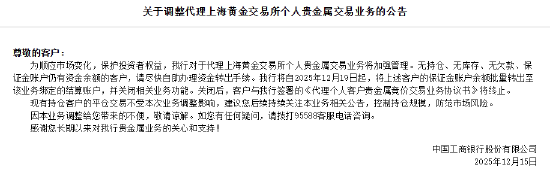
工商银行:对于代理上金所个人贵金属交易业务将加强管理
Bei Jing Shang Bao· 2025-12-15 09:27
Core Viewpoint - Industrial and Commercial Bank of China (ICBC) is adjusting its management of personal precious metals trading business to adapt to market changes and protect investor rights [1] Group 1: Business Adjustments - ICBC will strengthen management of its agency business for personal precious metals trading at the Shanghai Gold Exchange [1] - Customers with no positions, no inventory, no debts, and a remaining balance in their margin accounts are advised to withdraw their funds promptly [1] - Starting from December 19, 2025, ICBC will transfer the balances of these customers' margin accounts to the linked settlement accounts and terminate related business functions [1] Group 2: Customer Impact - The agreements signed by customers with ICBC regarding the agency personal precious metals bidding trading business will be terminated after the closure [1] - Existing customers with open positions will not be affected by this business adjustment for their closing transactions [1] - Customers are encouraged to monitor related announcements and manage their positions to mitigate market risks [1]
工商银行:对于代理上海黄金交易所个人贵金属交易业务将加强管理
Xin Lang Cai Jing· 2025-12-15 09:18
Core Viewpoint - Industrial and Commercial Bank of China (ICBC) announced an enhancement in the management of its personal precious metals trading business, in response to market changes and to protect investor rights [1][2]. Group 1: Business Changes - ICBC will strengthen management for its agency business related to the Shanghai Gold Exchange for personal precious metals trading [1][2]. - Customers with no positions, no inventory, no debts, and a remaining balance in their margin accounts are urged to withdraw their funds promptly [1][2]. Group 2: Account Closure - Starting from December 19, 2025, ICBC will batch transfer the remaining balances in the margin accounts of the specified customers to the linked settlement accounts and will close the related business functions [1][2]. - Following the closure, the agreement signed by customers regarding the agency personal precious metals bidding trading business will be terminated [1][2].
工商银行(601398) - 工商银行H股公告
2025-12-15 09:15
EF002 | 灣仔 | | | | | --- | --- | --- | --- | | 香港 | | | | | 代扣所得稅信息 | | | | | | | 請參考日期為2025年11月28日之2025年第二次臨時股東會投票表決結果公告內有關代扣 | | | 所得稅之詳情。 | | | | | | 股東類型 | 稅率 | 有關代預扣所得稅之更多補充 (如適用) | | | 非居民企業 | | | | | | | 根據《中華人民共和國企業所得稅 | | | (非中國內地登記地址) | 10% | 法》及其實施條例,本行向於股權 | | | | | 登記日登記在冊的H股非居民企業 | | | | | 股東派發股息時,有義務代扣代繳 | | | | | 企業所得稅,稅率為10%。對於截 | | | | | 止至股權登記日的H股股東名冊上 | | | | | 的所有以非個人名義登記的股東 | | | | | (包括香港中央結算(代理人)有 限公司,其他企業代理人或受託 | | | | | 人,或其他組織及團體皆被視為非 | | | | | 居民企業股東),本行將扣除10% | | | | | 的所得稅后派發20 ...
工商银行:调整代理上海黄金交易所个人贵金属交易业务
Xin Lang Cai Jing· 2025-12-15 09:05
Core Viewpoint - The Industrial and Commercial Bank of China (ICBC) is enhancing management of its personal precious metals trading business to adapt to market changes and protect investor interests [1] Group 1: Business Changes - ICBC will batch transfer the margin account balances of clients with no positions, no inventory, and no debts to the settlement accounts linked to this business starting from December 19, 2025 [1] - After the transfer, the related business functions will be closed, and the agreement signed with clients regarding the personal precious metals bidding trading business will be terminated [1] Group 2: Client Actions - Clients with remaining funds in their margin accounts are urged to complete the fund withdrawal procedures as soon as possible [1]
部分内银股午后走低 年底银行股资金面波动率放大 分红除净亦可能造成股价调整
Zhi Tong Cai Jing· 2025-12-15 06:29
Group 1 - The core viewpoint of the article indicates that the recent decline in Chinese bank stocks is attributed to fluctuations in year-end trading fund allocations, reflecting changes in market risk appetite as the quarter and year-end approaches [1] - Major state-owned banks have recently completed their interim dividend ex-dividend dates, which historically leads to short-term stock price adjustments. The ex-dividend date for this year was moved up to December [1] - Long-term investment opportunities may arise from stock price adjustments caused by trading factors such as ex-dividend dates, as these periods are often seen as good entry points for long-term capital [1] Group 2 - Specific declines in bank stocks include Bank of Communications down 3.93% to HKD 6.84, Agricultural Bank down 2.52% to HKD 5.41, China Construction Bank down 0.79% to HKD 7.58, and Industrial and Commercial Bank down 0.33% to HKD 6.12 [1] - The report from Changjiang Securities suggests that the fluctuations in bank stocks are expected to stabilize and potentially increase after the year-end, as institutional investors may need to realize profits [1] - It is anticipated that large banks such as Bank of Communications, Postal Savings Bank, China Merchants Bank, and Industrial Bank will also implement interim dividend ex-dividend dates towards the end of the year and early next year [1]


港股异动 | 部分内银股午后走低 年底银行股资金面波动率放大 分红除净亦可能造成股价调整
Zhi Tong Cai Jing· 2025-12-15 06:29
Group 1 - The core viewpoint of the article indicates that certain Chinese bank stocks experienced a decline in the afternoon trading session, with notable drops in shares of major banks such as Bank of Communications, Agricultural Bank of China, China Construction Bank, and Industrial and Commercial Bank of China [1] - Longjiang Securities released a report stating that the initial rise of bank stocks in the fourth quarter followed by recent adjustments reflects fluctuations in year-end trading fund allocations. This is expected to mirror changes in market risk appetite as the quarter and year-end approaches [1] - The report anticipates that after the cross-year period, the allocation power will push up bank stock valuations and the scale of bank index funds [1] Group 2 - Longjiang Securities noted that the recent completion of interim dividend ex-dividend dates by the four major state-owned banks typically leads to short-term stock price adjustments. Historically, similar fluctuations have occurred after ex-dividend dates [1] - The interim dividend ex-dividend date for the four major state-owned banks has been moved up to December this year, with expectations that other large banks will also implement interim dividend ex-dividend dates towards the end of the year and early next year [1] - From a long-term perspective, if stock price adjustments occur due to trading factors like ex-dividend dates, it is usually a favorable time for long-term investors to allocate funds [1]