
资金面波动

Search documents
哈铁科技资金面波动,行业政策与基本面变化引关注
Jing Ji Guan Cha Wang· 2026-02-15 03:28
Funding Situation - Main capital flow showed significant volatility in January 2026, with a net inflow of 1.173 million yuan on January 9, contrasting with a net outflow of 3.836 million yuan on January 7, indicating short-term market sentiment divergence [1] - As of January 26, 2026, the financing balance stood at 82.2743 million yuan, accounting for 4.63% of the circulating market value, which is at a historically high level within the top 80% percentile over the past year, potentially increasing stock price volatility [1] Industry Policy and Environment - The rail transit equipment industry is expected to benefit from ongoing investments in infrastructure and policy support, particularly from the "14th Five-Year Plan" which emphasizes railway network upgrades, with infrastructure investment policies likely to act as catalysts for future stock price movements [2] Company Fundamentals - The Q3 2025 financial report indicated revenue of 551 million yuan, a year-on-year increase of 12.27%, and a net profit of 56.5127 million yuan, also up 12.18% year-on-year; however, both revenue and net profit saw a decline in the third quarter compared to the previous year, with accounts receivable representing a high proportion of profit at 379.92%, necessitating attention to future improvements [3] - As of September 30, 2025, new institutional shareholders, such as the China Europe Value Selection Mixed Fund, may bolster market confidence [3] - Future focus areas include monitoring the company's order progress, technology conversion efficiency, and macro policy signals, as these factors could influence long-term valuation recovery; the upcoming annual report disclosures may also represent critical events for the company's performance outlook [3]

中盈盛达融资担保股价窄幅震荡,资金面波动显著
Jing Ji Guan Cha Wang· 2026-02-11 07:38
Group 1 - The stock price of Zhongying Shengda Financing Guarantee (01543.HK) exhibited a narrow fluctuation pattern from February 5 to February 11, 2026, with a range change of 0.41% and a volatility of 8.16%, reaching a high of HKD 0.27 on February 6 and a low of HKD 0.24 on February 5 [1] - Significant fluctuations in capital flow were noted, with a net inflow of HKD 298,280 on February 10, followed by a net outflow of HKD 12,300 on February 11, indicating that trading was primarily driven by retail investors, as major funds did not participate [1] - From a technical perspective, the MACD indicator showed a narrowing negative divergence, and the Bollinger Bands continued to contract, suggesting that the stock price is under pressure below the moving averages, indicating a weak short-term trend [1] Group 2 - On February 4, 2026, the company released its monthly securities change report, confirming that as of January 31, 2026, there was no change in the share capital of both domestic and H-shares, maintaining a total share capital of 1.561 billion shares, which complies with the Hong Kong Stock Exchange's public holding requirements [2]
债市日报:2月2日
Xin Hua Cai Jing· 2026-02-02 08:06
Core Viewpoint - The bond market is experiencing consolidation, with fluctuations in the context of equity market adjustments, and the focus is on the central bank's operations and liquidity conditions ahead of the Spring Festival [1] Market Performance - The majority of government bond futures closed lower, with the 30-year main contract up 0.18% at 112.06, while the 10-year main contract fell 0.03% to 108.25 [2] - The 30-year government bond yield decreased by 0.8 basis points to 2.252%, while the 10-year government bond yield increased by 0.15 basis points to 1.8115% [2] - The China Convertible Bond Index fell by 2.39%, with 194 convertible bonds dropping over 2%, while a few saw gains exceeding 2% [2] Overseas Bond Market - In the Eurozone, 10-year bond yields decreased, with French yields down 0.9 basis points to 3.417% and German yields down 1.8 basis points to 2.838% [3] - In North America, 10-year U.S. Treasury yields rose by 0.62 basis points to 4.237%, while 2-year yields fell by 2.85 basis points to 3.522% [3] Primary Market - Agricultural Development Bank's financial bonds were issued with yields below market estimates, with 1-year, 3-year, and 10-year yields at 1.4719%, 1.5418%, and 1.9599% respectively [4] Liquidity Conditions - The central bank conducted a 750 billion yuan reverse repurchase operation at a rate of 1.40%, resulting in a net withdrawal of 755 billion yuan for the day [5] - Short-term Shibor rates mostly declined, with the overnight rate rising by 3.7 basis points to 1.365% [5] Economic Indicators - The manufacturing PMI, non-manufacturing business activity index, and composite PMI output index were reported at 49.3%, 49.4%, and 49.8%, indicating a decline in economic activity [6] Institutional Views - Huatai Fixed Income suggests that the traditional strategy of "watching stocks or commodities to trade bonds" is failing due to commodity price volatility and increased demand for dividend insurance, leading to a "stock-bond co-temperature" [8] - Huachuang Securities notes that the January PMI's unexpected decline reflects a weak economic reality, with caution advised regarding upstream price increases affecting downstream demand [8] - Jianghai Securities indicates that while caution is warranted regarding low bond yields, the risk of rising rates is limited, with recent market performance showing strength amid easing concerns [8]
中信明明:央行仍可能通过国债买入等方式,对冲阶段性扰动,平抑资金面波动
Xin Lang Cai Jing· 2025-12-25 21:17
Core Viewpoint - The short-term liquidity in the funding market at year-end shows no significant signs of tightening, indicating a super-seasonally loose market liquidity [1] Group 1: Market Liquidity - Short-term funding rates are generally low, with overnight rates dropping below 1.3%, reflecting an overall loose liquidity environment [1] - The central bank's approach to maintaining ample liquidity remains unchanged, suggesting continued support for market stability [1] Group 2: Central Bank Actions - As the year-end approaches, the central bank may utilize open market operations and government bond purchases to mitigate temporary disturbances and stabilize funding fluctuations [1]

股价下跌遭质疑,设研院回应!高点至今,股价回调超60%
Zheng Quan Shi Bao Wang· 2025-12-24 12:01
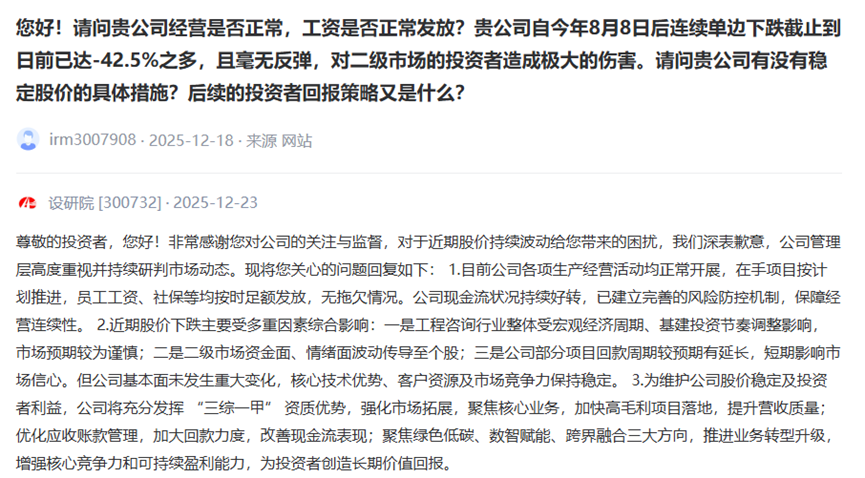
Group 1 - The core viewpoint of the article highlights that despite a 1.34% rebound in the stock price of the company on December 24, the cumulative decline since August 11 has exceeded 35%, making it the largest drop in the engineering consulting service sector and placing it among the top 25 declines in the entire A-share market [1] - Investors have expressed dissatisfaction regarding the stock's performance, with one investor noting a decline of 42.5% since August 8, which has significantly harmed market confidence [1] - The company attributes the recent stock price decline to multiple factors, including the overall impact of the macroeconomic cycle and adjustments in infrastructure investment, leading to cautious market expectations [1] Group 2 - The company also mentioned that fluctuations in the secondary market's funding and sentiment have affected individual stocks, contributing to the decline [1] - Additionally, the company indicated that some project payment cycles have extended beyond expectations, which has temporarily impacted market confidence [1] - Despite these challenges, the company asserts that its fundamental business has not undergone significant changes, maintaining stable core technological advantages, customer resources, and market competitiveness [1] Group 3 - The company's stock price reached a peak of 19.45 yuan per share on January 24, 2018, but has since fallen to below 8 yuan per share, representing a decline of over 60% from its highest price [1]


债市日报:12月23日
Xin Hua Cai Jing· 2025-12-23 09:20
Core Viewpoint - The bond market showed slight recovery on December 23, with short-term bonds performing better, as the main government bond futures all closed higher and interbank bond yields fell by 1-2 basis points [1] Market Performance - Government bond futures closed higher across the board, with the 30-year main contract rising by 0.89% to 112.83, the 10-year main contract up by 0.26% to 108.22, the 5-year main contract increasing by 0.17% to 106.025, and the 2-year main contract rising by 0.07% to 102.526 [2] - Interbank major interest rate bond yields generally declined, with the 30-year government bond yield down by 1.3 basis points to 2.2245%, the 10-year policy bank bond yield down by 1.15 basis points to 1.895%, and the 7-year government bond yield down by 2.2 basis points to 1.7% [2] International Market Trends - In North America, U.S. Treasury yields collectively rose on December 22, with the 2-year yield increasing by 2.32 basis points to 3.509%, and the 10-year yield rising by 2.35 basis points to 4.161% [3] - In Asia, Japanese bond yields fell across the board, with the 10-year yield down by 4.3 basis points to 2.04% [4] - In the Eurozone, the 10-year French bond yield remained flat at 3.610%, while the 10-year German bond yield rose by 0.2 basis points to 2.896% [4] Funding Conditions - The central bank conducted a 7-day reverse repurchase operation of 593 billion yuan at a fixed rate of 1.40%, with a net withdrawal of 760 billion yuan for the day [6] - The Shibor short-term rates mostly declined, with the overnight rate unchanged at 1.272%, and the 7-day rate down by 1.8 basis points to 1.399%, marking a new low since January 2023 [6] Institutional Insights - Huaxi Securities noted that recent funding disturbances are mainly due to tax periods, with manageable pressure expected as December is not a traditional tax month [7] - CITIC Securities expressed concerns over excessive worries regarding banks' capacity to hold long-term bonds, suggesting that the compression of long-term yield spreads may be challenging [8]
港股异动 | 部分内银股午后走低 年底银行股资金面波动率放大 分红除净亦可能造成股价调整
Zhi Tong Cai Jing· 2025-12-15 06:29
Group 1 - The core viewpoint of the article indicates that certain Chinese bank stocks experienced a decline in the afternoon trading session, with notable drops in shares of major banks such as Bank of Communications, Agricultural Bank of China, China Construction Bank, and Industrial and Commercial Bank of China [1] - Longjiang Securities released a report stating that the initial rise of bank stocks in the fourth quarter followed by recent adjustments reflects fluctuations in year-end trading fund allocations. This is expected to mirror changes in market risk appetite as the quarter and year-end approaches [1] - The report anticipates that after the cross-year period, the allocation power will push up bank stock valuations and the scale of bank index funds [1] Group 2 - Longjiang Securities noted that the recent completion of interim dividend ex-dividend dates by the four major state-owned banks typically leads to short-term stock price adjustments. Historically, similar fluctuations have occurred after ex-dividend dates [1] - The interim dividend ex-dividend date for the four major state-owned banks has been moved up to December this year, with expectations that other large banks will also implement interim dividend ex-dividend dates towards the end of the year and early next year [1] - From a long-term perspective, if stock price adjustments occur due to trading factors like ex-dividend dates, it is usually a favorable time for long-term investors to allocate funds [1]


中加基金权益周报︱股市大跌,但债市反应钝化
Xin Lang Ji Jin· 2025-11-27 08:10
Market Overview and Analysis - The primary market saw the issuance of government bonds, local government bonds, and policy financial bonds amounting to 187 billion, 184.7 billion, and 114.9 billion respectively, with net financing of 101.6 billion, 126.7 billion, and 114.9 billion [1] - Financial bonds (excluding policy financial bonds) totaled an issuance of 206.8 billion with a net financing of 28 billion [1] - Non-financial credit bonds had an issuance of 384.6 billion and a net financing of 129.1 billion, while a new convertible bond was issued with an expected financing scale of 560 million [1] Secondary Market Review - The stock market experienced significant declines, while the bond market showed narrow fluctuations, influenced by factors such as liquidity volatility and rumors regarding mortgage interest subsidies [2] - The liquidity tracking indicated that funding rates fluctuated, with R001 down by 4.2 basis points and R007 up by 0.1 basis points compared to the previous week [2] Policy and Fundamentals - October fiscal revenue showed a clear divergence, with tax revenue increasing significantly while general fiscal expenditure saw a notable decline [3] - High-frequency data indicated weakening in both production and demand sides, with prices of food and production materials decreasing [3] Overseas Market - The non-farm payroll data for September showed mixed results, with Nvidia's earnings exceeding expectations, but the US stock market declined, leading to increased risk aversion overseas [4] - The 10-year US Treasury bond closed at 4.06%, down 8 basis points from the previous week [4] Equity Market - The A-share market weakened significantly, with the Wind All A index dropping by 5.13%, particularly affecting growth sectors [5] - Trading volume decreased, with an average daily trading volume of 1.87 trillion, down by 178.79 billion week-on-week, although there was a surge in trading on Friday due to panic selling and margin calls [5] - As of November 20, 2025, the total financing balance for the entire A-share market was 2.474 trillion, a decrease of 137.75 billion from November 13 [5] Bond Market Strategy Outlook - Given the limited risk of a significant downturn in fundamentals and the central bank's liquidity support, the short-term bond market lacks a clear direction, with the 10-year government bond expected to fluctuate within the 1.75%-1.85% range [6] - As the end of the month approaches, the bond market may operate flexibly around liquidity fluctuations and the central bank's expected bond trading volume in November, suggesting a focus on short to medium-term, high-grade credit bonds to manage risk and stabilize returns [6] - The convertible bond index is expected to experience high-level fluctuations, with a preference for a risk-reward framework to navigate the current market conditions [6]
A股走高是本周资金波动的主因吗?
Xinda Securities· 2025-08-24 11:59
Monetary Market Overview - The central bank's OMO net injection this week was CNY 13,652 billion, with CNY 2,200 billion in treasury cash deposits maturing[3] - The average daily transaction volume of pledged repos decreased by CNY 1 trillion to CNY 7.1 trillion, with overall pledged repo volume lower than last week[3] - The new caliber funding gap rose to -640 on Tuesday but fell to -4,625 by Friday, remaining above last week's -5,511[3] Market Reactions and Trends - A-share market strength and the freezing of funds for new listings on the Beijing Stock Exchange have been suggested as factors influencing market adjustments[3] - The average DR001 rate for August was 1.32%, indicating that the central bank may tolerate increased funding volatility in the latter half of the month[3] - Government bond net payments this week totaled CNY 2,948 billion, with next week's treasury payment scale expected to be CNY 2,370 billion[3] Future Projections - The forecast for September includes CNY 12,900 billion in treasury issuance and a net financing of CNY 5,300 billion[4] - The overall government bond issuance scale for August was CNY 2.33 trillion, with a net financing scale of CNY 1.33 trillion, slightly lower than previous expectations[4] - Next week, the government bond net payment scale is projected to decrease to CNY 2,114 billion[4]

央行连日加码“补水” 熨平资金面波动
Xin Hua Wang· 2025-08-12 06:14
Group 1 - The People's Bank of China (PBOC) has increased liquidity support through significant reverse repo operations to maintain reasonable liquidity in the banking system [1][2] - On October 23, the PBOC conducted a 7-day reverse repo operation of 808 billion yuan, resulting in a net injection of 702 billion yuan [1] - The PBOC's actions are in response to a tightening of the funding environment due to factors such as tax payment deadlines and government bond issuance [2] Group 2 - Analysts note that the recent tightening of the funding environment is influenced by the issuance of local special refinancing bonds, with a total net financing of 943.8 billion yuan reported by October 20 [2] - The expected net financing scale of government bonds in October is projected to reach 1.25 trillion yuan, an increase of 295.1 billion yuan compared to September [2] - The impact of tax payment deadlines on the funding environment is expected to ease after October 23, as historical trends indicate that funding rates typically peak before tax deadlines [2] Group 3 - The market outlook suggests that funding pressures may persist, but the PBOC is likely to continue increasing reverse repo operations to stabilize the funding environment [2][3] - With the peak supply period for government bonds passing, a significant decrease in net issuance is anticipated for November and December [3] - Overall, both fiscal and monetary policies are expected to remain supportive, with the PBOC utilizing various tools to ensure adequate liquidity for economic recovery [3]