ICBC(01398)

Search documents
工、农、中、建、交、邮储,六大行密集发布业绩
新华网财经· 2026-03-31 06:33
Core Viewpoint - The six major state-owned commercial banks in China reported strong financial performance for the year 2025, with total operating income exceeding 35,482 billion yuan and net profit surpassing 14,200 billion yuan, indicating robust growth and stability in the banking sector [1][2]. Group 1: Financial Performance - All six banks achieved growth in both operating income and net profit for 2025, which has enabled them to maintain a high dividend payout ratio [2]. - The Industrial and Commercial Bank of China (ICBC) reported a stock price increase of 14.6% in A-shares and 20.7% in H-shares, along with a cash dividend of 1,105.93 billion yuan [4]. Group 2: Wealth Management and Consumer Services - Banks are focusing on innovating wealth management services to enhance residents' income and asset allocation [6]. - The Agricultural Bank of China emphasized leveraging its comprehensive operations to offer diverse financial products that meet clients' customized needs [8]. Group 3: Consumer Spending Initiatives - Several banks have prioritized boosting consumption and expanding domestic demand in 2025, enhancing financial services to support consumer spending [9]. - The Bank of China plans to inject over 20,000 billion yuan in credit to key consumption sectors, with subsidies and fee reductions benefiting over 100 million people [9]. - The China Construction Bank reported a personal consumption loan balance of 6,832 billion yuan, with a net increase of 1,552 billion yuan, and has provided 220 billion yuan in government consumption subsidies, stimulating 1,800 billion yuan in consumer spending [11].





高盛:工商银行、建设银行、交通银行上季业绩符预期 上调H股目标价
Zhi Tong Cai Jing· 2026-03-31 05:59
Core Viewpoint - Goldman Sachs reported that four major state-owned banks in mainland China, including Industrial and Commercial Bank of China (ICBC), China Construction Bank (CCB), Bank of Communications (BoCom), and Postal Savings Bank of China (PSBC), have released their Q4 performance, which met expectations with average revenue and profit both increasing by 2% year-on-year [1] Group 1: Financial Performance - The loan growth has slowed down; however, net interest margin stabilized quarter-on-quarter, supporting net interest income which remained flat year-on-year [1] - Non-interest income exceeded expectations, but provisions have increased, and the non-performing loan (NPL) formation rate has risen [1] - The NPL coverage ratio continues to decline, indicating ongoing pressure on retail asset quality, with rapid growth in non-mortgage retail loans posing potential risks [1] Group 2: Earnings Forecast Adjustments - Goldman Sachs has slightly adjusted the earnings forecasts for ICBC, CCB, and BoCom, and has made minor downward adjustments to some A-share valuations to reflect the narrowing A-H share premium [1] - Target prices for ICBC A-shares (601398.SH) and H-shares have been raised by 2% and 8% respectively, to RMB 7.71 and HKD 6.27, maintaining a "Neutral" rating [1] - Target prices for CCB A-shares (601939.SH) and H-shares have been increased by 4% and 9% respectively, to RMB 11.41 and HKD 9.01, with a "Buy" rating [1] - Target prices for BoCom A-shares (601328.SH) have been decreased by 3%, while H-shares have been increased by 6%, resulting in target prices of RMB 5.9 and HKD 6.11, with a "Sell" rating [1]


高盛:工商银行(01398)、建设银行(00939)、交通银行(03328)上季业绩符预期 上调H股目标价
智通财经网· 2026-03-31 05:58
Core Viewpoint - Goldman Sachs reported that four major state-owned banks in mainland China (Industrial and Commercial Bank of China, China Construction Bank, Bank of Communications, and Postal Savings Bank) released their Q4 performance, which met expectations with average revenue and profit growth of 2% year-on-year [1] Group 1: Financial Performance - The loan growth has slowed down, but net interest margin stabilized quarter-on-quarter, supporting net interest income which remained flat year-on-year [1] - Non-interest income exceeded expectations, although provisions increased and the non-performing loan formation rate rose [1] - The non-performing loan coverage ratio continued to decline, indicating ongoing pressure on retail asset quality [1] Group 2: Investment Recommendations - Goldman Sachs adjusted profit forecasts for ICBC, CCB, and BOCOM, and slightly lowered some A-share valuations to reflect the narrowing A-H share premium [1] - Target prices for ICBC A-shares and H-shares were raised by 2% and 8% respectively, to RMB 7.71 and HKD 6.27, with a "Neutral" rating [1] - Target prices for CCB A-shares and H-shares were increased by 4% and 9% respectively, to RMB 11.41 and HKD 9.01, both rated as "Buy" [1] - Target prices for BOCOM A-shares were lowered by 3% but raised for H-shares by 6%, to RMB 5.9 and HKD 6.11, both rated as "Sell" [1]
工商银行取得Oracle存储过程性能测试方法及装置专利
Sou Hu Cai Jing· 2026-03-31 01:07
Group 1 - The core point of the article is that the Industrial and Commercial Bank of China (ICBC) has obtained a patent for a method and device for performance testing of Oracle stored procedures, with the patent number CN115269430B and application date in August 2022 [1] - ICBC was established in 1985 and is headquartered in Beijing, primarily engaged in monetary financial services [1] - The registered capital of ICBC is approximately 35.64 billion RMB [1] Group 2 - According to data from Tianyancha, ICBC has invested in 28 companies and participated in 11,495 bidding projects [1] - The bank holds 965 trademark registrations and 5,000 patent records, along with 79 administrative licenses [1]
工商银行(601398):国际业务深化发展,深耕长尾零售客户
Guohai Securities· 2026-03-30 14:35
Investment Rating - The investment rating for the company is "Buy" (maintained) [1][4]. Core Insights - The company reported a revenue growth of 2.00% year-on-year for 2025, with a net profit attributable to shareholders increasing by 0.74%. In Q4 2025, revenue grew by 1.5% year-on-year, and net profit grew by 1.9% [6]. - The deposit cost rate decreased by 36 basis points year-on-year, indicating effective cost management. The company is focusing on expanding domestic demand and supporting people's livelihoods, with long-tail customers contributing over half of the retail asset growth [6]. - The net interest margin remained stable at 1.28%, with the company avoiding "price wars" in deposit competition [6]. - The international business has seen significant development, with revenue from overseas institutions and domestic subsidiaries accounting for 13.7% of total revenue, an increase of 0.6 percentage points year-on-year [6]. - The company has achieved industry-leading positions in various service areas, including treasury payment services and healthcare payment solutions [6]. - Profit forecasts indicate a gradual increase in net profit growth, with expected revenue growth rates of 2.45%, 8.75%, and 5.40% for 2026-2028, and net profit growth rates of 3.18%, 4.03%, and 4.42% for the same period [6][8]. Financial Metrics Summary - Current stock price is 7.57 CNY, with a market capitalization of approximately 2,698 billion CNY [3]. - The company’s total assets are projected to grow from 53,477.77 million CNY in 2025 to 66,123.21 million CNY by 2028 [8]. - The return on equity (ROE) is expected to decline slightly from 9.51% in 2025 to 8.86% in 2028 [8]. - The price-to-earnings (P/E) ratio is projected to decrease from 6.64x in 2025 to 5.87x in 2028, indicating potential undervaluation [8].
工商银行常州分行落地高速公路项目营运期贷款2.66亿元
Jiang Nan Shi Bao· 2026-03-30 12:45
Group 1 - The Industrial and Commercial Bank of China (ICBC) Changzhou Branch has successfully approved a 266 million yuan project operation loan for a local highway project, marking the first such loan in nearly six years [1][2] - The highway is a crucial part of the Changzhou regional road network, with a total length of 26.63 kilometers and designed for a speed of 120 km/h, featuring a dual six-lane standard with future expansion capabilities [1] - This project is expected to optimize urban traffic patterns, enhance regional connectivity, and support economic and social development [1] Group 2 - ICBC Changzhou Branch is committed to serving the real economy, focusing on key areas such as transportation, infrastructure, and livelihood, while continuously increasing credit support and optimizing service processes [2] - The bank has formed a specialized service team to proactively address the funding needs of enterprises during the project operation phase, receiving strong support and professional guidance from the provincial approval department [2] - The bank plans to deepen cooperation between government, banks, and enterprises, aiming to provide high-quality financial services for major infrastructure projects and contribute to the development of a modern comprehensive transportation system in Changzhou [2]
工商银行常州分行多举措推进“常个贷”业务高质量发展
Jiang Nan Shi Bao· 2026-03-30 12:32
Core Viewpoint - The Industrial and Commercial Bank of China (ICBC) Changzhou Branch has launched the "ICBC Changge Loan" online financing service, which has evolved into the largest and most customer-rich regional e-loan solution among secondary branches, with a loan balance of 915 million yuan as of February 2026, reflecting strong market feedback and customer satisfaction [1][2]. Group 1: Product Development and Performance - The "ICBC Changge Loan" has reached a loan balance of 915 million yuan, with an increase of 94 million yuan since the beginning of the year, and a non-performing loan balance of 5.12 million yuan, resulting in a non-performing loan ratio of 0.56% [1]. - The innovative "Changge Score" credit evaluation system quantifies traditional qualitative indicators to create a precise profile of individual business owners, using various data points such as registration, social security, and court records [1]. Group 2: Risk Management and Control - The loan process incorporates full-process intelligent risk control, automatically intercepting clients who do not meet eligibility criteria, such as those with abnormal operations or credit defaults [2]. - The bank employs big data and artificial intelligence to analyze clients' credit status, ensuring that potential risks are identified and managed effectively throughout the loan lifecycle [2]. - The bank has implemented a risk warning system that utilizes big data analysis and natural language processing to enhance risk prevention and customer service efficiency [2]. Group 3: Future Plans - The ICBC Changzhou Branch aims to continue optimizing product features and improving service efficiency while expanding its market influence and coverage to promote inclusive finance [3].
机构行为图谱系列之二:藩篱与抉择:商业银行配债受哪些指标影响
ZHESHANG SECURITIES· 2026-03-30 12:24
Report Industry Investment Rating - The report does not mention the industry investment rating [1] Core Viewpoints - Multiple regulatory indicators form the "fence" for banks' allocation behavior, and banks' "choices" within these fences determine their asset allocation structure [1][3][24] Summary by Relevant Catalog 1. Fence Within: How Regulatory Constraints Determine Banks' Bond Market Choices - **"Ballast Stone" Status of Bank Allocation in the Bond Market**: As the main bond allocators in the bond market, commercial banks' "ballast stone" status is rooted in three logics: scale dominance, counter - cyclical characteristics, and stability under regulatory constraints. As of the end of February 2026, commercial banks' bond allocation in the inter - bank market was 82.16 trillion yuan, ranking first among various institutions, mainly investing in interest - rate bonds. Their counter - cyclical allocation provides a buffer for the market, and regulatory constraints make them natural buyers of interest - rate bonds [2][17][18] - **Commercial Bank Regulation: Macro - Prudential + Micro - Constraints**: Understanding banks' bond allocation behavior requires understanding their regulatory constraints, including the Macro - Prudential Assessment System (MPA), interest - rate risk indicators (ΔEVE/NII), liquidity risk indicators (LCR/NSFR), and capital adequacy ratio. These indicators form the "fence" for banks' allocation behavior [3][24] 2. Central Bank MPA: From Broad Credit to Bond Allocation - **Overview of MPA Indicator System**: MPA reshapes banks' bond - allocation behavior in three dimensions: total amount, structure, and timing. In terms of total amount, the broad - credit growth constraint makes bond investment a "regulatory item" after loan issuance. Structurally, capital - adequacy pressure forces banks' self - operated funds to concentrate on interest - rate bonds with zero risk - weight. Temporally, liquidity assessment indicators create a rigid "quarter - end effect". Under these constraints, banks' self - operated bond - allocation behavior shows characteristics of "quota restricted by credit, concentration on interest - rate bonds, and rhythm restricted by quarter - ends" [4][29] - **Three Transmission Paths of MPA on Banks' Bond Allocation**: - **Broad - Credit Growth Constraint → Limited Bond Allocation Quota**: The upper limit of broad - credit growth locks the growth rate of bond investment, squeezing out bond allocation when loan growth is fast, especially at quarter - ends [32][33] - **Capital - Adequacy Constraint → Decreased Risk Appetite + Increased Supply of Capital Instruments**: To meet capital - adequacy requirements, banks issue secondary - capital bonds and perpetual bonds and increase the allocation of low - capital - occupancy interest - rate bonds while reducing high - capital - occupancy credit bonds. In a period of strict capital regulation, the spread between interest - rate bonds and credit bonds tends to widen [34] - **Liquidity Indicator Constraint → Quarter - End Fund Pulse + Solidified Maturity Preference**: LCR assessment tightens the quarter - end capital market and releases concentrated demand for interest - rate bonds. NSFR constraint restricts banks from lending to non - bank institutions at quarter - ends, inhibits excessive maturity mismatch, and solidifies banks' preference for short - term bonds or long - term interest - rate bonds [35] 3. Triple Constraints of the Banking Risk Supervision System under the Financial Regulatory System - **Capital - Adequacy Constraint: Risk Weights Guide Allocation**: Capital - adequacy ratio is the core regulatory indicator. Risk weights determine the capital occupancy of bonds, and banks prefer bonds with lower risk weights. The investment priority of bond types is: treasury bonds, policy - financial bonds > local - government bonds > general - credit bonds, commercial - financial bonds > secondary - capital bonds > perpetual bonds. When capital adequacy is under pressure, banks compress high - weight assets, and the regulatory rating affects business qualifications and asset structure. Capital - supplement pressure increases the supply of capital instruments [37][44][45] - **Liquidity Risk Indicators: LCR and NSFR's "Rigid Demand" for High - Liquidity Assets**: The core goal of liquidity - risk supervision is to guide banks to match the maturity structure of assets and liabilities. LCR and NSFR are the two pillars. Different bonds have different conversion rates in HQLA and RSF coefficients, which affect banks' bond - type preferences. The comprehensive impact includes a significant quarter - end effect, solidified maturity preference, and structural differentiation [47][51][57] - **Interest - Rate Risk Supervision Indicators: How ΔEVE and ΔNII Constrain Allocation Maturity**: ΔEVE measures the maximum loss of the net present value of banks' assets and liabilities under different interest - rate shocks, and ΔNII measures the impact of interest - rate changes on net interest income. These two indicators jointly restrict large domestic banks' long - bond allocation. Banks tend to "buy short and sell long" to control bond maturity [58][59][60]
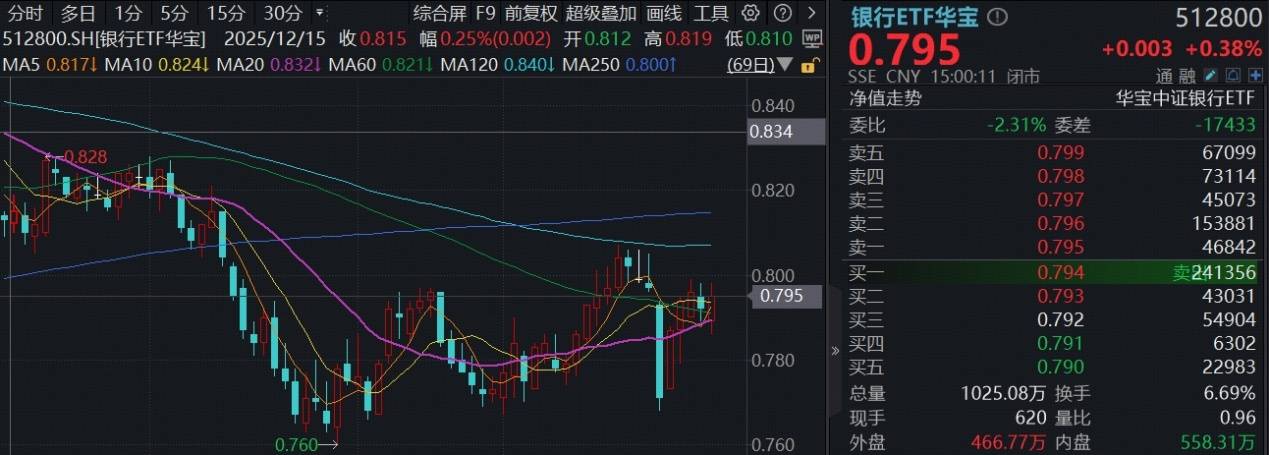
避险情绪升温,百亿银行ETF华宝(512800)向上突破,营收净利双增,工商银行涨超2%
Sou Hu Cai Jing· 2026-03-30 11:25
Core Viewpoint - The banking sector shows resilience amid geopolitical tensions, with a focus on high-dividend defensive assets attracting investor interest [3] Group 1: Market Performance - On March 30, the Shanghai Composite Index rose by 0.24% after initially dropping over 1%, while the ChiNext and Shenzhen Composite Indices fell [1] - The banking sector demonstrated defensive characteristics, with most individual stocks closing higher; Xiamen Bank led with a nearly 4% increase, and major banks like ICBC and Bank of China also saw gains [1] Group 2: Banking Sector Insights - Major state-owned banks, including ICBC, CCB, BOC, and PSBC, reported annual results showing steady asset growth and increases in both revenue and net profit [3] - Despite challenges such as narrowing net interest margins, bank management expressed optimism about stabilizing margins, which received positive market feedback [3] - According to CITIC Securities, the disclosed bank performance aligns with expectations, and future disclosures are likely to show minimal deviations from forecasts [3] Group 3: Investment Opportunities - With rising risk aversion, the banking sector is expected to benefit from increased allocation due to its defensive characteristics and potential for fundamental improvements [3] - The banking ETF (512800) has a significant scale of over 12 billion, making it the largest and most liquid among A-share banking ETFs, with an average daily trading volume exceeding 800 million since 2025 [4]


宇宙行的“双轴”叙事
华尔街见闻· 2026-03-30 08:16
Core Viewpoint - The financial report of the Industrial and Commercial Bank of China (ICBC) serves as a precise reflection of China's macroeconomic dynamics, highlighting its dual role in supporting both the real economy and consumer spending [1][2]. Group 1: Asset and Profitability Performance - ICBC has achieved a net profit of 370.77 billion yuan in 2025, marking a year-on-year increase of 1.0%, while operating income exceeded 800 billion yuan, growing by 1.9% [2]. - The total assets of ICBC reached 53.48 trillion yuan, representing a 9.5% increase from the previous year [2]. - The bank's non-performing loan ratio decreased by 3 basis points, with capital adequacy and provision coverage ratios remaining at high levels, demonstrating strong resilience [3]. Group 2: Strategic Focus on Supply and Demand - ICBC's strategy emphasizes a dual approach of strengthening the supply side while nurturing the demand side, which has translated into operational resilience against cyclical fluctuations [2][3]. - The bank's corporate loans reached 18.84 trillion yuan by the end of 2025, with an increase of 1.36 trillion yuan from the previous year, reflecting its deep integration into the industrial chain [3]. Group 3: Sector-Specific Investments - In the industrial sector, ICBC's manufacturing loans amounted to 5.24 trillion yuan, with a growth rate of 19.4%, positioning it as a leader in the industry [5]. - The bank has expanded its cross-border financial services, with the number of overseas RMB clearing banks increasing to 12 and cross-border RMB business volume surpassing 10 trillion yuan [6]. - ICBC's technology loans reached 6 trillion yuan, supported by innovative risk pricing models and a focus on high-quality sectors [7]. Group 4: Retail Banking and Consumer Support - By the end of 2025, ICBC's domestic branches increased RMB loans by 2.17 trillion yuan, with personal consumption loans growing by 18.5% and personal operating loans by 15% [8]. - The bank has actively implemented policies to stimulate domestic demand, including significant investments in personal auto finance and consumer loan interest subsidies [9]. - ICBC has established over 9,300 specialized financial outlets for elderly services and launched various pension investment solutions to cater to the aging population [9][10]. Group 5: Risk Management and Future Outlook - ICBC is enhancing its risk management capabilities through intelligent risk control measures, ensuring high-quality development and safety [10]. - The bank's dual focus on industrial and consumer sectors positions it well to navigate economic fluctuations and sustain growth during the 14th Five-Year Plan period [11][12]. - Looking ahead, ICBC aims to continue providing robust support for China's high-quality economic development through efficient capital allocation [13].