MEDBOT(02252)

Search documents
未知机构:东北医疗大健康价格立项落地手术机器人迎来收费模式突破事件国家医保-20260121
未知机构· 2026-01-21 02:10
Summary of Conference Call on Northeast Medical Health Industry Industry Overview - The conference call discusses the Northeast Medical Health industry, specifically focusing on the recent developments in surgical robotics and innovative medical technologies. Key Points and Arguments 1. **National Pricing Guidelines**: On January 20, the National Healthcare Security Administration (NHSA) released the "Guidelines for the Establishment of Pricing Projects for Surgical and Treatment Auxiliary Medical Services (Trial)" which establishes a unified pricing framework for surgical robots, energy equipment consumables, and remote surgery technologies across the country [1][3]. 2. **Provincial Implementation Timeline**: Historical data suggests that it typically takes between six months to a year for provinces to implement specific projects and pricing after the NHSA's announcement [2]. 3. **Benefits of Pricing Directory**: The establishment of a clear pricing directory is expected to facilitate the entry of innovative devices into hospitals and increase the sales volume of consumables [4]. 4. **Impact on Clinical Promotion**: Previously, the need for medical institutions to apply for self-pricing or provincial pricing led to reduced enthusiasm for clinical promotion. The new pricing directory aims to streamline the final pricing model across provinces, enhancing the accessibility of advanced medical technologies and promoting a shift from traditional to precision medicine [5]. 5. **Tiered Pricing System for Surgical Robots**: A tiered pricing system based on the clinical value and participation level of surgical robots has been introduced. Prices will be set in three tiers: navigation, participation in execution, and precise execution. The guidelines also include specific consumables in the pricing structure [5]. 6. **Independent Pricing for Remote Surgery**: Remote surgery has been given independent pricing status, which is expected to benefit leading hospitals and increase surgical volumes [6]. 7. **Clarification on Consumable Charges**: The guidelines clarify the charging logic for disposable and reusable consumables, stating that disposable consumables will be sold at zero markup, while reusable consumables will incur an auxiliary operation fee [7]. Key Beneficiaries 1. **MicroPort Robotics**: A leading domestic surgical robot company with over 160 cumulative orders for laparoscopic robots expected by December 2025. The company is positioned to capitalize on the commercialization of surgical robots and expand market share through innovative procedures [8]. 2. **JinFeng Medical**: Among the top two domestic surgical robot manufacturers, it is rapidly increasing the volume of multi-port and single-port laparoscopic robots, leading in domestic procurement bids [8]. 3. **Tianzhihang**: A leader in orthopedic surgical robots, the company has developed a comprehensive business model that includes equipment, consumables, and technical services [8]. 4. **Sanyou Medical**: Focused on developing three-arm spinal surgical robots and ultrasonic bone knives, benefiting from the new pricing regulations for energy equipment consumables [8]. 5. **Aikang Medical**: Set to launch a second-generation knee joint surgical robot in collaboration with Peking University Third Hospital, aiming to provide a complete digital orthopedic solution [8]. 6. **Chunli Medical**: Innovating with handheld robotic technology, the company plans to establish multiple surgical training centers overseas to accelerate international expansion [9].


微创机器人-B再涨超7% 国家医保局首次明确机器人手术收费指引
Zhi Tong Cai Jing· 2026-01-21 01:57
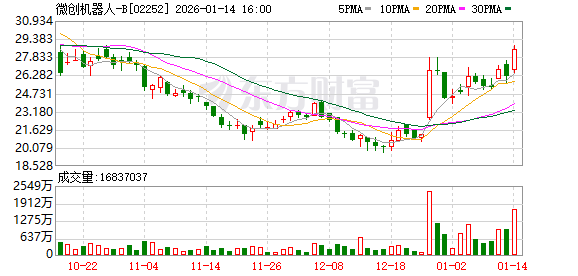
微创机器人-B(02252)再涨超7%,截至发稿,涨7.21%,报28.26港元,成交额7265.63万港元。 值得注意的是,微创机器人此前公告,综合订单方面,经本集团内部初步统计,本集团旗下腔镜、骨 科、血管介入核心产品的综合订单量累计突破230台。其中,核心产品图迈腔镜手术机器人(图迈)于全 球范围内累计商业化订单超过160台,含今年新获订单近120台。根据公开统计数据,图迈2025年全球订 单量已跻身全球前二。 消息面上,国家医保局近日印发《手术与治疗辅助操作类医疗服务价格项目立项指南(试行)》,聚焦 3D打印、手术机器人、远程手术等前沿医疗技术,统一规范了37项价格项目、5项加收项及1项扩展 项,旨在以价格机制引领医疗技术升级,推动"传统治疗"向"精准医疗"转型。 ...

港股异动 | 微创机器人-B(02252)再涨超7% 国家医保局首次明确机器人手术收费指引
智通财经网· 2026-01-21 01:48
消息面上,国家医保局近日印发《手术与治疗辅助操作类医疗服务价格项目立项指南(试行)》,聚焦 3D打印、手术机器人、远程手术等前沿医疗技术,统一规范了37项价格项目、5项加收项及1项扩展 项,旨在以价格机制引领医疗技术升级,推动"传统治疗"向"精准医疗"转型。 值得注意的是,微创机器人此前公告,综合订单方面,经本集团内部初步统计,本集团旗下腔镜、骨 科、血管介入核心产品的综合订单量累计突破230台。其中,核心产品图迈腔镜手术机器人(图迈)于全 球范围内累计商业化订单超过160台,含今年新获订单近120台。根据公开统计数据,图迈2025年全球订 单量已跻身全球前二。 智通财经APP获悉,微创机器人-B(02252)再涨超7%,截至发稿,涨7.21%,报28.26港元,成交额 7265.63万港元。 ...
微创机器人重塑全球手术机器人市场格局 ——专访微创机器人创始人、首席执行官何超博士
Zheng Quan Shi Bao· 2026-01-14 18:15
Core Viewpoint - The company, MicroPort Robotics, has become the first and only enterprise globally to achieve commercialized listings of surgical robots across all categories, breaking a 20-year monopoly held by foreign products in the surgical robot market [1][2]. Group 1: Product Development and Market Position - MicroPort Robotics has received approval for seven surgical robot products, including the recently approved bronchoscopic surgical robot, establishing itself as a leader in the domestic surgical robot industry [2]. - The company’s first product, the TUMAI laparoscopic surgical robot, ended the long-standing monopoly of the Da Vinci system in the laparoscopic field, with over 160 global orders and more than 100 commercial installations [2]. - The orthopedic surgical robot, HONGHU, has also gained significant traction, with hospitals in Germany fully adopting it for joint replacement surgeries, marking a shift from traditional surgical methods [2]. Group 2: Financial Performance and Growth - In the first half of the previous year, the company reported a revenue of 176 million yuan, representing a 77% year-on-year increase, while significantly reducing losses by 59% [3]. - The company achieved overseas revenue of 103 million yuan, a 189% increase year-on-year, accounting for approximately 60% of total revenue [4]. Group 3: International Expansion and Strategy - MicroPort Robotics has successfully expanded into international markets, including Europe, Latin America, the Middle East, Southeast Asia, and Africa, with the TUMAI robot's overseas installations surpassing the total installations of all domestic brands in China [4]. - The company is focusing on innovation in overseas markets, particularly in vascular intervention robots, utilizing European research and clinical applications to leverage academic influence globally [4]. Group 4: Industry Insights and Future Directions - The company recognizes the need for collaborative efforts among policies and markets to promote healthy industry development, emphasizing the importance of innovation and unique value in technology [6]. - MicroPort Robotics has completed the world's first animal experiment of "large model autonomous surgery," exploring the integration of AI technology with surgical robots [6]. - There is a growing consensus within the industry regarding the need for improved policies and mechanisms to support original technology and facilitate clinical transformation [7].
微创机器人重塑全球手术机器人市场格局
Zheng Quan Shi Bao· 2026-01-14 17:56
Core Insights - The company, MicroPort Robotics, has achieved a significant milestone by becoming the first and only company globally to commercialize a full range of surgical robot products, with a total of 7 products approved for market since January 2022 [1][2] - The company has successfully broken the 20-year monopoly of foreign products in the surgical robot field, reshaping the global market landscape [1][2] Product Development - MicroPort Robotics has received approval for its bronchoscopic surgical robot, bringing the total number of approved products to 7 [2] - The company launched its first laparoscopic surgical robot, the TiMai, in January 2022, ending the monopoly of the Da Vinci system in this area, with over 160 global orders and more than 100 commercial installations [2] - The orthopedic surgical robot, Honghu, was approved shortly after TiMai and has entered multiple overseas markets, with some German hospitals fully adopting it for joint replacement surgeries [2] Financial Performance - In the first half of 2022, the company reported revenue of 176 million yuan, a year-on-year increase of 77%, and significantly reduced losses by 59% [3] International Market Expansion - The company has made significant strides in international market expansion, achieving comprehensive breakthroughs in regions such as Europe, Latin America, the Middle East, Southeast Asia, and Africa [4] - Overseas revenue reached 103 million yuan in the first half of 2022, a year-on-year increase of 189%, accounting for approximately 60% of total revenue [4] - The company is focusing on innovation in overseas markets, particularly in vascular intervention robots, leveraging European academic influence for global outreach [4] Industry Challenges and Opportunities - The surgical robot industry in China is at a stage where most companies are still balancing R&D investment with commercial expansion, with no company achieving overall profitability yet [4] - The industry faces both opportunities and challenges, requiring a collaborative effort from policy and market forces to promote healthy development [5][6] - There is a growing consensus among industry stakeholders on the need for improved policies and mechanisms to support original innovations and facilitate clinical application [6]


微创机器人重塑全球手术机器人市场格局——专访微创机器人创始人、首席执行官何超博士
Zheng Quan Shi Bao· 2026-01-14 17:33
Core Insights - The company, MicroPort Robotics, has achieved a significant milestone by becoming the first and only company globally to commercialize a full range of surgical robots, with a total of 7 products approved for market since January 2022 [2][3] - The company has successfully broken the 20-year monopoly of foreign products in the surgical robot field, reshaping the global market landscape [2][3] Product Development - The latest product, a bronchoscopic surgical robot, has received approval from the National Medical Products Administration, bringing the total number of approved surgical robots to 7 [3] - The first product, the TUMI laparoscopic surgical robot, was approved in January 2022, ending the monopoly of the Da Vinci system in this field, with over 160 global orders and more than 100 commercial installations [3] - The orthopedic surgical robot, Honghu, was approved shortly after TUMI and has entered multiple overseas markets, with some hospitals in Germany fully adopting it for joint replacement surgeries [3] Financial Performance - In the first half of 2025, the company reported revenue of 176 million yuan, a year-on-year increase of 77%, and significantly reduced losses by 59% [4] - The company achieved overseas revenue of 103 million yuan, a 189% increase year-on-year, accounting for approximately 60% of total revenue [6] Market Strategy - The company is accelerating its international market expansion, having made significant breakthroughs in Europe, Latin America, the Middle East, Southeast Asia, and Africa [6] - The domestic market is still dominated by Da Vinci, but the share of domestic brands is expected to reverse starting in 2024, indicating substantial growth potential for local brands [6] Innovation and Industry Challenges - The company emphasizes the need for innovation and unique value in the surgical robot industry, having completed the world's first autonomous surgery using AI technology [7] - There is a call for improved policies and market mechanisms to support the healthy development of the industry, particularly for original technology and innovative products [7][8]
港股AI医疗概念股再度走强
Mei Ri Jing Ji Xin Wen· 2026-01-14 06:58
Group 1 - The Hong Kong stock market for AI healthcare concept stocks has strengthened again, with notable increases in share prices for several companies [1] - Alibaba Health (00241.HK) saw a significant rise of 18.81%, reaching HKD 7.77 [1] - Weigao Robot-B (02252.HK) increased by 7.7%, trading at HKD 28.24 [1] - Yidu Tech (02158.HK) rose by 6.06%, with shares priced at HKD 6.83 [1] - Ping An Good Doctor (01833.HK) experienced a 5.9% increase, reaching HKD 18.6 [1] - JD Health (06618.HK) saw a rise of 4.08%, with shares priced at HKD 70.15 [1]


港股异动 | AI医疗概念股再度走强 英伟达将“全栈式”布局医疗领域 AI医疗商业化确定性将加强
智通财经网· 2026-01-14 06:49
Group 1 - AI healthcare concept stocks have strengthened, with notable increases in share prices for companies such as Alibaba Health (+18.81%), MicroPort Scientific (+7.7%), Yidu Tech (+6.06%), Ping An Good Doctor (+5.9%), and JD Health (+4.08%) [1] - NVIDIA and Eli Lilly announced a joint investment of $1 billion to establish an AI drug development lab in San Francisco, aimed at accelerating drug development processes [1] - NVIDIA has previously invested in biotechnology company Recursion and established partnerships with leading firms in the healthcare sector, including Novo Nordisk and Mayo Clinic [1] Group 2 - Citic Securities believes that AI in healthcare will accelerate the restructuring of the trillion-dollar pharmaceutical market, with a fundamental change in the logic of AI healthcare expected by 2026 [2] - The core of this change is that the payers for AI healthcare have become clearer and more powerful this year, indicating a stronger certainty for commercialization in 2026 [2]

微创机器人-B午后涨超7% 手术机器人行业有望进入商业化和政策加速期
Xin Lang Cai Jing· 2026-01-14 05:13
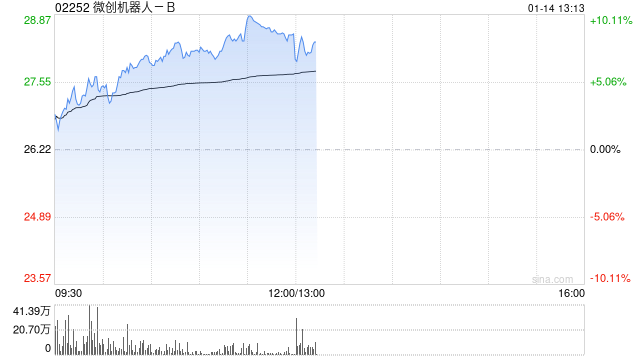
Group 1 - The stock price of MicroPort Scientific Corporation-B (02252) rose by 7.25%, reaching HKD 28.12, with a trading volume of HKD 310 million [4]. - Nvidia and Eli Lilly announced a joint investment of USD 1 billion to establish an AI drug discovery laboratory, exploring opportunities in clinical development, manufacturing, and commercial operations using AI and robotics [4]. - A report from Zhongyou Securities indicates that the surgical robotics industry may enter a period of commercialization and policy acceleration [4]. Group 2 - As of December 24, MicroPort announced that its cumulative orders for surgical robot products have exceeded 230 units, with over 160 units of laparoscopic surgical robots in global commercial orders [4]. - The company's self-developed bronchoscopic surgical robot "Dudao" has received approval from the NMPA [4]. - Zhongyou Securities believes that the company's globalization strategy is rapidly being validated in the market, with increasing competitiveness overseas [4]. - In the domestic market, the relaxation of policies regarding laparoscopic robot configurations may allow the company to maintain its advantages, and the optimization of charging policies is expected to enhance industry penetration [4].
AI医疗概念股继续强势 阿里健康大涨超13% 医渡科技大涨超9%
Ge Long Hui· 2026-01-14 04:30
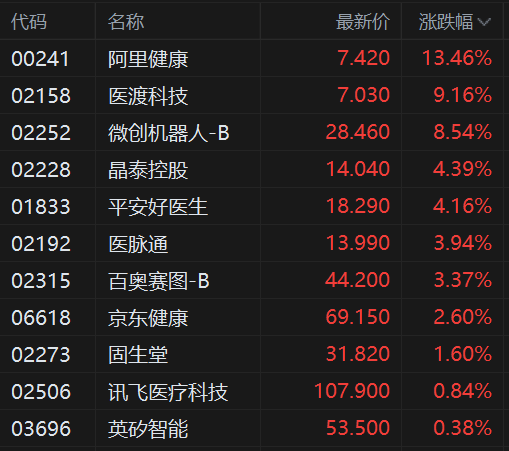
Group 1 - The core viewpoint of the article highlights the strong performance of AI healthcare stocks in the Hong Kong market, driven by clear industry trends and significant demand for health AI solutions [1] - Alibaba Health led the surge with a rise of over 13%, accumulating a monthly increase of over 46%, while other companies like Yidu Tech and MicroPort Robotics also saw substantial gains [1] - The launch of Ant Group's AI health assistant "Ant Aifu," which quickly surpassed 30 million monthly active users and received over 10 million daily inquiries, underscores the massive demand and market potential for health AI [1] Group 2 - OpenAI's introduction of "ChatGPT Health" on January 8 further indicates that leading AI companies are optimistic and heavily investing in the health AI sector [1] - Frost & Sullivan predicts that China's "AI + healthcare" market will grow from 8.8 billion yuan in 2023 to 315.7 billion yuan by 2033, with a compound annual growth rate of 43.1% over the next decade [1] - Huafu Securities' latest report states that the AI healthcare industry has entered a critical phase of commercialization, supported by national strategies and market demand [1]