
PING AN OF CHINA(02318)

Search documents
中国平安官宣与马龙合作: 实力派出马,财富、健康、养老一条“龙”规划
Xin Lang Zheng Quan· 2025-11-18 09:26
Group 1 - Ma Long is recognized as a dominant figure in table tennis, achieving unprecedented milestones such as being the first player to complete the "Grand Slam" and maintaining a high winning percentage in men's singles [1][2] - His consistent performance over 15 years has established him as a "six-dimensional warrior" in the sport, characterized by comprehensive skills, mental strength, quick adaptability, precise judgment, deep experience, and stability in critical moments [1][2] - The current National Games may be his last chance to compete for a team gold medal, highlighting his commitment to overcoming the only shortcoming in his career [1] Group 2 - China Ping An officially announced Ma Long as a brand ambassador, emphasizing a partnership between two entities that excel in their respective fields through long-term stability and strength [3][4] - The collaboration is framed as a "strong union," with both Ma Long and China Ping An embodying qualities of strength, precision, stability, flexibility, longevity, and comprehensiveness [3][7] - The product "Yuxiang Dividend 26" from China Ping An reflects a strategy of stable returns and high participation in dividends, paralleling Ma Long's approach to competition, which relies on steadiness and skill rather than risk [7]

险企释放信号!分红型健康险离回归还有多远
Bei Jing Shang Bao· 2025-11-18 07:03
Core Viewpoint - The health insurance market is eager for innovative products, and the recent announcement from China Ping An regarding the development of participating critical illness insurance signals a potential revival of this product type after many years of absence [1][2]. Group 1: Product Development and Market Response - China Ping An has initiated research and development for participating critical illness insurance, aiming to launch products as soon as relevant regulations are established [1]. - Many insurance companies are reportedly preparing for the launch of new participating critical illness insurance products, indicating a broader industry movement towards this innovation [1]. - The recent policy change allowing the development of participating long-term health insurance has cleared obstacles for the reintroduction of these products [2]. Group 2: Characteristics of Participating Health Insurance - True participating health insurance combines coverage with variable returns, allowing policyholders to share in the insurer's profits while providing disease protection [5]. - Unlike current market offerings, which often combine participating whole life insurance with critical illness coverage, genuine participating critical illness insurance has not yet been available [3][4]. - The return on participating health insurance is not guaranteed and depends on the insurer's actual performance, requiring high actuarial and risk management capabilities [5]. Group 3: Market Dynamics and Future Implications - The return of participating critical illness insurance is expected to address current market pain points and enhance product competitiveness, particularly as traditional critical illness insurance faces challenges from rising prices [8][9]. - The shift towards participating products may lead to a market transformation from a "price war" to a "value war," emphasizing long-term investment capabilities and customer service [9]. - The reintroduction of these products is seen as a sign of market maturity and a response to consumer demand for value-added protection in a low-interest-rate environment [12]. Group 4: Challenges and Considerations for Implementation - For widespread market acceptance, participating health insurance must overcome challenges such as independent accounting for participating accounts, transparency in dividend policies, and balancing coverage with investment functions [10][11]. - The timeline for product rollout is expected to take several months to a year, with initial offerings likely to be cautious as companies await regulatory guidelines [10]. - The industry's ability to innovate and adapt to these new products will be crucial for meeting diverse consumer needs and ensuring sustainable growth in the health insurance sector [12].

智通港股通持股解析|11月18日
智通财经网· 2025-11-18 00:32
Core Insights - The top three companies by Hong Kong Stock Connect holding ratios are China Telecom (00728) at 72.14%, COSCO Shipping Energy (01138) at 69.18%, and GCL-Poly Energy (01330) at 69.09% [1][2] - Xiaomi Group-W (01810), Pop Mart (09992), and Industrial and Commercial Bank of China (01398) saw the largest increases in holding amounts over the last five trading days, with increases of +34.20 billion, +12.67 billion, and +11.24 billion respectively [1][2] - The largest decreases in holding amounts were observed in the Tracker Fund of Hong Kong (02800) at -58.33 billion, Alibaba Group-W (09988) at -40.89 billion, and Hang Seng China Enterprises Index (02828) at -18.98 billion [1][3] Group 1: Top Holding Ratios - China Telecom (00728) has a holding ratio of 72.14% with 10.013 billion shares [2] - COSCO Shipping Energy (01138) has a holding ratio of 69.18% with 0.897 billion shares [2] - GCL-Poly Energy (01330) has a holding ratio of 69.09% with 0.279 billion shares [2] Group 2: Recent Increases in Holdings - Xiaomi Group-W (01810) increased by +34.20 billion with a change of +81.51 million shares [2] - Pop Mart (09992) increased by +12.67 billion with a change of +5.83 million shares [2] - Industrial and Commercial Bank of China (01398) increased by +11.24 billion with a change of +172.61 million shares [2] Group 3: Recent Decreases in Holdings - Tracker Fund of Hong Kong (02800) decreased by -58.33 billion with a change of -219.93 million shares [3] - Alibaba Group-W (09988) decreased by -40.89 billion with a change of -26.39 million shares [3] - Hang Seng China Enterprises Index (02828) decreased by -18.98 billion with a change of -19.89 million shares [3]




智通港股通资金流向统计(T+2)|11月18日
智通财经网· 2025-11-17 23:32
智通财经APP获悉,11月13日,阿里巴巴-W(09988)、小米集团-W(01810)、华润万象生活 (01209)南向资金净流入金额位列市场前三,分别净流入13.15 亿、7.77 亿、6.71 亿 盈富基金(02800)、恒生中国企业(02828)、腾讯控股(00700)南向资金净流出金额位列市场前 三,分别净流出-62.19 亿、-22.83 亿、-8.78 亿 在净流出比方面,中集集团(02039)、绿城管理控股(09979)、361度(01361) 以-59.72%、-56.62%、-56.52%位列市场前三。 | 股票名称 | 净流入比↓ | 净流入(元) | 收盘价 | | --- | --- | --- | --- | | 南方港美科技(03442) | 88.11% | 1.10 亿 | 9.435(+0.05%) | | 南方东西精选(03441) | 74.90% | 1930.75 万 | 10.580(-0.47%) | | 至源控股(00990) | 62.95% | 1787.74 万 | 0.760(+1.33%) | | 深圳高速公路股份 | 60.48% | 645.88 ...


市场交投维持高位,板块后续业绩有望延续高增
Changjiang Securities· 2025-11-17 23:30
Investment Rating - The report maintains a positive outlook on the investment banking and brokerage industry [7] Core Insights - The brokerage sector continues to see high trading activity, with expectations for sustained high growth in future performance, suggesting active allocation [2][4] - In the insurance sector, listed insurance companies reported significant growth in value, premiums, and profits in Q3, with a notable performance in the growth/technology-dominated equity market, challenging the traditional view of insurance investment as merely dividend-based [2][4] - The report indicates a potential for continued valuation recovery in the short term, supported by the logic of deposit migration, increased equity allocation, and improved new policy costs, enhancing the certainty of long-term ROE improvement [2][4] Summary by Sections Brokerage Sector - Trading activity remains high, with daily average transaction volume at 20,438.27 billion, up 1.56% week-on-week, and a daily turnover rate of 2.09%, up 3.64 basis points [5][40] - The report recommends active allocation in the brokerage sector due to the expected recovery in profitability and stability in commission rates [4][40] Insurance Sector - The cumulative premium income for the insurance industry reached 52,146 billion, with a year-on-year increase of 8.76%, driven by a 10.19% increase in life insurance premiums [22][23] - The report highlights the significant growth in premium income for major insurers, with New China Insurance reporting a 17% increase in premium income for the period from January 1 to October 31, 2025 [6][27] - The insurance sector is expected to see a valuation recovery, supported by improved asset allocation towards bonds and equity [22][27] Market Performance - The non-bank financial index increased by 0.2% this week, with a year-to-date increase of 7.6%, although it ranks lower compared to the broader market [5][18] - The report notes a mixed performance in the non-bank sector, with the insurance sector up 2.6% while the brokerage sector saw a decline of 0.9% [18][20] Financing Activities - In October, equity financing increased to 501.42 billion, up 20.4% month-on-month, while bond financing decreased to 6.56 trillion, down 19.2% [50] - The report anticipates an increase in stock underwriting scale due to new refinancing regulations, while bond underwriting will be influenced by interest rate changes [50] Asset Management - The report indicates a decline in new issuance of collective asset management products, with a total of 41.83 billion units issued in October, down 37.3% from the previous month [54] - The asset management sector is entering a recovery phase as the transition period for new regulations approaches its end [54]


智通ADR统计 | 11月18日
智通财经网· 2025-11-17 22:44
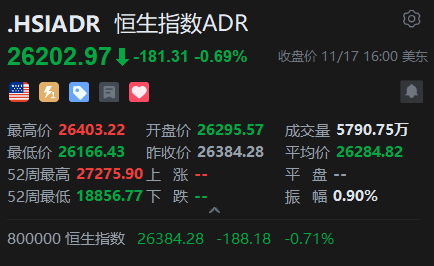
Market Overview - The Hang Seng Index (HSI) closed at 26,202.97, down by 181.31 points or 0.69% on November 17 [1] - The index's trading volume was 57.9075 million, with a daily average price of 26,284.82 [1] - The 52-week high for the index was 27,275.90, while the low was 18,856.77 [1] Major Blue-Chip Stocks Performance - Most large-cap stocks experienced declines, with HSBC Holdings closing at HKD 110.738, down 1.21% from the Hong Kong close [2] - Tencent Holdings closed at HKD 629.180, down 1.15% from the Hong Kong close [2] Stock Price Movements - Tencent Holdings (00700) saw a decrease of HKD 4.500, or 0.70%, with an ADR price of HKD 629.180, which is HKD 7.320 lower than its Hong Kong stock price [3] - HSBC Holdings (00005) dropped by HKD 0.800, or 0.71%, with an ADR price of HKD 110.738, which is HKD 1.362 lower than its Hong Kong stock price [3] - Other notable declines included AIA Group (01299) down by 1.28% and China Construction Bank (00939) down by 1.32% [3]


分红型重疾险离上市还有多远?
Sou Hu Cai Jing· 2025-11-17 16:39
Core Viewpoint - The health insurance market is eager for innovative products, and China Ping An has announced the development of participating critical illness insurance, indicating a potential revival of "guarantee + investment" products after years of absence [1][3]. Group 1: Market Dynamics - The recent policy change in September, which allows the development of participating long-term health insurance, has cleared obstacles for the return of these products [3][6]. - Many companies are reportedly preparing to launch new participating critical illness insurance products, with expectations for market entry soon [3][4]. - The return of participating critical illness insurance is seen as a response to the declining competitiveness of traditional critical illness insurance due to falling preset interest rates [7][8]. Group 2: Product Characteristics - True participating health insurance differs fundamentally from existing products, which are often combinations of participating whole life insurance and critical illness coverage [4][5]. - Participating long-term health insurance combines coverage with the opportunity to share in the insurer's profits, potentially increasing the policy value over time to combat inflation [5][11]. - The new products are expected to enhance competitiveness in the market by offering both protection and potential value growth, appealing to consumers seeking both security and investment [7][8]. Group 3: Industry Implications - The reintroduction of participating critical illness insurance is anticipated to shift the industry from a "price war" to a "value war," focusing on long-term investment capabilities and customer service [8][11]. - The regulatory approval for these products is seen as a cautious decision based on the maturity of the market and the capabilities of insurance companies [7][10]. - The successful launch of these products will depend on several factors, including regulatory guidelines, actuarial pricing capabilities, and consumer understanding of the products [10][11].

2025三季度寿险公司保险业务收入排名榜:平安增速两年超10%,新华升至第五,中邮、阳光、友邦增速超15%,大都会首破300亿!
13个精算师· 2025-11-17 15:20
Core Insights - The insurance industry has seen a significant increase in premium growth, reaching a record high due to the recent suspension of certain traditional insurance products [1][9][11] - Major players like Ping An and Xinhua Insurance have consistently reported premium growth exceeding 10% and 18% respectively, with Xinhua rising to the fifth position in the industry [1][19][21] - Companies such as Zhongyou and AIA are experiencing rapid growth, while Sunshine Life is expected to surpass 100 billion in premiums this year [1][25][26] - MetLife has achieved a milestone by surpassing 30 billion in premiums, climbing five positions to rank 18th in the industry [1][29] Premium Growth Trends - As of Q3 2025, the total premium income for life insurance companies reached 3.84 trillion, marking a substantial increase compared to earlier in the year [9][11] - The premium growth rate for the industry has exceeded 10%, the highest in nearly four years, driven by the suspension of 2.5% priced traditional insurance products [11][13] - The surge in premiums was particularly notable in July and August 2025, with growth rates reaching around 40% during these months [13][14] Company Performance - Ping An Life has maintained a premium growth rate above 10% for two consecutive years, with a current growth rate of 11.7% [21][22] - Xinhua Insurance has reported an impressive growth rate of 18.6%, making it the fastest-growing among the top six insurers [22][23] - Zhongyou Life's premium income reached 151.3 billion, with a growth rate of 17.7%, narrowing the gap with Taiping Life [25] - Sunshine Life's premium growth rate surged to 29.9%, with expectations to exceed 100 billion in total premiums by year-end [26] - AIA has maintained a consistent growth rate of over 10% for 12 consecutive years, showcasing stable performance across quarters [27] Market Dynamics - The top six insurers have shown resilience, with premium growth rates improving compared to the previous year, while smaller insurers are experiencing a slowdown [30][33] - The disparity in growth rates among insurers has widened, with many smaller firms reporting negative growth, particularly those with premiums below 300 billion [36][39] - The shift towards bancassurance channels has been a key strategy for larger firms, contributing to their premium growth while smaller firms struggle to compete [30][33]

2025年三季度保险公司资金运用点评:资产配置股升债降,主动管理将更为重要
GUOTAI HAITONG SECURITIES· 2025-11-17 06:22
Investment Rating - The report maintains an "Overweight" rating for the insurance industry [3][5]. Core Insights - As of Q3 2025, the balance of insurance funds has steadily increased, with stock assets' proportion rising while bond assets' proportion has decreased. The importance of active management in investments is expected to grow [3][5]. - The insurance industry fund utilization balance reached CNY 37.5 trillion, up 12.6% year-to-date, driven by stable growth in new and renewal premiums, with an overall premium growth of 8.8% year-on-year [5][6]. - The allocation to stock assets increased to CNY 3.62 trillion, representing 10.0% of total assets, up 2.5 percentage points year-to-date [5][6]. - The report emphasizes the need for insurance companies to shift from passive to active asset management strategies to enhance investment returns [5][6]. Summary by Sections Fund Utilization - The insurance industry's fund utilization balance as of Q3 2025 is CNY 37.5 trillion, a 12.6% increase from the beginning of the year. Life insurance accounts for CNY 33.7 trillion (up 12.6%), while property insurance accounts for CNY 2.4 trillion (up 7.5%) [5][6]. - Premium growth for the insurance industry was 8.8% year-on-year, with life insurance growing by 10.2% and property insurance by 4.9% [5][6]. Asset Allocation - Stock asset allocation reached CNY 3.62 trillion, a 1.19 trillion increase year-to-date, with a 10.0% share of total assets, up 2.5 percentage points from the start of the year [5][6]. - The proportion of bond assets is 50.3%, a slight decrease of 0.8 percentage points from the previous quarter, while bank deposits decreased to 7.9% [5][6]. - Other assets, primarily non-standard assets, decreased to 18.4% [5][6]. Investment Strategy - The report highlights the need for improved active management capabilities in the investment sector, as net investment yields are declining in a low-interest-rate environment [5][6]. - It is suggested that insurance companies should adopt more flexible asset allocation strategies to optimize returns [5][6]. Stock Recommendations - The report recommends specific stocks including New China Life, Ping An Insurance, China Pacific Insurance, China Life, and China People's Insurance Group [5][6].

金华监管分局同意中国平安金华中心支公司武义县营销服务部变更营业场所
Jin Tou Wang· 2025-11-17 05:30
Core Viewpoint - The National Financial Supervision Administration of Jinhua has approved the change of business location for China Ping An Life Insurance Co., Ltd. in Wuyi County, Jinhua [1] Group 1 - The new business location for the Wuyi County marketing service department is set to be at Room 508, Building 1, Wuyi International Digital Trade Port, No. 31, Wenquan North Road, Hushan Street, Jinhua City, Zhejiang Province [1] - China Ping An Life Insurance Co., Ltd. is required to handle the change and obtain the necessary permits in accordance with relevant regulations [1]