
BANK OF QINGDAO(03866)

Search documents
银行股增持潮持续升温,“国信系”跃居青岛银行第一大股东
Nan Fang Du Shi Bao· 2025-11-10 11:17
Core Viewpoint - Local state-owned enterprises are significantly increasing their stakes in listed banks, indicating a strategic move to enhance control over regional financial resources and support local economic development [2][8]. Group 1: Shareholding Changes - Qingdao Bank announced that its largest shareholder, Guoxin Industrial Investment Holding Group Co., Ltd., has increased its stake to 19.17%, surpassing previous major shareholders [2][3]. - The shareholding increase was executed through a rapid four-round acquisition, raising the stake from 11.26% to 15.42% within two months, demonstrating a strategic approach to financial resource allocation [3]. Group 2: Financial Performance - Qingdao Bank reported a net profit of 3.992 billion yuan for the first three quarters of 2025, a year-on-year increase of 15.54%, with total revenue reaching 11.013 billion yuan, up 5.03% [4]. - The bank's total assets grew to 765.571 billion yuan, reflecting a 10.96% increase from the previous year, while the non-performing loan ratio improved to 1.10% [4]. Group 3: Challenges and Market Conditions - Despite strong performance, Qingdao Bank faces challenges, including a slight decline in third-quarter revenue and a 10.72% drop in non-interest income [5]. - The bank's capital adequacy ratios have decreased, with the core tier one capital ratio at 8.75%, down 0.36 percentage points from the previous year [5]. Group 4: Broader Market Trends - Several banks, particularly city commercial banks, have seen significant shareholding increases from major stakeholders, indicating a trend of confidence in the banking sector [6][7]. - The overall performance of listed banks has been positive, with over 60% reporting year-on-year revenue growth, contributing to a favorable environment for shareholding increases [7].


真金白银出手!这些上市银行获增持
证券时报· 2025-11-10 09:31
Core Viewpoint - Multiple A-share listed banks have recently seen significant share purchases by their directors, supervisors, and major shareholders, indicating confidence in the banks' long-term value and stability in market sentiment [1][5]. Group 1: Shareholder and Management Purchases - Qilu Bank announced on November 7 that its directors and executives have collectively increased their holdings by approximately 3.15 million yuan, achieving 90% of their planned purchase amount [1][3]. - Qingdao Bank reported that its major shareholder, Guoxin Chanin Holdings, increased its stake to 15.42% through the Hong Kong Stock Connect, becoming the largest shareholder [1][4]. - Since 2025, over 10 banks, including Xiamen Bank and Suzhou Bank, have experienced similar increases in shareholdings by management or major shareholders, predominantly among city commercial banks [1][3]. Group 2: Financial Performance and Trends - The third-quarter reports of listed banks show positive performance, with 35 out of 42 banks reporting year-on-year profit growth, and seven banks achieving double-digit growth [7]. - Qingdao Bank and Qilu Bank led the profit growth among listed banks, with increases of 15.54% and 15.14% respectively [7]. - The overall revenue of A-share listed banks grew by 0.9% year-on-year, while net profit increased by 1.5%, driven by stable expansion and improved net interest margins [7][8]. Group 3: Net Interest Margin Stability - The net interest margin (NIM) of many listed banks has shown signs of stabilization, particularly among city commercial banks, with 19 banks reporting an increase compared to the first half of 2025 [8]. - Notable increases in NIM were observed in banks such as Xi'an Bank and Nanjing Bank, with rises of 11 basis points and 7 basis points respectively [8]. - Analysts expect continued improvement in NIM due to the optimization of funding costs, with city commercial banks maintaining good growth potential [8][9].

真金白银出手,这些上市银行获增持
Zheng Quan Shi Bao· 2025-11-10 07:29
Core Viewpoint - Several A-share listed banks have recently seen significant share purchases by their directors, supervisors, and major shareholders, indicating confidence in the banks' long-term value and stability in market sentiment [1][4]. Group 1: Shareholder and Management Purchases - Qilu Bank announced on November 7 that its directors and executives have completed 90% of their share purchase plan, amounting to approximately 3.15 million yuan, with a total planned investment of at least 3.5 million yuan [2][3]. - Qingdao Bank reported that its major shareholder, Guoxin Chanin Holdings, increased its stake to 15.42%, becoming the largest shareholder after purchasing 243 million H-shares for a total of 9.57 billion yuan [2][3]. - Over 10 banks have experienced similar share purchases since 2025, with a majority being city commercial banks [1][2]. Group 2: Financial Performance and Trends - The recent quarterly reports indicate a positive performance among listed banks, with 35 out of 42 banks reporting year-on-year profit increases, and seven banks achieving double-digit growth [5][6]. - Qilu Bank and Qingdao Bank led the profit growth among listed banks, with increases of 15.54% and 15.14%, respectively [6]. - The overall revenue of 42 A-share listed banks grew by 0.9% year-on-year, while net profit increased by 1.5%, driven by stable expansion and a narrowing decline in net interest margins [6][7]. Group 3: Net Interest Margin and Market Outlook - The net interest margin for many listed banks has shown signs of stabilization, with 19 banks reporting an increase compared to the first half of 2025 [6][7]. - City commercial banks have particularly benefited from improved profit growth and stable loan growth, contrasting with weaker performance in other bank types [7]. - Analysts predict a continued positive trend in net interest margins and overall profitability for the banking sector in 2026, despite potential pressures on asset quality, especially in retail [7].
从增量扩面到提质控险 银行业普惠金融迈向差异化精准服务
2 1 Shi Ji Jing Ji Bao Dao· 2025-11-10 04:21
Core Insights - The report highlights the significant growth and development of inclusive finance in China, particularly focusing on small and micro enterprises and rural areas, with a notable annual growth rate of over 20% in inclusive micro loans during the 14th Five-Year Plan period [1][2] - As of June 2025, the balance of inclusive micro loans reached 36 trillion yuan, which is 2.3 times that of the end of the 13th Five-Year Plan, with a decrease in interest rates by 2 percentage points [1][2] - The average interest rate for newly issued inclusive micro loans was 3.48% as of June 2025, reflecting a decrease of 66 basis points year-on-year [1][2] Group 1: Digital Empowerment - Digital technology has been a key driver for the development of inclusive finance, with banks utilizing big data and AI to enhance loan approval efficiency and reduce financing costs [2][7] - The market structure among banks is changing, with large commercial banks holding a 45.11% share of inclusive micro loans, while rural financial institutions have seen a decline in their market share [2][3] - The average growth rate of inclusive micro loans has been slowing down, with a decrease from 30.9% in 2020 to 12.3% by mid-2025 [2][3] Group 2: Performance of Listed Banks - Among listed banks, Agricultural Bank of China, Industrial and Commercial Bank of China, and Beijing Bank reported the highest growth rates in inclusive micro loans at 18.50%, 17.30%, and 17.27% respectively [3][4] - In contrast, some banks, including Shanghai Bank and Zhengzhou Bank, experienced negative growth rates of -3.97% and -2.06% [3][4] - The performance of different banks varies significantly, with state-owned banks generally showing stronger growth in inclusive micro loans compared to smaller banks [3][4] Group 3: Interest Rates and Risk Management - The interest rates for newly issued inclusive micro loans have decreased across various banks, with the highest rate at 4.20% and the lowest at 2.94% [7][8] - The gap in interest rates between large and small banks is narrowing, with some large banks' rates aligning closely with those of smaller banks [8][9] - The report emphasizes the importance of risk management in the inclusive finance sector, with several banks focusing on improving asset quality and managing non-performing loans [9][10]



智通港股通占比异动统计|11月10日
智通财经网· 2025-11-10 00:38
Core Insights - The article highlights the changes in the Hong Kong Stock Connect holdings, with notable increases in ownership for certain companies and significant decreases for others [1][2]. Summary by Category Increased Holdings - Haotian International Construction (01341) saw the largest increase in ownership percentage, rising by 3.28% to a total holding of 57.57% [2]. - Qingdao Bank (03866) and Hang Seng China Enterprises (02828) also experienced notable increases of 2.91% and 1.80%, respectively, with their latest holdings at 17.78% and 9.30% [2]. - Over the last five trading days, Qingdao Bank led with a 10.00% increase, followed by Hang Seng China Enterprises at 8.30% and Haotian International Construction at 5.79% [1][3]. Decreased Holdings - Xintian Green Energy (00956) faced the largest decrease, with a drop of 9.22% to a holding of 56.56% [2]. - Other companies with significant reductions include Dazhong Public Utilities (01635) and Changfei Optical Fiber Cable (06869), which decreased by 0.92% and 0.83%, respectively [2]. - In the past five trading days, Xintian Green Energy again led the decrease with a 9.14% drop, followed by Changfei Optical Fiber Cable at 5.19% and Delin Holdings (01709) at 3.75% [1][3]. Additional Insights - The data reflects a broader trend in the market, indicating shifts in investor sentiment towards specific sectors and companies, which could present both opportunities and challenges for investors [1][2].
智通港股通资金流向统计(T+2)|11月10日
智通财经网· 2025-11-09 23:32
Core Insights - Southbound funds saw significant inflows into Southern Hang Seng Technology, Alibaba-W, and Xiaomi Group-W, with net inflows of 1.286 billion, 0.885 billion, and 0.650 billion respectively [1][2] - Conversely, Huahong Semiconductor, SMIC, and Bilibili-W experienced the largest net outflows, with amounts of -0.642 billion, -0.505 billion, and -0.188 billion respectively [1][2] Net Inflow Summary - The top three stocks by net inflow were: - Southern Hang Seng Technology (03033) with a net inflow of 1.286 billion and a closing price of 5.670 (-0.61%) [2] - Alibaba-W (09988) with a net inflow of 0.885 billion and a closing price of 158.500 (-0.31%) [2] - Xiaomi Group-W (01810) with a net inflow of 0.650 billion and a closing price of 43.320 (-0.23%) [2] Net Outflow Summary - The top three stocks by net outflow were: - Huahong Semiconductor (01347) with a net outflow of -0.642 billion and a closing price of 73.450 (-3.10%) [2] - SMIC (00981) with a net outflow of -0.505 billion and a closing price of 71.700 (-0.21%) [2] - Bilibili-W (09626) with a net outflow of -0.188 billion and a closing price of 220.200 (-4.09%) [2] Net Inflow Ratio Summary - The top three stocks by net inflow ratio were: - Qingdao Bank (03866) with a net inflow ratio of 83.58% and a closing price of 4.240 (-1.17%) [1][2] - China Communication Construction (03969) with a net inflow ratio of 56.27% and a closing price of 3.490 (+1.16%) [2] - Datang New Energy (01798) with a net inflow ratio of 55.14% and a closing price of 2.470 (+0.82%) [2] Net Outflow Ratio Summary - The top three stocks by net outflow ratio were: - Yimaitong (02192) with a net outflow ratio of -51.15% and a closing price of 10.210 (+0.39%) [3] - China Oriental Education (00667) with a net outflow ratio of -48.49% and a closing price of 6.310 (-2.77%) [3] - Gushengtang (02273) with a net outflow ratio of -46.32% and a closing price of 28.180 (-1.33%) [3]



青岛银行大股东斥资近10亿元增持股份
Zhong Guo Jing Ying Bao· 2025-11-09 13:24
Core Points - Qingdao Bank announced that its major shareholder, Guoxin Chanquan Holdings, increased its stake in the bank by acquiring 243,000,000 H-shares through the Hong Kong Stock Connect from September 15 to November 5, 2025, representing 4.18% of the bank's total shares [1] - The total amount invested in this share acquisition was approximately RMB 956.79 million, sourced from the company's own funds [1] - Following this increase, Guoxin Chanquan Holdings and its concerted parties hold a total of 1.115 billion shares in Qingdao Bank, accounting for 19.17% of the bank's total shares [1]
青岛银行股权结构重塑 国信系成第一大股东
Jing Ji Guan Cha Wang· 2025-11-09 06:38
Core Viewpoint - The recent shareholding increase by Qingdao Bank's major shareholder, Guoxin Chanin Holdings, marks a significant shift in the bank's equity structure and reflects a broader trend of capital reallocation within the banking sector in 2025 [1][6]. Group 1: Shareholding Increase Details - Guoxin Chanin Holdings and its concerted actions have raised their combined shareholding in Qingdao Bank to 19.17% within a few months, showcasing a well-structured and strategic approach to capital investment [1][4]. - The shareholding increase was executed through a series of transactions from September 15 to November 5, with the shareholding rising from 11.26% to 15.42% during this period [2][3]. - The increase was completed without triggering a mandatory tender offer and did not alter the bank's governance status, which maintains no controlling shareholder [1][2]. Group 2: Financial Performance and Shareholder Confidence - Qingdao Bank's third-quarter report for 2025 indicated a total asset growth of 10.96% year-on-year, with a net profit increase of 15.54% for the first three quarters [4]. - The bank's non-performing loan ratio decreased to 1.10%, and the provision coverage ratio improved to 269.97%, providing a solid foundation for the shareholder's confidence in the bank's long-term value [4][9]. - The commitment from Guoxin Chanin Holdings to hold the shares for at least five years reflects a long-term investment perspective rather than a short-term financial strategy [4]. Group 3: Broader Industry Trends - The shareholding increase at Qingdao Bank is part of a larger trend in the banking sector, where several banks have seen significant capital inflows from major shareholders throughout 2025 [6][8]. - Regional banks, particularly in economically vibrant areas, have experienced notable increases in shareholding, indicating strong local capital support for financial institutions [6][8]. - The current environment of improved bank profitability expectations and a stabilizing macroeconomic backdrop has led to a redefinition of bank stocks as core assets with safety margins and dividend appeal [8][9].
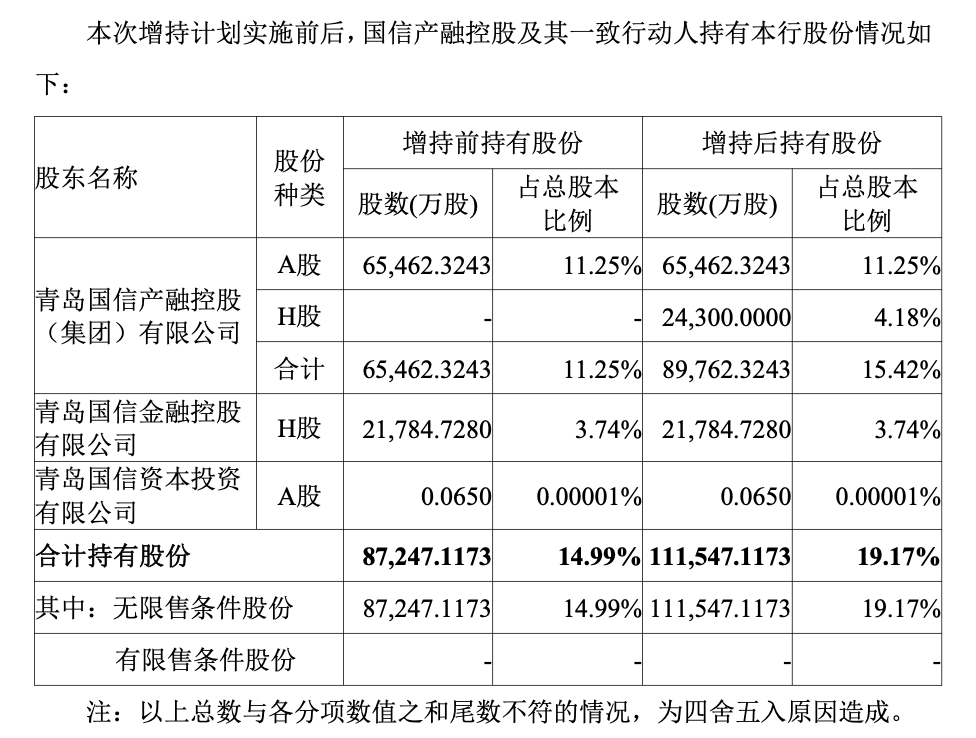
青岛银行:大股东增持H股至持股19.17%,完成增持计划
Hua Er Jie Jian Wen· 2025-11-07 13:11
Core Viewpoint - Qingdao Bank's major shareholder, Qingdao Guoxin Financial Holdings (Group) Co., Ltd., has successfully completed its shareholding increase plan, raising its stake to 19.17% from 14.99% [1] Group 1: Shareholder Increase Details - Increasing entity: Qingdao Guoxin Financial Holdings (Group) Co., Ltd. and its concerted parties [1] - Pre-increase shareholding: 87,247.11 million shares, accounting for 14.99% of total share capital [1] - Target shareholding: Aiming to reach a range of 19.00%-19.99% [1] Group 2: Implementation of Increase - Funding source: Self-owned funds [1] - Increase period: From September 15, 2025, to November 5, 2025 [1] - Number of shares increased: 24,300 million shares through Hong Kong Stock Connect, representing 4.18% of total share capital [1] - Amount of increase: RMB 95,679.37 million (excluding transaction taxes and fees) [1] Group 3: Post-Increase Shareholding Structure - Post-increase shareholding: Total shares held increased to 111,547.11 million, accounting for 19.17% of total share capital [1] - Completion of increase: The increase plan has been successfully achieved [1] - Share lock-up: Increased shares are not transferable for five years from the date of acquisition [1] - Regulatory approval: Approval obtained from the Qingdao Regulatory Bureau of the National Financial Supervision Administration [1] Group 4: Company Impact - Company status: The increase does not affect the company's listing status and governance structure [1]