
BANK OF QINGDAO(03866)

Search documents
银行股配置重构系列九:从主动基金 Q4 持仓看配置思路
Changjiang Securities· 2026-01-27 15:25
Investment Rating - The investment rating for the banking sector is "Positive" and is maintained [12] Core Insights - In Q4 2025, active funds did not significantly reduce their holdings in bank stocks, with a stable allocation ratio of 1.86% compared to the previous quarter. This reflects a general decline in market risk appetite. However, it is anticipated that the allocation ratio may decrease further in Q1 2026 due to a significant rebound in risk appetite and the relative underperformance of bank stocks at the beginning of the year [2][6] - The selection of individual stocks has shifted towards a focus on fundamental trends, with Ningbo Bank seeing the most significant increase in allocation due to improved asset quality and performance expectations. The bank has established a turning point in retail asset quality and is expected to lead the sector in performance [7][8] - The report suggests that the core investment strategy for 2026 should prioritize high-performing regional banks, particularly city commercial banks, as they are expected to maintain superior growth rates amid a stable credit structure [9] Summary by Sections Active Fund Holdings - As of Q4 2025, the allocation ratio of active public funds to bank stocks remained stable at 1.86%, indicating a recovery in market risk appetite. The allocation ratio is expected to hit a new low in Q1 2026 due to a resurgence in risk appetite and the underperformance of bank stocks [6][8] - City commercial banks experienced a reduction of approximately 1.7 billion in total holdings, but Ningbo Bank was notably increased by 860 million, reflecting a shift towards stocks with improving fundamentals [7][8] Stock Selection Trends - The focus on stock selection has shifted from high dividend yields to fundamental trends, with Ningbo Bank being the most significantly increased stock in Q4 2025. The bank's asset quality indicators have shown continuous improvement, and it is expected to see a growth in performance in 2026 [7][8] - Conversely, stocks like Chengdu Bank have been reduced significantly, reflecting concerns over performance volatility and ongoing adjustments in business structure [7] Market Dynamics - The banking sector has faced downward pressure due to capital outflows from active funds and index funds, leading to undervaluation in bank stocks. The report recommends seizing opportunities in quality city commercial banks at lower price levels [9][33] - The report highlights that the allocation strategy for 2026 should focus on high-quality city commercial banks, as they are expected to outperform in terms of earnings growth amid a stable credit environment [9]





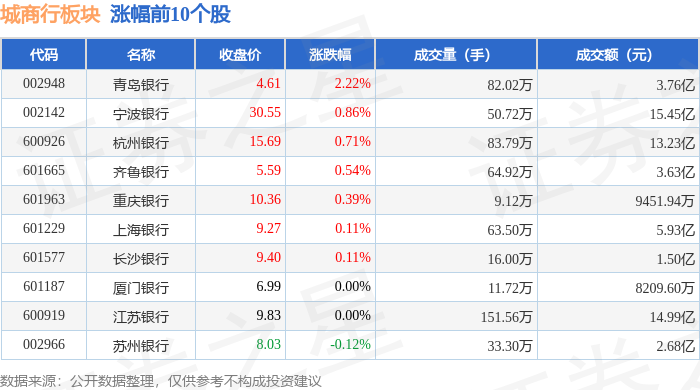
城商行板块1月27日涨0.13%,青岛银行领涨,主力资金净流入4.04亿元
Zheng Xing Xing Ye Ri Bao· 2026-01-27 09:06
Market Performance - The city commercial bank sector increased by 0.13% compared to the previous trading day, with Qingdao Bank leading the gains [1] - The Shanghai Composite Index closed at 4139.9, up 0.18%, while the Shenzhen Component Index closed at 14329.91, up 0.09% [1] Individual Stock Performance - Qingdao Bank (002948) closed at 4.61, up 2.22% with a trading volume of 820,200 shares and a transaction value of 376 million [1] - Ningbo Bank (002142) closed at 30.55, up 0.86% with a trading volume of 507,200 shares and a transaction value of 1545 million [1] - Hangzhou Bank (600926) closed at 15.69, up 0.71% with a trading volume of 837,900 shares and a transaction value of 1323 million [1] - Qilu Bank (601665) closed at 5.59, up 0.54% with a trading volume of 649,200 shares and a transaction value of 363 million [1] - Chongqing Bank (601963) closed at 10.36, up 0.39% with a trading volume of 91,200 shares and a transaction value of 94.52 million [1] - Shanghai Bank (601229) closed at 9.27, up 0.11% with a trading volume of 635,000 shares and a transaction value of 593 million [1] - Other banks such as Changsha Bank, Xiamen Bank, and Suzhou Bank showed minimal changes in their stock prices [1] Capital Flow - The city commercial bank sector saw a net inflow of 404 million from main funds, while retail investors experienced a net outflow of 4.15 billion [2] - The main funds' net inflow and outflow for individual banks varied, with Ningbo Bank and Jiangsu Bank showing significant inflows [3] - Retail investors showed notable outflows in several banks, indicating a shift in investment sentiment [3]

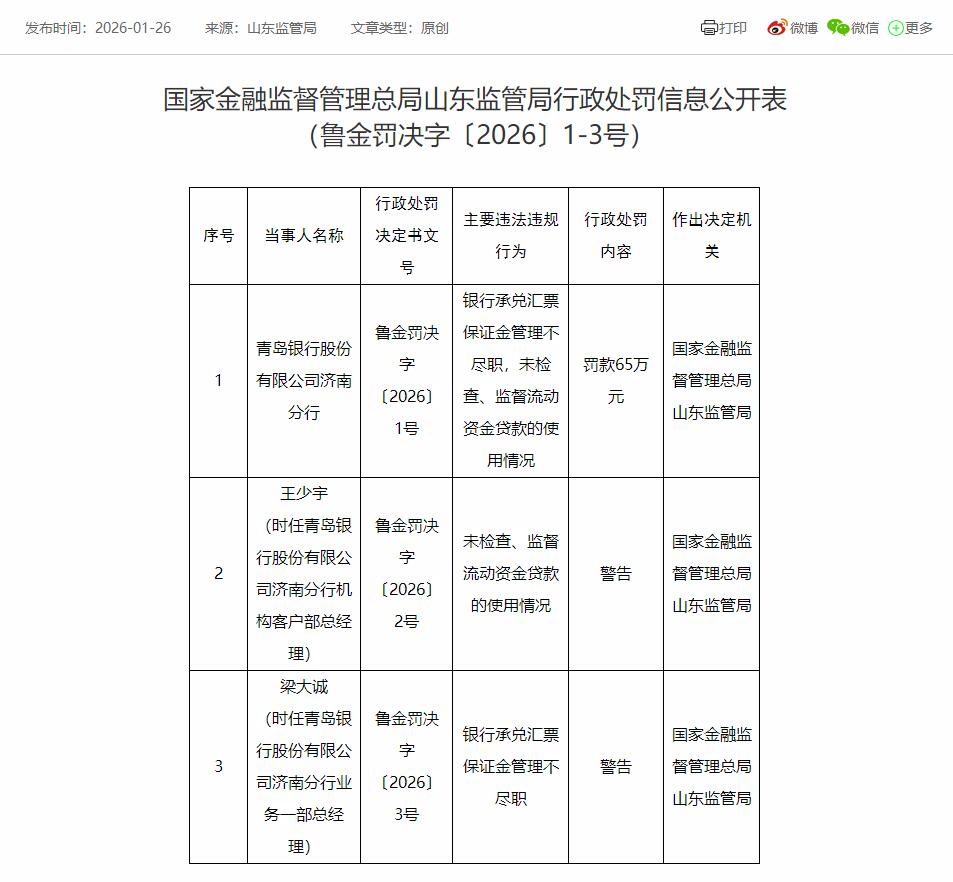
青岛银行济南分行被罚 涉承兑汇票保证金管理不尽职等
Zhong Guo Jing Ji Wang· 2026-01-27 06:40
中国经济网北京1月27日讯 国家金融监督管理总局网站昨日发布的山东监管局行政处罚信息公开表(鲁金罚决字〔2026〕1号)显示, 青岛银行(002948)股份有限公司济南分行存在以下主要违法违规行为:银行承兑汇票保证金管理不尽职,未检查、监督流动资金贷款 的使用情况。国家金融监督管理总局山东监管局对青岛银行股份有限公司济南分行罚款65万元。 鲁金罚决字〔2026〕2号显示,王少宇(时任青岛银行股份有限公司济南分行机构客户部总经理)未检查、监督流动资金贷款的使用情 况,被警告。 梁大诚(时任青岛银行股份有限公司济南分行业务一部总经理)银行承兑汇票保证金管理不尽职,被警告。 | 序号 | 当事人名称 | 行政处罚 决定书文 | 主要违法违规 | 行政处罚 | 作出决定机 | | --- | --- | --- | --- | --- | --- | | | | | 行为 | 内容 | 米 | | | | 름 | | | | | 1 | 青岛银行股份 | 鲁金罚决 字 [2026] | 银行承兑汇票 保证金管理不 尽职,未检 查、监督流动 | 罚款65万 元 | 国家金融监 | | | 有限公司济南 | | | | ...
青岛银行济南分行被罚 涉承兑汇票保证金管理不尽职等
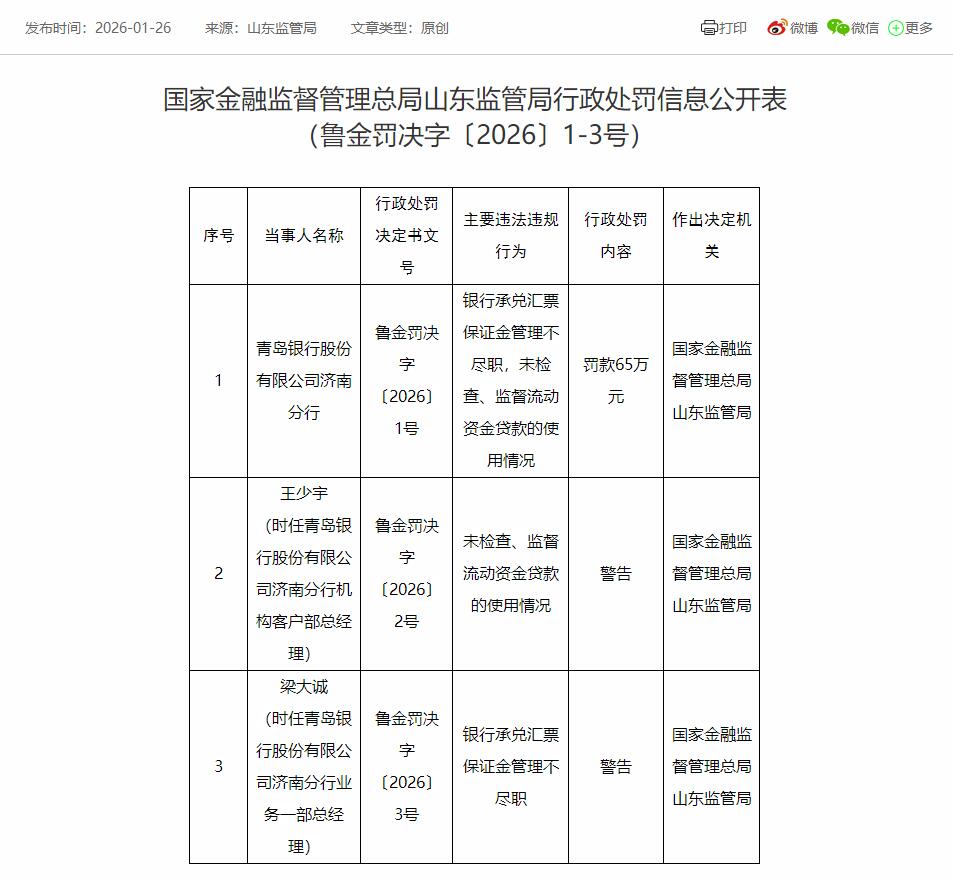
Zhong Guo Jing Ji Wang· 2026-01-27 06:40
中国经济网北京1月27日讯 国家金融监督管理总局网站昨日发布的山东监管局行政处罚信息公开表(鲁金罚决字〔2026〕1号)显 示,青岛银行股份有限公司济南分行存在以下主要违法违规行为:银行承兑汇票保证金管理不尽职,未检查、监督流动资金贷款的使用 情况。国家金融监督管理总局山东监管局对青岛银行股份有限公司济南分行罚款65万元。 鲁金罚决字〔2026〕2号显示,王少宇(时任青岛银行股份有限公司济南分行机构客户部总经理)未检查、监督流动资金贷款的使 用情况,被警告。 梁大诚(时任青岛银行股份有限公司济南分行业务一部总经理)银行承兑汇票保证金管理不尽职,被警告。 以下为原文: | 序号 | 当事人名称 | 行政处罚 决定书文 | 主要违法违规 | 行政处罚 | 作出决定机 | | --- | --- | --- | --- | --- | --- | | | | | 行为 | 内容 | 米 | | | | 름 | | | | | 1 | 青岛银行股份 | 鲁金罚决 字 (2026) | 银行承兑汇票 保证金管理不 尽职,未检 查、监督流动 | 罚款65万 元 | 国家金融监 | | | 有限公司济南 | | | | 督 ...
银行板块获政策加持,或筑底反弹
Mei Ri Jing Ji Xin Wen· 2026-01-27 05:43
Core Viewpoint - The recent implementation of coordinated fiscal and financial policies has provided structural support for the banking sector, leading to a rise in the China Securities Banking Index and individual bank stocks [1] Group 1: Market Performance - As of January 27, 2026, the China Securities Banking Index increased by 0.93%, with notable gains from Agricultural Bank (+2.34%), Qingdao Bank (+2.22%), China Construction Bank (+1.73%), Bank of China (+1.69%), and Hangzhou Bank (+1.6%) [1] Group 2: Policy Impact - On January 20, the State Council Information Office, in collaboration with the Ministry of Finance and other departments, announced a comprehensive policy package that includes a 1.5 percentage point interest subsidy for small and medium-sized enterprise loans, an expanded scope for equipment upgrade loan subsidies, and an extension of consumer and operational loan subsidies until the end of 2026 [1] - The policy also includes a 500 billion yuan special guarantee plan for private investment and improvements to the risk-sharing mechanism for corporate bonds, aimed at reducing social financing costs and directing credit resources towards small and micro enterprises, technological innovation, and domestic demand expansion [1] Group 3: Banking Sector Outlook - These measures are expected to optimize the asset structure of banks and alleviate non-performing loan pressures through risk-sharing mechanisms, providing medium to long-term support for stabilizing interest margins and improving asset quality [1] Group 4: Investment Products - The Huaxia Bank ETF, which tracks the China Securities Banking Index, is noted for having the lowest comprehensive fee rate among ETFs, along with various classes of linked funds [1]


银行业周度追踪2026年第3周:再议指数基金波动对银行股的影响-20260126
Changjiang Securities· 2026-01-26 13:44
Investment Rating - The investment rating for the banking sector is "Positive" and maintained [12] Core Insights - The banking sector continues to adjust, underperforming compared to the CSI 300 and ChiNext indices, primarily due to significant net outflows from broad-based ETF index funds [2][6] - Despite the short-term pressures, the fundamental outlook for quality bank stocks is stable, and their valuations are considered oversold, indicating a potential buying opportunity [6][20] - Recommended banks include quality city commercial banks in Zhejiang, Jiangsu, and Shandong regions, such as Hangzhou Bank, Ningbo Bank, Jiangsu Bank, Nanjing Bank, Qilu Bank, and Qingdao Bank [2][6] Summary by Sections Market Performance - The banking index fell by 2.7%, with excess returns of -2.0% and -2.3% compared to the CSI 300 and ChiNext indices respectively [6][20] - Significant net outflows from the CSI 300 and SSE 50 ETFs amounted to 238 billion and 36.1 billion respectively, indicating a worsening trend in fund outflows [6][20] Individual Bank Performance - Some smaller banks, like Qingdao Bank, showed positive performance due to favorable fundamental expectations, while larger state-owned banks lagged [2][6] - Eight banks reported Q4 earnings, with most showing revenue growth exceeding expectations, driven by stabilized net interest margins and increased interest income [8] Market Trends - There is a growing interest in the recovery potential of oversold bank stocks, as evidenced by a slight net inflow into bank-related index funds after a period of outflows [26] - The average turnover rate for bank stocks has increased, but the transaction volume share for various bank types, excluding joint-stock banks, has decreased [45][49] Convertible Bonds - The space for strong redemption of convertible bonds in the banking sector has expanded, with current stock prices approaching redemption thresholds [43] - Notable banks for potential convertible bond trading opportunities include Changshu Bank, Shanghai Bank, and Chongqing Bank, which have stable performance expectations [43]
金融行业周报(2026、01、25):业绩比较基准新规正式落地,坚定保险中长期向好逻辑-20260125
Western Securities· 2026-01-25 10:30
Investment Rating - The report maintains a positive long-term outlook for the insurance sector, indicating a strong continuity in market performance despite recent fluctuations [2][12][16]. Core Insights - The financial sector experienced a mixed performance this week, with the non-bank financial index down by 1.45%, underperforming the CSI 300 index by 0.83 percentage points. The insurance sector saw a decline of 4.02%, while the brokerage sector decreased by 0.61% [1][10]. - The insurance sector's performance is driven by two main factors: policy support leading to economic recovery and liquidity easing combined with a strong stock market. The report suggests a shift from liquidity-driven growth to a focus on macro policy support and economic recovery expectations [2][13][16]. - The brokerage sector is expected to benefit from new regulations that enhance investment management quality, with a recommendation to focus on larger, undervalued firms and those involved in mergers and acquisitions [3][18]. - The banking sector is facing a slight decline, but there are signs of recovery in profitability for leading banks, with recommendations to focus on banks with high dividend yields and those expected to benefit from market conditions [19][21]. Summary by Sections Insurance Sector - The insurance sector's recent decline is attributed to short-term market sentiment and liquidity changes, but the long-term outlook remains positive due to strong support from both the liability and asset sides [2][12][16]. - Key recommendations include focusing on companies like China Pacific Insurance, China Ping An, China Life (H), and China Taiping, with a specific recommendation for New China Life [4][16]. Brokerage Sector - The brokerage sector's performance is slightly better than the overall market, with a focus on the new guidelines from the regulatory body that aim to improve fund management quality [3][17]. - Recommended firms include Guotai Junan, Huatai Securities, and others, particularly those with strong merger and acquisition prospects [4][18]. Banking Sector - The banking sector has shown a decline but is expected to stabilize, with recommendations to focus on banks with high earnings elasticity and strong dividend yields [19][21]. - Specific banks to watch include Hangzhou Bank, Ningbo Bank, and others, with a focus on those that have previously been undervalued [4][21].




丈量地方性银行(1):江苏127家区域性银行全梳理-20260123
GF SECURITIES· 2026-01-23 11:08
Investment Rating - The industry investment rating is "Buy" [2] Core Insights - The report provides a comprehensive analysis of 127 regional banks in Jiangsu Province, highlighting their asset and liability structures, profitability, and asset quality [6][18] - Jiangsu's regional banks have shown a significant increase in asset growth, with major city commercial banks growing at 19.4%, surpassing the growth of listed city commercial banks at 14.2% [24][26] - The report indicates that the loan-to-asset ratio for city commercial banks is projected to reach 48.4% in 2024, reflecting a gradual increase in lending activities [30] - Jiangsu's regional banks exhibit better return on assets (ROA) compared to listed banks, with city commercial banks outperforming by 16 basis points and rural commercial banks by 9 basis points [6][42] - The asset quality of Jiangsu's regional banks is superior to that of listed banks, with lower non-performing loan ratios and higher provision coverage ratios [6][42] Summary by Sections 1. Economic Structure of Jiangsu Province - Jiangsu Province is focusing on new industrialization and strategic emerging industries, with significant contributions from cities like Nanjing and Suzhou [13][14] 2. Overview of 127 Regional Banks in Jiangsu - The report categorizes the banks into city commercial banks, rural commercial banks, and others, with a total of 127 banks established between 2006 and 2015 [18][20] 3. Asset/Liability Structure - The asset growth of major city commercial banks is accelerating, while rural commercial banks are experiencing a decline in growth rates [24][26] - The loan-to-asset ratio for city commercial banks is expected to increase to 48.4% by 2024, indicating a shift towards more lending [30] 4. Profitability - Jiangsu's regional banks have a higher ROA compared to listed banks, with city commercial banks showing a 16 basis point advantage [6][42] 5. Asset Quality/Capital Levels - Jiangsu's regional banks maintain a lower non-performing loan ratio compared to listed banks, with city commercial banks having a 30 basis point lower ratio [6][42]


城商行板块1月22日涨0.8%,青岛银行领涨,主力资金净流入3.96亿元
Zheng Xing Xing Ye Ri Bao· 2026-01-22 09:01
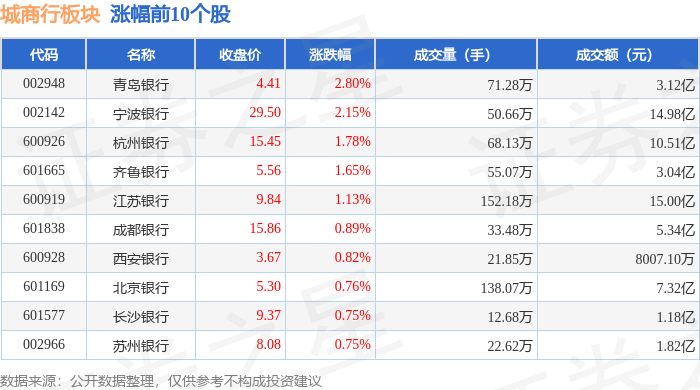
Group 1 - The city commercial bank sector increased by 0.8% on January 22, with Qingdao Bank leading the gains [1] - The Shanghai Composite Index closed at 4122.58, up 0.14%, while the Shenzhen Component Index closed at 14327.05, up 0.5% [1] - Key individual stock performances in the city commercial bank sector included Qingdao Bank at 4.41 with a rise of 2.80%, and Ningbo Bank at 29.50 with a rise of 2.15% [1] Group 2 - The city commercial bank sector saw a net inflow of 396 million yuan from main funds, while retail funds experienced a net outflow of 172 million yuan [2] - The trading volume for Qingdao Bank was 712,800 shares, with a transaction value of 312 million yuan [1][2] - The main fund inflow for Jiangsu Bank was 202 million yuan, representing 13.49% of its total trading volume [3]

数字人民币2.0:从M0到M1的质变
GF SECURITIES· 2026-01-22 05:07
Investment Rating - The report provides a "Buy" rating for all major banks analyzed, indicating a positive outlook for the banking sector [7]. Core Insights - The digital renminbi has entered its 2.0 era, transitioning from a central bank liability (M0) to a commercial bank liability (M1), allowing it to earn interest and be included in deposit insurance and reserve requirements [6][14]. - This transformation positions China as the first economy to offer interest on its central bank digital currency (CBDC), fundamentally altering its monetary attributes and creating a new financial paradigm in the digital economy [27]. - The digital renminbi's interest-bearing feature enhances user motivation to hold it, shifting its perception from a mere payment tool to a viable store of value, thus promoting its integration into everyday financial activities [27][28]. Summary by Sections 1. Digital Renminbi 2.0 Era - The digital renminbi (e-CNY) is now classified as a digital deposit currency, which can earn interest and is managed under a new regulatory framework [14]. - Major state-owned banks have begun offering interest on digital renminbi wallet balances, marking a significant shift in its utility and appeal [14][27]. 2. Development Progress and Application Status - The development of the digital renminbi began in 2014, with significant milestones including pilot tests in various cities and the establishment of a comprehensive operational framework by 2025 [32][33]. - As of November 2025, the digital renminbi has processed 34.8 billion transactions amounting to 16.7 trillion yuan, with extensive coverage across multiple provinces and cities [37]. 3. Global CBDC Development Trends - The report identifies three main trends in global CBDC development: active retail CBDC initiatives, innovation in payment systems, and cautious approaches in some countries like the U.S. [6]. - China's proactive stance in developing its CBDC positions it favorably in the global digital economy landscape, particularly in cross-border trade applications [30].
