BRAINAURORA-B(06681)

Search documents
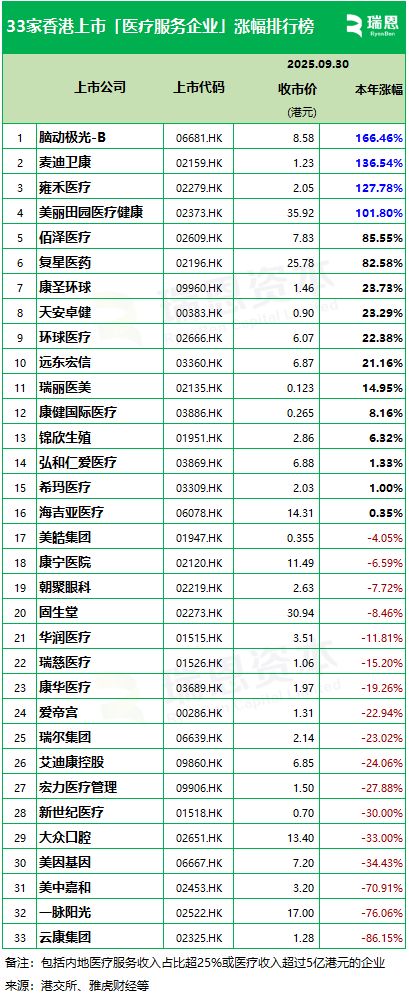
33家香港上市「医疗服务企业」市值排行及股市表现
Xin Lang Cai Jing· 2025-10-11 05:58
Core Insights - The article presents a ranking of 33 Hong Kong-listed medical service companies based on their stock price performance as of September 30, 2025, highlighting significant price increases and declines among these companies [1][2]. Group 1: Top Performers - The top performer is Brainstorm Cell Therapeutics (脑动极光-B) with a stock price of HKD 8.58, reflecting a remarkable increase of 166.46% [1]. - MediWound (麦迪卫康) ranks second with a stock price of HKD 1.23, showing a growth of 136.54% [1]. - Yonghe Medical (雍禾医疗) comes in third with a stock price of HKD 2.05, marking a rise of 127.78% [1]. Group 2: Notable Declines - The company with the largest decline is Yimeng Group (云康集团), with a stock price of HKD 1.28, experiencing a drop of 86.15% [1]. - Meizhong Jiahe (美中嘉和) follows with a stock price of HKD 3.20, down by 70.91% [1]. - Another significant decline is seen in Yimeng Sunshine (一昧阳光), which has a stock price of HKD 17.00, down by 76.06% [1]. Group 3: Market Capitalization - Fosun Pharma (复星医药) has the highest market capitalization at HKD 680.48 billion, with a stock price of HKD 25.78 [2]. - Far East Horizon (远东宏信) ranks second with a market cap of HKD 328.32 billion and a stock price of HKD 6.87 [2]. - Global Medical (环球医疗) holds a market cap of HKD 114.82 billion, with a stock price of HKD 6.07 [2].

脑动极光(06681) - 截至2025年9月30日止之股份发行人的证券变动月报表
2025-10-02 08:50
股份發行人及根據《上市規則》第十九B章上市的香港預託證券發行人的證券變動月報表 截至月份: 2025年9月30日 狀態: 新提交 致:香港交易及結算所有限公司 公司名稱: 腦動極光醫療科技有限公司(於開曼群島註冊成立的有限公司) 呈交日期: 2025年10月2日 I. 法定/註冊股本變動 | 1. 股份分類 | 普通股 | 股份類別 | 不適用 | | 於香港聯交所上市 (註1) | | 是 | | | --- | --- | --- | --- | --- | --- | --- | --- | --- | | 證券代號 (如上市) | 06681 | 說明 | | | | | | | | | | 法定/註冊股份數目 | | | 面值 | | 法定/註冊股本 | | | 上月底結存 | | | 500,000,000,000 | USD | 0.0000001 | USD | | 50,000 | | 增加 / 減少 (-) | | | 0 | | | USD | | 0 | | 本月底結存 | | | 500,000,000,000 | USD | 0.0000001 | USD | | 50,000 | ...
异动盘点0930|优必选涨超5%,脑动极光-B涨超16%;阿里巴巴美股涨超4%,美光科技涨超4%
贝塔投资智库· 2025-09-30 04:00
Group 1: Hong Kong Stocks - China Metallurgical Group (01618) rose nearly 7%, with institutions stating that the value of this resource-rich construction company needs urgent reassessment [1] - Rongchang Bio (09995) increased over 5%, as its innovative ophthalmic drug RC28 has been submitted for listing, following a partnership with Santen China [1] - Laikang Pharmaceutical-B (02105) surged nearly 6%, with a cumulative increase of 36% over the last three trading days, driven by positive preliminary results from the Phase I clinical MAD study of LAE102 [1] - UBTECH Robotics (09880) rose over 5%, with a report from CMB International recommending UBTECH as the top pick in the humanoid robot sector and raising its target price [1] - Innovent Biologics (09969) increased over 6%, as the company announced the first prescriptions for Tanshitumomab in several provinces [1] - BrainCo-B (06681) surged over 16%, benefiting from policy catalysts in the brain-computer interface industry, with its cognitive impairment digital therapy product having a first-mover advantage [1] - Yaoshi Bang (09885) rose over 10%, with high-margin business accelerating growth and POCT devices expected to see increased deployment in the second half of the year [1] - DCH Holdings (00179) fell over 7%, as Citigroup downgraded its investment rating from "Buy" to "Neutral," citing limited upside potential for the stock [1] - Minmetals Resources (01208) rose over 2%, planning to issue $500 million zero-coupon convertible bonds maturing in 2030 for overseas debt refinancing [1][2] Group 2: US Stocks - Alibaba (BABA.US) rose 4.65%, with Morgan Stanley reiterating an "Overweight" rating and raising the ADR target price from $165 to $200 [3] - Li Auto (LI.US) increased 3.57%, as the Li One officially commenced delivery at the Changzhou smart manufacturing base, with a report indicating that the i6 model's sales performance is expected to outperform the i8 [3] - JD.com (JD.US) rose 0.15%, announcing that the 2025 Double 11 shopping festival will start on October 9 at 8 PM, two days earlier than last year [3] - Xpeng Motors (XPEV.US) increased 1.76%, with the company announcing that the Xpeng MONA M03 has delivered a total of 180,000 units [3] - New Oriental (EDU.US) rose 4.38%, with a report indicating that the overall business development of the group is stabilizing [3] - Merus (MRUS.US) surged 35.97%, following an agreement with Danish biotech company Genmab for a cash acquisition at $97 per share [3] - Novo Nordisk (NVO.US) fell 0.20%, as Morgan Stanley downgraded its rating to "Sell" and reduced the target price from $99 to $47 [4] - MoonLake (MLTX.US) plummeted 89.93%, with trial results for its therapeutic drug falling far below expectations, leading to a significant target price cut by RBC [4] - TSMC (TSM.US) fell 0.05%, reaffirming that it has not engaged in discussions regarding potential investments or collaborations with any companies [4] - Micron Technology (MU.US) rose 4.22%, with Morgan Stanley predicting that the storage industry price increase cycle may continue into next year [4]



脑动极光-B拉升逾14% 脑机接口产业迎政策催化 公司认知障碍数字疗法产品具先发优势
Zhi Tong Cai Jing· 2025-09-30 03:31
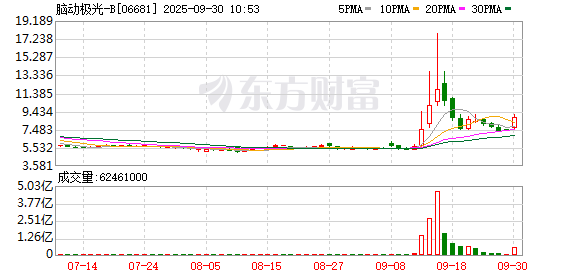
Core Insights - The stock of Brain Dynamics Aurora-B (06681) surged over 14%, reaching HKD 8.5 with a trading volume of HKD 311 million [1] Industry Developments - The Minister of Industry and Information Technology, Li Lecheng, emphasized the need to cultivate emerging industries and create new momentum during the 25th China International Industry Fair, focusing on technological innovation and the establishment of new pillar industries [1] - The National Medical Products Administration has approved the first medical device standard for brain-computer interface technology, which will be implemented on January 1, 2026, laying the foundation for the high-quality development of the brain-computer interface medical device industry [1] Company Highlights - Brain Dynamics Aurora's core product is a brain function information management platform software system, recognized as China's first regulatory-approved digital therapy product for cognitive impairment [2] - The company combines brain science with artificial intelligence, offering unique technological advantages such as virtual human technology and AI [2] - As the first company in China to develop a medical-grade digital therapy product for cognitive impairment, Brain Dynamics Aurora holds a first-mover advantage [2] - The core product is included in the provincial medical insurance reimbursement catalog across 30 provinces in China, enhancing product accessibility and market promotion [2] - The company has successfully established cognitive centers in over 120 hospitals in China, including several leading hospitals certified as "National Medical Centers" [2]
港股脑动极光-B拉升逾14%
Mei Ri Jing Ji Xin Wen· 2025-09-30 02:52
Group 1 - The stock of Brainstorm Cell Therapeutics Inc. (06681.HK) surged over 14% on September 30, reaching a price of 8.5 HKD [2] - The trading volume amounted to 311 million HKD [2]
港股异动 | 脑动极光-B(06681)拉升逾14% 脑机接口产业迎政策催化 公司认知障碍数字疗法产品具先发优势
智通财经网· 2025-09-30 02:32
Group 1 - The stock of Brain Dynamics Aurora-B (06681) surged over 14%, reaching HKD 8.5 with a trading volume of HKD 311 million [1] - The Minister of Industry and Information Technology emphasized the need to cultivate emerging industries and accelerate the development of new pillar industries, including human-machine interfaces and quantum information [1] - The National Medical Products Administration approved the first medical device standard for brain-machine interface technology, which will be implemented on January 1, 2026, laying a foundation for the high-quality development of the industry [1] Group 2 - Brain Dynamics' core product is a brain function information management platform, recognized as China's first regulatory-approved digital therapy for cognitive disorders [2] - The company combines brain science with artificial intelligence, offering unique technological advantages such as virtual human technology and AI [2] - The core product is included in the provincial medical insurance reimbursement list across 30 provinces in China, and the company has established cognitive centers in over 120 hospitals, including several certified as "National Medical Centers" [2]
脑动极光(06681) - 2025 - 中期财报
2025-09-29 12:38
Revenue and Financial Performance - Revenue increased from RMB 51.89 million for the six months ended June 30, 2024, to RMB 100.05 million for the six months ended June 30, 2025, representing a year-on-year growth of 92.81%[15] - The total loss and comprehensive expenses for the period amounted to RMB 126.88 million, an increase of 10.92% compared to RMB 114.39 million in the previous year[18] - The adjusted net loss for the period was RMB 88.02 million, reflecting an increase of 11.64% from RMB 78.84 million in the prior year[18] - Gross profit increased from RMB 24.52 million for the six months ended June 30, 2024, to RMB 40.85 million for the six months ended June 30, 2025, an increase of 66.60%[44] - Other income surged from RMB 0.58 million for the six months ended June 30, 2024, to RMB 7.28 million for the six months ended June 30, 2025, a growth of 1,155.17%[45] - The company reported a loss before tax of RMB 125,214,000, which is a 9.3% increase from RMB 114,389,000 in the prior year[141] - The company reported a net loss attributable to owners of RMB 126,365,000 for the six months ended June 30, 2025, compared to a loss of RMB 114,328,000 in 2024, indicating a decline of 10.6%[173] Research and Development - The company has completed the research and development phase and is about to enter the registration clinical trial phase for its cognitive digital therapy, with data collection expected to be completed by early 2026[12] - A total of 649 patients were included in the randomized controlled trial for cognitive digital therapy in patients with hypertension and coronary heart disease, with data analysis and report writing completed, aiming for medical device registration submission in 2026[12] - The company has developed a depression treatment software, with clinical trials planned to start in 2026[12] - The ADHD treatment study showed significant improvement in core symptoms, with attention deficit scores improving from 23.3% to 34.6% in the combined treatment group[13] - The company plans to submit applications for medical device registration for multiple products in 2026, indicating a strong pipeline for future growth[12] - The Depression Cognitive Quantitative Assessment software is expected to complete clinical trials by Q3 2025, with commercialization anticipated in 2026[32] - The company is in preclinical development for a Depression Treatment software, projected to start clinical trials in Q1 2026[33] Product Development and Market Expansion - The company launched the BrainAu Onebox M1, a smart medical model machine, in 2025, representing a significant advancement in digital health transformation[16] - The core product, the Brain Function Information Management Platform, is the first regulatory-approved digital therapy product for cognitive impairment in China[22] - As of the report date, the core product has been included in the medical insurance reimbursement catalog of 30 provinces in China[22] - The product pipeline includes eight indications for four major types of cognitive impairment that have been commercialized, with three additional products approved in China and one in the EU[20] - The Basic Cognitive Ability Test software (BCAT) received regulatory approval in October 2022 and is set for commercialization in 2025[27] - The Cognitive Ability Screening Assessment software (SAS) was approved in December 2022 and is also scheduled for commercialization in 2025[28] - The Reading Disability Screening Assessment software (DSS) received approval in September 2023 and is expected to be commercialized in 2025[29] - The company is conducting clinical trials for a Reading Disability Rehabilitation Training software, which includes modules for perception and language training[30] - The company plans to expand its international footprint and establish a global presence by developing cognitive impairment assessment and treatment software for the US and EU markets[34] Operational Metrics - The number of hospitals purchasing the system increased from 186 in 2024 to 205 for the six months ended June 30, 2025[41] - Patient usage of the system rose from approximately 1,800,000 times in 2024 to 2,595,554 times for the six months ended June 30, 2025[41] - The number of cognitive centers increased from 107 in 2024 to 138 for the six months ended June 30, 2025, leading to increased operational costs[43] Expenses and Financial Management - Sales and distribution expenses rose from RMB 25.38 million for the six months ended June 30, 2024, to RMB 30.45 million for the six months ended June 30, 2025, an increase of 19.98%[48] - Administrative expenses increased from RMB 281.4 million for the six months ended June 30, 2024, to RMB 460.1 million for the six months ended June 30, 2025, representing a 63.5% increase[49] - R&D expenses rose from RMB 642.3 million for the six months ended June 30, 2024, to RMB 681.5 million for the six months ended June 30, 2025, an increase of 6.1%[50] - Financial costs increased from RMB 109.0 million for the six months ended June 30, 2024, to RMB 119.8 million for the six months ended June 30, 2025, a rise of 9.82%[53] Assets and Liabilities - Current assets as of June 30, 2025, amounted to RMB 6,701.4 million, with cash and cash equivalents at RMB 2,879.2 million, an increase of 2.88% from RMB 2,798.6 million as of June 30, 2024[56] - The current liabilities as of June 30, 2025, totaled RMB 2,753.3 million, including bank and other borrowings of RMB 1,431.0 million[56] - The gross profit margin decreased to 40.8% for the six months ended June 30, 2025, down from 47.3% for the same period in 2024[60] - The current ratio improved to 2.4 as of June 30, 2025, compared to 0.7 as of June 30, 2024[60] - Unpaid borrowings as of June 30, 2025, were approximately RMB 1,431.0 million, significantly up from RMB 161.3 million as of June 30, 2024[57] Shareholder Information and Corporate Governance - The company holds a total of 1,266,278,000 issued shares as of June 30, 2025[86] - The company’s major shareholders include Mr. Tan with a total holding of 401,701,000 shares, representing approximately 31.72% of the total shares[86] - The company has a significant concentration of ownership, with the top shareholders holding over 31.72% collectively[91] - The company is subject to the Securities and Futures Ordinance, which governs the disclosure of interests and shareholdings[91] - The audit committee reviewed the interim financial performance and confirmed compliance with relevant accounting standards and regulations[75] - The company has adhered to all applicable corporate governance code provisions since its listing date[130] Risks and Challenges - The company faces significant risks related to the successful completion of clinical development and regulatory approvals, which could adversely impact its business and financial outlook[81] - Regulatory requirements are becoming increasingly stringent, potentially hindering the development and launch of new products[84] - The company has a risk of product obsolescence if it fails to develop and launch competitive new products in a timely manner[81]
部分热门入通概念股午后跌幅扩大 佰泽医疗跌超20% 药捷安康跌近13%
Zhi Tong Cai Jing· 2025-09-18 05:57
Group 1 - Recent trading of Hong Kong stocks related to the "Inbound Concept" has seen significant declines, with Baize Medical (02609) down 19.16% to HKD 9.45, Brain Dynamics (06681) down 18.32% to HKD 8.56, and Yaojie Ankang-B (02617) down 12.62% to HKD 182.8 [1] - Yaojie Ankang announced in August that it would be included in several Hang Seng Index series components, effective from September 8, which includes nine indices such as the Hang Seng Composite Index and the Hang Seng Healthcare Index [1] - The inclusion of Yaojie Ankang in multiple indices has led to passive buying by ETFs tracking these indices, resulting in significant trading activity [1] Group 2 - On September 15, the Guozheng Hong Kong Stock Connect Innovative Drug Index underwent a quarterly adjustment, incorporating Yaojie Ankang as a constituent stock [1] - The largest Hong Kong Stock Connect Innovative Drug ETF purchased 3 million shares of Yaojie Ankang on September 15, amounting to approximately HKD 578 million, which represents about 2.62% of the fund's net asset value [1]
港股异动 | 部分热门入通概念股午后跌幅扩大 佰泽医疗(02609)跌超20% 药捷安康(02617)跌近13%
智通财经网· 2025-09-18 05:51
Group 1 - The core viewpoint of the article highlights the recent decline in the stock prices of companies related to the "Hong Kong Stock Connect" concept, particularly Baize Medical, Brainstorm Aurora, and PharmaJet, which saw significant drops of 19.16%, 18.32%, and 12.62% respectively [1] - PharmaJet was recently included in multiple Hang Seng Index series components, effective from September 8, which has led to passive buying by ETFs tracking these indices [1] - The stock price volatility of PharmaJet has affected related ETF products, prompting urgent communication between fund companies and index providers [1] Group 2 - On September 15, the Guozhen Hong Kong Stock Connect Innovative Drug Index underwent a quarterly adjustment, with PharmaJet being added as a constituent stock [1] - The largest Hong Kong Stock Connect Innovative Drug ETF purchased 3 million shares of PharmaJet on September 15, amounting to approximately 578 million HKD, which represents about 2.62% of the fund's net asset value [1]
智通港股通资金流向统计(T+2)|9月18日
智通财经网· 2025-09-17 23:34
Key Points - The top three stocks with net inflow of southbound funds are Alibaba-W (09988) with 5.278 billion, Yingfu Fund (02800) with 2.782 billion, and Hang Seng China Enterprises (02828) with 1.566 billion [1] - The top three stocks with net outflow of southbound funds are Xiaomi Group-W (01810) with -0.721 billion, Innovent Biologics (01801) with -0.466 billion, and Pop Mart (09992) with -0.458 billion [1] - In terms of net inflow ratio, Yuexiu Transportation Infrastructure (01052) leads with 63.76%, followed by Crystal International (02232) with 56.34%, and China Resources Gas (01193) with 53.63% [1] - The stocks with the highest net outflow ratio include QuanFeng Holdings (02285) at -59.36%, Yadea Group (01585) at -54.53%, and TCL Electronics (01070) at -54.28% [1] Net Inflow Rankings - The top ten stocks by net inflow include Alibaba-W (09988) with 5.278 billion, Yingfu Fund (02800) with 2.782 billion, and Hang Seng China Enterprises (02828) with 1.566 billion [2] - Other notable stocks in the net inflow list are Meituan-W (03690) with 0.670 billion and Southern Hang Seng Technology (03033) with 0.620 billion [2] Net Outflow Rankings - The top ten stocks by net outflow include Xiaomi Group-W (01810) with -0.721 billion, Innovent Biologics (01801) with -0.466 billion, and Pop Mart (09992) with -0.458 billion [2] - Other significant stocks in the net outflow list are Li Auto-W (02015) with -0.298 billion and China Construction Bank (00939) with -0.254 billion [2] Net Inflow Ratio Rankings - The top three stocks by net inflow ratio are Yuexiu Transportation Infrastructure (01052) at 63.76%, Crystal International (02232) at 56.34%, and China Resources Gas (01193) at 53.63% [3] - Additional stocks with high net inflow ratios include China Ship Leasing (03877) at 49.13% and Jiangsu Ninghu Expressway at 45.49% [3] Net Outflow Ratio Rankings - The stocks with the highest net outflow ratios include QuanFeng Holdings (02285) at -59.36%, Yadea Group (01585) at -54.53%, and TCL Electronics (01070) at -54.28% [3] - Other notable stocks with significant net outflow ratios are Kangji Medical (09997) at -53.77% and QiuTai Technology (01478) at -47.17% [3]