
Sinopec Corp.(600028)

Search documents
2026年1月6日中国石化化工销售有限公司工业用乙二醇各地区对外报价一览
Xin Lang Cai Jing· 2026-01-06 10:41
2026年1月6日中国石化化工销售有限公司各地区分公司工业用乙二醇对外报价如下: 化工销售华东分公司工业用乙二醇对外报价3800元/吨,具体生产公司(品牌)及价格,如下: 化工销售华南分公司工业用乙二醇对外报价3800元/吨,生产公司(品牌)及价格具体如下: 茂名 南 海3800元/吨, 上海石化3800元/吨, 扬子石化3800元/吨, 镇海炼化3800元/吨, 扬巴3800元/吨, 燕山分公司3800元/吨, 武汉乙烯3800元/吨, 中科炼化3800元/吨, 海南乙烯3800元/吨, 上海石化3800元/吨, 扬子石化3800元/吨, 镇海炼化3800元/吨, 扬巴3800元/吨, 燕山分公司3800元/吨, 武汉乙烯3800元/吨, 中科炼化3800元/吨, 海南乙烯3800元/吨, 化工销售华南分公司工业用乙二醇对外报价3800元/吨,生产公司(品牌)及价格具体如下: 茂名 南 海3800元/吨, 中科炼化3800元/吨, 海南乙烯3800元/吨; 化工销售华中分公司工业用乙二醇对外报价3750元/吨,生产公司(品牌)及价格具体如下: 武汉乙烯3750元/吨。 (文章来源:生意社采编) 新浪合作大平 ...



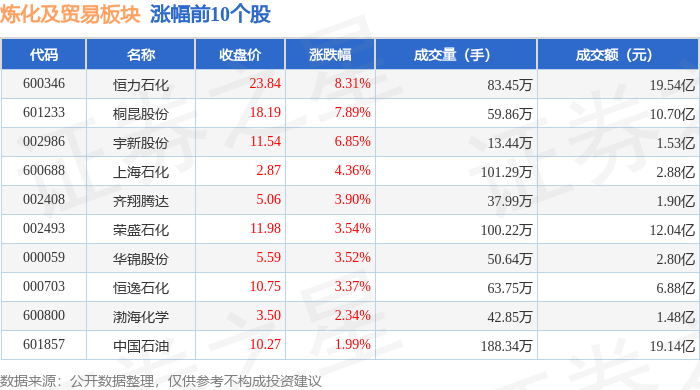
炼化及贸易板块1月6日涨2.36%,恒力石化领涨,主力资金净流入4.08亿元
Zheng Xing Xing Ye Ri Bao· 2026-01-06 09:03
Market Performance - The refining and trading sector increased by 2.36% on January 6, with Hengli Petrochemical leading the gains [1] - The Shanghai Composite Index closed at 4083.67, up 1.5%, while the Shenzhen Component Index closed at 14022.55, up 1.4% [1] Stock Performance - Hengli Petrochemical (600346) closed at 23.84, up 8.31%, with a trading volume of 834,500 shares and a transaction value of 1.954 billion [1] - Tongkun Co., Ltd. (601233) closed at 18.19, up 7.89%, with a trading volume of 598,600 shares and a transaction value of 1.07 billion [1] - Other notable stocks include Yuxin Co., Ltd. (002986) up 6.85%, Shanghai Petrochemical (600688) up 4.36%, and Rongsheng Petrochemical (002493) up 3.54% [1] Capital Flow - The refining and trading sector saw a net inflow of 408 million in main funds, while retail investors experienced a net outflow of 382 million [2] - The main funds' net inflow for Hengli Petrochemical was 122 million, while retail investors had a net outflow of 132 million [3] - Other companies like China Petroleum (601857) and Rongsheng Petrochemical also experienced significant capital movements, with net inflows of 193 million and 70 million respectively [3]


中国石化取得水合物转化抑制剂专利
Sou Hu Cai Jing· 2026-01-06 08:50
国家知识产权局信息显示,中国石油化工股份有限公司;中石化(大连)石油化工研究院有限公司取得 一项名为"一种水合物转化抑制剂及其制备方法和应用"的专利,授权公告号CN119614169B,申请日期 为2023年9月。 天眼查资料显示,中国石油化工股份有限公司,成立于2000年,位于北京市,是一家以从事石油和天然 气开采业为主的企业。企业注册资本12173968.9893万人民币。通过天眼查大数据分析,中国石油化工 股份有限公司共对外投资了267家企业,参与招投标项目5000次,财产线索方面有商标信息45条,专利 信息5000条,此外企业还拥有行政许可41个。 声明:市场有风险,投资需谨慎。本文为AI基于第三方数据生成,仅供参考,不构成个人投资建议。 来源:市场资讯 中石化(大连)石油化工研究院有限公司,成立于2022年,位于大连市,是一家以从事研究和试验发展 为主的企业。企业注册资本338459.08万人民币。通过天眼查大数据分析,中石化(大连)石油化工研 究院有限公司共对外投资了1家企业,参与招投标项目2799次,专利信息4999条,此外企业还拥有行政 许可65个。 ...
中石化取得氢化丁腈橡胶及其组合物、硫化橡胶专利
Sou Hu Cai Jing· 2026-01-06 08:50
中石化(北京)化工研究院有限公司,成立于2021年,位于北京市,是一家以从事化学原料和化学制品 制造业为主的企业。企业注册资本10000万人民币。通过天眼查大数据分析,中石化(北京)化工研究 院有限公司共对外投资了4家企业,参与招投标项目2718次,财产线索方面有商标信息17条,专利信息 1990条,此外企业还拥有行政许可937个。 国家知识产权局信息显示,中国石油化工股份有限公司;中石化(北京)化工研究院有限公司取得一项 名为"氢化丁腈橡胶及其组合物、硫化橡胶"的专利,授权公告号CN119144068B,申请日期为2023年6 月。 天眼查资料显示,中国石油化工股份有限公司,成立于2000年,位于北京市,是一家以从事石油和天然 气开采业为主的企业。企业注册资本12173968.9893万人民币。通过天眼查大数据分析,中国石油化工 股份有限公司共对外投资了267家企业,参与招投标项目5000次,财产线索方面有商标信息45条,专利 信息5000条,此外企业还拥有行政许可41个。 声明:市场有风险,投资需谨慎。本文为AI基于第三方数据生成,仅供参考,不构成个人投资建议。 来源:市场资讯 ...
中国石化取得硫化型加氢催化剂及其制备方法专利
Sou Hu Cai Jing· 2026-01-06 08:13
Group 1 - The State Intellectual Property Office of China has granted a patent to China Petroleum & Chemical Corporation for a "sulfurized hydrogenation catalyst and its preparation method," with the announcement number CN119327496B and application date of July 2023 [1] - China Petroleum & Chemical Corporation, established in 2000 and based in Beijing, primarily engages in oil and gas extraction, with a registered capital of 121,739.6893 million RMB [1] - The company has made investments in 267 enterprises, participated in 5,000 bidding projects, holds 45 trademark registrations, and possesses 5,000 patents, along with 41 administrative licenses [1] Group 2 - Sinopec (Dalian) Petroleum and Chemical Research Institute Co., Ltd., established in 2022 and located in Dalian, focuses on research and experimental development, with a registered capital of 3,384.5908 million RMB [1] - The research institute has invested in 1 enterprise, participated in 2,799 bidding projects, holds 4,999 patents, and has 65 administrative licenses [1]
中石化取得多孔材料耦合镁粉填料专利
Sou Hu Cai Jing· 2026-01-06 07:23
声明:市场有风险,投资需谨慎。本文为AI基于第三方数据生成,仅供参考,不构成个人投资建议。 来源:市场资讯 国家知识产权局信息显示,中国石油化工股份有限公司取得一项名为"一种多孔材料耦合镁粉的填料及 其制备方法及应用"的专利,授权公告号CN119660952B,申请日期为2023年9月。 天眼查资料显示,中国石油化工股份有限公司,成立于2000年,位于北京市,是一家以从事石油和天然 气开采业为主的企业。企业注册资本12173968.9893万人民币。通过天眼查大数据分析,中国石油化工 股份有限公司共对外投资了267家企业,参与招投标项目5000次,财产线索方面有商标信息45条,专利 信息5000条,此外企业还拥有行政许可41个。 中石化(北京)化工研究院有限公司,成立于2021年,位于北京市,是一家以从事化学原料和化学制品 制造业为主的企业。企业注册资本10000万人民币。通过天眼查大数据分析,中石化(北京)化工研究 院有限公司共对外投资了4家企业,参与招投标项目2718次,财产线索方面有商标信息17条,专利信息 1990条,此外企业还拥有行政许可937个。 ...
中国石化涨2.13%,成交额8.21亿元,主力资金净流入1.10亿元
Xin Lang Zheng Quan· 2026-01-06 05:54
Core Viewpoint - China Petroleum & Chemical Corporation (Sinopec) has shown a positive stock performance recently, with a notable increase in trading volume and market capitalization, despite a decline in revenue and net profit year-on-year [1][3]. Group 1: Stock Performance - As of January 6, Sinopec's stock price increased by 2.13%, reaching 6.22 CNY per share, with a trading volume of 8.21 billion CNY and a turnover rate of 0.14%, resulting in a total market capitalization of 752.16 billion CNY [1]. - Year-to-date, Sinopec's stock price has risen by 0.65%, with a 7.43% increase over the last five trading days, a 4.36% increase over the last 20 days, and a 15.83% increase over the last 60 days [1]. Group 2: Financial Performance - For the period from January to September 2025, Sinopec reported an operating revenue of 21,134.41 billion CNY, a year-on-year decrease of 10.69%, and a net profit attributable to shareholders of 29.98 billion CNY, down 32.23% year-on-year [3]. - The company has distributed a total of 627.59 billion CNY in dividends since its A-share listing, with 110.51 billion CNY distributed over the past three years [4]. Group 3: Shareholder Information - As of September 30, 2025, Sinopec had 459,700 shareholders, an increase of 0.80% from the previous period, with an average of 208,630 circulating shares per shareholder, a decrease of 0.81% [3]. - The top ten circulating shareholders include China Securities Finance Corporation, holding 2.32 billion shares, and Hong Kong Central Clearing Limited, holding 501 million shares, which decreased by 382 million shares from the previous period [4].
中石化取得喷淋式萃取塔及萃取方法专利
Sou Hu Cai Jing· 2026-01-06 05:34
国家知识产权局信息显示,中国石油化工股份有限公司、中石化上海工程有限公司取得一项名为"一种 喷淋式萃取塔及萃取方法"的专利,授权公告号CN119792994B,申请日期为2023年10月。 天眼查资料显示,中国石油化工股份有限公司,成立于2000年,位于北京市,是一家以从事石油和天然 气开采业为主的企业。企业注册资本12173968.9893万人民币。通过天眼查大数据分析,中国石油化工 股份有限公司共对外投资了267家企业,参与招投标项目5000次,财产线索方面有商标信息45条,专利 信息5000条,此外企业还拥有行政许可41个。 中石化上海工程有限公司,成立于1993年,位于上海市,是一家以从事批发业为主的企业。企业注册资 本50000万人民币。通过天眼查大数据分析,中石化上海工程有限公司共对外投资了11家企业,参与招 投标项目5000次,财产线索方面有商标信息4条,专利信息855条,此外企业还拥有行政许可31个。 声明:市场有风险,投资需谨慎。本文为AI基于第三方数据生成,仅供参考,不构成个人投资建议。 来源:市场资讯 ...
中国石化取得加氢脱金属催化剂及其制备方法专利
Sou Hu Cai Jing· 2026-01-06 05:34
Group 1 - The core point of the article is that China Petroleum & Chemical Corporation (Sinopec) has obtained a patent for a hydrogenation demetallization catalyst and its preparation method and application, with the patent announcement number CN119926441B and application date of November 2023 [1] Group 2 - China Petroleum & Chemical Corporation was established in 2000 and is based in Beijing, primarily engaged in oil and gas extraction, with a registered capital of 121,739.6893 million RMB [1] - The company has made investments in 267 enterprises, participated in 5,000 bidding projects, holds 45 trademark registrations, and has 5,000 patent records, along with 41 administrative licenses [1] Group 3 - Sinopec (Dalian) Petroleum and Chemical Research Institute Co., Ltd. was established in 2022 and is located in Dalian, focusing on research and experimental development, with a registered capital of 3,384.5908 million RMB [1] - The research institute has invested in 1 enterprise, participated in 2,799 bidding projects, holds 4,999 patent records, and has 65 administrative licenses [1]
中国石化取得光催化材料及其制备方法专利
Sou Hu Cai Jing· 2026-01-06 03:56
声明:市场有风险,投资需谨慎。本文为AI基于第三方数据生成,仅供参考,不构成个人投资建议。 来源:市场资讯 中石化(大连)石油化工研究院有限公司,成立于2022年,位于大连市,是一家以从事研究和试验发展 为主的企业。企业注册资本338459.08万人民币。通过天眼查大数据分析,中石化(大连)石油化工研 究院有限公司共对外投资了1家企业,参与招投标项目2799次,专利信息4999条,此外企业还拥有行政 许可65个。 国家知识产权局信息显示,中国石油化工股份有限公司取得一项名为"一种光催化材料及其制备方法和 应用"的专利,授权公告号CN119215879B,申请日期为2023年6月。 天眼查资料显示,中国石油化工股份有限公司,成立于2000年,位于北京市,是一家以从事石油和天然 气开采业为主的企业。企业注册资本12173968.9893万人民币。通过天眼查大数据分析,中国石油化工 股份有限公司共对外投资了267家企业,参与招投标项目5000次,财产线索方面有商标信息45条,专利 信息5000条,此外企业还拥有行政许可41个。 ...