Vantone NeoDev Group(600246)

Search documents
万通发展跌2.03%,成交额5.62亿元,主力资金净流出2888.09万元
Xin Lang Cai Jing· 2025-10-16 05:28
Core Viewpoint - Wan Tong Development's stock has experienced significant fluctuations, with a year-to-date increase of 62.28% but a recent decline of 6.64% over the past five trading days [1] Company Overview - Wan Tong Development, established on December 30, 1998, and listed on September 22, 2000, is based in Beijing and operates in real estate development and sales, urban renewal and operation, and communication and digital technology [1] - The company's revenue composition is as follows: 50.30% from property leasing, 49.60% from property sales, and 0.10% from other sources [1] Financial Performance - For the first half of 2025, Wan Tong Development reported revenue of 1.87 billion yuan, a year-on-year decrease of 20.50%, and a net profit attributable to shareholders of -28.04 million yuan, an increase of 64.57% year-on-year [2] - The company has distributed a total of 1.42 billion yuan in dividends since its A-share listing, with no dividends paid in the last three years [3] Shareholder Information - As of June 30, 2025, the number of shareholders decreased by 14.40% to 58,700, while the average circulating shares per person increased by 15.22% to 32,638 shares [2] - Notable shareholders include Shenwan Hongyuan Securities Co., Ltd., which is the fifth-largest shareholder with 25.50 million shares, and Southern CSI Real Estate ETF, which is the eighth-largest shareholder with 14.68 million shares [3]

万通发展10月15日现1笔大宗交易 总成交金额3999.39万元 溢价率为0.00%
Xin Lang Cai Jing· 2025-10-15 10:19
Group 1 - The core point of the article highlights the recent trading activity of Wantong Development, which saw a decline of 1.99% on October 15, closing at 12.34 yuan [1] - A significant block trade occurred, with a total volume of 3.241 million shares and a transaction amount of 39.9939 million yuan, indicating a premium rate of 0.00% [1] - Over the past three months, Wantong Development has recorded five block trades, totaling a transaction amount of 112 million yuan [1] Group 2 - In the last five trading days, the stock has increased by 0.90%, while the main capital has seen a net outflow of 224 million yuan [1]
万通发展今日大宗交易平价成交324.1万股,成交额3999.39万元
Xin Lang Cai Jing· 2025-10-15 09:37
Group 1 - The core event involves a block trade of 3.241 million shares of Wantong Development, with a transaction value of 39.9939 million yuan, accounting for 3.56% of the total trading volume on that day [1][2] - The transaction price was 12.34 yuan per share, which remained unchanged compared to the market closing price of 12.34 yuan [1][2]


开源证券:国产Scale-up/Scale-out硬件商业化提速 聚焦AI运力产业投资机遇
智通财经网· 2025-10-15 07:35
Core Viewpoint - The traditional computing architecture is insufficient for the efficient, low-energy, and large-scale collaborative AI training needs, leading to the trend of supernodes which significantly boosts the demand for Scale up-related hardware [1][3] Group 1: AI Hardware Capabilities - AI hardware capabilities are driven by three main factors: computing power (determined by GPU performance and quantity), storage capacity (high-bandwidth memory cache close to GPUs), and communication capacity (encompassing Scale up, Scale out, and Scale across scenarios) [1][2] Group 2: Market Trends and Projections - The market for Scale up switching chips is expected to reach nearly $18 billion by 2030, with a CAGR of approximately 28% from 2022 to 2030, driven by the demand for supernodes [3] - The construction of large-scale AI clusters necessitates extensive interconnectivity between nodes, leading to increased demand for Scale out hardware, while power resource limitations in single regions will promote the adoption of Scale across solutions [3] Group 3: Communication Protocols - Different communication protocols are required for Scale up and Scale out, with major companies developing proprietary protocols alongside third-party and smaller firms promoting public protocols [4] - Notable proprietary protocols for Scale up include NVIDIA's NVlink and AMD's Infinity Fabric, while public protocols include Broadcom's SUE and PCIe [4] Group 4: Domestic Hardware Development - The domestic production rate of communication hardware is currently very low, presenting a significant opportunity for domestic replacement in the market [5] - Companies like Shudao Technology and Shengke Communication are advancing towards commercialization of their products, indicating a growing domestic market potential [5] Group 5: Investment Opportunities - Beneficiaries of PCIe hardware include Wantong Development and Lanke Technology, while Ethernet hardware beneficiaries include Shengke Communication and ZTE [6]




万通发展涨2.05%,成交额5.31亿元,主力资金净流出370.27万元
Xin Lang Cai Jing· 2025-10-13 02:47
Core Viewpoint - Wantong Development's stock has shown significant volatility and growth in 2023, with a year-to-date increase of 66.98% and a recent 9.12% rise over the last five trading days [1] Financial Performance - For the first half of 2025, Wantong Development reported revenue of 1.87 billion yuan, a year-on-year decrease of 20.50%, while the net profit attributable to shareholders was -28.04 million yuan, an increase of 64.57% compared to the previous year [2] - The company has cumulatively distributed 1.42 billion yuan in dividends since its A-share listing, with no dividends paid in the last three years [3] Stock Market Activity - As of October 13, 2023, Wantong Development's stock price was 12.44 yuan per share, with a market capitalization of 23.517 billion yuan and a trading volume of 5.31 billion yuan [1] - The stock has appeared on the "龙虎榜" (a list of stocks with significant trading activity) 16 times this year, with the most recent appearance on September 4, 2023, showing a net buy of -280 million yuan [1] Shareholder Structure - As of June 30, 2025, Wantong Development had 58,700 shareholders, a decrease of 14.40% from the previous period, with an average of 32,638 shares held per shareholder, an increase of 15.22% [2] - The top ten circulating shareholders include new entrants such as Shenwan Hongyuan Securities Co., Ltd., which holds 25.4963 million shares [3]
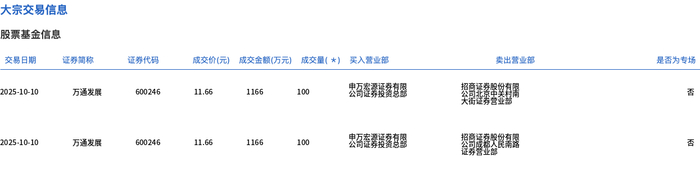
万通发展今日大宗交易折价成交200万股,成交额2332万元
Xin Lang Cai Jing· 2025-10-10 09:44
Group 1 - The core point of the news is that Wantong Development executed a block trade of 2 million shares on October 10, with a transaction value of 23.32 million yuan, accounting for 1.61% of the total trading volume for that day [1] - The transaction price was 11.66 yuan, which represents a discount of 4.35% compared to the market closing price of 12.19 yuan [1]
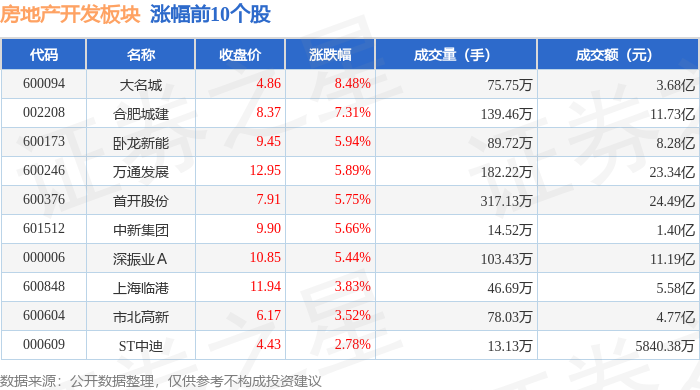
房地产开发板块10月9日跌1.34%,深深房A领跌,主力资金净流出8.82亿元
Zheng Xing Xing Ye Ri Bao· 2025-10-09 09:03
Core Insights - The real estate development sector experienced a decline of 1.34% on October 9, with Shen Shen Fang A leading the drop [1] - The Shanghai Composite Index closed at 3933.97, up 1.32%, while the Shenzhen Component Index closed at 13725.56, up 1.47% [1] Stock Performance - Notable gainers in the real estate sector included: - Daming City (600094) with a closing price of 4.86, up 8.48% on a trading volume of 757,500 shares and a turnover of 368 million [1] - Hefei Urban Construction (002208) closed at 8.37, up 7.31% with a trading volume of 1,394,600 shares and a turnover of 1.173 billion [1] - Wolong New Energy (600173) closed at 9.45, up 5.94% with a trading volume of 897,200 shares and a turnover of 828 million [1] - Major decliners included: - Shen Shen Fang A (000029) with a closing price of 30.22, down 10.01% on a trading volume of 112,700 shares and a turnover of 348 million [2] - Zhangjiang Changke (600895) closed at 49.46, down 9.99% with a trading volume of 1,475,800 shares and a turnover of 741.5 million [2] - New Town Holdings (601155) closed at 15.32, down 5.72% with a trading volume of 357,200 shares and a turnover of 54.9 million [2] Capital Flow - The real estate development sector saw a net outflow of 882 million from institutional investors, while retail investors contributed a net inflow of 49.1 million [2] - Key stocks with significant capital flow included: - Wolong New Energy (600173) with a net inflow of 1.19 billion from institutional investors, but a net outflow of 1.05 billion from retail investors [3] - Wanfang Development (600246) had a net inflow of 89.19 million from institutional investors, but a net outflow of 75.61 million from retail investors [3] - Hefei Urban Construction (002208) saw a net inflow of 82.03 million from institutional investors, with a net outflow of 16.89 million from retail investors [3]


万通发展涨2.06%,成交额8.33亿元,主力资金净流出5046.09万元
Xin Lang Cai Jing· 2025-09-30 05:56
Core Viewpoint - Wantong Development's stock has shown significant volatility, with a year-to-date increase of 59.60%, but a recent decline of 8.19% over the last five trading days [1][2] Financial Performance - For the first half of 2025, Wantong Development reported revenue of 1.87 billion yuan, a year-on-year decrease of 20.50%, and a net profit attributable to shareholders of -28.04 million yuan, an increase of 64.57% compared to the previous year [2] - The company has cumulatively distributed 1.42 billion yuan in dividends since its A-share listing, with no dividends distributed in the last three years [3] Stock Market Activity - As of September 30, the stock price was 11.89 yuan per share, with a market capitalization of 22.48 billion yuan and a trading volume of 833 million yuan [1] - The stock has appeared on the "龙虎榜" (a list of stocks with significant trading activity) 16 times this year, with the most recent appearance on September 4, where it recorded a net buy of -280 million yuan [1] Shareholder Structure - As of June 30, 2025, the number of shareholders decreased by 14.40% to 58,700, while the average circulating shares per person increased by 15.22% to 32,638 shares [2] - Notable shareholders include Shenwan Hongyuan Securities Co., Ltd. as the fifth largest shareholder with 25.50 million shares, and Southern CSI Real Estate ETF as the eighth largest with 14.68 million shares [3]
万通发展涨2.02%,成交额5.07亿元,主力资金净流出1154.84万元
Xin Lang Zheng Quan· 2025-09-29 03:24
Company Overview - Wantong Development is primarily engaged in real estate development and sales, urban renewal and operation, and communication and digital technology, with revenue composition of 50.30% from property leasing, 49.60% from property sales, and 0.10% from other sources [1][2] Stock Performance - As of September 29, the stock price of Wantong Development increased by 2.02% to 11.63 CNY per share, with a trading volume of 5.07 billion CNY and a turnover rate of 2.32%, resulting in a total market capitalization of 219.85 billion CNY [1] - Year-to-date, the stock price has risen by 56.11%, but it has seen a decline of 14.99% over the last five trading days and 13.14% over the last twenty days, while it has increased by 82.29% over the last sixty days [1] Financial Performance - For the first half of 2025, Wantong Development reported a revenue of 1.87 billion CNY, a year-on-year decrease of 20.50%, and a net profit attributable to shareholders of -28.04 million CNY, which represents a year-on-year increase of 64.57% [2] Shareholder Information - As of June 30, 2025, the number of shareholders for Wantong Development was 58,700, a decrease of 14.40% from the previous period, with an average of 32,638 circulating shares per shareholder, an increase of 15.22% [2] - The top ten circulating shareholders include Shenyin Wanguo Securities Co., Ltd. as the fifth largest shareholder with 25.50 million shares, and Southern CSI Real Estate ETF as the eighth largest shareholder with 14.68 million shares, which decreased by 122,200 shares compared to the previous period [3]
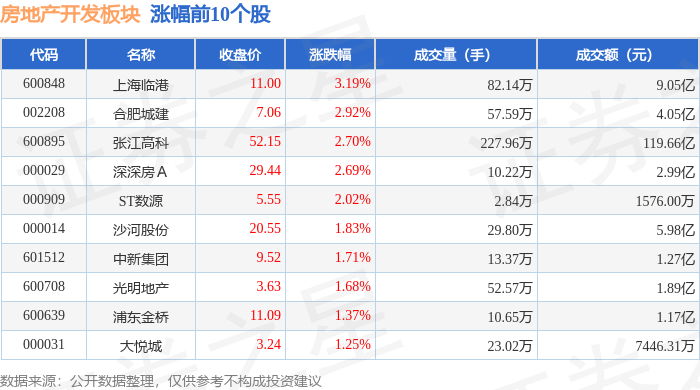
房地产开发板块9月25日跌0.69%,大龙地产领跌,主力资金净流出18.4亿元
Zheng Xing Xing Ye Ri Bao· 2025-09-25 08:37
Market Overview - On September 25, the real estate development sector declined by 0.69%, with Dalong Real Estate leading the drop [1] - The Shanghai Composite Index closed at 3853.3, down 0.01%, while the Shenzhen Component Index closed at 13445.9, up 0.67% [1] Stock Performance - Notable gainers in the real estate sector included: - Shiguyou (600848) with a closing price of 11.00, up 3.19% on a trading volume of 821,400 shares and a turnover of 905 million [1] - Hefei Urban Construction (002208) at 7.06, up 2.92% with a trading volume of 575,900 shares and a turnover of 405 million [1] - Major decliners included: - Dalong Real Estate (600159) at 3.30, down 10.08% with a trading volume of 1,564,300 shares and a turnover of 538 million [2] - Jintou City Development (600322) at 2.35, down 6.37% with a trading volume of 868,900 shares and a turnover of 210 million [2] Capital Flow - The real estate development sector experienced a net outflow of 1.84 billion in main funds, while retail investors saw a net inflow of 1.138 billion [2][3] - Notable stocks with significant capital inflows included: - China National Trade (600007) with a net inflow of 15.34 million, representing 18.30% of its trading volume [3] - Shiguyou (600848) with a net outflow of 40.30 million, accounting for 4.45% of its trading volume [3]