ZZPZH(600436)

Search documents
片仔癀(600436) - 漳州片仔癀药业股份有限公司第七届董事会第三十三次会议决议公告
2025-08-29 10:04
证券代码:600436 证券简称:片仔癀 公告编号:2025-028 漳州片仔癀药业股份有限公司 第七届董事会第三十三次会议决议公告 本公司董事会及全体董事保证本公告内容不存在任何虚假记载、误导性陈 述或者重大遗漏,并对其内容的真实性、准确性和完整性承担法律责任。 漳州片仔癀药业股份有限公司(以下简称"公司")第七届董事 会第三十三次会议于 2025 年 8 月 28 日(星期四)上午 09:00 在片 仔癀大厦 23 楼会议室以通讯方式召开。会议通知和议案以专人送达、 电子邮件方式发出。本次会议应参加表决的董事 7 人,实际表决的 董事 7 人。会议召开符合《公司法》《漳州片仔癀药业股份有限公司 公司章程》的有关规定,合法、有效,会议由董事长林志辉先生主 持。经审议,与会董事以通讯方式表决以下议案: 一、审议通过《公司 2025 年半年度报告及摘要》; 该议案已经公司董事会审计委员会 2025 年第六次会议审议通过, 同意相关内容并同意提交公司董事会审议。 出席会议的董事 7 票同意,0 票反对,0 票弃权。 报告内容详见公司同日在上海证券交易所网站披露的公告。 该议案无需提交至公司股东大会审议。 二、审议 ...

片仔癀(600436) - 漳州片仔癀药业股份有限公司关于2025年半年度利润分配预案的公告
2025-08-29 10:04
证券代码:600436 证券简称:片仔癀 公告编号:2025-030 漳州片仔癀药业股份有限公司 关于 2025 年中期利润分配预案的公告 本公司董事会及全体董事保证本公告内容不存在任何虚假记载、误导性陈 述或者重大遗漏,并对其内容的真实性、准确性和完整性承担法律责任。 重要内容提示: 每股分配比例:每股派发现金红利 1.40 元(含税)。 本次利润分配以实施权益分派股权登记日登记的总股本为 基数,具体日期将在权益分派实施公告中明确。 在实施权益分派的股权登记日前,漳州片仔癀药业股份有 限公司(以下简称"公司")总股本发生变动的,拟维持分配总额不 变,相应调整每股分配比例,并将另行公告具体调整情况。 公司 2024 年年度股东大会授权董事会决策并实施 2025 年 中期利润分配预案。本次 2025 年中期利润分配预案,经公司第七届 董事会第三十三次会议和第七届监事会第二十三次会议审议通过。 公司拟以实施权益分派股权登记日登记的总股本为基数,向全体 股东每 10 股派发现金红利 14.00 元(含税)。 以截至 2025 年 6 月 30 日,公司总股本 603,317,210 股测算,合 1 / 3 一、20 ...
片仔癀(600436) - 2025 Q2 - 季度财报
2025-08-29 09:20
[Section I Definitions](index=5&type=section&id=Section%20I%20Definitions) This section defines common terms used in the report, such as CSRC, SSE, controlling shareholder, the Company, Pien Tze Huang Cosmetics, Articles of Association, and the reporting period, to ensure clear understanding of the report content - The report defines key terms including regulatory bodies (**CSRC**, **SSE**), company entities (**Zhangzhou Pien Tze Huang Pharmaceutical Co., Ltd.**, **Fujian Pien Tze Huang Cosmetics Co., Ltd.**), controlling shareholder (**Zhangzhou Jiulongjiang Group Co., Ltd.**), Articles of Association, and the reporting period (**January 1, 2025, to June 30, 2025**)[16](index=16&type=chunk) [Section II Company Profile and Key Financial Indicators](index=5&type=section&id=Section%20II%20Company%20Profile%20and%20Key%20Financial%20Indicators) This section presents Zhangzhou Pien Tze Huang Pharmaceutical Co., Ltd.'s basic information, contact details, stock overview, key accounting data, and financial indicators for the reporting period, along with disclosure of non-recurring gains and losses; during the period, operating revenue and total profit decreased year-on-year, while total assets and net assets increased [I. Company Information](index=5&type=section&id=I.%20Company%20Information) The company's Chinese name is Zhangzhou Pien Tze Huang Pharmaceutical Co., Ltd., abbreviated as Zhangzhou Pien Tze Huang, with Lin Zhihui as its legal representative - The company's Chinese name is **Zhangzhou Pien Tze Huang Pharmaceutical Co., Ltd.**, abbreviated as **Zhangzhou Pien Tze Huang**, with **Lin Zhihui** as its legal representative[18](index=18&type=chunk) [II. Contact Person and Information](index=5&type=section&id=II.%20Contact%20Person%20and%20Information) The company's Board Secretary is Shi Yixiong, Securities Affairs Representative is Ye Qing, and the contact address for both is No. 1 Hupo Road, Xiangcheng District, Zhangzhou City, Fujian Province - The company's Board Secretary is **Shi Yixiong**, Securities Affairs Representative is **Ye Qing**, and the contact address for both is **No. 1 Hupo Road, Xiangcheng District, Zhangzhou City, Fujian Province**[19](index=19&type=chunk) [III. Brief Introduction to Changes in Basic Information](index=5&type=section&id=III.%20Brief%20Introduction%20to%20Changes%20in%20Basic%20Information) The company's registered address has changed from No. 1 Shangjie, Zhangzhou City, Fujian Province, to No. 1 Hupo Road, Xiangcheng District, Zhangzhou City, Fujian Province, and its website is http://www.zzpzh.com - The company's registered address has changed from **No. 1 Shangjie, Zhangzhou City, Fujian Province**, to **No. 1 Hupo Road, Xiangcheng District, Zhangzhou City, Fujian Province**, and its website is **http://www.zzpzh.com**[20](index=20&type=chunk)[21](index=21&type=chunk) [IV. Brief Introduction to Changes in Information Disclosure and Document Storage Locations](index=6&type=section&id=IV.%20Brief%20Introduction%20to%20Changes%20in%20Information%20Disclosure%20and%20Document%20Storage%20Locations) The company's designated information disclosure newspapers include four publications such as China Securities Journal, the website for semi-annual reports is www.sse.com.cn, and the report storage location is the company's Securities Investment Department - The company's designated information disclosure newspapers are **China Securities Journal**, **Shanghai Securities News**, **Securities Daily**, and **Securities Times**, the website for semi-annual reports is **www.sse.com.cn**, and the report storage location is the company's **Securities Investment Department**[22](index=22&type=chunk) [V. Company Stock Overview](index=6&type=section&id=V.%20Company%20Stock%20Overview) The company's A-shares are listed on the Shanghai Stock Exchange, with the stock abbreviation Pien Tze Huang and stock code 600436 - The company's A-shares are listed on the **Shanghai Stock Exchange**, with the stock abbreviation **Pien Tze Huang** and stock code **600436**[23](index=23&type=chunk) [VII. Key Accounting Data and Financial Indicators](index=6&type=section&id=VII.%20Key%20Accounting%20Data%20and%20Financial%20Indicators) During the reporting period, the company's operating revenue and total profit decreased year-on-year, net profit attributable to listed company shareholders and basic earnings per share also declined, while total assets and net assets attributable to listed company shareholders increased Key Accounting Data and Financial Indicators for H1 2025 | Indicator | Current Period (Jan-Jun) (CNY) | Prior Year Same Period (CNY) | YoY Change (%) | | :--- | :--- | :--- | :--- | | Operating Revenue | 5,378,537,133.95 | 5,650,587,551.82 | -4.81 | | Total Profit | 1,705,759,306.42 | 2,062,247,619.70 | -17.29 | | Net Profit Attributable to Listed Company Shareholders | 1,442,309,309.94 | 1,721,539,641.37 | -16.22 | | Net Cash Flow from Operating Activities | 375,544,161.63 | 381,494,673.18 | -1.56 | | Basic Earnings Per Share (CNY/share) | 2.39 | 2.85 | -16.14 | | Weighted Average Return on Net Assets (%) | 9.62 | 12.10 | Decreased by 2.48 percentage points | | **End of Current Period** | **End of Prior Year** | **Change (%)** | | | Net Assets Attributable to Listed Company Shareholders | 14,624,557,775.97 | 14,271,727,825.79 | 2.47 | | Total Assets | 18,708,792,009.00 | 17,539,661,657.50 | 6.67 | - The company plans to distribute a cash dividend of **CNY 14.00 (tax inclusive) per 10 shares** to all shareholders based on the total share capital registered on the equity distribution record date, totaling **CNY 844,644,094.00 (tax inclusive)**, representing **58.56%** of the net profit attributable to listed company shareholders in the consolidated financial statements for this reporting period[8](index=8&type=chunk) [IX. Non-Recurring Gains and Losses Items and Amounts](index=7&type=section&id=IX.%20Non-Recurring%20Gains%20and%20Losses%20Items%20and%20Amounts) During the reporting period, the company's total non-recurring gains and losses amounted to -CNY 10,563,729.06, primarily including gains and losses from disposal of non-current assets, government subsidies, fair value changes, and other non-operating income and expenses Non-Recurring Gains and Losses Items and Amounts for H1 2025 | Non-Recurring Gains and Losses Item | Amount (CNY) | | :--- | :--- | | Gains and Losses from Disposal of Non-Current Assets | 3,961,886.81 | | Government Subsidies Included in Current Profit and Loss (Excluding) | 6,464,485.60 | | Gains and Losses from Fair Value Changes and Disposal of Financial Assets and Liabilities | -9,892,208.32 | | Other Non-Operating Income and Expenses | -6,840,905.78 | | Other Gains and Losses Items Meeting the Definition of Non-Recurring | 528,700.31 | | Less: Income Tax Impact | 3,052,509.91 | | Minority Interest Impact (After Tax) | 1,733,177.77 | | Total | -10,563,729.06 | - The company recognized **CNY 6,986,955.91** in additional VAT deductions for advanced manufacturing enterprises as a recurring gain and loss item, due to its continuous acquisition and relevance to the company's operations[29](index=29&type=chunk)[704](index=704&type=chunk) [Section III Management Discussion and Analysis](index=9&type=section&id=Section%20III%20Management%20Discussion%20and%20Analysis) This section elaborates on the policy environment, industry characteristics, and company position within the pharmaceutical sector, analyzes operating performance, core competitiveness, reasons for key financial data changes, asset-liability, and investment status during the reporting period, identifies potential policy, quality, environmental, raw material, and R&D risks, and highlights efforts to enhance investor returns [I. Description of the Company's Industry and Main Business During the Reporting Period](index=9&type=section&id=I.%20Description%20of%20the%20Company%27s%20Industry%20and%20Main%20Business%20During%20the%20Reporting%20Period) The pharmaceutical industry receives high national policy attention with frequent policies encouraging innovative drug R&D and traditional Chinese medicine development; as a 'China Time-Honored Brand' and high-tech enterprise, the company continues to develop in pharmaceutical manufacturing, distribution, and cosmetics, with its main product Pien Tze Huang enjoying high prestige [(I) Industry Development](index=9&type=section&id=%28I%29%20Industry%20Development) The pharmaceutical industry is a key direction for developing new quality productive forces, with national and local governments issuing multiple support policies to deepen drug and medical device regulatory reforms, promote high-quality development of traditional Chinese medicine, and accelerate innovative drug R&D - National and local governments highly value pharmaceutical industry development, issuing multiple support policies including deepening drug and medical device regulatory reforms, improving mechanisms for inheriting and innovating traditional Chinese medicine, and optimizing review and approval for innovative drug clinical trials[32](index=32&type=chunk)[33](index=33&type=chunk) - From January to June 2025, the total operating revenue of national pharmaceutical industrial enterprises above designated size was **CNY 1,227.52 billion**, a **1.2% year-on-year decrease**; total profit was **CNY 176.69 billion**, a **2.8% year-on-year decrease**[33](index=33&type=chunk) [(II) Industry Cyclical Characteristics](index=10&type=section&id=%28II%29%20Industry%20Cyclical%20Characteristics) The pharmaceutical industry is characterized by strong endogenous growth drivers, rigid demand, and weak cyclicality, showing no obvious long-term cyclical patterns - The pharmaceutical industry is typically characterized by **strong endogenous growth drivers**, **rigid demand**, and **weak cyclicality**, showing no obvious long-term cyclical patterns[34](index=34&type=chunk) [(III) Company's Industry Position](index=10&type=section&id=%28III%29%20Company%27s%20Industry%20Position) The company is among the first batch of 'China Time-Honored Brands' recognized by the Ministry of Commerce and a 'National High-Tech Enterprise' recognized by the Ministry of Science and Technology, with its stock included in three major international index systems, earning high recognition from domestic and international investors - The company is among the first batch of '**China Time-Honored Brands**' recognized by the Ministry of Commerce and one of the first '**National High-Tech Enterprises**' recognized by the Ministry of Science and Technology[34](index=34&type=chunk) - The company's stock has successively been included in the three major international index systems: **MSCI Index**, **FTSE Russell Index**, and **S&P Dow Jones (S&P Emerging BMI) Index**, as well as multiple domestic index systems such as CSI 50, SSE 180, and CSI 300[35](index=35&type=chunk) [(IV) Company's Main Business Segments](index=10&type=section&id=%28IV%29%20Company%27s%20Main%20Business%20Segments) The company's main businesses are pharmaceutical manufacturing, distribution, and cosmetics; pharmaceutical manufacturing focuses on 'Pien Tze Huang' as its main product and actively develops classic traditional Chinese medicine formulas; pharmaceutical distribution aims to build a professional marketing platform; cosmetics owns brands like 'Pien Tze Huang' and 'Queen,' focusing on R&D innovation in Chinese ingredients - Pharmaceutical manufacturing focuses on '**Pien Tze Huang**' as its main product, available in both tablet and capsule forms, and is a national-level protected traditional Chinese medicine variety, with its prescription and process protected as state secrets[35](index=35&type=chunk) - The company actively develops classic traditional Chinese medicine formulas, with **Pien Tze Huang Angong Niuhuang Wan** (dual natural specifications, natural musk (cultured bezoar) specifications) successfully launched, and **Pien Tze Huang Ginseng and Antler Sedative Pills** newly listed for sale[36](index=36&type=chunk) - Pharmaceutical distribution is guided by 'optimization and upgrading, quality and quantity improvement, and innovation-driven,' transitioning from a 'delivery and maintenance' dominant business model to a 'professional marketing' business model[37](index=37&type=chunk) - The cosmetics industry owns multiple skincare and personal care brands such as '**Pien Tze Huang**,' '**Queen**,' and '**Jindaifu**,' and will focus on whitening and anti-aging through a dual-brand driven model, continuously emphasizing R&D innovation in Chinese ingredients[38](index=38&type=chunk) [II. Discussion and Analysis of Operating Performance](index=11&type=section&id=II.%20Discussion%20and%20Analysis%20of%20Operating%20Performance) During the reporting period, facing a complex market environment, the company adhered to the development philosophy of 'integrity, innovation, stability, and longevity,' focusing on four core areas: 'grasping production, reducing inventory, promoting sales, and transforming work style,' achieving multi-faceted results in brand honors, scientific research breakthroughs, market expansion, and internal management improvement [(I) Company Honors](index=11&type=section&id=%28I%29%20Company%20Honors) The company achieved significant results in brand and scientific research, ranking first in the 'Hurun Brand List Healthcare Brand Value List' for five consecutive years, with its Class 1.1 traditional Chinese medicine new drug Yangchao Granules receiving clinical trial approval, and multiple research achievements published and platforms selected for national lists - The company ranked first in the '**Hurun Brand List Healthcare Brand Value List**' for five consecutive years, topping the 'China Time-Honored Brand List' with a brand value of **CNY 43.739 billion**[39](index=39&type=chunk) - The Class 1.1 traditional Chinese medicine new drug **Yangchao Granules** received the 'Drug Clinical Trial Approval Notice,' approved for clinical trials targeting kidney deficiency syndrome with diminished ovarian reserve function[40](index=40&type=chunk) - Pien Tze Huang showed significant efficacy in treating chronic hepatitis B with liver fibrosis, improving the degree of liver tissue fibrosis, increasing the anti-fibrosis effective rate (approximately **20% improvement** in both entecavir-naive and early liver fibrosis populations), and improving liver function indicator alkaline phosphatase[40](index=40&type=chunk) - The company's Fujian Provincial Modern Traditional Chinese Medicine Development Expert Service Base was selected for the 11th batch of expert service bases by the Ministry of Human Resources and Social Security, and the **Pien Tze Huang Wang Qi Academician Expert Workstation** was approved as a Fujian Provincial Academician Expert Workstation[40](index=40&type=chunk) [(II) Key Initiatives](index=12&type=section&id=%28II%29%20Key%20Initiatives) The company focused on advancing five key projects under the 'Yuanshan Plan,' including attracting renowned doctors for growth, strengthening innovation drivers, launching new blockbuster products, pursuing M&A for scale expansion, and completing fund establishment; concurrently, it concentrated on core and diversified tracks, strengthened brand building and rights protection, and promoted 'municipal key project' construction and internal management improvement - As of the end of July, a total of **525 Guoyaotang** (including Guoyitang, Mingyiguan) have been opened nationwide, with **237 renowned doctors** signed, including **6 National Masters of Traditional Chinese Medicine**[41](index=41&type=chunk) - Actively advancing **2 new drug projects** and **18 new drugs under research**, including clinical studies for **5 Class 1.1 traditional Chinese medicines**, **1 Class 1.2 traditional Chinese medicine**, and **4 Class 1 chemical drugs**[41](index=41&type=chunk) - Developed Pien Tze Huang 'medicine and food homology' functional foods and health foods, with **Licorice Lily Loquat Herbal Beverage** and **high-end immune-modulating Cordyceps Cicadae series products** currently launched[42](index=42&type=chunk) - Focused on intensive cultivation of Pien Tze Huang tablets as a strategic single product, which remained at the top of the liver and gallbladder medicine—traditional Chinese medicine category on Tmall and JD platforms in 2025; its star product, **Queen's Pearl Cream**, saw sales growth of **over 60%** year-on-year in the first half[42](index=42&type=chunk) - Obtained authorization through review by the National Intellectual Property Administration, with a total of **147 effective patent grants**; **2 utility model patent applications** were accepted, with a total of **38 effective utility model patents**[45](index=45&type=chunk) - Vigorously promoted the construction of the **Pien Tze Huang Grand Health Smart Manufacturing Park** and **Pien Tze Huang Grand Health Beauty Park** projects, with all previously delayed construction schedules fully recovered[46](index=46&type=chunk) - Established a new pattern of penetrative internal control, upgraded and optimized the performance appraisal system, introduced a 'forced ranking' mechanism, implemented dynamic salary adjustments, and fully implemented market-oriented operations[46](index=46&type=chunk)[47](index=47&type=chunk) [III. Analysis of Core Competitiveness During the Reporting Period](index=15&type=section&id=III.%20Analysis%20of%20Core%20Competitiveness%20During%20the%20Reporting%20Period) The company's core competitiveness lies in its strong brand advantage, leading technological advantage, and comprehensive channel advantage; the Pien Tze Huang brand enjoys high renown domestically and internationally, technological innovation continues to break through, and channel layout covers the entire country while deepening online-offline integration [(I) Brand Advantage](index=15&type=section&id=%28I%29%20Brand%20Advantage) The company boasts a long history and profound cultural heritage, with the Pien Tze Huang brand consistently ranking first in various brand lists for years, enjoying high recognition and reputation both domestically and internationally - The **Pien Tze Huang brand** consecutively ranked first in the '**2024 Hurun Healthcare Brand Value List**'; it has been at the top of the '**Hurun China's Most Historically and Culturally Rich Brands List**' for three consecutive years; and it was awarded first place in the '**2024 China Time-Honored Brand List**' with a brand value of **CNY 43.739 billion**[48](index=48&type=chunk) - '**Pien Tze Huang**' has ranked among the top in foreign exchange earnings from single traditional Chinese medicine exports for many years, earning the reputation as a '**Chinese symbol**' on the Maritime Silk Road[48](index=48&type=chunk) [(II) Technological Advantage](index=15&type=section&id=%28II%29%20Technological%20Advantage) The company is a national high-tech enterprise, possessing multiple core independent R&D platforms, and has achieved significant progress in new drug development and cultivation of major traditional Chinese medicine varieties - The company is a **National High-Tech Enterprise**, **National Technology Innovation Demonstration Enterprise**, and **National Intellectual Property Demonstration Enterprise**, possessing multiple core independent R&D platforms such as a **National Enterprise Technology Center**, **Postdoctoral Research Workstation**, and **Academician Expert Workstation**[50](index=50&type=chunk) - The Class 1.1 traditional Chinese medicine new drug **Yangchao Granules** obtained the 'Drug Clinical Trial Approval Notice,' approved for clinical trials for kidney deficiency syndrome with diminished ovarian reserve function[50](index=50&type=chunk) - The company focuses on cultivating major traditional Chinese medicine varieties with definite clinical efficacy, clear mechanisms of action, well-defined material basis, and prominent advantages and characteristics, centered around Pien Tze Huang, Pien Tze Huang Angong Niuhuang Wan, and other distinctive and advantageous series products[50](index=50&type=chunk) [(III) Channel Advantage](index=16&type=section&id=%28III%29%20Channel%20Advantage) The company continuously strengthens Pien Tze Huang's core position, achieving extensive terminal store coverage through the 'Renowned Doctors in Zhangzhou' strategy, scientific layout of Guoyaotang and Guoyiguan, and strategic cooperation with leading chain pharmacies - The company actively implements the '**Renowned Doctors in Zhangzhou**' strategy, supporting the construction of the five major projects under the 'Yuanshan Plan,' and scientifically deploying Mingyiguan (Guoyiguan) and Pien Tze Huang Guoyaotang[51](index=51&type=chunk) - Through its wholly-owned subsidiary Fujian Pien Tze Huang Health Technology Co., Ltd., the company established full-category strategic partnerships with leading well-known chains such as **Laobaixing**, **Yifeng**, and **Kangbaijia**, achieving terminal store coverage of **over 100,000 stores**[51](index=51&type=chunk) [IV. Key Operating Performance During the Reporting Period](index=16&type=section&id=IV.%20Key%20Operating%20Performance%20During%20the%20Reporting%20Period) As of June 30, 2025, the company's total assets were CNY 18.709 billion, and equity attributable to parent company shareholders was CNY 14.625 billion; during the reporting period, total operating revenue was CNY 5.379 billion, a 4.81% year-on-year decrease; total profit was CNY 1.706 billion, a 17.29% year-on-year decrease; net profit was CNY 1.448 billion, a 17.18% year-on-year decrease; within main businesses, pharmaceutical manufacturing revenue increased, but pharmaceutical distribution and cosmetics revenue decreased, with gross margins generally declining [(I) Analysis of Main Business](index=17&type=section&id=%28I%29%20Analysis%20of%20Main%20Business) During the reporting period, the company's operating revenue, total profit, and net profit attributable to the parent company all decreased year-on-year, while net cash flow from operating activities slightly decreased; financial expenses increased due to reduced interest income, credit impairment losses increased due to higher bad debt provisions for accounts receivable, and net cash flow from investment activities significantly decreased due to fewer matured time deposits Analysis of Changes in Key Accounting Data | Item | Current Period (Jan-Jun) (CNY) | Prior Year Same Period (CNY) | Change (%) | | :--- | :--- | :--- | :--- | | Operating Revenue | 5,378,537,133.95 | 5,650,587,551.82 | -4.81 | | Total Profit | 1,705,759,306.42 | 2,062,247,619.70 | -17.29 | | Net Profit Attributable to Listed Company Shareholders | 1,442,309,309.94 | 1,721,539,641.37 | -16.22 | | Net Cash Flow from Operating Activities | 375,544,161.63 | 381,494,673.18 | -1.56 | - Financial expenses increased by **CNY 11.269 million** year-on-year, primarily due to a decrease in interest income from the company's daily operating funds during this period[55](index=55&type=chunk) - Credit impairment losses increased by **CNY 9.7628 million** year-on-year, primarily due to an increase in bad debt provisions for accounts receivable during this period[56](index=56&type=chunk) - Net cash flow from investment activities decreased by **CNY 8.7787194 billion** year-on-year, primarily due to a decrease in the company's matured time deposits compared to the same period last year[57](index=57&type=chunk) - Net cash flow from financing activities increased by **CNY 1.3002097 billion** year-on-year, primarily due to a decrease in cash paid for dividend distribution during this reporting period[57](index=57&type=chunk) [(II) Main Business by Industry, Product, Region, and Sales Model](index=19&type=section&id=%28II%29%20Main%20Business%20by%20Industry%2C%20Product%2C%20Region%2C%20and%20Sales%20Model) Pharmaceutical manufacturing operating revenue increased by 3.15% year-on-year with a gross margin of 59.95%, but the gross margin decreased by 7.60 percentage points; pharmaceutical distribution and cosmetics operating revenues both declined, with corresponding reductions in gross margins; liver disease medication revenue grew by 9.70%, while cardiovascular and cerebrovascular medication revenue sharply decreased by 71.04%; online sales revenue decreased by 52.74%, and offline sales revenue decreased by 2.60% Main Business by Industry | Industry Segment | Operating Revenue (CNY million) | YoY Change in Operating Revenue (%) | Gross Margin (%) | YoY Change in Gross Margin (%) | | :--- | :--- | :--- | :--- | :--- | | Pharmaceutical Manufacturing | 2,985.1443 | 3.15 | 59.95 | Decreased by 7.60 percentage points | | Pharmaceutical Distribution | 1,977.3223 | -12.82 | 8.78 | Decreased by 4.90 percentage points | | Cosmetics | 320.1155 | -17.01 | 61.45 | Decreased by 3.08 percentage points | Main Business by Product | Product Segment | Operating Revenue (CNY million) | YoY Change in Operating Revenue (%) | Gross Margin (%) | YoY Change in Gross Margin (%) | | :--- | :--- | :--- | :--- | :--- | | Liver Disease Medication | 2,896.3479 | 9.70 | 61.50 | Decreased by 10.89 percentage points | | Cardiovascular and Cerebrovascular Medication | 60.1041 | -71.04 | 8.94 | Decreased by 6.17 percentage points | Main Business by Sales Model | Sales Model | Operating Revenue (CNY million) | YoY Change in Operating Revenue (%) | Gross Margin (%) | YoY Change in Gross Margin (%) | | :--- | :--- | :--- | :--- | :--- | | Online | 119.1090 | -52.74 | 39.38 | Increased by 10.97 percentage points | | Offline | 5,245.8679 | -2.60 | 40.48 | Decreased by 5.12 percentage points | [(IV) Analysis of Assets and Liabilities](index=21&type=section&id=%28IV%29%20Analysis%20of%20Assets%20and%20Liabilities) At the end of the reporting period, the company's total assets were CNY 18.709 billion, a 6.67% increase from the end of the previous year; net assets attributable to listed company shareholders were CNY 14.625 billion, a 2.47% increase; long-term equity investments, other payables, and deferred income tax liabilities saw significant increases, while notes payable and contract liabilities decreased Changes in Assets and Liabilities | Item Name | Period-End Balance (CNY million) | YoY Change (%) | Change Explanation | | :--- | :--- | :--- | :--- | | Long-term Equity Investments | 559.0092 | 35.81 | Primarily due to an increase in long-term equity investments accounted for using the equity method by subsidiary Zhangzhou Pien Tze Huang Investment Management Co., Ltd. | | Notes Payable | 23.8099 | -48.52 | Primarily due to a decrease in procurement payments settled by notes by subsidiaries Fujian Pien Tze Huang Health Food Co., Ltd. and Pien Tze Huang (Zhangzhou) Pharmaceutical Co., Ltd. | | Contract Liabilities | 166.3575 | -38.57 | Primarily due to a decrease in prepayments received by the company with clear performance obligations at the end of the reporting period. | | Other Payables | 1,418.9607 | 242.13 | Primarily due to an increase in cash dividends payable by the company at the end of the reporting period. | | Deferred Income Tax Liabilities | 2.0646 | 526.59 | Primarily due to an increase in deferred income tax liabilities recognized from the fair value appreciation of the company's other equity instrument investments at the end of the reporting period. | - Overseas assets amounted to **CNY 6.4845 million**, accounting for **0.0347%** of total assets[68](index=68&type=chunk) Major Restricted Assets | Item | Current Period Amount (CNY) | Reason | | :--- | :--- | :--- | | Cash and Cash Equivalents | 13,119,347.08 | Settlement frozen funds, deposits, etc. | | Construction in Progress | 13,125,166.25 | Loan collateral | | Fixed Assets | 84,634,568.62 | Loan collateral | | Intangible Assets | 24,808,699.49 | Loan collateral | | Total | 135,687,781.44 | / | [(V) Analysis of Investment Status](index=22&type=section&id=%28V%29%20Analysis%20of%20Investment%20Status) During the reporting period, the company's total equity investments significantly increased, primarily for capital injections into subsidiaries to participate in establishing a grand health industry investment fund; concurrently, the company continued to advance major non-equity investment projects such as the science and technology building and industrial park; regarding financial assets, the fair value of other equity instrument investments and private equity funds changed - During the reporting period, the company's total equity investment amounted to **CNY 176.1524 million**, an increase of **CNY 171.0524 million** compared to the same period last year, primarily for the second phase capital contribution of Zhangzhou Yuanshan Grand Health Industry Investment Fund Partnership (Limited Partnership) and the first phase subscribed capital of Zhangzhou Taiwanese Investment Zone Zhaoying Huikang Equity Investment Partnership (Limited Partnership), in which the subsidiary Zhangzhou Pien Tze Huang Investment Management Co., Ltd. participated as a发起人[72](index=72&type=chunk) - The company's investment in the new Science and Technology Building project has an estimated total investment of **CNY 999.08 million**, with **CNY 258.9162 million** recognized as construction in progress as of June 30, 2025[73](index=73&type=chunk) - The company's investment in the new Industrial Park project has a total investment not exceeding **CNY 4.48 billion**, of which **Pien Tze Huang Health and Beauty Park** has recognized **CNY 69.2089 million** as construction in progress[73](index=73&type=chunk) Financial Assets Measured at Fair Value | Asset Category | Period-End Balance (CNY) | Period-Beginning Balance (CNY) | | :--- | :--- | :--- | | Stocks | 407,417,478.22 | 396,198,210.95 | | Private Equity Funds | 44,568,764.80 | 52,371,358.01 | | Other | 50,478,535.91 | 40,671,747.74 | | Total | 502,464,778.93 | 489,241,316.70 | [VII. Analysis of Major Controlled and Invested Companies](index=27&type=section&id=VII.%20Analysis%20of%20Major%20Controlled%20and%20Invested%20Companies) This section lists the major subsidiaries with an impact of over 10% on the company's net profit, including financial data for Xiamen Pien Tze Huang Hongren Pharmaceutical Co., Ltd. and Fujian Pien Tze Huang Cosmetics Co., Ltd. Financial Data of Major Subsidiaries | Company Name | Operating Revenue (CNY million) | Operating Profit (CNY million) | Net Profit (CNY million) | | :--- | :--- | :--- | :--- | | Xiamen Pien Tze Huang Hongren Pharmaceutical Co., Ltd. (Consolidated) | 1,547.9390 | -10.3360 | -12.1195 | | Fujian Pien Tze Huang Cosmetics Co., Ltd. (Consolidated) | 269.4657 | 71.0063 | 61.7800 | [VIII. Information on Structured Entities Controlled by the Company](index=28&type=section&id=VIII.%20Information%20on%20Structured%20Entities%20Controlled%20by%20the%20Company) During the reporting period, the company had no controlled structured entities [I) Potential Risks](index=28&type=section&id=%28I%29%20Potential%20Risks) The company faces policy risks, tax policy change risks, quality risks, environmental risks, raw material supply and price risks, and R&D risks; the company has formulated corresponding countermeasures, including close monitoring of policies, increasing R&D investment, strengthening quality control, enhancing environmental management, diversifying procurement, and strengthening project management - The pharmaceutical industry faces frequent policy changes and increasingly strict regulation, with policies such as dynamic adjustments to the medical insurance drug catalog, reform of medical insurance payment methods, centralized procurement of traditional Chinese medicines, and anti-corruption measures significantly impacting the industry's competitive landscape, integration process, and corporate business models[83](index=83&type=chunk) - The company and its controlled subsidiaries, as high-tech enterprises, enjoy a preferential corporate income tax rate of **15%**; any future changes in tax preferential policies will have a certain impact on the company's net profit[83](index=83&type=chunk) - Drug production is characterized by complex processes and long production cycles, making it susceptible to factors such as raw and auxiliary material procurement, production process control, and product storage and transportation, thus posing quality risks[85](index=85&type=chunk) - The deepening of the national 'dual carbon' goals and continuous tightening of ecological environmental protection policies impose higher requirements on environmental compliance, pollution prevention and control, and green production[89](index=89&type=chunk) - Affected by changes in supply and demand for traditional Chinese medicinal materials, prices of common medicinal materials decreased, but prices of valuable and rare raw materials remained high in the first half, posing risks to raw material supply and pricing[90](index=90&type=chunk) - Drug R&D is characterized by long cycles, multiple stages, and high risks, making it susceptible to unpredictable factors such as technology, finance, and policy[91](index=91&type=chunk)[92](index=92&type=chunk) [(II) Other Disclosure Matters](index=31&type=section&id=%28II%29%20Other%20Disclosure%20Matters) The company actively responded to the 'Quality Improvement, Efficiency Enhancement, and Return Focus' special action, striving to enhance investor gains and intrinsic company value through continuous and stable cash dividends, strengthened investor communication, improved information disclosure quality and efficiency, reinforced corporate governance, and adhered to standardized operations - In 2024, the company distributed a cash dividend of **CNY 2.97 (tax inclusive) per share** to investors, totaling **CNY 1,791,852,113.70 (tax inclusive)**, with the cumulative cash dividend ratio reaching **143.54%** over the past three fiscal years[94](index=94&type=chunk) - The company maintains high-frequency, effective communication with investors through various means, such as holding performance briefings and hosting on-site visits by funds and institutions, while continuously strengthening information disclosure efforts[95](index=95&type=chunk) - During the reporting period, the company held **1 general meeting of shareholders**, **5 board meetings**, and **3 supervisory board meetings**, approving all proposals, thereby improving corporate governance structure, enhancing internal management, and standardizing company operations[96](index=96&type=chunk) [Section IV Corporate Governance, Environment, and Society](index=33&type=section&id=Section%20IV%20Corporate%20Governance%2C%20Environment%2C%20and%20Society) This section primarily discloses changes in the company's directors, supervisors, and senior management, the semi-annual profit distribution plan, and the company's efforts in consolidating poverty alleviation achievements and rural revitalization [I. Changes in Company Directors, Supervisors, and Senior Management](index=33&type=section&id=I.%20Changes%20in%20Company%20Directors%2C%20Supervisors%2C%20and%20Senior%20Management) During the reporting period, multiple changes occurred in the company's directors, supervisors, and senior management, including the departures of Chen Honghui, Hong Fei, Lai Wenning, Wei Tengyun, and Huang Qiumin, the appointments of Shi Yixiong and He Wei, and Wei Tengyun's transition to Chief Engineer - In January 2025, Mr. Chen Honghui, former Director, Board Secretary, and Deputy General Manager, and Ms. Hong Fei, former Deputy General Manager, resigned due to work adjustments[99](index=99&type=chunk) - In January 2025, Mr. Shi Yixiong was appointed as Deputy General Manager and acting Board Secretary; in April 2025, Mr. Shi Yixiong was appointed as Board Secretary[99](index=99&type=chunk)[100](index=100&type=chunk) - In August 2025, Mr. Lai Wenning, former Director, Mr. Wei Tengyun, former Employee Supervisor, and Ms. Huang Qiumin, Supervisor, resigned due to work adjustments[100](index=100&type=chunk) - In August 2025, Mr. He Wei was appointed as Deputy General Manager; Mr. Wei Tengyun was appointed as Chief Engineer[100](index=100&type=chunk) [II. Profit Distribution or Capital Reserve Conversion Plan](index=34&type=section&id=II.%20Profit%20Distribution%20or%20Capital%20Reserve%20Conversion%20Plan) The company's proposed semi-annual profit distribution plan is a cash dividend of CNY 14.00 (tax inclusive) per 10 shares, with no bonus shares issued and no capital reserve conversion to share capital Semi-Annual Profit Distribution Plan | Item | Value | | :--- | :--- | | Whether to Distribute or Convert | Yes | | Number of Bonus Shares per 10 Shares (shares) | Not applicable | | Dividend per 10 Shares (CNY) (Tax Inclusive) | 14.00 | | Number of Shares Converted from Capital Reserve per 10 Shares (shares) | Not applicable | [V. Specifics of Consolidating Poverty Alleviation Achievements and Rural Revitalization Efforts](index=35&type=section&id=V.%20Specifics%20of%20Consolidating%20Poverty%20Alleviation%20Achievements%20and%20Rural%20Revitalization%20Efforts) The company actively responded to the national call, signing a scientific research assistance cooperation agreement with Bianba County Government, introducing research teams to conduct experimental cultivation of medicinal materials and research on forest musk deer, promoting local employment and income growth, and contributing to rural revitalization - The company closely coordinated with the Fujian Provincial Counterpart Support Bianba County Working Group, signed a scientific research assistance cooperation agreement with Bianba County Government, and introduced research teams from institutions such as the **Institute of Medicinal Plant Development, Chinese Academy of Medical Sciences**, and **Sichuan University**[103](index=103&type=chunk) - Assisted in conducting experimental cultivation of relevant medicinal materials and research on forest musk deer, provided corresponding technical guidance, promoted local employment and income growth, and contributed to rural revitalization[103](index=103&type=chunk) [Section V Significant Matters](index=36&type=section&id=Section%20V%20Significant%20Matters) This section primarily states that during the reporting period, the company had no significant commitments, no non-operating funds occupied by controlling shareholders or related parties, no illegal guarantees, and no major lawsuits or arbitrations, and discloses significant related party transactions related to daily operations and joint external investments [I. Fulfillment of Commitments](index=36&type=section&id=I.%20Fulfillment%20of%20Commitments) During the reporting period, no commitments by the company's actual controller, shareholders, related parties, acquirers, or the company itself continued into the reporting period [VII. Major Litigation and Arbitration Matters](index=36&type=section&id=VII.%20Major%20Litigation%20and%20Arbitration%20Matters) The company had no major litigation or arbitration matters during this reporting period - The company had **no major litigation or arbitration matters** during this reporting period[105](index=105&type=chunk) [X. Significant Related Party Transactions](index=37&type=section&id=X.%20Significant%20Related%20Party%20Transactions) During the reporting period, the company had significant related party transactions related to daily operations and joint external investments, all of which were reviewed and disclosed in accordance with regulations [(I) Related Party Transactions Related to Daily Operations](index=37&type=section&id=%28I%29%20Related%20Party%20Transactions%20Related%20to%20Daily%20Operations) The company's 28th meeting of the Seventh Board of Directors approved the 'Proposal on the Company's 2024 Daily Related Party Transactions and 2025 Daily Related Party Transaction Forecast,' with related directors abstaining from voting - On April 25, 2025, the company's **28th meeting of the Seventh Board of Directors** approved the 'Proposal on the Company's 2024 Daily Related Party Transactions and 2025 Daily Related Party Transaction Forecast'[106](index=106&type=chunk) - The proposal was reviewed and approved by the company's **Seventh Board of Directors' Independent Directors' Special Meeting (Second Meeting in 2025)** and the **Board of Directors' Audit Committee (Third Meeting in 2025)**, with related directors Lin Zhihui, Huang Jinming, Lai Wenning, and Yang Haipeng abstaining from voting[106](index=106&type=chunk) [(III) Significant Related Party Transactions for Joint External Investments](index=38&type=section&id=%28III%29%20Significant%20Related%20Party%20Transactions%20for%20Joint%20External%20Investments) Proposals for the company's wholly-owned subsidiaries to jointly invest with professional investment institutions in establishing Zhaoying Fund and Gaoxin Runxin Fund have been approved by the Board of Directors - On March 28, 2025, the company's **27th meeting of the Seventh Board of Directors** approved the 'Proposal on the Company's Wholly-Owned Subsidiaries Jointly Investing with Professional Investment Institutions to Establish Zhaoying Fund and Related Party Transactions'[108](index=108&type=chunk) - On June 8, 2025, the company's **31st meeting of the Seventh Board of Directors** approved the 'Proposal on the Company's Wholly-Owned Subsidiaries Jointly Investing with Professional Investment Institutions to Establish Gaoxin Runxin Fund and Related Party Transactions'[108](index=108&type=chunk) [Section VI Changes in Shares and Shareholder Information](index=41&type=section&id=Section%20VI%20Changes%20in%20Shares%20and%20Shareholder%20Information) This section discloses that the company's share capital structure remained unchanged during the reporting period, and details the total number of shareholders, top ten shareholders, and top ten holders of unrestricted shares as of the end of the reporting period [I. Changes in Share Capital](index=41&type=section&id=I.%20Changes%20in%20Share%20Capital) During the reporting period, the company's total share capital and share capital structure remained unchanged - During the reporting period, the company's **total share capital and share capital structure remained unchanged**[113](index=113&type=chunk) [II. Shareholder Information](index=41&type=section&id=II.%20Shareholder%20Information) As of the end of the reporting period, the total number of common shareholders was 119,270; Zhangzhou Jiulongjiang Group Co., Ltd. is the controlling shareholder, holding 51.30% of shares - As of the end of the reporting period, the total number of common shareholders was **119,270**[114](index=114&type=chunk) Top Ten Shareholders' Shareholding as of the End of the Reporting Period | Shareholder Name | Number of Shares Held at Period-End (shares) | Proportion (%) | Pledged, Marked, or Frozen Status | Shareholder Nature | | :--- | :--- | :--- | :--- | :--- | | Zhangzhou Jiulongjiang Group Co., Ltd. | 309,522,643 | 51.30 | Pledged 58,680,000 shares | State-owned Legal Person | | Wang Fuji | 27,100,000 | 4.49 | Unknown | Domestic Natural Person | | Zhangzhou State-owned Capital Operation Group Co., Ltd. | 20,083,600 | 3.33 | Unknown | State-owned Legal Person | | Hong Kong Securities Clearing Company Limited | 19,239,366 | 3.19 | Unknown | Unknown | | China Securities Finance Corporation Limited | 11,253,490 | 1.87 | Unknown | State-owned Legal Person | | Zhangzhou Transportation Development Group Co., Ltd. | 6,300,000 | 1.04 | Pledged 3,150,000 shares | State-owned Legal Person | | Industrial and Commercial Bank of China Co., Ltd. - Huatai-PineBridge CSI 300 ETF | 5,307,739 | 0.88 | Unknown | Other | | Fujian Zhanglong Group Co., Ltd. | 5,056,700 | 0.84 | Unknown | State-owned Legal Person | | China Construction Bank Co., Ltd. - E Fund CSI 300 Healthcare ETF | 4,959,626 | 0.82 | Unknown | Other | | Fujian Zhangzhou Urban Investment Group Co., Ltd. | 4,800,000 | 0.80 | Unknown | State-owned Legal Person | [Section VII Bond-Related Information](index=45&type=section&id=Section%20VII%20Bond-Related%20Information) This section states that the company had no corporate bonds, enterprise bonds, non-financial enterprise debt financing instruments, or convertible corporate bonds during the reporting period - The company has **no corporate bonds** (including enterprise bonds) and **non-financial enterprise debt financing instruments**[121](index=121&type=chunk) - The company has **no convertible corporate bonds**[121](index=121&type=chunk) [Section VIII Financial Report](index=45&type=section&id=Section%20VIII%20Financial%20Report) This section includes the company's unaudited financial statements, comprising consolidated and parent company balance sheets, income statements, cash flow statements, and statements of changes in owners' equity, along with the company's basic information, basis of financial statement preparation, significant accounting policies and estimates, taxation, notes to consolidated financial statement items, R&D expenses, changes in consolidation scope, interests in other entities, government grants, risks related to financial instruments, fair value disclosures, related parties and related party transactions, commitments and contingencies, post-balance sheet events, other significant matters, and supplementary information [I. Audit Report](index=45&type=section&id=I.%20Audit%20Report) This semi-annual report is unaudited - This semi-annual report is **unaudited**[7](index=7&type=chunk) [II. Financial Statements](index=46&type=section&id=II.%20Financial%20Statements) This section provides the company's consolidated and parent company balance sheets, income statements, cash flow statements, and statements of changes in owners' equity for H1 2025, comprehensively reflecting the company's financial position at the end of the reporting period, operating results, and cash flows during the reporting period [Consolidated Balance Sheet](index=46&type=section&id=Consolidated%20Balance%20Sheet) As of June 30, 2025, the company's total consolidated assets were CNY 18.709 billion, a 6.67% increase from the end of the previous year; current assets were CNY 12.292 billion, non-current assets were CNY 6.417 billion; total liabilities were CNY 3.512 billion, a 30.03% increase from the end of the previous year; current liabilities were CNY 3.203 billion, non-current liabilities were CNY 0.309 billion; equity attributable to parent company owners was CNY 14.625 billion, a 2.47% increase from the end of the previous year Key Data from Consolidated Balance Sheet | Item | June 30, 2025 (CNY) | December 31, 2024 (CNY) | Change (%) | | :--- | :--- | :--- | :--- | | Total Assets | 18,708,792,009.00 | 17,539,661,657.50 | 6.67 | | Total Current Assets | 12,291,930,567.28 | 11,328,819,511.46 | 8.50 | | Total Non-Current Assets | 6,416,861,441.72 | 6,210,842,146.04 | 3.32 | | Total Liabilities | 3,511,940,391.49 | 2,700,924,667.75 | 30.03 | | Total Current Liabilities | 3,202,842,525.16 | 2,373,814,467.43 | 35.09 | | Total Non-Current Liabilities | 309,097,866.33 | 327,110,200.32 | -5.69 | | Total Equity Attributable to Parent Company Owners | 14,624,557,775.97 | 14,271,727,825.79 | 2.47 | [Parent Company Balance Sheet](index=48&type=section&id=Parent%20Company%20Balance%20Sheet) As of June 30, 2025, the parent company's total assets were CNY 15.046 billion, an 8.23% increase from the end of the previous year; current assets were CNY 8.339 billion, non-current assets were CNY 6.707 billion; total liabilities were CNY 1.653 billion, a 132.99% increase from the end of the previous year; current liabilities were CNY 1.603 billion, non-current liabilities were CNY 0.050 billion; total owners' equity was CNY 13.393 billion, a 1.52% increase from the end of the previous year Key Data from Parent Company Balance Sheet | Item | June 30, 2025 (CNY) | December 31, 2024 (CNY) | Change (%) | | :--- | :--- | :--- | :--- | | Total Assets | 15,045,626,855.73 | 13,901,799,118.34 | 8.23 | | Total Current Assets | 8,338,638,191.92 | 7,384,973,902.43 | 12.91 | | Total Non-Current Assets | 6,706,988,663.81 | 6,516,825,215.91 | 2.92 | | Total Liabilities | 1,652,762,164.36 | 709,570,374.53 | 132.99 | | Total Current Liabilities | 1,602,786,137.43 | 658,769,969.47 | 143.32 | | Total Non-Current Liabilities | 49,976,026.93 | 50,800,405.06 | -1.62 | | Total Owners' Equity | 13,392,864,691.37 | 13,192,228,743.81 | 1.52 | [Consolidated Income Statement](index=50&type=section&id=Consolidated%20Income%20Statement) In H1 2025, the company achieved total operating revenue of CNY 5.379 billion, a 4.81% year-on-year decrease; total operating costs were CNY 3.738 billion, a 2.20% year-on-year increase; total profit was CNY 1.706 billion, a 17.29% year-on-year decrease; net profit was CNY 1.448 billion, a 17.18% year-on-year decrease; net profit attributable to parent company shareholders was CNY 1.442 billion, a 16.22% year-on-year decrease Key Data from Consolidated Income Statement | Item | H1 2025 (CNY) | H1 2024 (CNY) | Change (%) | | :--- | :--- | :--- | :--- | | Total Operating Revenue | 5,378,537,133.95 | 5,650,587,551.82 | -4.81 | | Total Operating Costs | 3,738,366,623.05 | 3,657,869,246.18 | 2.20 | | Total Profit | 1,705,759,306.42 | 2,062,247,619.70 | -17.29 | | Net Profit | 1,447,998,913.89 | 1,748,357,713.90 | -17.18 | | Net Profit Attributable to Parent Company Shareholders | 1,442,309,309.94 | 1,721,539,641.37 | -16.22 | | Basic Earnings Per Share (CNY/share) | 2.39 | 2.85 | -16.14 | [Parent Company Income Statement](index=52&type=section&id=Parent%20Company%20Income%20Statement) In H1 2025, the parent company achieved operating revenue of CNY 2.892 billion, largely flat year-on-year; net profit was CNY 1.350 billion, an 18.79% year-on-year decrease Key Data from Parent Company Income Statement | Item | H1 2025 (CNY) | H1 2024 (CNY) | Change (%) | | :--- | :--- | :--- | :--- | | Operating Revenue | 2,892,191,804.25 | 2,891,548,735.22 | 0.02 | | Net Profit | 1,349,760,116.62 | 1,659,600,681.65 | -18.79 | [Consolidated Cash Flow Statement](index=53&type=section&id=Consolidated%20Cash%20Flow%20Statement) In H1 2025, net cash flow from operating activities was CNY 0.376 billion, a 1.56% year-on-year decrease; net cash flow from investment activities was -CNY 0.008 billion, a significant 100.09% year-on-year decrease; net cash flow from financing activities was -CNY 0.094 billion, a significant 93.25% year-on-year increase Key Data from Consolidated Cash Flow Statement | Item | H1 2025 (CNY) | H1 2024 (CNY) | Change (%) | | :--- | :--- | :--- | :--- | | Net Cash Flow from Operating Activities | 375,544,161.63 | 381,494,673.18 | -1.56 | | Net Cash Flow from Investment Activities | -7,809,265.55 | 8,770,910,115.64 | -100.09 | | Net Cash Flow from Financing Activities | -93,834,152.87 | -1,394,043,863.96 | 93.25 | | Net Increase in Cash and Cash Equivalents | 274,188,868.32 | 7,765,453,605.98 | -96.47 | [Parent Company Cash Flow Statement](index=54&type=section&id=Parent%20Company%20Cash%20Flow%20Statement) In H1 2025, net cash flow from operating activities was CNY 0.248 billion, a 40.52% year-on-year decrease; net cash flow from investment activities was CNY 0.034 billion, a significant 99.57% year-on-year decrease; net cash flow from financing activities was -CNY 1.400 billion, a significant year-on-year decrease Key Data from Parent Company Cash Flow Statement | Item | H1 2025 (CNY) | H1 2024 (CNY) | Change (%) | | :--- | :--- | :--- | :--- | | Net Cash Flow from Operating Activities | 247,766,103.97 | 416,312,223.35 | -40.52 | | Net Cash Flow from Investment Activities | 34,231,691.22 | 8,041,009,325.00 | -99.57 | | Net Cash Flow from Financing Activities | -1,399,695,927.20 | -1,399,695,927.20 | 0.00 | | Net Increase in Cash and Cash Equivalents | 283,132,876.76 | 7,064,711,380.49 | -95.99 | [Consolidated Statement of Changes in Owners' Equity](index=55&type=section&id=Consolidated%20Statement%20of%20Changes%20in%20Owners%27%20Equity) As of June 30, 2025, total consolidated owners' equity was CNY 15.197 billion, an increase of CNY 0.358 billion from the beginning of the period; of this, equity attributable to parent company owners increased by CNY 0.353 billion, and minority interests increased by CNY 0.005 billion; major changes included an increase of CNY 1.458 billion in total comprehensive income and a decrease of CNY 1.098 billion in profit distribution Changes in Consolidated Owners' Equity | Item | June 30, 2025 (CNY) | December 31, 2024 (CNY) | Change (CNY) | | :--- | :--- | :--- | :--- | | Total Owners' Equity | 15,196,851,617.51 | 14,838,736,989.75 | 358,114,627.76 | | Total Equity Attributable to Parent Company Owners | 14,624,557,775.97 | 14,271,727,825.79 | 352,829,950.18 | | Minority Interests | 572,293,841.54 | 567,009,163.96 | 5,284,677.58 | | Total Comprehensive Income | 1,457,807,912.26 | 1,719,404,678.53 | -261,596,766.27 | | Profit Distribution | -1,098,037,322.20 | -1,400,677,220.97 | 302,639,898.77 | [Parent Company Statement of Changes in Owners' Equity](index=59&type=section&id=Parent%20Company%20Statement%20of%20Changes%20in%20Owners%27%20Equity) As of June 30, 2025, total parent company owners' equity was CNY 13.393 billion, an increase of CNY 0.201 billion from the beginning of the period; major changes included an increase of CNY 1.347 billion in total comprehensive income and a decrease of CNY 1.098 billion in profit distribution Changes in Parent Company Owners' Equity | Item | June 30, 2025 (CNY) | December 31, 2024 (CNY) | Change (CNY) | | :--- | :--- | :--- | :--- | | Total Owners' Equity | 13,392,864,691.37 | 13,192,228,743.81 | 200,635,947.56 | | Total Comprehensive Income | 1,347,405,237.06 | 1,626,265,971.25 | -278,860,734.19 | | Profit Distribution | -1,098,037,322.20 | -1,399,695,927.20 | 301,658,605.00 | [III. Company Basic Information](index=61&type=section&id=III.%20Company%20Basic%20Information) Zhangzhou Pien Tze Huang Pharmaceutical Co., Ltd. was established on December 28, 1999, listed on the Shanghai Stock Exchange on May 30, 2003, with stock code 600436; as of June 30, 2025, the company's registered capital was CNY 603,317,210.00, its main products are Pien Tze Huang and its series, and its business scope covers pharmaceutical production, wholesale and retail, food, health products, cosmetics, etc. - **Zhangzhou Pien Tze Huang Pharmaceutical Co., Ltd.** was established on **December 28, 1999**, and listed on the **Shanghai Stock Exchange** on **June 16, 2003**, with stock code **600436**[146](index=146&type=chunk) - As of June 30, 2025, the company's registered capital was **CNY 603,317,210.00**[148](index=148&type=chunk) - The company's business scope includes **pharmaceutical production**, **food production**, **health food production**, **pharmaceutical wholesale and retail**, **medical device production and operation**, **traditional Chinese herbal medicine cultivation**, **medical research and experimental development**, and **cosmetics wholesale**[149](index=149&type=chunk) - The company's main products are **Pien Tze Huang and its series products**[149](index=149&type=chunk) [IV. Basis of Financial Statement Preparation](index=62&type=section&id=IV.%20Basis%20of%20Financial%20Statement%20Preparation) The company prepares its financial statements on a going concern basis, in accordance with actual transactions and events, and in compliance with 'Enterprise Accounting Standards' and relevant regulations, declaring its ability to continue as a going concern - The company prepares its financial statements on a **going concern basis**, in accordance with actual transactions and events, and in compliance with '**Enterprise Accounting Standards**' and relevant regulations[150](index=150&type=chunk) - The company has the ability to continue as a going concern for at least **12 months** from the end of this reporting period, with no significant matters affecting its going concern ability[151](index=151&type=chunk) [V. Significant Accounting Policies and Estimates](index=63&type=section&id=V.%20Significant%20Accounting%20Policies%20and%20Estimates) This section details the company's specific accounting policies and estimates for business combinations, consolidated financial statement preparation, financial instruments, notes receivable, accounts receivable, inventories, long-term equity investments, fixed assets, intangible assets, revenue recognition, government grants, and explains the method for determining materiality standards - The company determines specific accounting policies and estimates based on its own production and operating characteristics, primarily reflected in the methods for calculating loss provisions for notes receivable, accounts receivable, and other receivables, depreciation of investment properties, fixed assets, and biological assets, amortization of intangible assets, and revenue recognition policies[152](index=152&type=chunk) - Assets and liabilities acquired by the company in a business combination are measured at their **carrying amounts** in the consolidated financial statements of the ultimate controlling party at the acquisition date[159](index=159&type=chunk) - The company classifies financial assets into three categories based on the business model for managing financial assets and the contractual cash flow characteristics of the financial assets: measured at **amortized cost**, measured at **fair value through other comprehensive income**, and measured at **fair value through profit or loss**[175](index=175&type=chunk) - The company measures loss provisions for notes receivable at an amount equal to the **expected credit losses over the entire lifetime**, and classifies them into different portfolios based on credit risk characteristics[188](index=188&type=chunk) - The company recognizes revenue when it has satisfied its performance obligations under the contract, which is when the customer obtains control of the relevant goods[249](index=249&type=chunk) - Government grants related to assets are offset against the carrying amount of the related asset or recognized as deferred income upon receipt; government grants related to income, if intended to compensate for future costs and expenses, are recognized as deferred income, and if intended to compensate for incurred costs and expenses, are directly recognized in current profit or loss[257](index=257&type=chunk) [VI. Taxation](index=108&type=section&id=VI.%20Taxation) This section discloses the company's main tax categories and rates, including VAT, urban maintenance and construction tax, education surcharges, and corporate income tax; the company and some subsidiaries, as high-tech enterprises or small-profit enterprises, enjoy corresponding tax preferential policies Main Tax Categories and Rates | Tax Category | Tax Rate | | :--- | :--- | | Value-Added Tax (VAT) | 13%, 9%, 6%, 5%, 3% | | Urban Maintenance and Construction Tax | 5%, 7% | | Education Surcharge, Local Education Surcharge | 3%, 2% | | Corporate Income Tax | 15%, 20%, 25% | - The company and its controlled subsidiary, **Fujian Pien Tze Huang Cosmetics Co., Ltd.**, were re-certified as high-tech enterprises, enjoying a reduced corporate income tax rate of **15%** from 2023 to 2025[271](index=271&type=chunk)[272](index=272&type=chunk) - Controlled subsidiary **Longhui Pharmaceutical Co., Ltd.** enjoyed a reduced corporate income tax rate of **15%** from 2022 to 2024, and provisionally paid corporate income tax at a **15%** rate in H1 2025[273](index=273&type=chunk) - For some subsidiaries qualifying as small-profit enterprises, the portion of annual taxable income not exceeding **CNY 1 million** is included in taxable income at **25%** and subject to a **20%** corporate income tax rate; the portion exceeding **CNY 1 million** but not exceeding **CNY 3 million** is included in taxable income at **25%** and subject to a **20%** corporate income tax rate[273](index=273&type=chunk)[274](index=274&type=chunk)[275](index=275&type=chunk) [VII. Notes to Consolidated Financial Statement Items](index=110&type=section&id=VII.%20Notes%20to%20Consolidated%20Financial%20Statement%20Items) This section details the specific composition, period-end balances, period-beginning balances, and current period changes of various asset, liability, owners' equity, revenue, cost, expense, and cash flow items in the company's consolidated financial statements, with explanations for significant changes; it primarily covers key financial accounts such as cash and cash equivalents, notes receivable, accounts receivable, inventories, long-term equity investments, fixed assets, construction in progress, short-term borrowings, employee compensation payable, and other payables - Cash and cash equivalents balance at period-end was **CNY 1,770,197,115.36**, of which **CNY 13,119,347.08** was restricted, primarily for settlement frozen funds and deposits[277](index=277&type=chunk) - Notes receivable balance at period-end was **CNY 70,154,911.29**, including **CNY 69,747,059.85** in bank acceptance bills and **CNY 444,055.00** in commercial acceptance bills[280](index=280&type=chunk) - Accounts receivable balance at period-end was **CNY 977,298,156.48**, with bad debt provisions of **CNY 38,735,697.42**[295](index=295&type=chunk) - Inventory balance at period-end was **CNY 5,723,911,277.99**, primarily consisting of **raw materials of CNY 3,893,313,883.99** and **inventories of CNY 1,212,797,849.45**[349](index=349&type=chunk) - Long-term equity investments balance at period-end was **CNY 559,009,217.85**, primarily including investments in joint ventures and associates[373](index=373&type=chunk) - Fixed assets book value at period-end was **CNY 1,222,489,609.07**, primarily consisting of **buildings and structures of CNY 1,099,830,159.65**[388](index=388&type=chunk) - Construction in progress book value at period-end was **CNY 347,947,822.93**, primarily including the **Pien Tze Huang Science and Technology Building project of CNY 258,916,151.51** and **Pien Tze Huang Health and Beauty Park of CNY 69,208,912.47**[394](index=394&type=chunk) - Short-term borrowings balance at period-end was **CNY 832,096,608.51**, all of which were credit borrowings[427](index=427&type=chunk) - Employee compensation payable balance at period-end was **CNY 135,475,227.53**, primarily short-term compensation[449](index=449&type=chunk) - Other payables balance at period-end was **CNY 1,418,960,737.09**, including **dividends payable of CNY 1,098,068,822.20** and **other payables of CNY 320,891,914.89**[456](index=456&type=chunk) - Operating revenue and operating costs: Main business revenue for the current period was **CNY 5,364,976,909.58**, and costs were **CNY 3,194,361,772.77**[506](index=506&type=chunk) - Financial expenses for the current period amounted to **CNY 6,291,060.91**, compared to -CNY 4,977,899.47 in the same period last year, primarily due to a decrease in interest income from the company's daily operating funds during this period[55](index=55&type=chunk) - Net cash flow from investment activities for the current period was **-CNY 7,809,265.55**, compared to CNY 8,770,910,115.64 in the same period last year, primarily due to a decrease in the company's matured time deposits during this reporting period[57](index=57&type=chunk) - Net cash flow from financing activities for the current period was **-CNY 93,834,152.87**, compared to -CNY 1,394,043,863.96 in the same period last year, primarily due to a decrease in cash paid for dividend distribution during this reporting period[57](index=57&type=chunk) [VIII. Research and Development Expenses](index=212&type=section&id=VIII.%20Research%20and%20Development%20Expenses) This section lists the company's R&D expenses during the reporting period, with total R&D expenses for the current period amounting to CNY 120.3418 million, primarily composed of outsourced R&D, employee compensation, and material consumption, all of which were expensed R&D Expense Details | Item | Amount for Current Period (CNY) | Amount for Prior Period (CNY) | | :--- | :--- | :--- | | Material Consumption Expenses | 13,065,381.04 | 1,997,490.22 | | Employee Compensation | 19,251,896.35 | 17,145,206.74 | | Depreciation and Amortization | 2,344,520.32 | 3,251,000.30 | | Outsourced R&D | 74,915,550.06 | 87,396,028.68 | | Other | 10,764,491.44 | 6,316,410.95 | | Total | 120,341,839.21 | 116,106,136.89 | | Of which: Expensed R&D | 120,341,839.21 | 116,106,136.89 | | Capitalized R&D | - | - | [IX. Changes in Consolidation Scope](index=213&type=section&id=IX.%20Changes%20in%20Consolidation%20Scope) During the reporting period, the company had no business combinations not under com
片仔癀(600436) - 漳州片仔癀药业股份有限公司董事、监事和高级管理人员关于公司2025年半年度报告的确认意见
2025-08-29 09:16
1、 公司严格按照股份制公司的财务制度规范运作,《公司 2025 年 半年度报告》的编制符合法律、行政法规、《漳州片仔癀药业股份有限公 司章程》及公司内部管理制度的各项规定,2025 年半年度报告公允、真实、 全面地反映了公司 2025 年半年度报告的财务状况和经营成果。 2、 公司第七届董事会第三十三次会议、第七届监事会第二十三次 会议审议通过《公司 2025 年半年度报告及摘要》的议案。 漳州片仔癀药业股份有限公司董事、监事和高级管理人员 关于公司 2025 年半年度报告的确认意见 根据《中华人民共和国证券法(2019 年修订)》《公开发行证券的公 司信息披露内容与格式准则第 3 号——半年度报告的内容与格式(2025 年修订)》和《上海证券交易所股票上市规则(2025 年修订)》等相关规 定和要求,作为漳州片仔癀药业股份有限公司的董事、监事和高级管理人 员,我们在全面了解和审核《公司 2025 年半年度报告》后,发表意见如 下: 漳州片仔癀药业股份有限公司 董事、监事和高级管理人员 3、 公司全体董事、监事和高级管理人员保证《公司 2025 年半年度 报告及摘要》所披露的信息真实、准确、完整,承诺其中不 ...
片仔癀:上半年净利润同比下降16.22% 拟每10股派14元
Zheng Quan Shi Bao Wang· 2025-08-29 09:13
Core Viewpoint - The company reported a decline in both revenue and net profit for the first half of 2025, indicating potential challenges in its financial performance [1] Financial Performance - The company achieved operating revenue of 5.379 billion yuan, a year-on-year decrease of 4.81% [1] - The net profit attributable to shareholders was 1.442 billion yuan, down 16.22% year-on-year [1] - Basic earnings per share were reported at 2.39 yuan [1] Dividend Distribution - The company plans to distribute a cash dividend of 14 yuan (including tax) for every 10 shares to all shareholders [1]
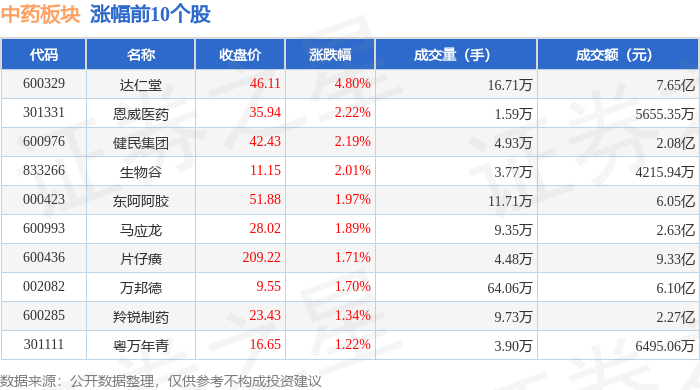
中药板块8月29日涨0.32%,达仁堂领涨,主力资金净流出5.1亿元
Zheng Xing Xing Ye Ri Bao· 2025-08-29 08:41
Market Overview - The Chinese traditional medicine sector saw a slight increase of 0.32% on August 29, with Darentang leading the gains [1] - The Shanghai Composite Index closed at 3857.93, up 0.37%, while the Shenzhen Component Index closed at 12696.15, up 0.99% [1] Top Performers - Darentang (600329) closed at 46.11, with a rise of 4.80% and a trading volume of 167,100 shares, amounting to a transaction value of 765 million [1] - Enwei Pharmaceutical (301331) increased by 2.22% to close at 35.94, with a trading volume of 15,900 shares [1] - Jianmin Group (600976) rose by 2.19% to 42.43, with a transaction value of 208 million [1] Underperformers - Qidi Pharmaceutical (000590) decreased by 3.11% to 11.84, with a trading volume of 129,400 shares and a transaction value of 155 million [2] - Tianmu Pharmaceutical (600671) fell by 2.89% to 19.81, with a transaction value of 209 million [2] - Buchang Pharmaceutical (603858) saw a decline of 2.55% to 19.51, with a trading volume of 198,400 shares [2] Capital Flow - The traditional medicine sector experienced a net outflow of 510 million from institutional investors, while retail investors saw a net inflow of 469 million [2] - The sector's overall capital flow indicates a mixed sentiment, with institutional investors pulling back while retail investors are more active [2] Individual Stock Capital Flow - Darentang had a net inflow of 77.24 million from institutional investors, but a net outflow of 59.46 million from retail investors [3] - Yunnan Baiyao (000538) saw a net inflow of 55.91 million from institutional investors, while retail investors had a net outflow of 0.83 million [3] - Zhendong Pharmaceutical (300158) experienced a net inflow of 48.61 million from institutional investors, but a significant net outflow of 79.17 million from retail investors [3]


2025年中国咽喉中成药行业发展历程、市场政策、产业链图谱、销售额、竞争格局及发展趋势:市场集中度较高,CR5占比超50%[图]
Chan Ye Xin Xi Wang· 2025-08-29 01:54
Core Viewpoint - The increasing prevalence of throat diseases due to environmental pollution, lifestyle changes, and an aging population is driving the demand for throat traditional Chinese medicine (TCM), with the market expected to reach 7.4 billion yuan in 2024, reflecting a year-on-year growth of 7.49% [1][9]. Overview - Throat diseases are primarily caused by various factors such as wind-heat invasion and internal heat, leading to symptoms like sore throat and hoarseness. Throat TCM is made from traditional Chinese medicinal ingredients and is used to treat throat-related ailments, characterized by stable efficacy and minimal side effects [1][3]. Development History - The throat medicine industry in China began relatively late, with significant advancements in chronic pharyngitis research in the 1980s leading to the development of throat medications. The market was initially fragmented, but the introduction of products like Guangxi Jinsongzi's throat lozenges in 1995 marked a turning point, establishing a competitive landscape [4][5]. Market Policy - The Chinese government has implemented various policies to support the development of the TCM industry, creating a favorable environment for throat TCM growth. These include measures to enhance TCM regulation and promote innovation [5][6]. Industry Chain - The throat TCM industry consists of an upstream segment focused on medicinal herb cultivation, a midstream segment for manufacturing, and a downstream segment involving sales through medical institutions, pharmacies, and e-commerce platforms. The primary consumer groups include individuals who use their voices frequently and patients with chronic throat conditions [6][7][8]. Current Market Situation - The throat TCM market is experiencing rapid growth, with a projected sales figure of 7.4 billion yuan in 2024. Tablets represent the largest segment at 41.65%, followed by granules and pills [1][9]. Competitive Landscape - The throat TCM market is characterized by high concentration, with the top five companies holding over 50% market share in retail pharmacies. Guangxi Jinsongzi leads with a market share of 16.95% [10][11]. Key Companies - Guangxi Jinsongzi Group is a major player in the throat TCM market, with a projected revenue of 1.185 billion yuan in 2024 and a gross profit margin of 75.46% [12]. - Guilin Sanjin Pharmaceutical Co., Ltd. is another key player, with a projected revenue of 2.194 billion yuan in 2024 and a gross profit margin of 73.41% [12]. Future Trends - The throat TCM industry is expected to focus on improving the quality of raw materials and production processes to meet rising consumer demands for high-quality products. Additionally, there is potential for international market expansion, particularly in Southeast Asia, as awareness and acceptance of TCM grow [13].



中成药高价整治,为何被“隐藏”处理?
Hu Xiu· 2025-08-26 23:40
Core Insights - The recent price governance actions on traditional Chinese medicine (TCM) have become less public, with many provinces opting for closed-door processes to handle pricing issues [1][2][9] - The high pricing of TCM has been a long-standing issue, with previous studies indicating that a significant number of TCM products are overpriced [4][5] - The ongoing price governance is expected to lead to a significant industry reshuffle, with many companies facing financial pressures due to continuous price cuts and declining market demand [10][11] Group 1: Price Governance Actions - Various provinces have initiated price governance for TCM, but details are often not disclosed publicly, requiring companies to log in to access specific information [1][2][9] - The price governance actions were prompted by public outcry over the high costs of TCM compared to Western medicine, revealing significant price discrepancies [2][4] Group 2: Industry Challenges - The TCM industry is experiencing financial difficulties, with a reported total revenue of 356.19 billion yuan for 75 listed TCM companies in 2024, a decrease of 4.6% year-on-year [10] - Major TCM companies, such as Pien Tze Huang and China Resources Sanjiu, have reported declines in revenue and net profit, indicating a challenging market environment [10][11] - The National Medical Insurance Administration plans to expand drug procurement alliances by 2025, which will further pressure TCM prices and potentially lead to the elimination of less competitive companies [12][13] Group 3: Future Outlook - The ongoing price governance and procurement reforms are expected to create downward pressure on TCM prices, leading to a necessary industry restructuring [13] - Despite the challenges, there remains potential for high-quality TCM companies to be revalued positively after the industry undergoes a transformation towards product-driven strategies [13]
沪深300制药指数报13434.35点,前十大权重包含复星医药等
Jin Rong Jie· 2025-08-26 07:40
Group 1 - The core viewpoint of the news is that the CSI 300 Pharmaceutical Index has shown significant growth, with a 10.82% increase over the past month, a 12.16% increase over the past three months, and a 23.32% increase year-to-date [1] - The CSI 300 Pharmaceutical Index is composed of listed companies in the pharmaceutical sector selected from the CSI 300 Index, reflecting the overall performance of these companies [1] - The index was established on December 31, 2004, with a base point of 1000.0 [1] Group 2 - The top ten weighted companies in the CSI 300 Pharmaceutical Index are: Heng Rui Medicine (44.62%), Pian Zai Huang (9.73%), Yunnan Baiyao (7.8%), Kelun Pharmaceutical (6.59%), East China Pharmaceutical (6.11%), New Harmony (5.67%), Fosun Pharmaceutical (5.58%), Baili Tianheng (3.99%), Tong Ren Tang (3.87%), and China Resources Sanjiu (3.11%) [1] - The market share of the CSI 300 Pharmaceutical Index holdings is 70.72% from the Shanghai Stock Exchange and 29.28% from the Shenzhen Stock Exchange [1] - The composition of the index holdings by industry shows that drug formulations account for 66.89%, traditional Chinese medicine accounts for 27.44%, and raw materials account for 5.67% [1] Group 3 - The index sample is adjusted every six months, with adjustments implemented on the next trading day following the second Friday of June and December each year [2] - Weight factors are adjusted in accordance with the sample adjustments, which occur at the same time as the regular sample adjustments [2] - In special circumstances, the index may undergo temporary adjustments, such as when a sample company is delisted or undergoes mergers, acquisitions, or splits [2]


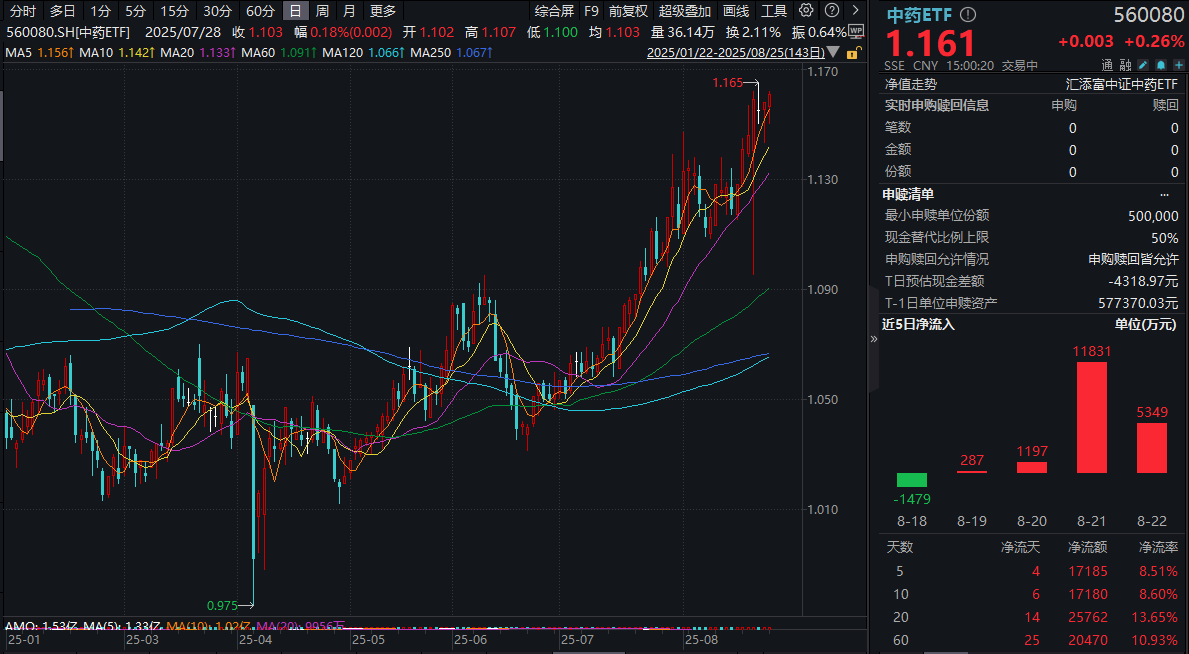
片仔癀绩后跌0.12%,众生药业涨超3%,中药ETF(560080)探底回升收红,全天溢价坚挺!中药公司业绩怎么看?机构:创新构建第二曲线
Xin Lang Cai Jing· 2025-08-25 10:01
Core Viewpoint - The A-share market experienced a significant increase on August 25, with a focus on companies in the traditional Chinese medicine (TCM) sector that have stable performance and high valuation attractiveness, as evidenced by the rebound of the Chinese Medicine ETF (560080) [1] Market Performance - The Chinese Medicine ETF (560080) rose by 0.26% on August 25, with a trading volume exceeding 150 million yuan, a 26% increase compared to the previous period, and a closing premium rate of 0.24% [1] - The ETF has seen a net inflow of over 180 million yuan for four consecutive days, indicating strong investor interest [1] - Key stocks within the ETF showed mixed performance, with New Tian Pharmaceutical rising over 6% and others like Yunnan Baiyao and Dong'e Ejiao experiencing slight increases [1][4] Valuation Metrics - The dynamic price-to-earnings (P/E) ratio of the TCM sector is at a low level since 2021, with the CSI Traditional Chinese Medicine Index TTM P/E ratio at 26.54x as of August 22, 2025 [2] Earnings Reports - As of August 23, 2025, 26 TCM companies have released their semi-annual reports, accounting for 38% of the total TCM companies, with 10 companies reporting revenue growth and 13 companies reporting positive net profit growth [5] - Upcoming reports from 43 companies are expected to provide further insights into the sector's performance [5] Industry Focus Areas - **Price Governance**: The industry is expected to see differentiation due to price governance policies, with companies that have competitive advantages likely to benefit from price-volume trade-offs [6][7] - **Consumption Recovery**: The recovery of consumption, driven by macroeconomic improvement and increased health awareness among the aging population, is anticipated to boost sales of consumer-oriented TCM products [6][8] - **State-Owned Enterprise Reform**: The TCM sector has a higher proportion of state-owned enterprises compared to the overall pharmaceutical industry, and ongoing reforms are expected to create investment opportunities through performance improvements [8] Innovation and Transformation - TCM companies are actively pursuing innovation and transformation into chemical and biological drugs to expand growth opportunities, utilizing strategies such as independent research and development, mergers and acquisitions, and strategic partnerships [9][10] - Specific companies like Zhongsheng Pharmaceutical and Tian Shi Li are focusing on innovative drug development in areas such as metabolic diseases and cardiovascular conditions, with several products in various clinical trial phases [10][11]