ZZPZH(600436)

Search documents
片仔癀:控股股东拟以3亿元—5亿元增持公司股份
Zheng Quan Shi Bao Wang· 2026-01-27 10:15
人民财讯1月27日电,片仔癀(600436)1月27日公告,公司控股股东漳州市九龙江集团有限公司计划自 2026年2月1日起至2026年7月31日以自有及自筹资金,通过上海证券交易所交易系统以集中竞价方式增 持公司股份,合计拟增持金额不低于3亿元(含)且不超过5亿元(含)。 ...

片仔癀(600436) - 漳州片仔癀药业股份有限公司关于PZH2113胶囊Ⅰ期临床试验完成首例受试者入组的公告
2026-01-27 10:15
证券代码:600436 证券简称:片仔癀 公告编号:2026-004 漳州片仔癀药业股份有限公司关于 PZH2113 胶囊 漳州片仔癀药业股份有限公司(以下简称"公司")PZH2113 胶囊Ⅰ期临床试验完成首例受试者入组,对公司本年度的财务状况和 经营业绩无重大影响。 由于药品研发的特殊性,具有周期长、环节多、风险大、投入 高的特点,容易受到政策、技术、市场等多方面因素的影响,审评政 策及产品未来市场竞争形势等存在诸多不确定性风险。 公司将密切关注该药物研发事项的后续进展情况,及时履行信 息披露义务。敬请广大投资者谨慎决策,注意防范投资风险。 Ⅰ期临床试验完成首例受试者入组的公告 本公司董事会及全体董事保证本公告内容不存在任何虚假记载、误导性 陈述或者重大遗漏,并对其内容的真实性、准确性和完整性承担法律责任。 重要内容提示: 近日,公司开展的"评价 PZH2113 胶囊治疗以弥漫性大 B 细胞淋 巴瘤为主的复发性/难治性 B 细胞非霍奇金淋巴瘤受试者的安全性、 耐受性、药代动力学特征和初步疗效的开放、多中心、I 期临床研究" 完成首例受试者入组,正式进入 I 期临床试验。现将相关内容公告如 下: 一、药物的基 ...
片仔癀股价连续8天下跌累计跌幅7.07%,银华基金旗下1只基金持4.66万股,浮亏损失55.83万元
Xin Lang Cai Jing· 2026-01-27 07:17
1月27日,片仔癀跌1.75%,截至发稿,报157.50元/股,成交6.37亿元,换手率0.67%,总市值950.22亿 元。片仔癀股价已经连续8天下跌,区间累计跌幅7.07%。 中药(562390)基金经理为马君。 截至发稿,马君累计任职时间13年149天,现任基金资产总规模508.95亿元,任职期间最佳基金回报 144.61%, 任职期间最差基金回报-75.62%。 资料显示,漳州片仔癀药业股份有限公司位于福建省漳州市芗城区琥珀路1号,成立日期1999年12月28 日,上市日期2003年6月16日,公司主营业务涉及锭剂、片剂、颗粒剂、胶囊剂、软膏剂、糖浆剂、酊 剂的生产,片仔癀牌蜂乳胶囊生产销售等。主营业务收入构成为:医药行业92.26%,其中:医药制造业 55.50%,其中:医药制造业;肝病用药53.85%,其中:医药流通业36.76%,化妆品业5.95%,其他1.53%, 其中:医药制造业;心脑血管用药1.12%,其中:医药制造业;其他0.53%,其他(补充)0.25%。 从基金十大重仓股角度 数据显示,银华基金旗下1只基金重仓片仔癀。中药(562390)四季度增持8900股,持有股数4.66万 股, ...
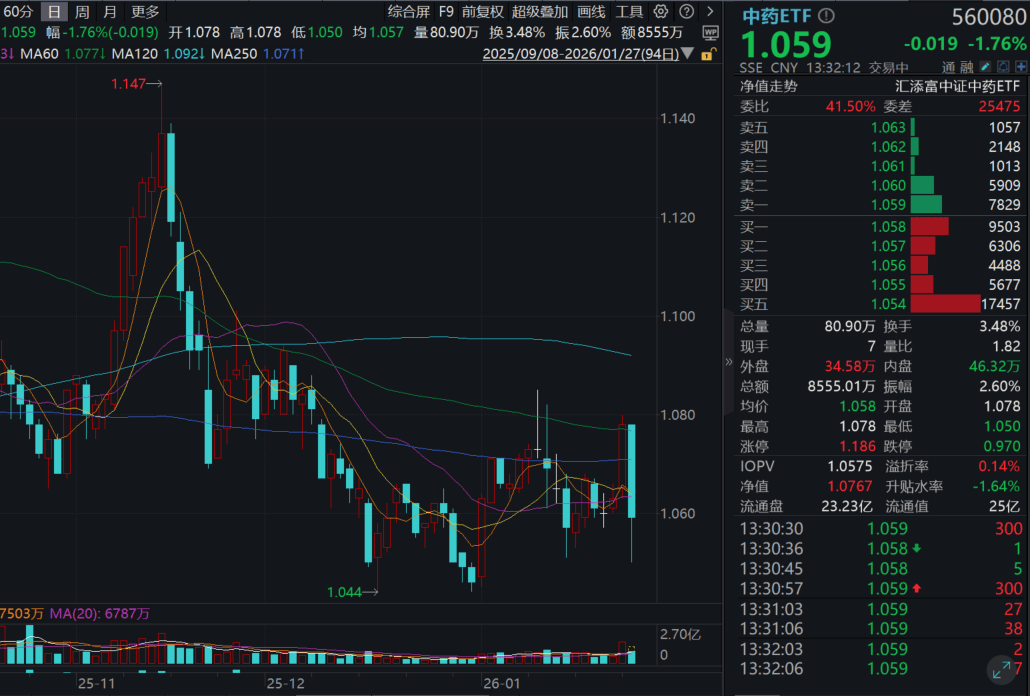
片仔癀连跌8日,盘中跌近1%,至2020年6月以来新低!中药ETF(560080)跌近2%,最新单日吸金近4000万元!众生药业业绩扭亏为盈
Sou Hu Cai Jing· 2026-01-27 06:36
Core Viewpoint - The A-share pharmaceutical sector has gained renewed investor interest due to the resurgence of COVID-19 cases in India, leading to fluctuations in the Chinese medicine ETF (560080) and notable stock performance among key companies in the sector [1][6]. Group 1: Market Performance - The Chinese medicine ETF (560080) experienced a nearly 2% decline on January 27, following a more than 1.4% increase the previous day, with trading volume surpassing 85 million yuan [1]. - Notable declines were observed in key stocks within the ETF, including Zhongsheng Pharmaceutical down over 7% and Yiling Pharmaceutical down over 5%, with several others also experiencing declines [3]. Group 2: Valuation Insights - The latest price-to-earnings ratio (PE TTM) for the index tracked by the Chinese medicine ETF (560080) is 24.57, indicating that the valuation is below 81.27% of the time since the index was published in May 2015, suggesting a favorable valuation opportunity [4]. Group 3: Company News - Zhongsheng Pharmaceutical announced a projected net profit of 260 million to 310 million yuan for 2025, marking a significant turnaround with an increase of 186.91% to 203.62% year-on-year [7]. - Yiling Pharmaceutical also forecasted a net profit of 1.2 billion to 1.3 billion yuan for 2025, indicating a key operational turning point [7]. - Kangyuan Pharmaceutical received approval for clinical trials of a new traditional Chinese medicine aimed at treating children's adenoid hypertrophy, marking a step forward in innovation [7]. Group 4: Industry Trends - The Chinese traditional medicine market is projected to exceed 700 billion yuan in 2024, driven by stable demand amid an aging population, although pricing volatility has been influenced by inventory adjustments and procurement policies [8]. - The industry is experiencing a consolidation trend, with leading companies capturing over half of the market revenue and profits, while ongoing policy focus on innovation and quality development is reshaping the competitive landscape [8].


中国科学家首次证实VV116对尼帕病毒的治疗潜力,医疗创新ETF(516820)连续7天净流入
Xin Lang Cai Jing· 2026-01-27 02:39
Group 1 - The core viewpoint of the news highlights the performance of the China Medical and Medical Device Innovation Index, with notable stock movements, including a leading increase of 8.29% by Sangfor Technologies [1] - The Medical Innovation ETF has seen continuous net inflows over the past week, with a maximum single-day net inflow of 40.537 million yuan, totaling 114 million yuan [1] - A significant research breakthrough was reported regarding the oral nucleoside drug VV116, which shows promising antiviral activity against the Nipah virus, providing a potential treatment option for high-risk populations [1] Group 2 - Guosen Securities noted that the innovative drug sector exhibited significant excess returns in 2025, driven by international business development, continuous positive clinical data, and supportive policies [2] - The Medical Innovation ETF closely tracks the China Medical and Medical Device Innovation Index, which selects 30 profitable and growth-oriented companies to reflect the overall performance of the sector [2] - As of December 31, 2025, the top ten weighted stocks in the index include WuXi AppTec, Heng Rui Medicine, and Mindray Medical, collectively accounting for 63.75% of the index [2]




百川发布循证增强医疗大模型M3 Plus,医疗创新ETF(516820)连续5天净流入
Sou Hu Cai Jing· 2026-01-23 05:56
Group 1 - The core viewpoint of the news highlights the performance of the medical innovation sector, with the China Securities Medical and Medical Device Innovation Index (931484) rising by 0.51% and notable increases in constituent stocks such as Ganli Pharmaceutical (3.05%) and Zhejiang Pharmaceutical (2.29%) [1] - The Medical Innovation ETF (516820) has seen a net inflow of funds over the past five days, with a peak single-day net inflow of 40.537 million yuan, totaling 62.4623 million yuan, averaging a daily net inflow of 12.4925 million yuan [1] - Baichuan Intelligent has launched the Baichuan-M3 Plus evidence-enhanced medical model, achieving a hallucination rate of 2.6%, the lowest globally, and introduced the "Evidence Anchoring" technology to provide citation sources for medical conclusions [1] Group 2 - Everbright Securities emphasizes that the AI+ healthcare sector should focus on several core areas: AI drug development, AI medical imaging, AI chronic disease management, and AI surgical robots, highlighting the strong willingness of pharmaceutical companies to invest in AI drug development due to its potential to significantly shorten drug development cycles [2] - The China Securities Medical and Medical Device Innovation Index selects 30 publicly listed companies with good profitability and growth potential from the pharmaceutical and healthcare sector, reflecting the overall performance of profitable and growth-oriented companies [2] - As of December 31, 2025, the top ten weighted stocks in the index include WuXi AppTec, Hengrui Medicine, Mindray Medical, and others, accounting for 63.75% of the total index weight [2]



股市必读:片仔癀(600436)1月20日主力资金净流出831.56万元,占总成交额2.32%
Sou Hu Cai Jing· 2026-01-20 18:35
漳州片仔癀药业股份有限公司全资子公司片仔癀投资参与设立中金(漳州)医疗产业投资合伙企业(有 限合伙),认缴出资20,000万元,占比20.00%。该基金已完成在中国证券投资基金业协会的私募投资基 金备案,备案编码SBMU37,管理人为中金资本运营有限公司,托管人为兴业银行股份有限公司。公司 本次投资旨在加强产业链整合,提升核心竞争力,但存在投资周期长、收益不确定等风险。 截至2026年1月20日收盘,片仔癀(600436)报收于167.22元,下跌0.36%,换手率0.35%,成交量2.14万 手,成交额3.58亿元。 以上内容为证券之星据公开信息整理,由AI算法生成(网信算备310104345710301240019号),不构成 投资建议。 当日关注点 来自交易信息汇总:1月20日主力资金净流出831.56万元,游资资金净流入1667.87万元。 来自公司公告汇总:片仔癀投资2亿元参与中金(漳州)医疗产业投资合伙企业,基金已完成备 案。 交易信息汇总资金流向 1月20日主力资金净流出831.56万元,占总成交额2.32%;游资资金净流入1667.87万元,占总成交额 4.66%;散户资金净流出836.31万 ...
富养自己的最好方式,8件好物,后悔没早买!
洞见· 2026-01-20 12:35
Core Viewpoint - The article highlights the rapid rise of domestic brands in China, showcasing their improved quality, aesthetic appeal, and cost-effectiveness, which has led to a significant shift in consumer preferences towards domestic products [4][6]. Group 1: Rise of Domestic Brands - Domestic brands have transformed from being perceived as low-quality to becoming competitive with international brands, with numerous new brands emerging in the market [4]. - Brands like Ma Ying Long, Kang Xue, and Shi Lang are gaining popularity due to their professional expertise and effective products [5]. - The phrase "Made in China" now carries a more positive connotation, reflecting the quality and innovation of domestic products [6]. Group 2: Product Recommendations - The article lists several high-quality domestic products, emphasizing their affordability and effectiveness: - Shi Lang Anti-Hair Loss Shampoo: 69.9 yuan for 2 bottles, known for its oil control and anti-hair loss properties [10]. - Kang Xue Camellia Seed Oil: 89 yuan for 3 bottles, praised for its skin-nourishing benefits [41][59]. - Ma Ying Long Eye Cream and Eye Mask: Starting at 69 yuan, effective for tightening and reducing wrinkles around the eyes [62][82]. - Pian Zai Huang Pearl Cream: 49.9 yuan for 3 bottles, recognized for its moisturizing and skin-softening effects [85][98]. - Soft and comfortable underwear: 69 yuan for 2 pieces, noted for its comfort and shaping qualities [100][113]. - Cherry Red Coat: 159 yuan, stylish and suitable for winter [138][156]. - Fatty Oil Cream: 49 yuan for 3 bottles, effective for dry skin [159][184]. - Wo Pin Bluetooth Earphones: 89 yuan, offering high-quality sound and comfort [185][210].


片仔癀:参投中金医疗基金完成备案 助力漳州“圆山计划”提速
Zhong Zheng Wang· 2026-01-20 07:17
中证报中证网讯(记者 罗京)1月19日晚,片仔癀(600436)发布公告称,公司近日收到通知,旗下公 司参与发起的中金医疗基金已在中国证券投资基金业协会完成私募投资基金备案手续,并取得《私募投 资基金备案证明》。 据介绍,中金医疗基金由片仔癀全资子公司漳州片仔癀投资管理有限公司(下称"片仔癀投资")与中金 资本运营有限公司、漳州市产业股权投资有限公司等多方共同发起设立,目标募集规模10亿元。其中, 片仔癀投资作为有限合伙人以自有资金认缴出资2亿元,占基金比例的20%。 值得注意的是,此次片仔癀参与设立的中金医疗基金,是漳州市"圆山计划"下设的第四只产业基金。该 计划于2024年4月由漳州市政府启动,旨在推动两岸医药、医疗、医养、医旅融合发展,进一步壮大中 医药产业。根据规划,"圆山计划"将分批次组建总规模50亿元的产业基金,以地方政府与国资为主导, 引导社会资本共同投入。 近年来,片仔癀持续推动医药主业与相关产业投资双向发力。一方面,公司围绕中成药、化药创新药、 大单品、医药商业、日化美妆五大方向强化主业;另一方面,通过并购与投资延伸产业链,发挥品牌 与"链主"作用,构建以片仔癀为核心的大健康产业生态圈。片仔 ...
脑机接口概念利好不断,医疗创新ETF(516820)持续吸金
Sou Hu Cai Jing· 2026-01-20 06:32
Group 1 - The core viewpoint of the articles indicates a mixed performance in the medical and healthcare sector, with the China Medical and Medical Device Innovation Index experiencing a decline of 0.85% as of January 20, 2026, while certain stocks like Xinhecheng and Xingqi Eye Medicine showed gains [1] - The medical innovation ETF saw a decrease of 0.80%, with the latest price at 0.37 yuan, reflecting the overall market sentiment [1] - The brain-computer interface concept is gaining traction, supported by a significant investment of over 730 billion yuan in technology loans by the China Export-Import Bank, focusing on AI, brain-computer interfaces, humanoid robots, and high-end instruments [1] Group 2 - According to J.P. Morgan's conference, over 20 Chinese companies participated, highlighting the growing global interest in domestic innovative drugs and medical devices, which is expected to boost industry sentiment [1] - The China Medical and Medical Device Innovation Index includes 30 companies with strong profitability and growth potential, with the top ten stocks accounting for 63.75% of the index [2] - Recent data shows a net inflow of 1.8727 million yuan into the medical innovation ETF, with a total of 59.7643 million yuan over the past five trading days, indicating a positive trend in investor interest [2]