Workflow
JLPC(600513)
icon
Search documents
江苏国企改革板块9月2日跌0.85%,联环药业领跌,主力资金净流出7.2亿元
Sou Hu Cai Jing· 2025-09-02 09:42
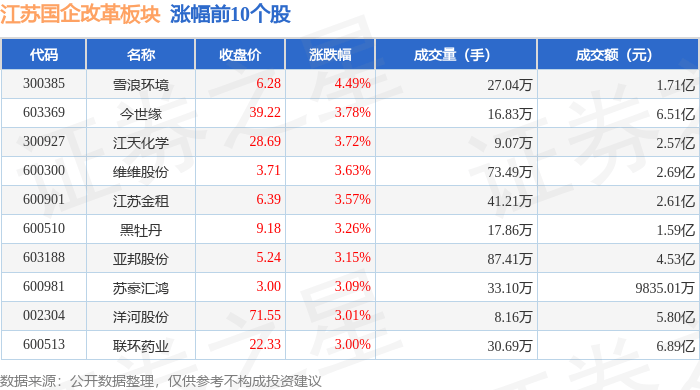
Market Overview - On September 2, the Jiangsu state-owned enterprise reform sector fell by 0.85% compared to the previous trading day, with Lianhuan Pharmaceutical leading the decline [1] - The Shanghai Composite Index closed at 3858.13, down 0.45%, while the Shenzhen Component Index closed at 12553.84, down 2.14% [1] Stock Performance - Notable gainers in the Jiangsu state-owned enterprise reform sector included: - Huami Environmental Energy (600475) with a closing price of 23.86, up 10.00% [1] - Zhongsheng High-Tech (002778) with a closing price of 20.94, up 5.23% [1] - Nanjing Port (002040) with a closing price of 10.03, up 3.62% [1] - Major decliners included: - Lianhuan Pharmaceutical (600513) with a closing price of 21.96, down 6.63% [2] - Tongxingbao (301339) with a closing price of 16.73, down 4.35% [2] - Nanjing Chemical Fiber (600889) with a closing price of 15.16, down 4.29% [2] Capital Flow - The Jiangsu state-owned enterprise reform sector experienced a net outflow of 720 million yuan from institutional investors, while retail investors saw a net inflow of 409 million yuan [2][3] - The capital flow for specific stocks showed: - Huami Environmental Energy (600475) had a net inflow of 1.421 billion yuan from institutional investors [3] - Jiangsu Jinzhu (002091) had a net inflow of 12.13 million yuan from institutional investors [3] - Nanjing Travel (600250) had a net inflow of 10.72 million yuan from institutional investors [3]
联环药业涨2.03%,成交额3.31亿元,主力资金净流入1260.89万元
Xin Lang Cai Jing· 2025-08-29 03:08
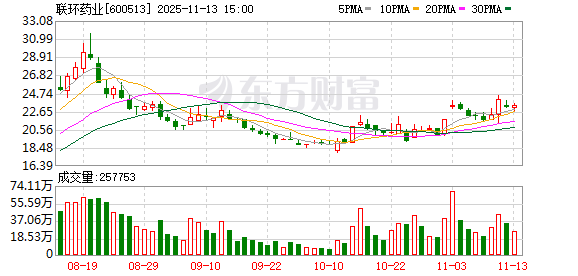
Group 1 - The core viewpoint of the news is that Lianhuan Pharmaceutical has shown significant stock performance with a year-to-date increase of 140.30%, despite a recent decline of 4.07% over the last five trading days [1] - As of August 29, Lianhuan Pharmaceutical's stock price reached 23.60 yuan per share, with a total market capitalization of 6.737 billion yuan [1] - The company has been actively traded, with a net inflow of main funds amounting to 12.6089 million yuan and significant trading volumes in large orders [1] Group 2 - Lianhuan Pharmaceutical operates in the pharmaceutical and biological industry, specifically in chemical pharmaceuticals and preparations, and is categorized under several concept sectors including small-cap and biomedicine [2] - For the first half of 2025, Lianhuan Pharmaceutical reported a revenue of 1.285 billion yuan, reflecting a year-on-year growth of 14.12%, while the net profit attributable to the parent company was -40.0284 million yuan, a decrease of 163.65% [2] - The company has distributed a total of 343 million yuan in dividends since its A-share listing, with 111 million yuan distributed over the past three years [3]
联环药业2025年中报简析:增收不增利
Zheng Quan Zhi Xing· 2025-08-27 22:56
Group 1 - The core viewpoint of the article highlights that Lianhuan Pharmaceutical (600513) has experienced revenue growth but a significant decline in profit, with total revenue reaching 1.285 billion yuan, a year-on-year increase of 14.12%, while net profit attributable to shareholders was -40.0284 million yuan, a year-on-year decrease of 163.65% [1] - In Q2, the company reported total revenue of 658 million yuan, reflecting a year-on-year increase of 9.99%, but the net profit attributable to shareholders was -63.0879 million yuan, a year-on-year decline of 307.92% [1] - The financial indicators show a gross margin of 38.8%, down 23.88% year-on-year, and a net margin of -2.52%, down 139.01% year-on-year [1] Group 2 - The company's return on invested capital (ROIC) for the previous year was 5.58%, indicating generally weak capital returns, with a median ROIC of 7.46% over the past decade [2] - The company's business model relies heavily on research and marketing, necessitating a thorough examination of the underlying drivers of these aspects [2] - The cash flow situation is concerning, with cash and cash equivalents to current liabilities at only 22.49%, and the average operating cash flow over the past three years to current liabilities at just 7.97% [2]
联环药业股价下跌5.1% 上半年亏损4003万元
Jin Rong Jie· 2025-08-27 20:53
Group 1 - The stock price of Lianhuan Pharmaceutical closed at 22.89 yuan on August 27, down 1.23 yuan or 5.1% from the previous trading day [1] - The company operates in the chemical pharmaceutical industry, focusing on the research, production, and sales of chemical raw materials and formulations, with products covering various therapeutic areas including anti-infectives, cardiovascular drugs, and digestive system medications [1] - Lianhuan Pharmaceutical completed the acquisition of Changle Pharmaceutical and signed an investment agreement with Longyi Pharmaceutical [1] Group 2 - The company reported a half-year revenue of 1.29 billion yuan, representing a year-on-year increase of 14.1%, but incurred a net loss attributable to shareholders of 40.03 million yuan, a decline of 163.7% year-on-year [1] - In the second quarter, the company experienced a loss of 63.09 million yuan, a year-on-year decrease of 307.9% [1] - Sales of the key product, Aipuliet Tablets, reached 116 million yuan, showing a year-on-year growth of 4.85% [1] Group 3 - On August 27, the net outflow of main funds from Lianhuan Pharmaceutical was 128 million yuan, accounting for 1.96% of the circulating market value [1] - Over the past five trading days, the cumulative net outflow of main funds reached 632 million yuan, representing 9.67% of the circulating market value [1]
联环药业(600513)6月30日股东户数3.01万户,较上期减少0.72%
Zheng Quan Zhi Xing· 2025-08-27 11:41
Core Viewpoint - Lianhuan Pharmaceutical reported a decrease in shareholder accounts and average shareholding value, indicating a trend of reduced investor engagement despite a slight increase in stock price over the observed period [1][2]. Group 1: Shareholder Statistics - As of June 30, 2025, the number of shareholders for Lianhuan Pharmaceutical was 30,095, a decrease of 218 accounts or 0.72% from March 31, 2025 [1][2]. - The average number of shares held per account increased from 9,417 shares to 9,485 shares, with an average market value of 95,100 yuan [1][2]. - Compared to the chemical pharmaceutical industry, Lianhuan's shareholder count is below the industry average of 33,000 accounts, and its average market value is significantly lower than the industry average of 394,700 yuan [1][2]. Group 2: Stock Performance - From March 31, 2025, to June 30, 2025, Lianhuan Pharmaceutical's stock price increased by 2.51%, while the number of shareholders decreased [1][2]. - During this period, the net outflow of funds from major investors was 74.91 million yuan, while retail investors contributed a net inflow of 88.67 million yuan [2].
联环药业6月30日股东户数3.01万户,较上期减少0.72%
Zheng Quan Zhi Xing· 2025-08-27 10:29
Group 1 - The core point of the article highlights that Lianhuan Pharmaceutical's shareholder count decreased to 30,095 as of June 30, 2025, representing a reduction of 218 shareholders or 0.72% compared to March 31, 2025 [1][2] - The average shareholding value per shareholder for Lianhuan Pharmaceutical is 95,100 yuan, which is below the industry average of 394,700 yuan for A-share listed companies in the chemical pharmaceutical sector [1][2] - The stock price of Lianhuan Pharmaceutical increased by 2.51% from March 31, 2025, to June 30, 2025, despite the decrease in shareholder count [1][2] Group 2 - From March 31, 2025, to June 30, 2025, the net outflow of main funds for Lianhuan Pharmaceutical was 74.91 million yuan, while retail investors saw a net inflow of 88.67 million yuan [2] - The average number of shares held per shareholder increased from 9,416.96 shares on March 31, 2025, to 9,485.17 shares on June 30, 2025 [2] - The overall trend in shareholder count shows fluctuations, with a notable increase of 3,244 shareholders from December 31, 2024, to March 31, 2025, followed by a decrease in the subsequent quarter [2]
破除垄断 为民监管——医药领域反垄断执法成效纪实
Zhong Guo Jing Ji Wang· 2025-08-27 09:54
Core Points - The Chinese government emphasizes that modernity is fundamentally linked to public health, with a focus on affordable and essential medications for the population [1] - The market regulatory authorities have intensified anti-monopoly enforcement in the pharmaceutical sector, resulting in significant price reductions for essential drugs [2][3] - Recent anti-monopoly cases have restored market competition and reduced both patient medication costs and insurance expenditures [3][4] Summary by Sections Anti-Monopoly Enforcement - The market regulatory authorities have taken strong actions against pharmaceutical monopolies, with penalties totaling 6.23 billion yuan in the first half of the year [4] - Specific cases include the price manipulation of dexamethasone phosphate sodium, where the price surged from 8,000 yuan per kilogram to 13,000 yuan, leading to a 282-fold increase in the injection price [2][3] - The authorities have implemented a "punishment to individuals" approach, holding both companies and responsible individuals accountable for anti-competitive practices [5] Market Impact - The crackdown on monopolistic practices has led to a nearly 94% price reduction for dexamethasone phosphate sodium injection, from 7.2 yuan to 0.45 yuan [2][3] - The enforcement actions have also addressed other critical drugs, ensuring their availability and affordability for patients [3][4] Regulatory Framework - The market regulatory authorities are developing clearer anti-monopoly guidelines for the pharmaceutical sector, with a focus on enhancing compliance and preventing future violations [6][7] - The shift from punitive measures to proactive compliance strategies aims to foster a competitive environment that benefits public health [6][7] Industry Response - Pharmaceutical companies are increasingly recognizing the importance of compliance with anti-monopoly regulations as essential for their survival and competitiveness [7] - Training programs are being implemented to enhance awareness and understanding of anti-monopoly laws among industry professionals [7]
联环药业: 联环药业董事会议事规则
Zheng Quan Zhi Xing· 2025-08-26 16:40
Core Points - The document outlines the rules for the board of directors of Jiangsu Lianhuan Pharmaceutical Co., Ltd., aiming to standardize meeting procedures and decision-making processes [2][3][19] Group 1: Board Structure and Meetings - The board consists of 9 directors, including 3 independent directors and 1 employee representative, with the chairman and vice-chairman also included [3][4] - Regular meetings must be held at least twice a year, while special meetings can be called under specific circumstances [4][5] - The board secretary is responsible for daily affairs and must ensure that meeting notifications are sent out in a timely manner [3][9] Group 2: Meeting Procedures - Meeting notifications for regular and special meetings must be sent out 10 days and 5 days in advance, respectively [9][10] - A quorum requires the presence of more than half of the directors, and the meeting can be conducted in person or through electronic means [11][14] - Decisions require a majority vote from the directors present, with specific rules for abstentions and conflicts of interest [19][15] Group 3: Documentation and Record-Keeping - The board secretary must maintain detailed records of meetings, including attendance, proposals, and voting results [25][27] - Meeting records must be signed by attending directors, and any dissenting opinions should be documented [17][18] - All meeting documentation must be preserved for at least ten years [30]
联环药业: 联环药业子公司董事、监事、高管委派制度(2025年8月修订)
Zheng Quan Zhi Xing· 2025-08-26 16:40
Core Points - The document outlines the system for appointing directors, supervisors, and senior executives in subsidiaries of Jiangsu Lianhuan Pharmaceutical Co., Ltd to strengthen management and protect the interests of the parent company [1][2] - The system is established in accordance with relevant laws, regulations, and internal control norms [1] Group 1: General Provisions - The system aims to enhance the management and control of subsidiaries by the parent company [1] - It defines the roles of appointed directors, supervisors, and senior executives as representatives of the parent company in subsidiaries [1] - The subsidiaries referred to include wholly-owned and controlled subsidiaries of the parent company [1] Group 2: Qualifications for Appointed Personnel - Appointed personnel must meet the qualifications set forth in the Company Law and the parent company's articles of association [2] - They should possess professional qualifications and experience of at least two years in similar positions [2] - Health and energy levels sufficient to fulfill their duties are also required [2] Group 3: Appointment and Dismissal Procedures - The appointment and dismissal procedures must comply with the collective decision-making system of the company [3] - The parent company's general manager, in collaboration with the HR department, recommends candidates for appointment [3] - The parent company may also utilize public recruitment to identify candidates for these positions [3] Group 4: Performance Evaluation and Compensation - The HR department of the parent company is responsible for evaluating the performance of appointed personnel [4] - Annual performance reports must be submitted by the appointed personnel to the HR department [4] - Compensation is linked to performance evaluations, with proposals submitted for approval by the parent company's management [4] Group 5: Legal Compliance and Responsibilities - Appointed personnel are required to comply with the Company Law and other relevant regulations [5] - The parent company retains the right to seek compensation for losses caused by negligence or misconduct of appointed personnel [5] - The system also applies to the appointment of personnel in affiliated subsidiaries, subject to actual circumstances [5]
联环药业: 联环药业募集资金使用管理办法(2025年8月修订)
Zheng Quan Zhi Xing· 2025-08-26 16:40
Core Viewpoint - The management measures for the use of raised funds by Jiangsu Lianhuan Pharmaceutical Co., Ltd. aim to standardize the usage and management of raised funds, enhance their effectiveness, and protect investors' rights [1]. Group 1: General Principles - The purpose of the management measures is to regulate the use and management of raised funds, improve their effectiveness, and protect investors' rights based on relevant laws and regulations [1]. - The term "raised funds" refers to funds raised through public and non-public securities issuance, excluding funds raised for equity incentive plans [1]. - "Excess raised funds" refers to the portion of actual net raised funds that exceeds the planned amount [1]. Group 2: Fund Storage - Raised funds must be stored in a special account approved by the board of directors, and cannot be used for non-raised fund purposes [4]. - A tripartite supervision agreement must be signed with the sponsor or independent financial advisor and the commercial bank within one month of the funds being received [4][5]. - The agreement must include details such as the account number, project details, and monthly bank statements [5]. Group 3: Fund Usage - The company must adhere to specific requirements when using raised funds, including clear regulations on application, approval, and disclosure procedures [11]. - Funds should primarily be used for main business operations and cannot be used for financial investments or to benefit related parties improperly [13]. - Any changes in the use of raised funds must be approved by the board and disclosed to shareholders [24][25]. Group 4: Supervision and Reporting - The company must maintain accurate records of fund usage and undergo quarterly internal audits [16]. - The board is required to conduct a comprehensive review of project progress and fund usage every six months, issuing a special report [32]. - Independent directors and the audit committee must continuously monitor the management and usage of raised funds [33]. Group 5: Excess Funds Management - Excess funds can be used for permanent working capital or repaying bank loans, with specific limits on the amount used [10][11]. - Any use of excess funds must be approved by the board and disclosed to shareholders, including the necessity and detailed plans for such use [11].