
Tsingtao Brewery(600600)

Search documents
青岛啤酒(600600) - 青岛啤酒股份有限公司第十一届董事会第四次会议决议公告
2026-01-20 12:15
青岛啤酒股份有限公司 第十一届董事会第四次会议决议公告 本公司董事会及全体董事保证本公告内容不存在任何虚假记载、误导性陈述 或者重大遗漏,并对其内容的真实性、准确性和完整性承担法律责任。 一、董事会会议召开情况 青岛啤酒股份有限公司(以下简称"公司"或"本公司")第十一届董事会第四 次会议(以下简称"会议")于 2026 年 1 月 19 日在青岛以现场结合视频会议方式召 开,会议通知及会议材料已按照《青岛啤酒股份有限公司章程》(以下简称"《公司 章程》")规定及时以书面方式送达全体董事。会议应出席董事 9 人,实际出席董事 9 人。会议由董事长姜宗祥先生主持,公司董事会秘书侯秋燕先生和证券事务代表孙晓 航先生列席参加。会议的召开符合《中华人民共和国公司法》(以下简称"《公司法》") 等现行法律法规、上市地上市规则及《公司章程》的规定。 二、董事会会议审议情况 (一)审议通过青岛啤酒财务有限责任公司(以下简称"财务公司")2026 年度 固定收益类投资业务规划。 1.同意财务公司在有效防控风险、确保资金安全的前提下,投资业务任一业务 时点余额合计不超过人民币 43.4 亿元且不超过财务公司资本净额的 70%, ...
食品饮料行业2026年投资策略:白酒有望调整结束,大众品优选个股
Southwest Securities· 2026-01-20 09:16
Core Insights - The report indicates that the adjustment period for high-end liquor is expected to end, highlighting the long-term investment value in this sector. The price of mainstream liquor has decreased from approximately 2200 yuan around the Spring Festival in 2025 to about 1560 yuan currently, with a notable decline since June [4][30][32] - The beer industry is anticipated to benefit from a low base effect in 2026, with emerging retail channels and government consumption stimulus policies expected to drive recovery [5][42] - The dairy industry is currently in a transitional phase, with low milk prices expected to rebound as demand improves and supply stabilizes. The long-term growth potential remains strong due to ongoing consumption upgrades [5][60][63] - The condiment sector is projected to benefit from a gradual recovery in restaurant consumption, with both B2B and B2C channels expected to see improved sales as consumer spending recovers [5][79] Liquor Industry - High-end liquor is expected to stabilize after a period of adjustment, with long-term investment value becoming more apparent. The market share of premium liquor brands continues to rise, and the consumption upgrade trend remains intact despite short-term impacts [4][30][34] - The competition in the mid-range liquor segment has intensified, with brands experiencing varying levels of performance due to market pressures. The demand for mid-range products has been notably affected by weak business consumption [36][39] - Inventory management is crucial, with manufacturers actively controlling supply to maintain price stability. The introduction of information systems has improved inventory management capabilities [40][39] Beer Industry - The beer market is expected to recover due to a low base effect from 2025, with national leaders likely to benefit significantly. The rise of instant retail channels is also anticipated to drive growth in non-on-premise beer sales [42][43] - The industry is entering a mature phase, with a focus on premiumization and product structure upgrades. The market share of high-end products is increasing, reflecting a shift in consumer preferences [47][50] - Cost stability is expected in 2026, with barley prices remaining low and contributing to profit margins. The overall cost structure is anticipated to support profitability in the beer sector [51][53] Dairy Industry - The dairy sector is currently experiencing a down cycle in milk prices, but a rebound is expected as demand improves and supply stabilizes. The long-term growth potential remains strong due to increasing consumer preferences for high-quality dairy products [60][63] - The population base in China supports the demand for dairy products, with significant growth potential in rural areas where consumption is currently lower compared to urban areas [66][70] - The industry is witnessing a shift towards high-quality growth, with leading companies focusing on improving profitability through better cost management and efficiency [60][77] Condiment Industry - The condiment sector is expected to benefit from a gradual recovery in restaurant consumption, with B2B channels likely to see significant improvements as consumer spending increases [79][84] - The industry has shown resilience, with a stable growth rate over the past five years. The market size for condiments has surpassed 650 billion yuan, driven by rising consumer demand and changing eating habits [83][84] - Cost advantages are anticipated in 2026, with raw material prices remaining low, which will help maintain stable growth in the condiment sector [79][80]




啤酒概念涨1.52%,主力资金净流入14股
Zheng Quan Shi Bao Wang· 2026-01-20 08:49
Group 1 - The beer concept index rose by 1.52%, ranking 8th among concept sectors, with 18 stocks increasing in value, including Hongmian Co., HeBai Group, and Jiamei Packaging reaching the daily limit [1] - Leading gainers in the beer sector included Haoxiangni, Kaimeteqi, and Aoruijin, with respective increases of 5.77%, 5.31%, and 3.76% [1] - The stocks with the largest declines were Zhuhai Zhongfu, *ST Lanhua, and Pinwo Food, which fell by 3.18%, 2.94%, and 1.94% respectively [1] Group 2 - The beer concept sector saw a net inflow of 828 million yuan, with 14 stocks receiving net inflows, and 5 stocks exceeding 50 million yuan in net inflow [2] - Kaimeteqi led the net inflow with 254 million yuan, followed by Hongmian Co., Luzhou Laojiao, and HeBai Group with net inflows of 167 million yuan, 164 million yuan, and 130 million yuan respectively [2] Group 3 - In terms of net inflow ratios, Hongmian Co., HeBai Group, and Chongqing Beer had the highest ratios at 32.90%, 15.07%, and 13.17% respectively [3] - The top stocks in the beer concept by net inflow included Kaimeteqi with a 5.31% increase and a turnover rate of 16.50%, and Hongmian Co. with a 10.13% increase and a turnover rate of 9.38% [3][4]



【转|太平洋食饮-26年度策略】底部向阳,寻找结构性亮点
远峰电子· 2026-01-18 11:38
Overall Sector Review - The food and beverage sector significantly underperformed the market, with a year-to-date decline of -0.62%, lagging behind the Shanghai Composite Index by 15.0 percentage points [2] - The sector experienced a deep correction after an initial rebound driven by expectations of consumption recovery and supportive policies, but the actual recovery rate was lower than anticipated, leading to a consensus on weak domestic demand [2] Subsector Performance - The snack sector outperformed with a year-to-date increase of 28.88%, driven by channel expansion and a revenue growth rate of 30.97% in the first three quarters [4] - Soft drinks also showed resilience with a 10.11% stock price increase, benefiting from strong travel demand and low-cost, high-frequency consumption [4] - The restaurant chain sector saw a rebound with gains of approximately 10.34% and 10.29% for pre-processed and baked goods, respectively [4] - The liquor sector, particularly high-end liquor, faced challenges with weaker sales and declining prices, while beer performance was supported but affected by high-end market constraints [4] Investment Insights - The sector is under pressure from deflationary trends and a weak recovery, with consumer confidence remaining low, indicating a shift to a "new normal" of low growth [8] - High-end consumption has shown slight recovery due to stock market wealth effects, but sustainability remains a concern [9] - The food and beverage sector's valuation is at historical lows, with a current PE (TTM) of 21.9X, indicating potential investment opportunities in undervalued segments [12] Fund Holdings - As of Q3 2025, the food and beverage sector's fund holdings decreased to 6.38%, nearing levels seen in 2016, with the liquor segment comprising 5.52% of this [14] - Fund holdings in the liquor sector increased for certain subsectors, including white liquor and seasoning products, while others saw declines [16] Long-term Trends - The liquor industry is undergoing its longest adjustment period since 2003, with significant price corrections and a potential bottoming out of valuations [21] - The white liquor sector has underperformed the market with a year-to-date return of -4.87%, reflecting weak demand and a divergence from broader market trends [24] - The third quarter of 2025 saw a significant decline in revenue and net profit for the white liquor sector, indicating a deep adjustment phase [27] Pricing Dynamics - The white liquor market is experiencing a general decline in prices, particularly in high-end segments, while lower price segments show resilience [29] - The average price of high-end products like Moutai has dropped significantly, while mid-range and lower-range products have maintained stability or slight increases [31] Investment Recommendations - The white liquor sector is advised to focus on inventory reduction and demand recovery, with a preference for leading brands that can maintain pricing power and product stability [32]





非白酒板块1月14日跌0.63%,燕京啤酒领跌,主力资金净流出7660.75万元
Zheng Xing Xing Ye Ri Bao· 2026-01-14 08:50
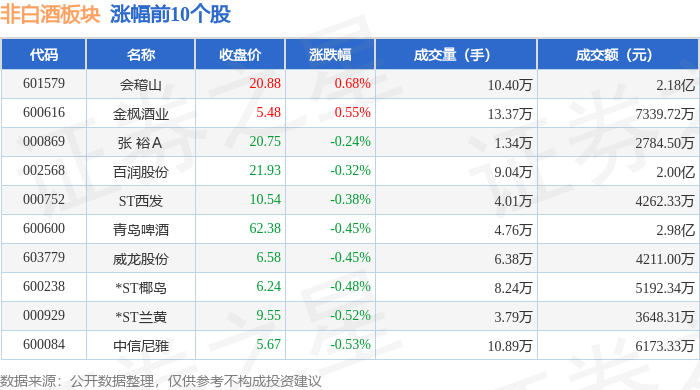
Market Overview - The non-baijiu sector experienced a decline of 0.63% on January 14, with Yanjing Beer leading the drop [1] - The Shanghai Composite Index closed at 4126.09, down 0.31%, while the Shenzhen Component Index closed at 14248.6, up 0.56% [1] Stock Performance - Key stocks in the non-baijiu sector showed varied performance, with Kuaijishan closing at 20.88, up 0.68%, and Zhangyu A at 20.75, down 0.24% [1] - Other notable declines included ST Xifa at 10.54, down 0.38%, and Qingdao Beer at 51.80, down 0.97% [2] Trading Volume and Value - Kuaijishan had a trading volume of 104,000 shares and a transaction value of 218 million yuan, while ST Xifa had a volume of 40,100 shares and a value of 42.62 million yuan [1] - The non-baijiu sector saw a total net outflow of 76.61 million yuan from main funds, with retail investors contributing a net inflow of 43.96 million yuan [2] Fund Flow Analysis - Main funds showed a net inflow of 10.61 million yuan for Kuaijishan, while Zhangyu A experienced a net outflow of 2.52 million yuan [3] - The overall fund flow indicates a mixed sentiment, with retail investors showing interest in certain stocks despite the overall outflow from main funds [3]


食品饮料行业周报:食品价格继续改善,消费潜力不断释放-20260113
Donghai Securities· 2026-01-13 09:17
Investment Rating - The report assigns an "Overweight" rating for the food and beverage industry, indicating a positive outlook for the sector relative to the broader market [1]. Core Insights - The report highlights that the Consumer Price Index (CPI) in December 2025 reached its highest year-on-year increase since March 2023, with food prices continuing to improve. This is attributed to policies aimed at boosting domestic demand and increased consumer spending during the New Year period [5][48]. - The food and beverage sector saw a 2.12% increase in the market last week, underperforming the CSI 300 index by 0.66 percentage points, ranking 26th among 31 sectors [10]. - Key companies such as Sam's Club and Alibaba are expanding aggressively, with Sam's Club projected to exceed 140 billion yuan in sales for 2025, marking a 40% increase from 2024 [48]. Summary by Sections 1. Market Performance - The food and beverage sector's performance was highlighted, with a 2.12% increase last week, while the pre-processed food sub-sector performed particularly well with a 6.72% increase [10][13]. - The top five performing stocks included Qianwei Yangchun, Anji Food, and Yangyuan Beverage, with respective increases of 22.52%, 18.34%, and 14.78% [10][15]. 2. Price Trends - The report notes that food prices have shown significant increases, particularly in fresh vegetables and fruits, which rose by 18.2% and 4.4% year-on-year, respectively [5]. - The price of milk was reported at 12.17 yuan per liter, with a slight year-on-year decrease of 0.16% [26]. 3. Industry Dynamics - The report discusses the expansion of membership supermarkets and instant retail, with notable growth in companies like Sam's Club and Alibaba's Taobao Flash Sale [48][49]. - The government is implementing a comprehensive policy to stimulate domestic demand, focusing on enhancing consumer spending and supporting private investment [49]. 4. Core Company Updates - New Dairy announced a cash dividend of 0.70 yuan per share, while Fuling Pickled Vegetables and Luzhou Laojiao also declared significant cash dividends [51].


啤酒行业专题报告:渠道变革,精酿崛起
GUOTAI HAITONG SECURITIES· 2026-01-13 05:15
Investment Rating - The report rates the beer industry as "Buy" [1] Core Insights - The beer industry is entering a new normal characterized by stock competition, with structural opportunities arising from category and channel changes. The demand for beer in China has been gradually declining in 2023, and it is expected to follow a long-term downward trend similar to overseas experiences. The average selling price (ASP) of leading companies is projected to increase by only 0.4% in 2024 due to weaker-than-expected demand recovery and inflation decline [4][7] - The rise of craft beer represents a significant opportunity for the industry, with leading companies likely to benefit from this trend. The penetration rate of craft beer in China is estimated to be around 3%, which is still significantly lower than the 5-15% levels seen in developed countries [4][20] - New retail channels are rapidly growing, driven by consumer demands for convenience, rationality, and differentiation. The estimated sales of beer through new retail channels are around 30 billion yuan, with a penetration rate of approximately 6% and an annual growth rate of about 20% [4][61] Summary by Sections 1. Industry New Phase: Stock Era, Channel Change, Craft Beer Rise - The beer industry in China is experiencing a new normal with both volume and price entering a downward trend. The production volume is expected to decline by 0.4% in 2023 and 1.0% in 2024 [7][4] - The concentration of leading companies is expected to decrease slightly, with the CR5 ratio projected to drop by 3.5 percentage points to around 74.8% in 2024 [14][4] 2. Category Change: Demand Shift Creates Opportunities, Large Companies to Benefit - The demand for beer in China is at a turning point, with potential for big single product opportunities. The younger generation is becoming the main consumer group, leading to a shift in drinking culture towards personal preference [23][24] - The craft beer market is expected to grow significantly, with an estimated annual growth rate in sales exceeding double digits. The penetration rate of craft beer is projected to reach around 3% by 2025 [29][30] 3. Channel Change: Demand Stock Competition, Impact on Structure Manageable - The structure of beer distribution channels is changing, with a decline in traditional on-premise sales and an increase in new retail channels. The new retail channel is expected to account for about 6% of total beer sales, with significant growth in instant retail and membership warehouse stores [56][61] - The rapid growth of new retail channels is driven by improved logistics efficiency and changing consumer preferences for convenience and differentiated products [57][61]

直航开通后,青岛迎来越南文旅考察团
Qi Lu Wan Bao· 2026-01-12 21:52
Group 1 - The core viewpoint of the news is that the opening of the direct flight route from Qingdao to Ho Chi Minh City marks a new phase in cultural and tourism exchanges between Qingdao and Southeast Asia, with expectations of increased Vietnamese tourist arrivals during the upcoming Spring Festival [1][2] - The direct flight route operates 14 round trips weekly, providing more convenient travel options for travelers between China and Vietnam, which is expected to enhance tourist conversion rates [2][3] - The Vietnamese travel merchants and influencers expressed strong interest in Qingdao's unique winter attractions and cultural offerings, indicating potential for Qingdao to become a popular destination for Vietnamese tourists during the Spring Festival [2][4] Group 2 - The itinerary of the Vietnamese delegation included visits to key cultural and tourism resources in Qingdao, such as historical sites, coastal attractions, and seasonal activities, showcasing the city's diverse offerings [3][4] - The delegation's immersive experience highlighted Qingdao's unique urban planning that integrates natural landscapes with cultural heritage, enhancing their understanding of the city's tourism potential [3][4] - Qingdao's tourism strategy for 2026 focuses on deepening ties with Korea, expanding into Southeast Asia, and enhancing its international brand through targeted marketing and product innovation [4]
酱酒品牌剩者为王,大众品重视春节催化:食品饮料行业周报(20260105-20260111)-20260112
Huachuang Securities· 2026-01-12 11:12
Investment Rating - The report maintains a "Recommendation" rating for the food and beverage industry, indicating an expected increase in the industry index exceeding the benchmark index by more than 5% in the next 3-6 months [26]. Core Insights - The report emphasizes that the remaining brands in the sauce liquor sector will thrive, while mass-market products are expected to benefit from the upcoming Spring Festival [2][8]. - The dairy sector is showing signs of improvement, with a potential rebound in raw milk prices and a narrowing supply-demand gap, which could lead to increased demand for processed dairy products [6]. - The beverage and snack categories are experiencing sustained growth, with specific segments like energy drinks and konjac snacks showing remarkable sales increases despite overall declines in the snack market [6]. - The report highlights a significant shift in the sauce liquor industry, where pricing strategies are becoming more pragmatic, with a new growth level emerging around the 200 yuan price point as lower-tier brands face market exit pressures [6][8]. - The report suggests that leading liquor companies should maintain operational stability during this industry downturn, focusing on balanced investments in base liquor to prepare for future market recovery [8]. Summary by Sections Industry Overview - The food and beverage sector consists of 126 listed companies with a total market capitalization of 44,935.30 billion yuan, representing 3.54% of the market [3]. - The circulating market value stands at 43,859.19 billion yuan, accounting for 4.28% of the total market [3]. Performance Metrics - The absolute performance of the industry over the past month is 1.3%, with a relative performance decline of 2.2% compared to the benchmark [4]. - Over the past 12 months, the industry has seen a relative performance decline of 25.2% [4]. Sector-Specific Insights - Dairy products are expected to benefit from a favorable pricing environment and improved supply dynamics, with major companies actively preparing for the Spring Festival [6]. - The beverage sector is witnessing growth in specific categories, with leading brands launching targeted marketing campaigns for the holiday season [6]. - The sauce liquor market is undergoing a consolidation phase, with a focus on brand strength and market share recovery among leading companies [6][8].


花旗:升青岛啤酒股份目标价至76.1港元 维持“买入”评级
Zhi Tong Cai Jing· 2026-01-12 06:44
Core Viewpoint - Citigroup has revised down its core net profit forecasts for Qingdao Beer (600600) for 2025 and 2026 by 2% and 3% respectively, and has also lowered its revenue forecast by 1% [1] Group 1 - The valuation benchmark has been adjusted to the 2026 enterprise value/EBITDA [1] - The target price for Qingdao Beer has been increased from HKD 75.2 to HKD 76.1 based on a 12x estimated enterprise value/EBITDA multiple [1] - The "Buy" rating for Qingdao Beer has been maintained [1]