
Tsingtao Brewery(600600)

Search documents
中国必选消费品1月需求报告:基础需求回暖,享乐型消费承压
Haitong Securities International· 2026-02-02 00:41
Investment Rating - The report rates multiple companies in the consumer staples sector as "Outperform," including Guizhou Moutai, Wuliangye, and Yili [1]. Core Insights - The consumer staples industry in January 2026 shows a recovery in basic demand while hedonic consumption remains under pressure, indicating a divergence in performance across different segments [3][29]. - Among the eight key consumer industries tracked, four are experiencing positive growth (condiments, frozen food, soft drinks, and catering), while four are facing declines (high-end and above Baijiu, mass-market Baijiu, dairy products, and beer) [29]. Summary by Segment Baijiu (High-end and Above) - In January, the revenue for high-end Baijiu reached 47 billion yuan, a year-on-year decline of 14.0%. The price pressure is significant, with expectations of over a 10% price drop throughout the year due to high inventory levels [11]. Baijiu (Mass-market and Below) - The mass-market Baijiu segment generated 22.9 billion yuan in January, down 3.0% year-on-year. Despite the decline, the segment shows resilience due to rigid demand and adaptability to consumption scenarios [13]. Beer - The beer industry reported revenues of 17 billion yuan in January, a decrease of 7.1% year-on-year. The demand was affected by adverse weather and the delayed Spring Festival, leading to a cautious inventory approach by distributors [15]. Condiments - The condiment sector achieved revenues of 46.9 billion yuan in January, reflecting a year-on-year growth of 3.5%. The recovery in the catering channel and increased demand from small and medium-sized businesses are key drivers [17]. Dairy Products - The dairy sector's revenue was 43.5 billion yuan in January, down 3.3% year-on-year. The demand remains under pressure, but a potential recovery is anticipated in the coming months due to low base effects [19]. Frozen Food - The frozen food segment saw revenues of 14.99 billion yuan in January, with a year-on-year increase of 8%. The demand is supported by pre-Spring Festival stocking and favorable weather conditions [21]. Soft Drinks - The soft drink industry generated 96.2 billion yuan in January, with a modest growth of 1.1% year-on-year. Increased promotional activities indicate heightened market competition [24]. Catering - The catering sector reported revenues of 16.2 billion yuan in January, up 2.5% year-on-year. The demand is gradually improving, particularly in small and medium-sized restaurants [26].





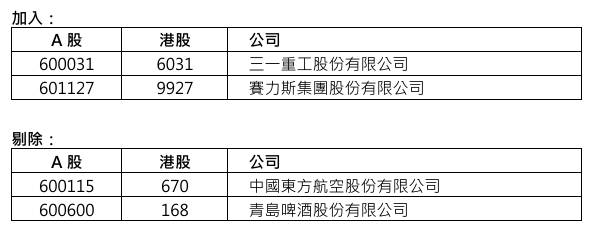
中证恒生沪港通AH股精明指数半年检:加入三一重工(600031.SH,06031)、赛力斯(601127.SH,09927)



智通财经网· 2026-01-30 09:05
Group 1 - The core announcement is about the semi-annual index review results of the China Securities Index Co., Ltd. and Hang Seng Index Company, which will affect the CSI Hang Seng Hong Kong Stock Connect AH Smart Index [1] - The index will include SANY Heavy Industry Co., Ltd. (600031.SH, 06031) and Seres Group Co., Ltd. (601127.SH, 09927) [1] - The index will exclude China Eastern Airlines Corporation Limited (600115.SH, 00670) and Qingdao Beer Co., Ltd. (600600.SH, 00168), maintaining a total of 50 constituent stocks [1] Group 2 - The share category for the newly included constituent stocks will be determined by March 2026, aligning with the monthly share category adjustment schedule [1]

当前时点如何看酒类投资
2026-01-30 03:11
Summary of Key Points from Conference Call Records Industry Overview: Baijiu (Chinese Liquor) - **Strong Sales Performance**: Moutai's sales velocity is robust, with prices recovering to over 1,600 RMB, exceeding market expectations. From January 1 to January 9, over 400,000 transactions occurred, with an average daily supply exceeding 50 tons, indicating strong market demand [1][2]. - **Market Bottom Indicators**: The baijiu industry is showing signs of bottoming out, with the 1,499 RMB Moutai indicating clear volume and price bottom characteristics. Historical data suggests that Moutai and Wuliangye's volume increases signal industry recovery [1][6]. - **Investment Recommendation**: Guizhou Moutai is the preferred investment target, historically outperforming in price, stock performance, and earnings when the industry enters a recovery phase. Revenue growth rates exceeded 20% in 2016 and over 50% in 2017 [1][7]. - **Valuation of Other Baijiu Companies**: Leading baijiu companies like Wuliangye, Luzhou Laojiao, Fenjiu, and Gujing Gongjiu are currently undervalued, with valuations around 15 times earnings or lower. These companies also have high dividend yields, making them attractive for investment [1][10]. Yellow Wine Sector - **Market Expansion**: The yellow wine sector is expanding through price increases, new product launches, and innovative marketing strategies. Leading companies like Kuaijishan are performing well, and Guolongshan is actively pursuing high-end, youth-oriented, and national strategies [1][12]. Beer Industry Insights - **Resilience in Sales**: The beer industry is showing resilience with positive sales growth, particularly as the restaurant sector recovers, which is expected to positively impact beer consumption. Yanjing Beer has high expectations for operational improvement, with significant profit contributions from its health product line [1][4][14]. - **Investment Opportunities**: Yanjing Beer is recommended due to its improving operational metrics and expansion into health products, with projected profit growth. Qingdao Beer and China Resources Beer are also noteworthy, with attractive dividend yields and low valuations [1][15]. Cost Factors - **Cost Management**: The cost of aluminum cans is under control, and there are signs of improvement in malt costs. The overall impact on ton costs is minimal, suggesting a focus on revenue recovery and price increases is essential [1][16]. Conclusion - **Overall Market Sentiment**: The baijiu industry is at a critical juncture, with Moutai leading the recovery. Other sectors like yellow wine and beer are also showing potential for growth, driven by strategic initiatives and market recovery trends. Investors are encouraged to consider both Moutai and other leading brands for their strong fundamentals and growth prospects [1][9][10].


青岛啤酒1月29日现1笔大宗交易 总成交金额720万元 溢价率为-5.62%
Xin Lang Cai Jing· 2026-01-29 10:14
Group 1 - Qingdao Beer saw a stock price increase of 5.49%, closing at 63.57 yuan on January 29 [1] - A block trade occurred with a total volume of 120,000 shares and a transaction amount of 7.2 million yuan [1] - The first transaction price was 60.00 yuan for 120,000 shares, resulting in a premium rate of -5.62% [1] Group 2 - In the last three months, there has been one block trade for the stock, totaling 7.2 million yuan [1] - Over the past five trading days, the stock has increased by 2.62%, with a net inflow of main funds amounting to 33.33 million yuan [1]
2025Q4机构持仓总结:食饮获配比例回落,乳品、零食板块加配
GUOTAI HAITONG SECURITIES· 2026-01-29 09:34
Investment Rating - The report rates the food and beverage sector as "Overweight" [4][6]. Core Insights - The allocation ratio for the food and beverage sector has decreased quarter-on-quarter, with significant reductions in the allocation for both liquor and non-liquor segments. Conversely, other segments such as beverages, dairy products, and snacks have seen an increase in allocation [2][16]. - The report suggests focusing on five main investment lines, emphasizing opportunities arising from supply-demand clearing. Recommended stocks include Guizhou Moutai, Wuliangye, and Luzhou Laojiao for liquor; Eastroc Beverage and Nongfu Spring for beverages; and various companies in the snack and food processing sectors [6][32]. Summary by Sections 1. Sector Allocation Trends - The allocation ratio for food and beverage stocks among actively managed equity mutual funds has continued to decline for seven consecutive quarters, reaching 4.04% in Q4 2025, ranking ninth among all sectors [8][11]. - The allocation for liquor stocks decreased to 2.92%, driven by declines in leading brands such as Wuliangye and Shanxi Fenjiu [16][18]. 2. Sub-Sector Performance - Liquor and non-liquor segments saw a reduction in allocation, while other segments like snacks and dairy products experienced increases. The allocation for snacks rose to 0.26%, and dairy products to 0.44% [16][17]. - Specific stock movements include a decrease in holdings for major liquor brands, while dairy leaders like Yili and Mengniu saw increases in their allocation ratios [23][24]. 3. Individual Stock Analysis - Major liquor stocks such as Guizhou Moutai and Wuliangye experienced significant reductions in their mutual fund holdings, with Moutai down by 0.8% and Wuliangye down by 13.2% [19][20]. - In the beverage sector, Eastroc Beverage's holdings decreased by 4.16%, while Yili's increased by 3.42% [23][24]. - Snack companies like Wancheng Group and Ximai Foods saw increases in their allocation ratios, indicating a positive trend in the snack segment [26][27]. 4. Valuation and Earnings Forecast - The report includes a section on earnings forecasts and valuations, indicating a cautious outlook for the food and beverage sector amidst changing consumer preferences and market dynamics [32].

华夏银行青岛分行携手青啤集团,共绘青岛“10+1”产业新蓝图
Qi Lu Wan Bao· 2026-01-28 12:00
Core Insights - The collaboration between Huaxia Bank Qingdao Branch and Qingdao Beer Group represents a significant integration of finance and industry, enhancing the development of Qingdao's "10+1" innovative industrial system [1] Group 1: Financial Innovation - Huaxia Bank Qingdao Branch has introduced supply chain credit financing services to address the funding pressures faced by small and medium-sized enterprises (SMEs) in Qingdao Beer’s supply chain, which often struggle with long payment terms and slow receivables [2] - The bank's innovative approach allows suppliers to access unsecured credit loans based on transaction data and performance records, alleviating their financial strain and enabling production expansion [2] Group 2: Digital Empowerment - The bank has launched a "digital credit enhancement financing service" utilizing Qingdao Beer Group's "Smart Chain" digital platform, which streamlines the financing process by verifying transaction data and enabling rapid fund disbursement [3] - This service enhances financing efficiency, reduces costs, and increases transparency and security for SMEs in the supply chain [3] Group 3: Strategic Partnership - The long-term partnership between Huaxia Bank Qingdao Branch and Qingdao Beer Group encompasses various areas such as credit support, fund transactions, and interbank wealth management, contributing to the stable growth of the beer industry [4] - The bank is committed to providing customized financial solutions to support the transformation and green development of Qingdao Beer Group and its supply chain [4] Group 4: Future Outlook - Looking ahead, Huaxia Bank Qingdao Branch aims to deepen its collaboration with Qingdao Beer Group to explore more financial innovation models, contributing to the development of Qingdao's "10+1" innovative industrial system [5] - The partnership is expected to create a more efficient supply chain financial ecosystem, enhancing the support for the real economy and fostering high-quality industrial development in Qingdao [5]

青岛啤酒股份获瑞众人寿保险增持20万股 每股作价约49.97港元
Xin Lang Cai Jing· 2026-01-28 00:10
Group 1 - The core point of the article is that Swiss Re Life Insurance has increased its stake in Qingdao Beer (00168) by purchasing 200,000 shares at a price of HKD 49.9658 per share, totaling HKD 9.9932 million [1] - After the purchase, Swiss Re Life Insurance's total holdings in Qingdao Beer amount to approximately 39.374 million shares, representing a 6.01% ownership stake [1]
青岛啤酒股份获瑞众人寿保险增持20万股
Ge Long Hui· 2026-01-27 13:37
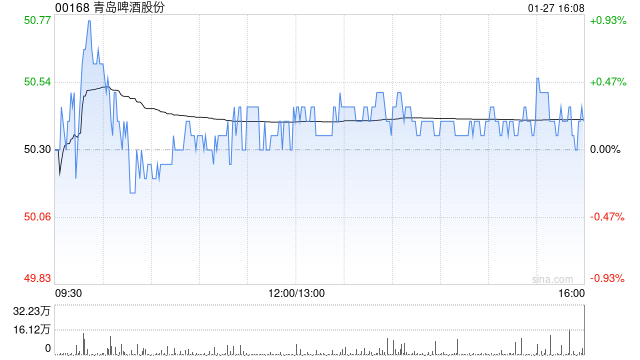
Group 1 - Qingdao Beer Co., Ltd. (00168.HK) received an increase in shareholding from Ruizhong Life Insurance Co., Ltd. on January 22, 2026, with the purchase of 200,000 shares at an average price of HKD 49.9658 per share, totaling approximately HKD 9.9932 million [1] - Following this transaction, Ruizhong Life Insurance's total shareholding rose to 39.374 million shares, increasing its ownership percentage from 5.98% to 6.01% [1]

瑞众人寿保险增持青岛啤酒股份20万股 每股作价约49.97港元
Zhi Tong Cai Jing· 2026-01-27 10:57
Group 1 - The core point of the article is that 瑞众人寿保险 has increased its stake in 青岛啤酒 by purchasing 200,000 shares at a price of 49.9658 HKD per share, totaling 9.9932 million HKD [1] - After the purchase, 瑞众人寿保险's total holdings in 青岛啤酒 amount to approximately 39.374 million shares, representing a 6.01% ownership stake [1]
瑞众人寿保险增持青岛啤酒股份(00168)20万股 每股作价约49.97港元
智通财经网· 2026-01-27 10:55
Group 1 - The core point of the article is that 瑞众人寿保险 has increased its stake in 青岛啤酒股份 by purchasing 200,000 shares at a price of 49.9658 HKD per share, totaling 9.9932 million HKD [1] - After the purchase, 瑞众人寿保险's total holdings in 青岛啤酒股份 amount to approximately 39.374 million shares, representing a 6.01% ownership stake [1]