Tsingtao Brewery(600600)

Search documents
中国必选消费品12月成本报告:下游需求偏弱,成本小幅波动
Haitong Securities International· 2025-12-30 09:00
Investment Rating - The report assigns an "Outperform" rating to multiple companies in the essential consumer goods sector, including Guizhou Moutai, Wuliangye, and Yili [1]. Core Insights - Downstream demand remains subdued, with modest fluctuations in costs across various consumer goods categories [1][34]. - The cost indices for six monitored consumer goods showed mixed trends, with soft drinks and instant noodles experiencing increases, while condiments, dairy products, frozen foods, and beer saw declines [34]. Cost Index Summary Beer - The spot cost index for beer decreased by 1.05% month-on-month, while the futures index increased by 0.88%. Year-to-date, the spot index has declined by 3.84% and the futures index by 7.87% [4][35]. - Glass prices fell by 1.9% month-on-month and 18.0% year-on-year, while aluminum prices showed mixed trends [12][35]. Condiments - The spot cost index for condiments dropped by 0.29% month-on-month, and the futures index fell by 0.47%. Year-to-date, the spot index has decreased by 3.95% and the futures index by 9.74% [16][36]. - Soybean prices showed a slight decrease in spot prices but an increase in futures prices [16][36]. Dairy Products - The spot cost index for dairy products decreased by 0.45% month-on-month, while the futures index increased by 0.39%. Year-to-date, the spot index has declined by 2.92% and the futures index by 4.19% [19][37]. - Raw milk prices remained stable at 3.03 yuan/kg, with supply pressures emerging due to cash flow issues in dairy farming [19][37]. Instant Noodles - The spot cost index for instant noodles rose by 0.49% month-on-month, while the futures index fell by 0.51%. Year-to-date, the spot index has decreased by 0.77% and the futures index by 7.05% [23][38]. - Palm oil prices showed a decline, impacting overall costs [23][38]. Frozen Foods - The spot cost index for frozen foods dropped by 0.54% month-on-month, and the futures index fell by 1.13%. Year-to-date, the spot index has decreased by 0.65% and the futures index by 2.42% [27][39]. - Vegetable prices experienced a month-on-month decline but a year-on-year increase, influenced by weather conditions affecting supply [27][39]. Soft Drinks - The spot cost index for soft drinks increased by 1.06% month-on-month, and the futures index rose by 0.99%. Year-to-date, the spot index has increased by 0.42% while the futures index has decreased by 10.18% [30][40]. - PET chip prices rose month-on-month, contributing to the cost increase in soft drinks [30][40].




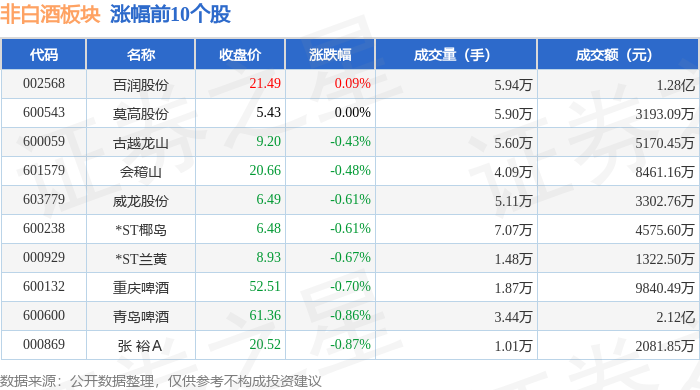
非白酒板块12月29日跌1.42%,惠泉啤酒领跌,主力资金净流出8152.72万元
Zheng Xing Xing Ye Ri Bao· 2025-12-29 09:06
Market Overview - The non-white liquor sector experienced a decline of 1.42% on the previous trading day, with Huichuan Beer leading the drop [1] - The Shanghai Composite Index closed at 3965.28, up 0.04%, while the Shenzhen Component Index closed at 13537.1, down 0.49% [1] Stock Performance - Key stocks in the non-white liquor sector showed varied performance, with Baijiu Co. closing at 21.49, up 0.09%, while other notable declines included Chongqing Beer at 52.51, down 0.70%, and Gu Yue Long Shan at 9.20, down 0.43% [1] - The trading volume for Baijiu Co. was 59,400 shares, with a transaction value of 128 million yuan, while Chongqing Beer had a trading volume of 18,700 shares and a transaction value of 98.4 million yuan [1] Capital Flow - The non-white liquor sector saw a net outflow of 81.52 million yuan from institutional investors, while retail investors contributed a net inflow of 9.23 million yuan [2] - Notable capital flows included Yanjing Lang with a net inflow of 18.08 million yuan from institutional investors, while ST Yedao experienced a net outflow of 9.32 million yuan [3]


2025年11月中国啤酒进出口数量分别为0.26亿升和0.66亿升
Chan Ye Xin Xi Wang· 2025-12-28 01:46
Group 1 - The core viewpoint of the article highlights the trends in China's beer import and export market, indicating a significant decline in imports and a notable increase in exports for November 2025 [1] Group 2 - In November 2025, China's beer import volume was 0.26 billion liters, representing a year-on-year decrease of 23.6%, while the import value was $0.38 billion, down 13.4% year-on-year [1] - Conversely, beer exports in November 2025 reached 0.66 billion liters, showing a year-on-year increase of 22.5%, with an export value of $0.44 billion, up 14.8% year-on-year [1] Group 3 - The article references a report by Zhiyan Consulting, which provides an analysis of the non-alcoholic beer industry market dynamics and competitive strategies in China from 2026 to 2032 [1] - Zhiyan Consulting is noted as a leading industry consulting firm in China, specializing in in-depth industry research reports, business plans, feasibility studies, and customized services [1]


食品饮料行业双周报(2025、12、12-2025、12、25):欧盟乳制品反补贴落地,把握结构性机会-20251226
Dongguan Securities· 2025-12-26 09:37
Investment Rating - The report maintains an "Overweight" rating for the food and beverage industry, indicating an expectation that the industry index will outperform the market index by more than 10% over the next six months [55]. Core Insights - The report highlights the structural opportunities arising from the EU's anti-subsidy measures on dairy products, which are expected to benefit domestic alternatives such as cheese and cream [50]. - The white liquor sector is experiencing a weak recovery in consumption, with expectations of continued pressure on sales in the fourth quarter and first quarter of the following year, but a potential rebound in the second quarter due to low base effects [50][51]. - The report emphasizes the importance of monitoring inventory levels ahead of the Spring Festival and the operational goals set by various liquor companies for the upcoming year [51]. - The report suggests focusing on high-end liquor brands like Kweichow Moutai (600519) and other regional brands such as Shanxi Fenjiu (600809) and Guojiao Liquor (000596) [51]. - The report notes that approximately 87% of stocks in the food and beverage sector recorded positive returns during the review period, with notable performers including Anji Food (+27.96%) and Huanlejia (+20.94%) [15]. Summary by Sections Market Review - From December 12 to December 25, 2025, the SW food and beverage industry index rose by 1.33%, underperforming the CSI 300 index by approximately 0.66 percentage points [11]. - Most sub-sectors outperformed the CSI 300 index, with the baking sector showing the highest increase of 7.63% [13]. Industry Data Tracking - **Liquor Sector**: The price of Feitian Moutai increased to 1575 RMB/bottle, while Guojiao 1573 decreased to 840 RMB/bottle [21]. - **Condiments Sector**: Prices for soybean meal and white sugar decreased, with soybean prices at 4288.90 RMB/ton [24]. - **Beer Sector**: Aluminum prices increased while glass and corrugated paper prices decreased; barley prices remained stable at 2200.00 RMB/ton [29]. - **Dairy Sector**: Fresh milk prices rose slightly to 3.03 RMB/kg [37]. - **Meat Sector**: The average wholesale price of pork decreased to 17.44 RMB/kg, with a year-on-year decline of 22.04% [39]. Important News - The report discusses the preliminary ruling on anti-subsidy measures for EU dairy imports, which is expected to positively impact domestic dairy producers [44][45]. - It also notes a decline in the production of white liquor and beer in November, with white liquor production down 11.3% year-on-year [43]. Company Announcements - Kweichow Moutai plans to distribute cash dividends amounting to at least 75% of its net profit for the years 2024-2026, alongside a share buyback plan [52]. - Haitian Flavoring plans to maintain a cash dividend payout ratio of no less than 80% of its net profit for the next three years [48].


酒业年度盘点:2025热榜事件简述,你最关注的是哪件事?
Sou Hu Cai Jing· 2025-12-26 03:11
Core Insights - The Chinese liquor industry in 2025 is undergoing significant transformation amidst challenges such as a sluggish macro environment, consumption differentiation, production contraction, and weak sales, leading to a reshaping of the industry landscape [2] - The industry is encouraged to innovate and break old rules to find new growth paths, reflecting a mix of pressure and hope [2] Group 1: Industry Developments - The Ministry of Industry and Information Technology has classified liquor production as a "historical classic industry," elevating its status and marking a shift towards high-quality development [3] - A stringent "ban on alcohol" was introduced, impacting high-end liquor sales and indicating a shift from government consumption to market-driven consumption [4] - The launch of "Da Zhen·Zhen Jiu" by Zhen Jiu represents a strategic move towards creating a "super product" in the liquor market, emphasizing quality and innovative packaging [5] Group 2: Market Strategies - The establishment of two platform companies by Wuliangye's distributors aims to enhance market control and stabilize high-end product prices, reflecting a shift towards a dual-driven model of channels and capital [7] - Sichuan Province has released a 21-point action plan to promote the high-quality development of the liquor industry, focusing on production capacity and market expansion [8] - Wuliangye's 12·18 conference emphasized the importance of quality, cultural heritage, and innovation in navigating market changes [9] Group 3: Consumer Engagement - The return of the white liquor milk tea "Drunk Step on the Road" by Tea Baidao highlights the growing trend of "micro-drunk" consumption among younger consumers [13] - The fifth live broadcast by Zhen Jiu's chairman garnered significant attention, showcasing innovative business models and strong consumer engagement [10] Group 4: Awards and Recognition - The 16th China (Dalian) Light Industry Commodity Expo featured a wine exhibition and quality competition, showcasing the strength and cultural appeal of Chinese liquor brands [16] - The announcement of the first batch of Chinese consumer brands included notable liquor brands, indicating recognition of quality and market position [5][6] Group 5: Future Outlook - The liquor industry is expected to continue evolving with a focus on quality, cultural integration, and innovative marketing strategies, as seen in the initiatives from various companies and government bodies [18][19]



华源证券:重视ROA企稳的消费板块 寻找价或量仍景气的细分赛道
智通财经网· 2025-12-24 13:01
Core Viewpoint - Different consumer sectors exhibit both differences and commonalities in recovery rhythms, with ROA being a leading indicator for operational recovery in consumer enterprises [1][2] Group 1: Recovery Rhythm Analysis - The recovery rhythm of various consumer sectors is influenced by industry supply and demand, as well as supply chain structures, with a focus on stock market competition as a mainstream phenomenon [2] - The stages of enterprise and channel adjustments are outlined, starting from oversupply to a new balance in supply and demand, with ROA serving as a key indicator throughout these stages [2] - Current recovery sequences indicate that soft drinks and snacks are leading, followed by food supply chains, condiments, dairy products, beer, and finally, liquor [2][3] Group 2: Investment Strategy - Emphasis on sectors where ROA stabilizes, indicating potential valuation recovery opportunities, with a preference for sectors that still show price or volume growth [3] - Price logic suggests that rising CPI may drive valuation recovery in traditional industries with high penetration rates, such as liquor, beer, and dairy products, which are likely to attract incremental capital [3][4] - Recommended companies in the liquor sector include Kweichow Moutai, Luzhou Laojiao, and Shanxi Fenjiu, while in dairy, focus on Yili and Mengniu [3] Group 3: Volume Logic - In the context of cost-effective consumption, companies with high supply chain efficiency are expected to gain volume, with specific recommendations for companies in the food supply chain and soft drinks [4] - Industries with low penetration rates may withstand economic cycles, with recommendations for low-alcohol beverages and functional foods that can enhance brand premium through specialization [4] - Companies benefiting from overseas market expansion include Angel Yeast and Bailong Chuangyuan [4]



扩内需:食品饮料行业投资机会
2025-12-24 12:57
Summary of Key Points from the Conference Call Industry Overview - The food and beverage industry is experiencing systemic opportunities driven by policies aimed at expanding domestic demand and increasing residents' income levels, which are expected to enhance consumption capabilities [1][2] - The liquor industry is undergoing a deep adjustment, with expectations of entering an EPS killing phase by 2025, while high-end liquor brands like Moutai and Lao Jiao are recommended for investment [1][4] - The dairy industry has completed supply-demand adjustments, with anticipated increases in demand for milk powder and liquid milk due to fertility and income policies, highlighting companies like Yili and New Dairy as potential recovery opportunities [1][5] - The snack food sector is benefiting from the "lipstick effect," new channels, and health trends, with recommendations for companies such as Salted Fish, Wei Long, Wan Chen Food, and Qiaqia Food [1][6] - The beverage sector is seeing a clear trend towards health, with non-traditional channels gaining market share, making high-growth companies like Dongpeng Beverage noteworthy [1][7] Key Insights and Arguments - The central economic work conference in 2026 will prioritize expanding domestic demand, which is expected to lead to a series of policies stimulating consumption, positively impacting the food and beverage industry [2] - The food and beverage sector has faced significant changes in volume, price, and channel structure over the past six years, with varying performances across sub-sectors [3] - The liquor sector is expected to see marginal improvements in 2026, driven by policies aimed at boosting business and government consumption [4] - The dairy sector is projected to enter a recovery phase, with increased demand anticipated due to supportive policies [5] - The snack food market is expected to gradually recover, supported by rising incomes and new retail channels [6] Additional Important Content - Cost fluctuations are a significant factor affecting the performance of consumer goods companies, with some agricultural product costs declining, providing investment opportunities [9] - The planting area for sunflower seeds is expected to recover, leading to a projected 10% decrease in the cost of sunflower seeds, which will positively impact Qiaqia Food's gross margin [10][11] - The konjac market is facing supply-demand imbalances, with high prices expected to ease in 2026, alleviating cost pressures for companies like Wei Long and Salted Fish [12] - The sugar molasses market is currently at low prices, providing strong support for Angel Yeast's profitability [13] - Innovative companies are leveraging product and channel innovations to drive growth, with notable examples including Nongfu Spring and Uni-President [14] - Efficient supply chain management is crucial for companies, with Dongpeng Beverage demonstrating strong performance in this area [15] Future Outlook - Dongpeng Beverage is expected to achieve double-digit growth in 2026 through strategic measures and product innovations [16] - Wan Chen is enhancing store quality and accelerating store openings, which is expected to improve profitability in the snack food sector [17][18] - Hai Tian Flavoring has implemented efficiency improvements under new management, resulting in revenue and profit growth exceeding industry averages [19] - The restaurant industry is expected to see a mild recovery, with companies like Yihai International and Tianhe Flavoring showing potential for improvement [20][21] - In the liquor sector, companies like Yanghe and Budweiser are expected to benefit from product and channel improvements, leading to potential breakthroughs in performance [22][23][25] - Gan Yuan Food is focusing on expanding e-commerce and high-end membership stores, with a stable development outlook [26][27] - Overall, companies in the food and beverage sector are expected to experience gradual recovery and growth, making them worthy of investor attention [28]



食品饮料2026年投资策略报告:曙光渐显,在分化中前行-20251224
Hua Yuan Zheng Quan· 2025-12-24 12:13
Group 1: Core Insights - The report emphasizes the recovery stage of consumer spending, highlighting that different sectors exhibit both commonalities and differences in their recovery rhythms, driven by supply-demand dynamics and industry structure [4][5] - ROA (Return on Assets) is identified as a leading indicator for the operational recovery of consumer companies, with a focus on analyzing various sub-sectors [4][13] Group 2: Sector Performance - The current recovery sequence indicates that soft drinks and snacks are leading, followed by the catering supply chain, condiments, dairy products, beer, and finally, liquor [5][25] - The report draws parallels with Japan's 1990s consumption differentiation, noting that sectors addressing consumer pain points and with low penetration rates are likely to succeed [5][6] Group 3: Investment Strategy - The report suggests focusing on sectors where ROA is stabilizing, indicating potential valuation recovery opportunities, particularly in traditional sectors like liquor, beer, and dairy [6][8] - It recommends identifying sub-sectors with either price or volume growth, with a preference for price-driven strategies [6][8] Group 4: Detailed Sector Analysis - The frozen food sector is showing signs of marginal improvement, with leading companies enhancing operational efficiency through product innovation and channel reforms [27][28] - The snack sector is experiencing high demand, driven by new channel developments, although competition is intensifying [33][35] - The beer industry is under pressure, with a focus on high-end products, but overall growth is slowing due to external economic factors [39][41] - The dairy sector is nearing the end of its adjustment phase, with expectations of improved performance as raw milk prices rise [41][42] - The liquor sector is currently in a phase of inventory reduction, with performance risks gradually clearing as channels stabilize [43][48]


青岛啤酒:公司高度重视股东合理投资回报
Zheng Quan Ri Bao· 2025-12-24 12:12
Core Viewpoint - Qingdao Beer emphasizes its commitment to providing reasonable returns to shareholders through a stable profit distribution policy, increasing cash dividends in line with business performance growth [1] Summary by Categories Dividend Policy - The company will distribute a cash dividend of 2.20 yuan per share (including tax) for the fiscal year 2024, representing a 10% increase compared to the 2023 fiscal year [1] - The dividend payout ratio has reached 69%, indicating a strong commitment to returning profits to shareholders [1] Financial Commitment - The total amount allocated for dividends in 2024 is set to be 3 billion yuan [1]
回望“十四五” | 青岛市国资委党委书记、主任王孝芝:青岛国企研发经费“十四五”年均增长15%
Xin Lang Cai Jing· 2025-12-24 10:32
Tax Contribution - During the "14th Five-Year Plan" period, the total tax revenue from state-owned enterprises in Qingdao remained stable at over 14 billion, representing a 46.7% increase compared to the end of the "13th Five-Year Plan" [4][20]. Social Welfare - The construction of transportation hubs has accelerated, including the world's largest and longest underwater highway, the Jiaozhou Bay Second Tunnel, which is being advanced by Guoxin Group [4][23]. - The Jiaodong International Airport has won the Excellent Service Quality Award for airports with over 10 million passengers for the third consecutive year [4][23]. - Public transport improvements have enhanced travel experiences, with annual passenger volume exceeding 940 million [4][23]. - Infrastructure projects, such as the largest LNG receiving station in the country and the comprehensive renovation of old heating pipelines, have been implemented [4][23]. Industry Leadership - Seven enterprises, including Qingdao Beer, Aucma, and Haigang, have been cultivated as "chain leaders" in the food and beverage, smart home appliances, and high-end chemical industries [5][24]. Asset Management - The Qingdao State-owned Assets Supervision and Administration Commission has developed a three-year action plan to revitalize idle assets, establishing an asset ledger and guiding enterprises in formulating revitalization plans [25]. - A dual-driven platform has been created for asset revitalization, including an online cloud platform for asset management and a physical platform for market-driven operations [25][26]. Innovation and Digital Transformation - The Qingdao State-owned Assets Supervision and Administration Commission has implemented a special action plan to cultivate new productive forces, with R&D funding expected to exceed 3.3 billion by 2025, more than doubling from 2020 [28]. - A digital transformation action plan for state-owned enterprises has been established, significantly enhancing digital management capabilities in finance, investment, and procurement [29]. - Notable achievements include the establishment of the first "Lighthouse Factory" in the global beer and beverage industry by Qingdao Beer and the development of the first autonomous train operation system in the country by the Metro Group [29].