
JINJIANG HOTELS(600754)

Search documents
中证旅游主题指数上涨0.9%,前十大权重包含中国中免等
Jin Rong Jie· 2025-05-12 13:42
Core Viewpoint - The China Securities Tourism Index has shown mixed performance, with a recent increase but a decline over the past month and year-to-date [2]. Group 1: Index Performance - The China Securities Tourism Index rose by 0.9% to 2783.81 points, with a trading volume of 6.719 billion yuan [1]. - Over the past month, the index has decreased by 4.42%, while it has increased by 1.01% over the last three months. Year-to-date, it has declined by 5.28% [2]. Group 2: Index Composition - The index includes up to 50 listed companies involved in various sectors of the tourism industry, such as accommodation, sightseeing, shopping, entertainment, and transportation [2]. - The top ten weighted companies in the index are: China Duty Free Group (14.99%), Songcheng Performance (7.39%), Shanghai Airport (6.38%), Jinjiang Hotels (5.53%), Shougang Hotel (5.15%), China Eastern Airlines (5.13%), Southern Airlines (5.05%), Air China (4.48%), Spring Airlines (4.38%), and Hainan Airport (3.87%) [2]. - The industry composition of the index shows that consumer services account for 48.04%, transportation for 31.30%, retail for 14.99%, and real estate for 5.67% [2]. Group 3: Index Adjustment - The index samples are adjusted semi-annually, with adjustments occurring on the next trading day after the second Friday of June and December [3]. - Weight factors are generally fixed until the next scheduled adjustment, with special circumstances allowing for temporary adjustments [3]. Group 4: Related Funds - Public funds tracking the China Securities Tourism Index include the Fortune China Securities Tourism Theme ETF and the Huaxia China Securities Tourism Theme ETF [4].




锦江酒店连跌4天,富国基金旗下1只基金位列前十大股东
Sou Hu Cai Jing· 2025-05-12 09:00
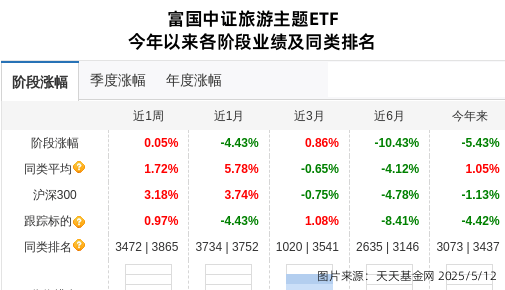
Group 1 - The core viewpoint of the news is that the Wutong Fund's Wutong CSI Tourism Theme ETF has increased its stake in Jinjiang Hotels and has reported a year-to-date return of -5.43%, ranking 3073 out of 3437 in its category [1][2]. Group 2 - The Wutong CSI Tourism Theme ETF has experienced a return of -5.43% this year, with a recent one-week increase of 0.05% and a one-month decrease of -4.43% [2]. - The fund's performance is below the average of its peers, which have shown a year-to-date return of 1.05% [2]. - The fund manager, Cao Ludi, has been with Wutong Fund Management since July 2016 and has held various positions, currently managing multiple funds including the Wutong CSI Tourism Theme ETF since July 2021 [3][4]. Group 3 - Wutong Fund Management Company was established in April 1999 and has four shareholders, with Guotai Junan Securities, Shenwan Hongyuan Securities, and the Bank of Montreal each holding 27.77%, and Shandong Financial Asset Management holding 16.68% [4].

社服&零售行业年报及一季报总结:子行业表现分化,关注新消费+出海服务+顺周期修复
HUAXI Securities· 2025-05-12 04:35
Investment Rating - The industry rating is "Recommended" [4] Core Insights - The consumer services and retail sectors are under pressure, with notable performance in emotional consumption and tourism consumption [1][2] - In 2024, CITIC consumer services revenue and net profit attributable to shareholders are expected to grow by 2% and decline by 24% respectively, while the retail sector is projected to see an 8% drop in revenue but a 6% increase in net profit [1][2] - The report highlights the divergence in performance among sub-sectors, with tourism services (+56%), human resources (+15%), and scenic areas (+3%) showing relative strength [1][2] Summary by Relevant Sections Consumer Services - In 2024, revenue for CITIC consumer services is projected to grow by 2%, while net profit is expected to decline by 24%. The tourism services sector shows a significant revenue increase of 56% [1] - For Q1 2025, the consumer services sector continues to face pressure, with revenues down by 0.1% and net profits down by 8% [2] Retail Sector - The retail sector is expected to see an 8% decline in revenue for 2024, but net profit is projected to increase by 6% [1] - Notable performances include supermarkets and convenience stores, which saw a 156% increase in net profit due to non-operating factors [1] OTA (Online Travel Agency) - The online booking rate for travel continues to rise, with OTA transaction volume expected to grow by 17.8% in 2024 [3] - Major players like Ctrip and Tongcheng are experiencing significant revenue growth, with Ctrip's international business revenue reaching 10% of total revenue [3][6] Scenic Areas - The scenic area sector is expected to see a 3% increase in revenue and a 30% increase in net profit for 2024, driven by strong performances from key players [7] - In Q1 2025, revenue is projected to grow by 2%, but net profit is expected to decline by 18% [7] Hotel Sector - The hotel sector is facing pressure with a decline in RevPAR (Revenue per Available Room), but major hotel groups are maintaining aggressive expansion plans [8][9] - For Q1 2025, major hotel groups are experiencing varying impacts on net profit, with some showing significant declines [9] Human Resources - The outsourcing business remains strong, with companies like Core International and Beijing Human Resources seeing revenue growth of 22% and 14% respectively [10] - Government subsidies are contributing to significant net profit increases for these companies [12] E-commerce and Services - The report highlights the growth of self-owned brands, with companies like Ruoyu Chen achieving a 29.26% increase in total revenue for 2024 [13] - The demand for agency operations is declining, but self-owned brands are driving high growth [13] Dining Sector - The dining sector is under pressure due to intense price competition, but some brands are showing resilience [14] - In Q1 2025, the dining sector shows signs of marginal improvement as price competition eases [14] Jewelry Sector - The jewelry sector is experiencing performance divergence, with strong brands outperforming the market amid rising gold prices [15] - In Q1 2025, brands like Chaohongji and Mankalon are showing significant revenue and profit growth [15] Investment Recommendations - The report suggests focusing on high-demand consumer products and travel services, as well as companies benefiting from overseas expansion [17]




深蓝智库2025 | 酒店业的新零售之战:从“卖床品”到场景革命
Bei Jing Shang Bao· 2025-05-11 05:54
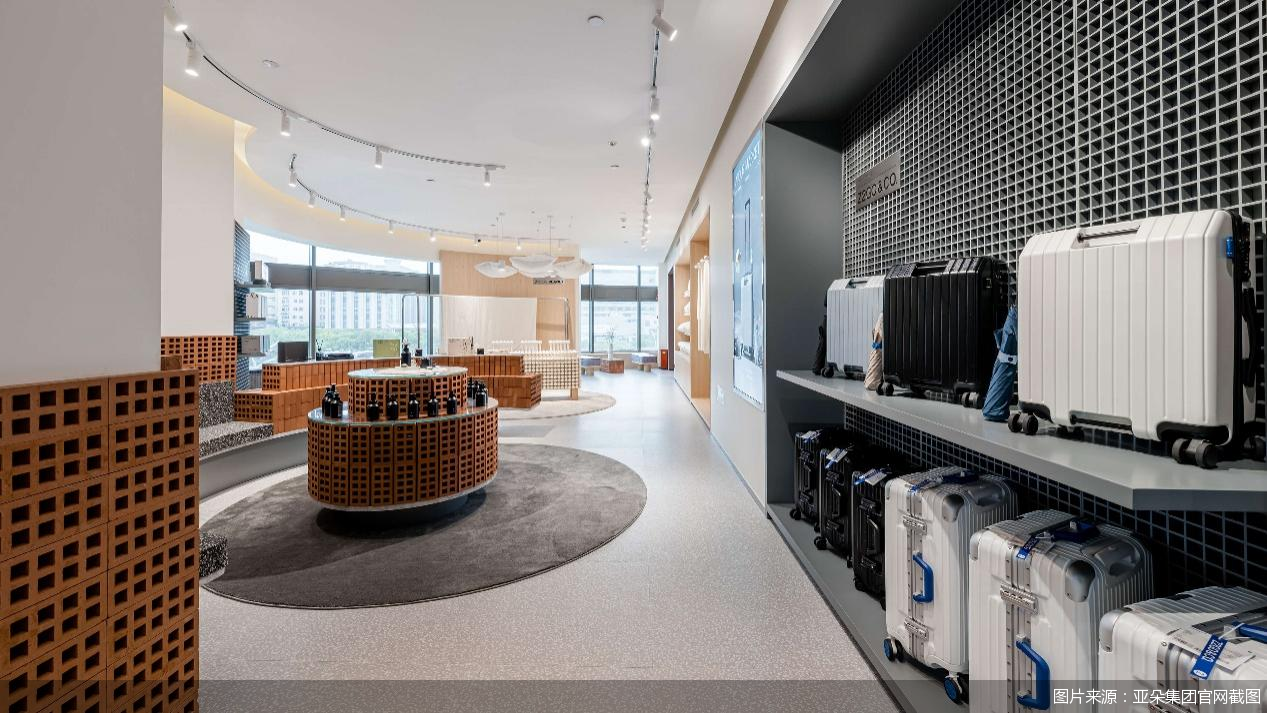
Core Viewpoint - The hotel industry is undergoing a new retail revolution as major hotel groups like Huazhu and Shoulv Rujia expand into new retail, selling "hotel-style" products, which is becoming a new growth driver for the industry [1][3] Group 1: New Retail Trends - Almost all hotel groups surveyed by Deep Blue Think Tank have ventured into new retail, selling hotel-branded bedding and toiletries, making new retail a standard in the hotel industry [3] - With changing consumer habits, hotel groups are targeting new retail to enhance revenue, with Huazhu Group selling products like pillows and toiletries [3] - The retail business is becoming a second growth curve for companies like Atour Group, which reported a GMV of 2.592 billion yuan in 2024, a 127.7% increase from 2023 [4] Group 2: Market Challenges - Over 80% of hotel groups mentioned "providing incremental value to consumers" and "increasing revenue" as reasons for entering new retail [6] - The hotel market is returning to rational growth after explosive growth in 2023, with many hotel groups experiencing declines in key operational metrics [6] - The competitive landscape is becoming crowded, prompting hotels to diversify into retail to boost revenue [7] Group 3: Future Directions - The future of the hotel industry will involve integrating various business models, moving beyond traditional services to create multi-functional spaces [10][11] - Hotels need to focus on differentiation and unique experiences to avoid low-level competition, as product homogeneity is a significant challenge [9] - The integration of cross-border e-commerce with new retail is being explored by hotel groups like Shoulv Rujia to enhance consumer engagement [9]
6大本土酒店集团,“西天取经”路上必有一战
3 6 Ke· 2025-05-09 01:58
Core Insights - Shangmei Smart Hotel Group has initiated a strategic partnership with various cultural and tourism sectors in Gansu, marking a significant milestone in its expansion in the northwest region of China [1] - The recovery of tourism demand has led to a surge in hotel accommodation needs in the northwest, with over 40 million visitors and a spending of over 22 billion yuan during the 2025 Spring Festival [2] - The northwest region is seen as a hotbed for investment due to favorable rental conditions and government policies supporting the hotel industry [2] Group 1: Shangmei Smart Hotel Group's Expansion - Shangmei Smart Hotel Group has established over 700 hotels in the northwest region by March 31, 2025, with 142 located in Gansu [2][3] - The group aims to play a dual role as an "investment model innovator" and "industry upgrade enabler" to capture value in the northwest hotel market [3] Group 2: Competitors in the Northwest Market - Major hotel groups like Jinjiang and Huazhu have also expanded in Gansu, with over 500 hotels opened collectively by these three groups [4][5] - Jinjiang has over 200 hotels in Gansu and nearly 300 signed contracts, while Huazhu's main brands have a significant presence in the region [5][6] Group 3: Market Dynamics and Future Outlook - The northwest hotel market is entering a new competitive phase, with various hotel groups vying for market share [7] - The region's vast potential and low hotel chain penetration make it an attractive target for expansion, with several groups already establishing a presence [9][10] - The competition is expected to intensify as major players like Jinjiang, Huazhu, and Shangmei Smart Hotel Group continue to expand their footprints in the region [11][12]
从品类到品质,从品质到品牌
China Securities· 2025-05-09 01:20
Investment Rating - The report maintains a rating of "Outperform the Market" for the industry [3]. Core Insights - The industry fundamentals are expected to remain under pressure in 2024, with most sectors and companies still significantly affected by macroeconomic factors. However, a number of companies are emerging that are successfully navigating the challenges of consumer downgrade by upgrading from categories to quality and then to brand [1][2]. - The report highlights that companies with strong brand attributes are likely to continue outperforming as the market transitions from price-performance to quality-price comparisons [2]. Summary by Sections 1. Duty-Free Sector - The duty-free sales in Hainan are gradually stabilizing, with the implementation of the Hainan closure policy expected to benefit the duty-free sector. The market is seeing improvements in channel and supply chain capabilities, leading to a stable outlook for profitability [2][49]. - Key companies to watch include China Duty Free Group and Wangfujing [2]. 2. Tourism and Gaming - The tourism sector shows strong resilience in demand, becoming a crucial driver for domestic consumption. The recovery in inbound and outbound travel is significant, with a focus on new consumption scenarios and the silver-haired tourism market [2][3]. - Recommended companies include Jiuhua Tourism, Lingnan Holdings, and Sands China [2]. 3. Hotel Industry - The hotel sector is experiencing weak business travel demand, leading to pressure on RevPAR. However, leisure demand remains resilient, and leading companies are enhancing profitability through brand matrix validation and supply chain optimization [3][72]. - Companies to focus on include Huazhu Group, Atour, and Jinjiang Hotels [3]. 4. Restaurant Sector - Leading restaurant companies are demonstrating strong supply chain negotiation and profitability advantages. The overall supply in the restaurant industry is optimizing, with a competitive trend in price-performance [3][7]. - Notable companies include Mixue Ice City, KFC, and Haidilao [3][7]. 5. Cosmetics and Medical Aesthetics - The cosmetics sector is seeing a shift in focus towards profitability, with companies restructuring their product and channel strategies. High-growth companies are expected to achieve both revenue and profit increases [7][23]. - Key players include Juzhibio, Shumei, and Marubi [7][23]. 6. General Retail - The retail sector is undergoing digital upgrades and operational adjustments, with a focus on essential demand and cash flow stability. Companies like Yonghui Supermarket and Multi-Point Intelligence are recommended [8][30]. - The report also highlights the ongoing challenges in the jewelry sector due to rising gold prices [8][30]. 7. Overall Market Performance - The consumer services sector is expected to face challenges, with a projected performance of -8.70% in 2024. However, the beauty and personal care sector is anticipated to recover with a growth of +8.15% in 2025 [11][19].


“这是一种背叛”,锦江酒店如何向2亿会员交代?
Guan Cha Zhe Wang· 2025-05-08 12:52
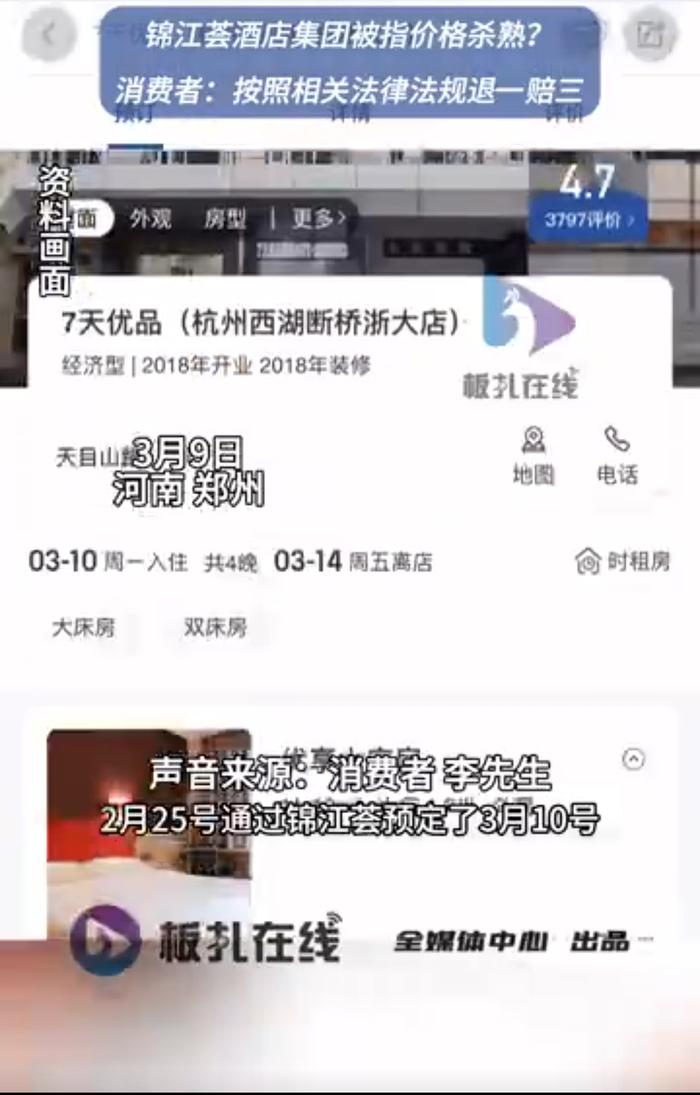
Core Viewpoint - Jinjiang Hotel Group is facing a trust crisis due to "price inversion" issues, where prices on its official platform are significantly higher than those on third-party platforms [1][3][4]. Group 1: Price Inversion Issues - Investigations revealed that some Jinjiang franchise hotels set prices on the Jinjiang Hui app five times higher than on third-party platforms [1][2]. - During the May Day holiday, certain hotels showed full bookings on the official platform while being available on OTA platforms [2][4]. - Jinjiang's official platform has been reported to have higher prices compared to OTA platforms multiple times in recent months, indicating a systemic issue [5][9]. Group 2: Franchise and Group Dynamics - The "price inversion" reflects a growing conflict between franchise hotels and the Jinjiang Group over profit-sharing and visibility on booking platforms [3][4]. - Franchise hotels are increasingly favoring OTA platforms due to higher traffic and visibility, leading to a weakening of the official booking channels [3][11]. - The lack of effective price monitoring and management by Jinjiang has contributed to these issues, as franchisees feel empowered to prioritize their own revenue [8][11]. Group 3: Membership and Revenue Challenges - Despite having over 200 million members, Jinjiang's occupancy and repurchase rates are lower than competitors like Huazhu and Atour, indicating a lack of attractive member benefits [9][11]. - Jinjiang's net profit for 2024 was only 9.11 billion RMB, a decline of 9.06% year-on-year, highlighting a disparity in performance compared to other hotel groups [9][11]. - The company plans to enhance its membership system to improve member engagement and loyalty, but the effectiveness of these measures remains uncertain [11][12].
酒店业“五一”成绩单:多家酒店集团连日满房,入境游客流激增
2 1 Shi Ji Jing Ji Bao Dao· 2025-05-07 10:10
Group 1 - The domestic tourism market in China is experiencing a strong recovery during the "May Day" holiday in 2025, with 314 million domestic trips taken, representing a year-on-year increase of 6.4% [1] - Total spending by domestic tourists reached 180.27 billion yuan, marking an 8.0% year-on-year growth [1] - Hotel occupancy rates during the holiday were high, with an overall occupancy rate exceeding 84%, a slight increase of about 1 percentage point compared to the previous year [1] Group 2 - Huazhu Group reported nearly 6.3 million guests at its hotels during the "May Day" holiday, which is 1.3 times that of the same period last year [1] - The peak occupancy period for hotels was from May 1 to May 3, with an average occupancy rate of 97% during these days [1] - The Atlantis Sanya resort received 120,000 visitors with an average hotel occupancy rate of 94% during the holiday [1] Group 3 - Jinjiang Hotels (China) recorded nearly 8.9 million guests during the holiday, a 13% increase compared to the previous year [2] - The average occupancy rate for high-star hotels was significantly higher than that of low-star hotels, with four-star hotel bookings increasing by 54% and five-star hotel bookings by 28% [3] - The inbound tourism market also showed strong performance, with Huazhu Group hosting over 43,000 foreign guests, 1.75 times more than the same period last year [3]

社会服务5月投资策略暨五一假期总结:旅游量增价稳半径延长,板块关注政策发力与AI+进展
Guoxin Securities· 2025-05-07 08:45
Investment Rating - The investment rating for the industry is "Outperform the Market" (maintained) [2] Core Viewpoints - The tourism volume is increasing while prices remain stable, with an extended travel radius. The focus is on policy support and advancements in AI applications [3] Summary by Sections Market Review - In April, the social service sector outperformed the benchmark by 1.42 percentage points, with strong performance from tourism and education stocks. The A-share scenic spots and leading education stocks led the gains, while Hong Kong stocks in the supply chain and tea beverage sectors also performed well [3][4][6] May Day Holiday Summary - Domestic spending during the holiday increased by 8.0%, with travel willingness remaining high and an extended travel radius. A total of 314 million domestic trips were made, a year-on-year increase of 6.4%. The average spending per person increased by 1.5%, recovering to 90% of the 2019 level [3][9] Sub-Industries - **Inbound and Outbound Travel**: Inbound travel increased by 28.7% during the holiday, with significant growth in travelers from Hong Kong, Macau, Taiwan, and foreign visitors. The number of inbound foreign visitors under visa-free policies grew by 72.7% [3][21] - **Hotel Industry**: The hotel industry saw a REVPAR of 192 yuan, up 11.5% year-on-year, with occupancy rates and average daily rates also increasing. High-star hotels in county areas outperformed the overall industry [24][22] - **Scenic Spots**: Many scenic spots experienced significant visitor growth, aided by favorable weather and local government promotional activities. For example, Xiangyuan Cultural Tourism received 51.79% more visitors compared to last year [25][28] - **Dining**: Key monitored dining enterprises saw sales increase by 8.7% year-on-year, indicating a recovery in consumer spending [29][30] - **Duty-Free Sales**: Duty-free shopping during the holiday saw a decline of 7% in sales, but the average spending per person remained stable [41][35] Investment Recommendations - The report suggests focusing on leading companies benefiting from policy support and marginal improvements, including Tongcheng Travel, Xueda Education, Jiuhua Tourism, and others. Mid-term recommendations include China Duty Free, Meituan, Huazhu Group, and others [3][42]


5月投资策略暨五一假期总结:旅游量增价稳半径延长,板块关注政策发力与AI+进展
Guoxin Securities· 2025-05-07 05:30
Core Insights - The report highlights that tourism volume is increasing while prices remain stable, with a focus on policy support and advancements in AI applications within the sector [3][9] - The domestic travel market saw 314 million trips during the May Day holiday, a year-on-year increase of 6.4%, with total spending reaching 180.27 billion yuan, up 8.0% [9][21] - The report suggests that the tourism trend will continue to improve due to consumer experience demands and favorable industry policies, recommending investments in leading companies benefiting from these trends [3][42] Market Review - In April, the consumer services sector outperformed the benchmark by 1.42 percentage points, with strong performances from tourism and education stocks [4][6] - The May Day holiday saw significant gains in the education sector and travel-related stocks, with notable performances from companies involved in AI-enhanced education [4][6] Sub-industry Analysis - **Inbound and Outbound Travel**: Inbound travel saw a 28.7% increase in visitor numbers during the May Day holiday, with significant growth in travelers from Hong Kong, Macau, and Taiwan [16][21] - **Hotel Industry**: The hotel sector experienced a 11.5% increase in revenue per available room (RevPAR) during the holiday, with occupancy rates and average daily rates also rising [24][22] - **Scenic Areas**: Major scenic spots reported strong visitor numbers, with some locations seeing over 50% growth compared to the previous year, aided by favorable weather and local government initiatives [25][28] - **Dining Sector**: Key monitored dining enterprises reported an 8.7% increase in sales during the holiday, reflecting a recovery in consumer spending [29][30] - **Duty-Free Sales**: Duty-free shopping during the holiday saw a decline of 7% in sales, although the average transaction value remained stable [35][41] Investment Recommendations - The report recommends focusing on leading companies that are expected to benefit from policy support and improving consumer sentiment, including Tongcheng Travel, Xueda Education, Jiuhua Tourism, and others [3][42]