
AGRICULTURAL BANK OF CHINA(601288)

Search documents
金融“酿”出增收味 惠州非遗美食踏浪来
Zheng Quan Ri Bao Zhi Sheng· 2025-12-07 15:11
Core Insights - The article highlights the financial empowerment of traditional non-heritage food businesses in Huizhou, Guangdong, through targeted loans from Agricultural Bank of China Huizhou Branch, transforming cultural heritage into economic opportunities [1][2][7] Group 1: Financial Support for Non-Heritage Food Businesses - Agricultural Bank of China Huizhou Branch has provided over 280 million yuan in loans to support local non-heritage industries, benefiting more than 300 enterprises and merchants [1] - The bank has tailored financial solutions to meet the specific needs of traditional food producers, simplifying approval processes and enhancing loan disbursement efficiency [2][6] Group 2: Case Study - Yi He Long Soy Sauce - Yi He Long Soy Sauce, established in 1882, has seen a rise in orders due to consumer preference for traditional flavors, leading to plans for production expansion [2][3] - The bank provided a timely loan of 300,000 yuan to Yi He Long, facilitating equipment upgrades and production scale expansion [2] Group 3: Case Study - Luo Fu Mountain Tofu Flower - Luo Fu Mountain Tofu Flower, a local delicacy, faced challenges in scaling production due to increased demand, prompting the need for financial support [4][5] - The bank's "Xianglv Loan" product enabled a loan of 1.39 million yuan, allowing the business to secure raw materials and expand production capacity [4] Group 4: Case Study - Xie Ji Pigeon Emperor - Xie Ji Pigeon Emperor, a well-known brand in Huizhou, required 1 million yuan to meet growing demand and expand its operations [6] - The bank responded quickly, providing 2.8 million yuan in loans, which significantly enhanced the restaurant's capacity and established it as a local landmark [6][7] Group 5: Future Outlook - The Agricultural Bank of China Huizhou Branch plans to continue developing financial services for non-heritage projects, aiming to foster cultural and economic growth in Huizhou [7]

农业银行衢州分行:创新金融服务模式 绘就乡村振兴新图景
Zheng Quan Ri Bao Zhi Sheng· 2025-12-07 15:11
Core Viewpoint - The article emphasizes the importance of financial support in achieving agricultural modernization and rural revitalization in China, highlighting the innovative financial services provided by Agricultural Bank of China (ABC) in Quzhou to empower rural industries and improve livelihoods [1]. Group 1: Empowering Leading Enterprises - Agricultural leading enterprises are crucial for rural industrial revitalization, and ABC Quzhou has introduced innovative financial products like living asset collateral and facility collateral to address the financing challenges faced by agricultural enterprises [2]. - The case of Zhejiang Helu Dairy Farm illustrates how the use of smart ear tags for cattle has enabled the farm to secure a loan of 4 million yuan, enhancing its operational efficiency and expected sales growth [2]. - ABC Quzhou has provided credit support exceeding 1.37 billion yuan to over 80 leading agricultural enterprises this year, enhancing the overall competitiveness of related industries [2]. Group 2: Building Credit Villages - ABC Quzhou is addressing the financing difficulties faced by farmers by establishing a comprehensive service channel that includes credit villages, which has led to significant improvements in local economies [3]. - The transformation of Shangjiang Village, which became a pilot credit village, showcases the positive impact of financial support on local agricultural practices and economic growth, with collective income doubling [3][4]. - The bank's grid-based service model has facilitated the issuance of over 200 million yuan in loans, benefiting more than 370 households in rural areas [4]. Group 3: Strengthening Agricultural Associations - Agricultural associations play a vital role in connecting small farmers with larger markets, and ABC Quzhou has adopted a model that integrates associations with farmers to provide targeted financial services [6]. - The case of the ecological Huju planting base demonstrates how timely financial support from ABC Quzhou helped alleviate short-term funding pressures, enabling efficient harvest and production processes [6][7]. - The collaboration between associations and banks has reduced financial service barriers and costs, enhancing the resilience and competitiveness of small farmers in the market [7].
农业银行东山支行金融活水润“蓝碳”闽南渔村绘就生态致富双赢画卷
Zheng Quan Ri Bao Zhi Sheng· 2025-12-07 15:11
Core Insights - The article highlights the transformation of Xiaxikeng Village into a "blue bank" through the development of the blue carbon economy, combining ecological protection with economic prosperity [1] Group 1: Ecological Practices - Xiaxikeng Village has implemented a comprehensive marine transformation, replacing traditional farming methods with eco-friendly practices, including the use of environmentally friendly plastic floats instead of foam ones [2] - The village cultivates high carbon-sequestering species such as kelp and seaweed, achieving a carbon fixation of over 16,000 tons annually, which is five times more efficient than tropical rainforests [2] Group 2: Financial Innovations - Agricultural Bank of Dongshan has introduced tailored financial services to address the funding challenges faced by aquaculture farmers, optimizing credit assessment to include farming facilities [3] - The maximum credit loan amount has been raised to 500,000 yuan, effectively alleviating financing difficulties for local farmers, with over 10 million yuan in loans disbursed to date [3] Group 3: Carbon Market Development - In April 2023, the village achieved a significant milestone with an annual carbon credit volume of 16,772.41 tons, valued at 946,100 yuan, and established the first village-level blue carbon economic service center in the province [4] - The village successfully facilitated the first on-site purchase of fishery carbon credits in the country, with a buyer acquiring 1,861.42 tons for ecological restoration purposes [4] Group 4: Economic Integration - Xiaxikeng Village has evolved from a traditional fishing village to a diversified economy, combining aquaculture with tourism, attracting nearly 500,000 visitors annually and generating over 20 million yuan in tourism revenue [5] - The collective economic income of the village has increased from 360,000 yuan to over 2 million yuan in five years, driven by initiatives such as digital aquaculture and the development of local seafood products [6]
固收点评 20251206:二级资本债周度数据跟踪(20251201-20251205)-20251206
Soochow Securities· 2025-12-06 07:18
证券研究报告·固定收益·固收点评 固收点评 20251206 二级资本债周度数据跟踪 (20251201-20251205) [Table_Tag] [Table_Summary] 观点 ◼ 一级市场发行情况: 本周(20251201-20251205)银行间市场及交易所市场共新发行二级资本 债 3 只,发行规模为 500.00 亿元。发行年限为 10Y;发行人性质为地方 国有企业、中央金融企业;主体评级为 AAA;发行人地域为安徽省、北 京市、四川省。 ◼ 二级市场成交情况: 本周(20251201-20251205)二级资本债周成交量合计约 1949 亿元,较 上周增加 164 亿元,成交量前三个券分别为 25 中行二级资本债 02BC (118.26 亿元)、25 工行二级资本债 02BC(87.73 亿元)和 25 长沙银 行二级资本债 01(85.56 亿元)。 分发行主体地域来看,成交量前三为北京市、上海市和湖南省,分别约 为 1410 亿元、100 亿元和 88 亿元。 从到期收益率角度来看,截至 12 月 5 日,5Y 二级资本债中评级 AAA-、 AA+、AA 级到期收益率较上周涨跌幅分别为 ...



中国农业银行取得页面生成方法、系统及存储介质专利
Sou Hu Cai Jing· 2025-12-06 06:14
Group 1 - The core point of the article is that Agricultural Bank of China has obtained a patent for a "page generation method, system, and storage medium," with the authorization announcement number CN114518881B and an application date of February 2022 [1] Group 2 - Agricultural Bank of China was established in 1986 and is located in Beijing, primarily engaged in monetary financial services [1] - The registered capital of Agricultural Bank of China is approximately 34.998 billion RMB [1] - The bank has made investments in 16 companies and participated in 5,000 bidding projects [1] - The bank holds 1,308 trademark information records and 5,000 patent information records, along with 119 administrative licenses [1]
中国农业银行取得数据传输方法及设备专利
Sou Hu Cai Jing· 2025-12-06 04:31
声明:市场有风险,投资需谨慎。本文为AI基于第三方数据生成,仅供参考,不构成个人投资建议。 来源:市场资讯 国家知识产权局信息显示,中国农业银行股份有限公司取得一项名为"数据传输方法及设备"的专利,授 权公告号CN119583141B,申请日期为2024年11月。 天眼查资料显示,中国农业银行股份有限公司,成立于1986年,位于北京市,是一家以从事货币金融服 务为主的企业。企业注册资本34998303.3873万人民币。通过天眼查大数据分析,中国农业银行股份有 限公司共对外投资了16家企业,参与招投标项目5000次,财产线索方面有商标信息1308条,专利信息 5000条,此外企业还拥有行政许可119个。 ...
农行取得攻击路径还原方法及设备专利
Sou Hu Cai Jing· 2025-12-05 13:16
Core Insights - China Agricultural Bank has obtained a patent for a method and device related to "attack path restoration," with the authorization announcement number CN119544329B and an application date of November 2024 [1] Company Overview - China Agricultural Bank, established in 1986 and located in Beijing, primarily engages in monetary financial services [1] - The company has a registered capital of approximately 34.998 billion RMB [1] - It has invested in 16 enterprises and participated in 5,000 bidding projects [1] - The bank holds 1,308 trademark records and 5,000 patent records, along with 119 administrative licenses [1]
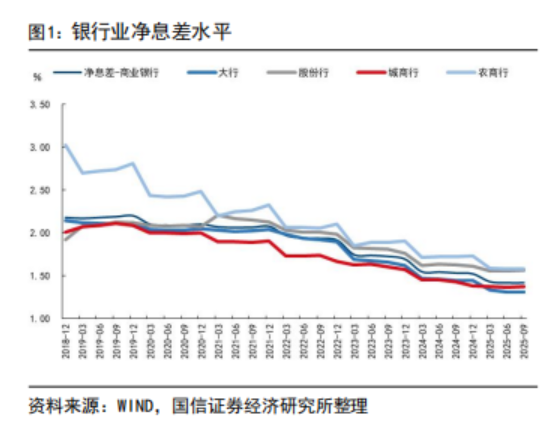
【国信银行·深度】银行业2026年经营展望之价格篇:货币政策相机抉择,净息差下降尾声
Xin Lang Cai Jing· 2025-12-05 12:56
Group 1: Core Insights - The current bottom line for the net interest margin (NIM) of major banks is approximately 1.2% to 1.3%, indicating limited room for further significant declines [1][6][84] - Maintaining a reasonable level of NIM is essential for economic growth and financial stability, as it relates to capital balance, breakeven points, and risk pricing mechanisms [6][20][21] Group 2: NIM Bottom Line Calculation - The projected nominal GDP growth during the "14th Five-Year Plan" period is estimated to be between 6.0% and 6.9%, which necessitates an M2 growth rate of about 7.0% to 8.0% [1][23][28] - The bottom line for NIM is calculated based on a required return on equity (ROE) of 7% to 8%, leading to a NIM bottom line of approximately 1.2% to 1.3% [36][84] Group 3: 2026 NIM Projections - If the Loan Prime Rate (LPR) decreases by 10 basis points (bps) and deposit rates remain unchanged, the NIM is expected to decline by approximately 5 to 8 bps in 2026 [2][85] - Without considering further interest rate cuts, the model predicts a decrease in loan rates by about 24 bps and deposit rates by 14 to 17 bps, resulting in a net interest margin contraction of about 2 to 5 bps [2][39][59] Group 4: Monetary Policy Outlook for 2026 - The monetary policy for 2026 is expected to be characterized by a "reasonable and ample" approach, with a likely LPR decrease of 10 bps and a reserve requirement ratio (RRR) cut of 50 bps [3][86] - The central bank's strategy will focus on balancing short-term and long-term goals, supporting economic growth while maintaining the health of the banking system [60][61] Group 5: Economic Recovery and Regulatory Impact - Economic recovery may not meet expectations, and regulatory changes could temporarily impact the banking sector's fundamentals [4][80] - The banking sector is under strong regulatory oversight, and any adverse policies could affect short-term valuations [80]

客户取款170万遭抢致重伤事件:农行回应与责任争议
Guan Cha Zhe Wang· 2025-12-05 11:45
Core Points - A bank robbery incident involving a large cash withdrawal of 1.7 million yuan occurred in July 2024, raising concerns about bank security measures for high-value transactions [1][5] - The victim, Mr. Ni, sustained severe injuries, including permanent blindness in one eye, and is seeking accountability from the bank for failing to ensure his safety during the withdrawal process [1][6] - The Agricultural Bank of China has acknowledged the incident, is cooperating with investigations, and is committed to enhancing security management and emergency response capabilities at its branches [2][5] Summary by Sections Incident Details - Mr. Ni withdrew 1.7 million yuan from the Agricultural Bank and was attacked by an assailant with a homemade firearm shortly after leaving the bank [1][3] - The assailant managed to escape with the cash but was apprehended later the same day [3] Bank's Response - The Agricultural Bank has expressed its commitment to support the victim and improve security protocols, although Mr. Ni reported a lack of follow-up communication from bank officials after the incident [2][5] - The bank's customer service indicated that there are no national guidelines for providing security for large cash withdrawals, leading to inconsistent practices across different branches [5] Legal and Regulatory Implications - Legal experts suggest that banks have a duty of care to ensure the safety of customers, especially during high-risk transactions like large cash withdrawals [5][6] - The incident has sparked discussions about the need for standardized security measures for large withdrawals and the extent of banks' liability in such situations [5][6]
农行取得细粒度理财风格识别方法及相关装置设备介质专利
Sou Hu Cai Jing· 2025-12-05 10:08
Group 1 - The core point of the article is that Agricultural Bank of China has obtained a patent for a method and device related to fine-grained wealth management style identification, with the patent granted under announcement number CN116245651B and the application date being February 2023 [1] Group 2 - Agricultural Bank of China was established in 1986 and is located in Beijing, primarily engaged in monetary financial services [1] - The registered capital of Agricultural Bank of China is approximately 34.998 billion RMB [1] - The bank has made investments in 16 enterprises and participated in 5,000 bidding projects, with 1,308 trademark records and 5,000 patent records, in addition to holding 119 administrative licenses [1]