
AGRICULTURAL BANK OF CHINA(601288)

Search documents
农业银行(01288) - 关於董事离任的公告
2026-03-31 11:01
香港交易及結算所有限公司及香港聯合交易所有限公司對本公告的內容概不負責,對其準確性或完整性亦不發表任 何聲明,並明確表示,概不對因本公告全部或任何部份內容而產生或因倚賴該等內容而引致的任何損失承擔任何責 任。 AGRICULTURAL BANK OF CHINA LIMITED 1288 公司秘書 中國北京 2026年3月31日 於本公告日期,本行的執行董事為谷澍先生、王志恒先生、劉洪先生和林立先生;本行的非執行董事為周濟女士、 劉曉鵬先生、張奇先生和張洪武先生;本行的獨立非執行董事為吳聯生先生、汪昌雲先生、鞠建東先生、 莊毓敏女士、張琦先生和王沛詩女士。 李蔚先生因任期屆滿不再擔任中國農業銀行股份有限公司(「本行」)非執行董事職務,同 時不再擔任本行董事會(「董事會」)「三農」金融與普惠金融發展委員會、提名與薪酬委員 會、審計委員會委員職務。 李蔚先生確認與董事會無不同意見,也沒有就其離任需要知會本行股東及債權人的任何 事項。 董事會對李蔚先生任職期間為本行發展做出的重要貢獻表示衷心感謝。 承董事會命 中國農業銀行股份有限公司 劉清 關於董事離任的公告 ...
农业银行:扩表与中收增长亮眼-20260331
HTSC· 2026-03-31 10:45
Investment Rating - The report maintains an "Accumulate" rating for A/H shares of the company [7] Core Views - The company reported a net profit of RMB 291.04 billion and operating income of RMB 725.31 billion for 2025, with year-on-year growth of 3.2% and 2.1% respectively, aligning with previous expectations [1] - The company plans to distribute a cash dividend of RMB 0.25 per share for 2025, maintaining a dividend payout ratio of 30% [1] - The company is leading in asset expansion among major banks, with total assets, loans, and deposits growing by 12.8%, 9.0%, and 7.7% respectively by the end of 2025 [2] - Non-interest income increased by 19.9% year-on-year, driven by a strong performance in wealth management and investment services [3] - The company’s non-performing loan ratio remained stable at 1.27%, with a provision coverage ratio of 293% [4] - The target price for 2026 A/H shares is set at RMB 7.67 and HKD 6.78, with a projected price-to-book ratio of 0.90 for A shares and 0.70 for H shares [5] Summary by Sections Financial Performance - For 2025, the company achieved a net profit of RMB 291.04 billion, with a year-on-year growth of 3.18% and operating income of RMB 725.31 billion, reflecting a growth rate of 2.08% [11] - The company’s net interest income decreased by 1.9% year-on-year, but the decline was less severe compared to previous quarters [2] Asset Growth - By the end of 2025, total assets grew by 12.8%, loans by 9.0%, and deposits by 7.7%, marking the fastest expansion among the six major banks [2] - The company’s corporate and retail loan growth rates were 9.2% and 5.0% respectively, with county loans growing at 11.0% [2] Non-Interest Income - Non-interest income rose by 19.9% year-on-year, with intermediary business income increasing by 16.6% [3] - The company’s investment income and fair value changes grew by 38.0% and 23.1% respectively, indicating resilience in the market [3] Risk Management - The non-performing loan ratio was stable at 1.27%, with a provision coverage ratio of 293%, indicating strong risk management capabilities [4] - The company maintained strict standards for non-performing loan recognition, with overdue loans over 90 days accounting for 72% of total non-performing loans [4] Valuation - The target price for 2026 A/H shares is RMB 7.67 and HKD 6.78, with a projected price-to-book ratio of 0.90 for A shares and 0.70 for H shares [5] - The company is expected to maintain a competitive edge in the market due to its unique county financial characteristics and resilient performance [5]
农业银行(601288.SH):非执行董事李蔚离任
Ge Long Hui A P P· 2026-03-31 10:41
Core Viewpoint - Agricultural Bank of China (601288.SH) announced that non-executive director Li Wei will no longer serve due to the expiration of his term, and he will also step down from various committee positions [1] Group 1 - Li Wei's term as a non-executive director has ended [1] - Li Wei will no longer be a member of the board's "Three Rural" finance and inclusive finance development committee [1] - Li Wei will also resign from the nomination and remuneration committee, as well as the audit committee [1]
农业银行(601288):扩表与中收增长亮眼
Xin Lang Cai Jing· 2026-03-31 10:30
Core Viewpoint - Agricultural Bank of China reported a net profit and operating income for 2025, showing year-on-year growth of 3.2% and 2.1% respectively, aligning closely with previous expectations [1] Group 1: Financial Performance - The bank's total assets, loans, and deposits grew by 12.8%, 9.0%, and 7.7% respectively by the end of 2025, leading among the six major banks [2] - Non-interest income increased by 19.9% year-on-year, with intermediary business income rising by 16.6%, ranking first among major banks [3] - The bank's net interest margin was 1.28%, a decrease of 14 basis points year-on-year, influenced by LPR adjustments and low market interest rates [2] Group 2: Risk and Asset Quality - The non-performing loan (NPL) ratio stood at 1.27% at the end of 2025, with a provision coverage ratio of 293%, remaining stable compared to the previous quarter [4] - Retail loan NPLs showed volatility, with increases in mortgage, business loan, and credit card NPL ratios, while corporate loan quality improved in sectors like transportation and water conservancy [4] Group 3: Future Outlook - The bank plans to continue expanding its wealth management and investment trading businesses to diversify income sources [3] - For 2026, the bank's projected net profit is estimated at 303 billion yuan, with a target price of 7.67 yuan for A shares and 6.78 Hong Kong dollars for H shares, maintaining a buy rating [5]
农业银行:非执行董事李蔚任期届满离任
Xin Lang Cai Jing· 2026-03-31 10:30
Core Viewpoint - Agricultural Bank announced that non-executive director Li Wei will no longer serve as a non-executive director due to the expiration of his term, and he will also step down from various committee positions within the board [1] Group 1 - Li Wei confirmed that there are no disagreements with the board regarding his departure [1] - His resignation does not require notification to shareholders or creditors [1]
农业银行:非执行董事李蔚离任
Ge Long Hui· 2026-03-31 10:26
Core Viewpoint - Agricultural Bank of China (601288.SH) announced that non-executive director Li Wei will no longer serve as a non-executive director due to the expiration of his term [1] Group 1 - Li Wei also stepped down from his positions on the board's "Three Rural" Financial and Inclusive Finance Development Committee, Nomination and Remuneration Committee, and Audit Committee [1]
净利增速连续6年领先可比同业,农行坚持的“难而正确的事”是什么?
券商中国· 2026-03-31 10:11
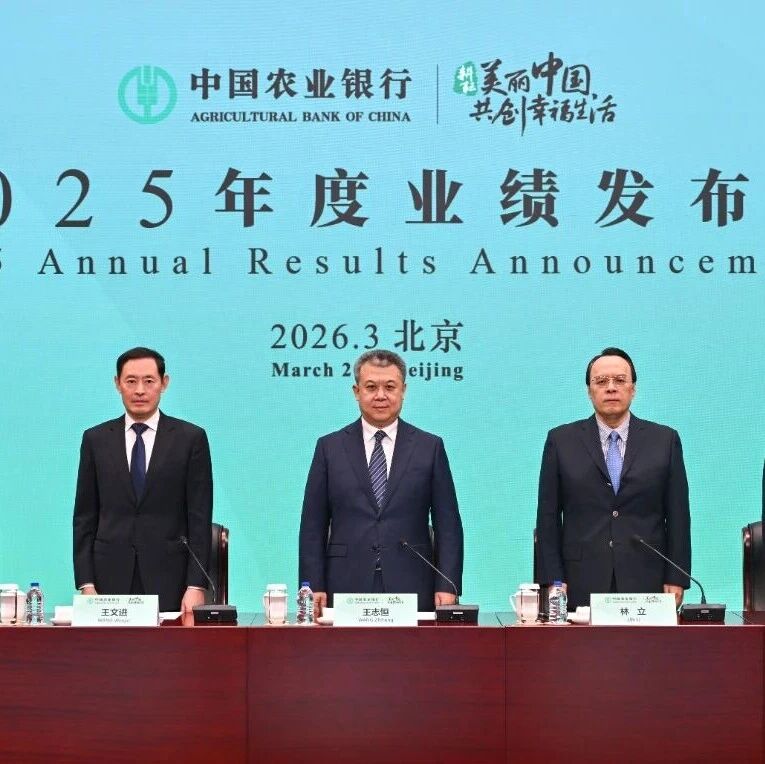
Core Viewpoint - Agricultural Bank of China (ABC) has demonstrated stable performance with continuous positive growth in operating income and net profit, achieving a net profit of 292 billion yuan, up 3.3% year-on-year, and operating income of 725.3 billion yuan, up 2.1% year-on-year, amidst a complex operating environment [3][4]. Financial Performance - Net profit and operating income have maintained "double positive growth" with net profit at 292 billion yuan and operating income at 725.3 billion yuan [3]. - The weighted average return on equity (ROE) stands at 10.16%, the highest among peers, while the average return on assets (ROA) is 0.63% [4]. - Total assets reached 48.8 trillion yuan, with new loans of 2.23 trillion yuan, an increase of 8.9% [5]. - Customer deposit balance is 38.69 trillion yuan, with an increase of 3.71 trillion yuan, leading peers in both daily average and growth rate of domestic RMB deposits [5]. Asset Quality - Non-performing loan (NPL) ratio is 1.27%, down 3 basis points from the beginning of the year, with overdue loan ratio at 1.25%, maintaining the best level among peers [5]. - The loan provision balance exceeds 1 trillion yuan, with a provision coverage ratio of 292.55%, both leading among peers [5]. Market Recognition - ABC has achieved the highest growth in A and H share prices, total market value, price-to-book (P/B) ratio, and price-to-earnings (P/E) ratio among peers [6]. - The bank's commitment to shareholder returns is evident with a proposed dividend of 1.3 yuan per 10 shares, totaling 454.98 billion yuan, maintaining a cash dividend ratio of 30% [7]. Future Outlook - The bank expresses confidence in 2026 performance, supported by stable credit growth and a positive trend in net interest income [8]. - ABC aims to enhance non-interest income and manage risks effectively while controlling overdue and new non-performing loans [8]. Inclusive Finance Strategy - ABC has established itself as a leader in inclusive finance, with the largest supply of inclusive loans and the widest customer coverage [10]. - By the end of 2025, inclusive loan balance reached 4.35 trillion yuan, with a year-on-year increase of 749.9 billion yuan, leading the industry [11]. County-Level Financial Services - ABC emphasizes its commitment to county-level financial services, with daily average deposits and loan increments exceeding 1 trillion yuan [19]. - The bank's county-level loan balance reached 10.9 trillion yuan, with an annual increase of over 1.08 trillion yuan, marking a growth rate of 11% [22]. Risk Management and Technology - ABC prioritizes risk management, with a continuous decline in NPL ratio over five years and a robust provision coverage ratio [26]. - The bank is leveraging AI technology for risk management, enhancing its ability to process data and manage credit risks effectively [27].

农业银行今日大宗交易平价成交400万股,成交额2680万元
Xin Lang Cai Jing· 2026-03-31 09:35
Group 1 - Agricultural Bank conducted a block trade of 4 million shares on March 31, with a transaction value of 26.8 million yuan, accounting for 0.68% of the total trading volume for the day [1] - The transaction price was 6.7 yuan per share, which was flat compared to the market closing price of 6.7 yuan [1]

农业银行(601288):盈利持续领跑大行,息差降幅收窄
Ping An Securities· 2026-03-31 07:29
银行 2026 年 3 月 31 日 农业银行(601288.SH) 盈利持续领跑大行,息差降幅收窄 推荐(维持) 股价:6.49 元 行情走势图 证券分析师 | 袁喆奇 | 投资咨询资格编号 | | --- | --- | | | S1060520080003 | | | YUANZHEQI052@pingan.com.cn | | 研究助理 | | | 李灵琇 | 一般证券从业资格编号 | | --- | --- | | | S1060124070021 | | | LILINGXIU785@pingan.com.cn | 主要数据 | 行业 | 银行 | | --- | --- | | 公司网址 | www.abchina.com;www.abchina.com | | | .cn | | 大股东/持股 | 中央汇金投资有限责任公司/40.14% | | 实际控制人 | | | 总股本(百万股) | 349,983 | | 流通 A 股(百万股) | 319,244 | | 流通 B/H 股(百万股) | 30,739 | | 总市值(亿元) | 22,186 | | 流通 A 股市值(亿元) | 20 ...
农业银行(601288):扩表与中收增长亮眼
HTSC· 2026-03-31 07:10
证券研究报告 农业银行 (601288 CH/1288 HK) 港股通 扩表与中收增长亮眼 华泰研究 年报点评 2026 年 3 月 31 日│中国内地/中国香港 国有大型银行 农业银行于 3 月 30 日发布 2025 年年报,2025 年归母净利润、营业收入分 别同比+3.2%、+2.1%,较 1-9 月+0.1pct、+0.1pct,基本符合我们此前预 期(25E 利润、营收增速 3.85%、2.18%)。2025 年拟每股派息 0.25 元, 年度现金分红比例为 30%(2024 年:30%),25 年 AH 股息率分别为 3.84%、 5.25%。公司利润和扩表增速领跑大行,中收增长亮眼,风险整体稳定,维 持 A/H 增持/买入评级。 扩表领先大行,息差降幅收窄 25 年末总资产、贷款、存款增速分别为+12.8%、+9.0%、+7.7%,较 9 月 末+2.3pct、-0.4pct、+0.3pct,扩表速度为六大行第 1。25 年末对公、零售 贷款分别同比+9.2%、+5.0%。县域贷款增速持续高于全行,2025 年末县 域贷款余额 10.9 万亿元,增速 11.0%,余额占境内贷款比重 41.0% ...