
AGRICULTURAL BANK OF CHINA(601288)

Search documents
农行取得LSM-Tree优化方法相关专利
Sou Hu Cai Jing· 2025-12-05 02:21
声明:市场有风险,投资需谨慎。本文为AI基于第三方数据生成,仅供参考,不构成个人投资建议。 天眼查资料显示,中国农业银行股份有限公司,成立于1986年,位于北京市,是一家以从事货币金融服 务为主的企业。企业注册资本34998303.3873万人民币。通过天眼查大数据分析,中国农业银行股份有 限公司共对外投资了16家企业,参与招投标项目5000次,财产线索方面有商标信息1308条,专利信息 5000条,此外企业还拥有行政许可119个。 国家知识产权局信息显示,中国农业银行股份有限公司取得一项名为"LSM-Tree的优化方法、相关装置 及存储介质"的专利,授权公告号CN119668502B,申请日期为2024年11月。 来源:市场资讯 ...

中国农业银行取得应用访问控制方法、装置、设备、介质及产品专利
Sou Hu Cai Jing· 2025-12-05 02:21
天眼查资料显示,中国农业银行股份有限公司,成立于1986年,位于北京市,是一家以从事货币金融服 务为主的企业。企业注册资本34998303.3873万人民币。通过天眼查大数据分析,中国农业银行股份有 限公司共对外投资了16家企业,参与招投标项目5000次,财产线索方面有商标信息1308条,专利信息 5000条,此外企业还拥有行政许可119个。 声明:市场有风险,投资需谨慎。本文为AI基于第三方数据生成,仅供参考,不构成个人投资建议。 来源:市场资讯 国家知识产权局信息显示,中国农业银行股份有限公司取得一项名为"应用访问控制方法、装置、设 备、介质以及产品"的专利,授权公告号CN119544341B,申请日期为2024年11月。 ...
银行业为和美乡村注入“金动能”
Jin Rong Shi Bao· 2025-12-05 02:03
在这一进程中,金融力量是不可或缺的重要支撑。各大银行机构精准施策、创新突破,以多元化服 务打通堵点、破解难点,让金融活水持续浸润乡村沃土,为宜居宜业和美乡村建设注入强劲动能。从陕 西延安的苹果园到广西桂林的罗汉果田,从浙江衢州的鸭蛋产销链到河西走廊的农批市场,金融活水正 精准滴灌,将农户的"产品清单"转化为实实在在的"幸福账单"。 打通金融服务"最后一公里" 今年是巩固拓展脱贫攻坚成果同乡村振兴有效衔接5年过渡期的最后一年。五载耕耘,脱贫成果持 续巩固,脱贫地区内生发展动力持续增强,宜居宜业和美乡村新画卷徐徐展开。 得知吴大哥的困境后,稠州银行衢州分行迅速行动,指导衢江支行启动专项帮扶机制,不仅通过厅 堂宣传展示、客户社群精准推送、员工志愿推广等多种方式拓宽销路,更是拿出专项资金给予消费补 贴。 "原本以为积压的鸭蛋要砸在手里,没想到银行掏钱补贴帮我找销路。"吴大哥感激之情溢于言表。 "农民不用跑银行网点,足不出户就能获得高效便捷的贷款服务。"在雷赤镇雷多村党支部书记郝缩 梅家里,她高兴地介绍,"这几年,银行工作人员把金融服务送到家门口,把政策讲进心坎里,给我们 吃了'定心丸'。" 雷赤镇雷多村位于陕西省延安 ...

农业银行取得内容分发方法、装置、电子设备及存储介质专利
Sou Hu Cai Jing· 2025-12-05 01:09
天眼查资料显示,中国农业银行股份有限公司,成立于1986年,位于北京市,是一家以从事货币金融服 务为主的企业。企业注册资本34998303.3873万人民币。通过天眼查大数据分析,中国农业银行股份有 限公司共对外投资了16家企业,参与招投标项目5000次,财产线索方面有商标信息1308条,专利信息 5000条,此外企业还拥有行政许可119个。 声明:市场有风险,投资需谨慎。本文为AI基于第三方数据生成,仅供参考,不构成个人投资建议。 国家知识产权局信息显示,中国农业银行股份有限公司取得一项名为"一种内容分发方法、装置、电子 设备及存储介质"的专利,授权公告号CN115913988B,申请日期为2022年11月。 来源:市场资讯 ...
农业银行取得一种银行流量入侵检测方法、装置、系统和介质专利
Sou Hu Cai Jing· 2025-12-05 01:09
来源:市场资讯 国家知识产权局信息显示,中国农业银行股份有限公司取得一项名为"一种银行流量入侵检测方法、装 置、系统和介质"的专利,授权公告号CN115913645B,申请日期为2022年10月。 声明:市场有风险,投资需谨慎。本文为AI基于第三方数据生成,仅供参考,不构成个人投资建议。 天眼查资料显示,中国农业银行股份有限公司,成立于1986年,位于北京市,是一家以从事货币金融服 务为主的企业。企业注册资本34998303.3873万人民币。通过天眼查大数据分析,中国农业银行股份有 限公司共对外投资了16家企业,参与招投标项目5000次,财产线索方面有商标信息1308条,专利信息 5000条,此外企业还拥有行政许可119个。 ...
数说“十四五”成绩单,看金融之笔绘就美好生活新画卷
21世纪经济报道· 2025-12-05 00:29
Group 1 - The article emphasizes the role of financial support in enhancing various industries and improving the livelihoods of individuals during the "14th Five-Year Plan" period in China [1][31] - The establishment of 12,900 non-heritage workshops has created over 1.2 million jobs, showcasing the impact of financial assistance on traditional crafts like Yi embroidery [3][4] - Agricultural Bank has introduced specialized financial products such as "Xiu Niang Loan" and "Park Loan" to address the financing challenges faced by artisans and small businesses [4][5] Group 2 - The article highlights the importance of supply chain finance in improving the efficiency of the dairy industry, with Agricultural Bank providing over 1.85 trillion yuan in supply chain financing by September 2025, benefiting 300,000 clients, primarily small and micro enterprises [10][9] - The average annual growth rate of inclusive agricultural loans reached 14.6% during the "14th Five-Year Plan," contributing to a historic grain production of 1.4 trillion jin and an increase in rural residents' disposable income to 23,000 yuan [12][15] - The number of new specialized and innovative small and medium-sized enterprises exceeded 100,000, with a total of over 140,000, indicating a robust growth in the sector supported by tailored financial products [24][26] Group 3 - The article notes that the number of new 5A-level tourist attractions has increased, with a total of 58 new sites and approximately 2,600 new A-level attractions, enhancing the supply of quality cultural and tourism products [18] - Agricultural Bank has expanded its financial services to remote areas, achieving over 98% coverage of township bank outlets, ensuring accessibility for rural communities [21][22] - The article mentions the significant increase in the number of individual businesses and enterprises, with nearly 2 million new enterprises and over 3.3 million new individual businesses during the "14th Five-Year Plan" [28][30]


大行撤退,小行“补位”!中长期大额存单成稀缺资源:年利率“2%+”产品多被抢空,有的门槛高达1000万元
Mei Ri Jing Ji Xin Wen· 2025-12-04 16:54
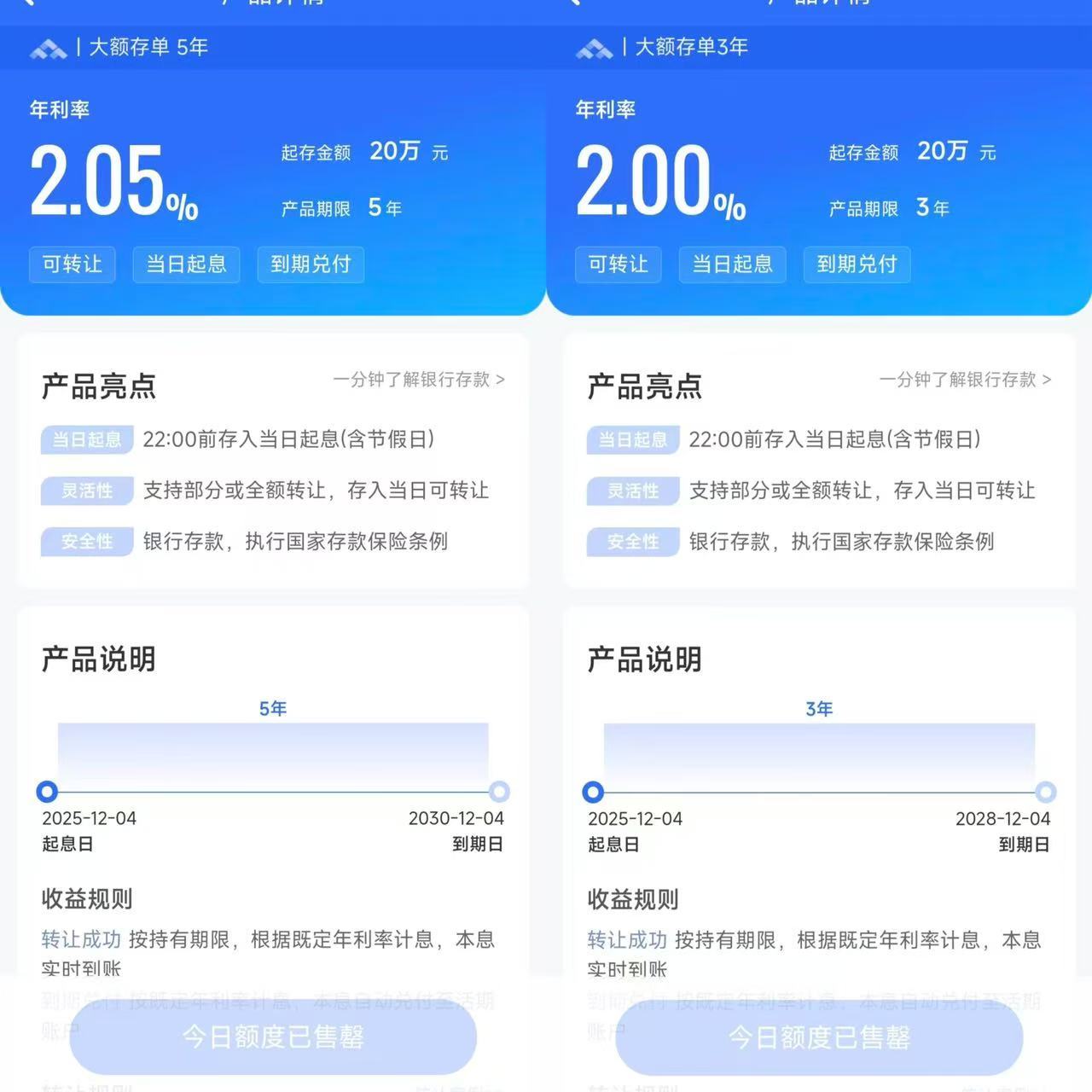
Core Viewpoint - The collective withdrawal of 5-year large denomination certificates of deposit (CDs) by six major state-owned banks has led to a significant shift in the market, with some small and medium-sized banks seizing the opportunity to promote their long-term deposit products as alternatives [1][2][18]. Group 1: Market Trends - The trend of shortening the term structure of large denomination CDs is evident, with the maximum available term generally reduced to three years and interest rates dropping to between 1.5% and 1.75% [2][20]. - Long-term, high-interest deposit products are becoming increasingly scarce, posing challenges for conservative investors who need to adjust their strategies [2][20]. Group 2: Small and Medium-Sized Banks' Strategies - Small and medium-sized banks are actively marketing their long-term deposit products, highlighting their competitive interest rates and terms in response to the withdrawal of major banks [2][4]. - Some banks are offering large denomination CDs with interest rates above 1.8%, while others have introduced alternative deposit products with similar rates but lower minimum deposit requirements [5][12]. Group 3: Customer Engagement and Marketing - Customer managers from small banks are leveraging the situation to attract clients by emphasizing the scarcity and advantages of their deposit products on social media platforms [2][4]. - The marketing efforts align with the traditional peak season for deposit gathering, allowing banks to secure a customer base seeking stable returns before the year-end [4][20]. Group 4: Interest Rate and Accessibility - Interest rates for large denomination CDs have been raised in some banks, with minimum deposit requirements reaching as high as 1 million to 1 billion [9][11]. - Despite the scarcity of high-interest large denomination CDs, some banks continue to offer competitive rates on alternative deposit products, ensuring accessibility for a broader customer base [12][15]. Group 5: Future Outlook - The overall trend indicates a tightening of supply for long-term, high-yield deposit products across various banks, with expectations of a long-term decline in deposit rates [20][21]. - Banks face the challenge of balancing deposit volume and pricing while managing risks associated with higher interest rates and liquidity [21][22].


“劝退”普通储户?大行3年期大额存单现500万“天价”起购
Xin Jing Bao· 2025-12-04 14:58
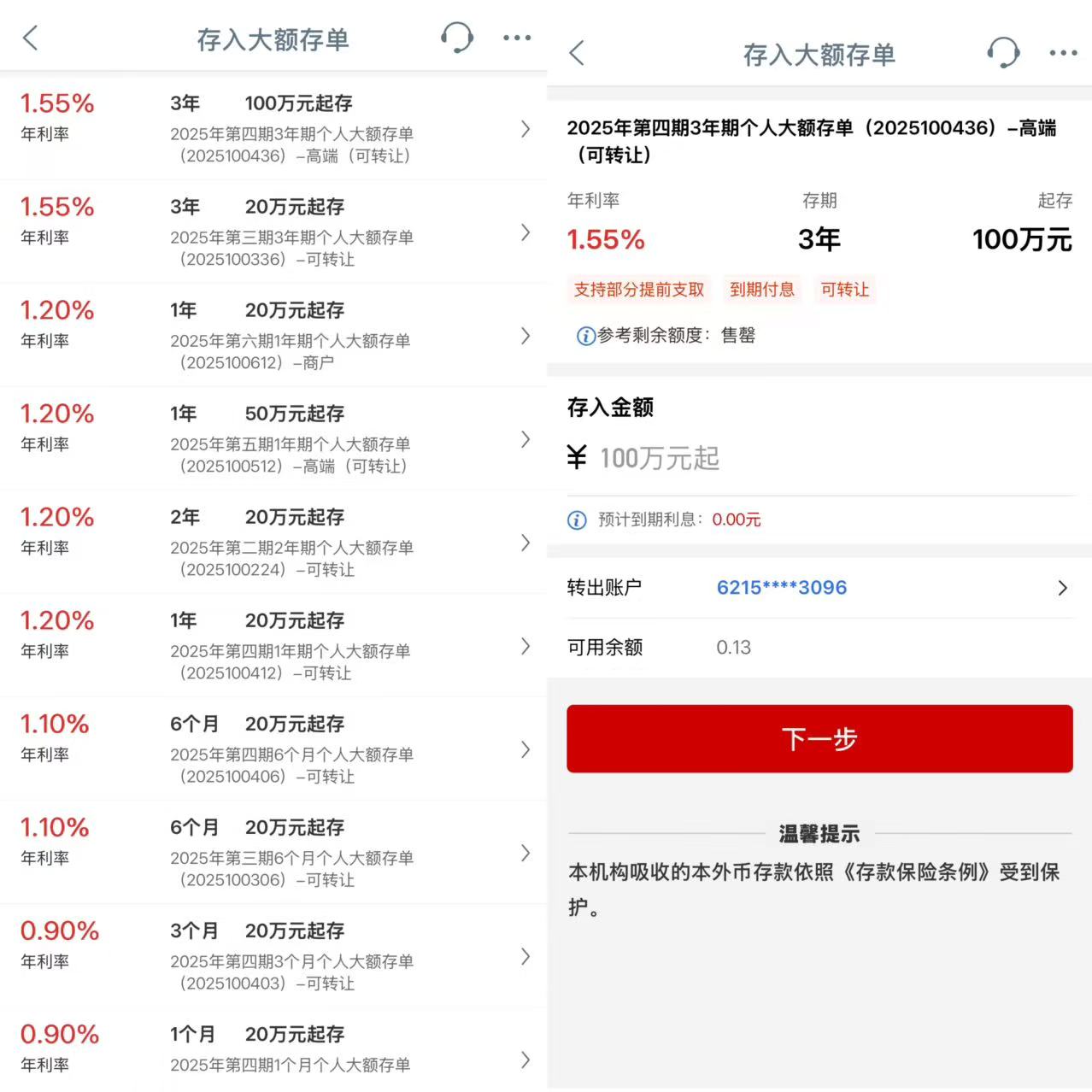
Core Viewpoint - The Industrial and Commercial Bank of China (ICBC) has raised the minimum deposit requirement for its three-year large-denomination certificates of deposit (CDs) to 1 million yuan, while still offering a lower threshold of 200,000 yuan for another product, both with an interest rate of 1.55% [1][2][4]. Summary by Sections Product Offerings - ICBC offers two types of three-year large-denomination CDs: one with a minimum deposit of 1 million yuan, which is currently sold out, and another with a minimum of 200,000 yuan, which still has a remaining balance of over 10 million yuan [1][2]. - Other banks, such as Agricultural Bank of China, also offer three-year CDs with varying minimum deposit requirements, including a product with a 500,000 yuan minimum [4][5]. Market Dynamics - The adjustment in deposit thresholds by major banks reflects a strategic move to manage liabilities more effectively in a low net interest margin environment, aiming to reduce high-cost long-term liabilities [1][9]. - The trend of raising minimum deposit requirements is seen as a way to filter out ordinary depositors and attract high-net-worth clients, thereby optimizing the customer structure [1][6]. Interest Rate Environment - The interest rates for three-year large-denomination CDs are currently set at 1.55%, which is consistent across several banks, indicating a stable yet competitive market for these products [2][4]. - The overall banking sector is experiencing a structural adjustment, with large state-owned banks reducing high-cost deposit products while some smaller banks are increasing interest rates to attract deposits [7][8]. Future Outlook - Analysts predict that the interest rates for large-denomination CDs may continue to decline due to ongoing pressure on banks' net interest margins and potential further reductions in policy rates by the central bank [10][11]. - The demand for large-denomination CDs is expected to remain strong in the short term due to their perceived safety and stability, particularly among risk-averse investors [10][12].
最高500万元!银行大额存单门槛为何高低并行?
Guo Ji Jin Rong Bao· 2025-12-04 14:28
Core Viewpoint - The recent adjustment by Industrial and Commercial Bank of China (ICBC) to raise the minimum investment for its 3-year large-denomination certificates of deposit (CDs) to 1 million yuan reflects a broader industry trend where commercial banks are transforming traditional large deposit products into tools for customer relationship management [1][5]. Group 1: Changes in Deposit Products - ICBC has increased the minimum investment for its "high-end" 3-year large-denomination CD to 1 million yuan, while still offering regular products starting at 200,000 yuan [2][3]. - Agricultural Bank of China (ABC) has a similar product with a minimum investment of 5 million yuan, while also maintaining lower threshold products [4]. - Many banks have removed 5-year large-denomination CDs from their offerings, indicating a tightening of availability for medium to long-term large-denomination CDs [4]. Group 2: Interest Rates and Market Dynamics - The interest rates for the high-threshold large-denomination CDs have aligned with those of regular 3-year fixed deposits, both at 1.55% [4]. - The limited availability of large-denomination CDs has led to a situation where banks are using these products to attract high-end clients rather than relying on interest rates as the main draw [5]. Group 3: Strategic Implications for Banks - The adjustments in deposit structures are seen as a strategy to manage high-cost liabilities and stabilize net interest margins, which have been under pressure [5]. - By increasing the minimum investment threshold, banks aim to reduce the number of lower-value depositors, thereby lowering operational and management costs [5]. - The trend of adjusting deposit structures and lowering interest rates is becoming a normalized practice in the banking industry as they seek to maintain profitability in a low-interest environment [5][6].
农行临朐支行手机银行预填单 指尖一点,业务提速
Feng Huang Wang Cai Jing· 2025-12-04 12:33
一台手机,几次点击,昔日需要耗时排队等候的银行业务,如今在农业银行县域基层网点实现了"分钟 级"办理。 在农业银行临朐朐山支行,刚办理完开卡业务的张先生感慨道:"以前听说取款耗时耗力,现在利用排 号时间通过手机提前填写信息,真是太方便了!" 这得益于农业银行在县域基层网点大力推广的手机银行预填单功能,通过数字化转型优化业务流程,将 便捷高效的金融服务延伸至县域的每个角落。 一、服务升级:解决县域客户业务办理痛点 耗时耗力曾是许多客户在银行网点办理业务的共同体验。存取款、转账、开卡等基础业务,虽然流程相 对简单,但在客流量大时,排队等候、填表繁琐却成为客户的共同困扰。 四、未来展望:数字化转型助推服务升级 随着5G、人工智能等新技术的发展,农业银行将继续丰富掌银功能,拓宽服务边界。未来的县域金融 服务将更加智能化、个性化,手机银行不再只是业务办理的渠道,更将成为集金融、生活、社交于一体 的综合服务平台。 这一功能针对存取款、转账、开卡等高频业务,允许客户通过手机银行预先填写相关信息,大大减少了 客户在网点的等待时间和办理时间。 二、多元渠道:构建便捷预填单服务体系 为满足县域客户多样化需求,农业银行构建了多元化 ...