
AGRICULTURAL BANK OF CHINA(601288)

Search documents
农业银行(601288) - 农业银行关于召开2025年度第二次临时股东会的通知
2025-11-10 10:15
证券代码:601288 证券简称:农业银行 公告编号:临 2025-052 号 中国农业银行股份有限公司 关于召开2025年度第二次临时股东会的通知 中国农业银行股份有限公司董事会及全体董事保证本公告内容不存在任何 虚假记载、误导性陈述或者重大遗漏,并对其内容的真实性、准确性和完整性承 担法律责任。 重要内容提示: 一、 召开会议的基本情况 (一)股东会类型和届次 2025年度第二次临时股东会 召开的日期时间:2025 年 11 月 28 日 14 点 50 分 召开地点:北京市东城区建国门内大街乙 18 号本行总行 (五)网络投票的系统、起止日期和投票时间 网络投票系统:上海证券交易所股东会网络投票系统 网络投票起止时间:自2025 年 11 月 28 日 1 股东会召开日期:2025年11月28日 本次股东会采用的网络投票系统:上海证券交易所股东会网络投票系统 不适用。 本次股东会审议议案及投票股东类型 二、 会议审议事项 (二)股东会召集人:董事会 (三)投票方式:本次股东会所采用的表决方式是现场投票和网络投票相结合的 方式 (四)现场会议召开的日期、时间和地点 至2025 年 11 月 28 日 采用 ...
农业银行(601288) - 农业银行2025年度第二次临时股东会会议资料
2025-11-10 10:15
中国农业银行股份有限公司 2025 年度第二次临时股东会 中国农业银行股份有限公司 2025 年度第二次临时股东会 会议资料 2025 年 11 月 28 日 中国农业银行股份有限公司 2025 年度第二次临时股东会 文件目录 中国农业银行股份有限公司 2025 年度第二次临时股东会 中国农业银行股份有限公司 2025 年度第二次临时股东会议案 1 选举刘洪先生担任中国农业银行股份有限公司执行董事 | 议案 | 1:选举刘洪先生担任中国农业银行股份有限公司执行董事 1 | | --- | --- | | 议案 | 2:选举张奇先生继续担任中国农业银行股份有限公司非执行董 | | 事 3 | | | 议案 | 3:选举张洪武先生担任中国农业银行股份有限公司非执行董事 | | 5 | | | 议案 | 4:选举汪昌云先生继续担任中国农业银行股份有限公司独立董 | | 事 7 | | | 议案 | 5:中国农业银行股份有限公司 年度中期利润分配方案.20 2025 | | 议案 | 6:中国农业银行股份有限公司金融债券发行计划事宜 22 | | 议案 | 7:中国农业银行股份有限公司资本工具和总损失吸收能力非资 | ...
农业银行(01288) - 建议派发截至2025年6月30日止六个月之中期股息
2025-11-10 09:43
EF002 免責聲明 | 香港交易及結算所有限公司及香港聯合交易所有限公司對本公告的內容概不負責,對其準確性或完整性亦不發表任何聲明,並明確表示,概不對因 | 公告全部或任何部份內容而產生或因倚賴該等內容而引致的任何損失承擔任何責任。 | | --- | --- | | | 股票發行人現金股息(可選擇貨幣)公告 | | 發行人名稱 | 中國農業銀行股份有限公司 | | 股份代號 | 01288 | | 多櫃檯股份代號及貨幣 | 不適用 | | 相關股份代號及名稱 | 不適用 | | 公告標題 | 建議派發截至2025年6月30日止六個月之中期股息 | | 公告日期 | 2025年11月11日 | | 公告狀態 | 更新公告 | | | 更新除淨日、為符合獲取股息分派而遞交股份過戶文件之最後時限及暫停辦理股份過戶 | | 更新/撤回理由 | 登記手續之日期 | | 股息信息 | | | 股息類型 | 中期(半年期) | | 股息性質 | 普通股息 | | 財政年末 | 2025年12月31日 | | 宣派股息的報告期末 | 2025年6月30日 | | 宣派股息 | 每 10 股 1.195 RMB | | 股 ...
农业银行(01288) - 2025年度第二次临时股东会出席回条
2025-11-10 09:40
日期:2025年 月 日 附註: 2025年度第二次臨時股東會出席回條 致:中國農業銀行股份有限公司(「貴行」) 本人╱吾等 (附註1) , , 為 貴行股本中 (附註2) 股H股之註冊持有人, 茲通知 貴行,本人╱吾等擬親自或委派代表出席 貴行於2025年11月28日(星期五)下午二時 五十分於中國北京市東城區建國門內大街乙18號 貴行總行舉行之2025年度第二次臨時股東 會。 簽名: AGRICULTURAL BANK OF CHINA LIMITED 1288 香港中央證券登記有限公司 香港灣仔皇后大道東183號 合和中心17M樓 傳真:(852) 2865 0990 地址為 , 1. 請用正楷填入登記於本行H股股東名冊上之股東全名及地址。 2. 請填入以 閣下名義登記之H股股份數目。 3. 請填妥並簽署本出席回條,並於2025年11月24日(星期一)或以前以專人遞送、郵寄或傳真方式交回本 行H股股份過戶登記處,地址如下: ...
农业银行(01288) - 2025年11月28日举行之2025年度第二次临时股东会之代表委任表格
2025-11-10 09:35
與本代表委任 表格有關之H股 股份數目 (附註1) 本人╱吾等 (附註2) , , 地址為 , AGRICULTURAL BANK OF CHINA LIMITED 1288 2025年11月28日舉行之 2025年度第二次臨時股東會之代表委任表格 為中國農業銀行股份有限公司(「本行」)股本H股之註冊持有人,玆委任 (附註3) , 附註: 1. 倘未有填上股份數目,則本代表委任表格將被視為與所有以 閣下名義登記之本行H股股份有關。 6. 填妥及簽署的代表委任表格連同經過公證人簽署證明之相關授權書(如有)及其他相關授權文件(如有),必須於臨時 股東會或其任何續會(視情況而定)指定舉行時間24小時前(即2025年11月27日(星期四)下午二時五十分前),送抵本 行H股股份過戶登記處香港中央證券登記有限公司,地址為香港灣仔皇后大道東183號合和中心17M樓,方為有效。 2. 請以正楷填上登記於本行H股股東名冊上所示之全名及地址。 3. 請填上代表之姓名及地址。倘未有填上姓名,則臨時股東會主席將出任 閣下之代表。每名股東可委任一名或以上 的代表出席會議並為其投票。受託代表毋須為本行股東,惟須親身出席大會以代表 閣下。 ...
农业银行(01288) - 2025年度第二次临时股东会通告
2025-11-10 09:28
香港交易及結算所有限公司及香港聯合交易所有限公司對本通告的內容概不負責,對其準確性或完整性亦不發表任 何聲明,並明確表示,概不對因本通告全部或任何部份內容而產生或因倚賴該等內容而引致的任何損失承擔任何責 任。 AGRICULTURAL BANK OF CHINA LIMITED 1288 2025年度第二次臨時股東會通告 兹通告,中國農業銀行股份有限公司(「本行」)將於2025年11月28日(星期五)下午二時五 十分於中國北京市東城區建國門內大街乙18號本行總行舉行2025年度第二次臨時股東會 (「臨時股東會」),以審議並酌情通過以下事項: 普通決議案 特別決議案 6. 審議及批准金融債券發行計劃事宜;及 - 1 - 1. 審議及批准選舉劉洪先生擔任本行執行董事; 2. 審議及批准選舉張奇先生繼續擔任本行非執行董事; 3. 審議及批准選舉張洪武先生擔任本行非執行董事; 4. 審議及批准選舉汪昌雲先生繼續擔任本行獨立非執行董事; 5. 審議及批准2025年度中期利潤分配方案; 7. 審議及批准資本工具和總損失吸收能力非資本債券計劃額度事宜。 代表委任表格連同經公證人簽署證明的授權書(如有)及其他授權文件(如有) ...
农业银行(01288) - 2025年度第二次临时股东会通函
2025-11-10 09:24
此乃要件 請即處理 如 閣下對本通函任何方面或對將採取的行動存有任何疑問,應諮詢 閣下的持牌證券經紀或 其他註冊證券商、銀行經理、律師、專業會計師或其他專業顧問。 如 閣下已出售或轉讓名下全部中國農業銀行股份有限公司股份,應立即將本通函及隨附的代 表委任表格及回條交給買主或承讓人,或送交經手買賣或轉讓的銀行、持牌證券經紀或其他代 理商,以便其轉交買主或承讓人。 香港交易及結算所有限公司及香港聯合交易所有限公司對本通函的內容概不負責,對其準確性 或完整性不發表任何聲明,並明確表示概不就因本通函全部或任何部分內容而產生或因倚賴該 等內容而引致的任何損失承擔任何責任。 資本工具和總損失吸收能力非資本債券計劃額度事宜 AGRICULTURAL BANK OF CHINA LIMITED 1288 選舉執行董事 選舉非執行董事 選舉獨立非執行董事 2025年度中期利潤分配方案 金融債券發行計劃事宜 及 2025年度第二次臨時股東會通告 本行謹訂於2025年11月28日(星期五)下午二時五十分於中國北京市東城區建國門內大街乙18 號本行總行舉行臨時股東會,大會通告載於本通函第ESM-1頁至第ESM-3頁內。 本通函隨附臨 ...
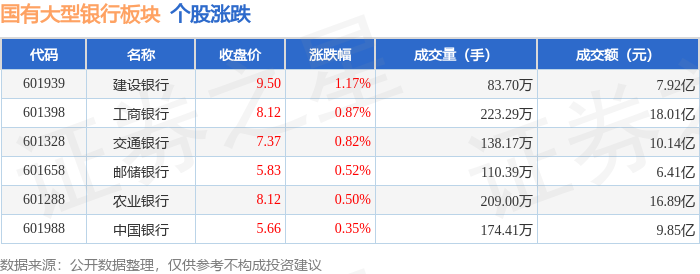
国有大型银行板块11月10日涨0.61%,建设银行领涨,主力资金净流入3.85亿元
Zheng Xing Xing Ye Ri Bao· 2025-11-10 08:48
Core Insights - The state-owned large bank sector saw an increase of 0.61% on November 10, with China Construction Bank leading the gains [1] - The Shanghai Composite Index closed at 4018.6, up 0.53%, while the Shenzhen Component Index closed at 13427.61, up 0.18% [1] Bank Performance Summary - China Construction Bank (CCB) closed at 9.50, up 1.17% with a trading volume of 837,000 shares and a transaction value of 79.267 million [1] - Industrial and Commercial Bank of China (ICBC) closed at 8.12, up 0.87% with a trading volume of 2.2329 million shares and a transaction value of 1.801 billion [1] - Bank of Communications closed at 7.37, up 0.82% with a trading volume of 1.3817 million shares and a transaction value of 1.014 billion [1] - Postal Savings Bank closed at 5.83, up 0.52% with a trading volume of 1.1039 million shares and a transaction value of 641 million [1] - Agricultural Bank of China closed at 8.12, up 0.50% with a trading volume of 2.09 million shares and a transaction value of 1.689 billion [1] - Bank of China closed at 5.66, up 0.35% with a trading volume of 1.7441 million shares and a transaction value of 985 million [1] Fund Flow Analysis - The state-owned large bank sector experienced a net inflow of 385 million from institutional investors, while retail investors saw a net outflow of 107 million [1] - The detailed fund flow for individual banks shows that ICBC had a net inflow of 172 million from institutional investors, while it faced a net outflow of 67.16 million from retail investors [2] - Bank of Communications had a net inflow of 133 million from institutional investors, with a net outflow of 34.23 million from retail investors [2] - CCB had a net inflow of 57.239 million from institutional investors, but also faced a net outflow of 53.9629 million from retail investors [2] - Agricultural Bank of China had a net inflow of 10.959 million from institutional investors, while retail investors contributed a net inflow of 60.3273 million [2] - Bank of China experienced a net outflow of 20.5749 million from institutional investors, but had a net inflow of 12.2374 million from retail investors [2]





本周在售最低持有期产品哪家强?
2 1 Shi Ji Jing Ji Bao Dao· 2025-11-10 08:44
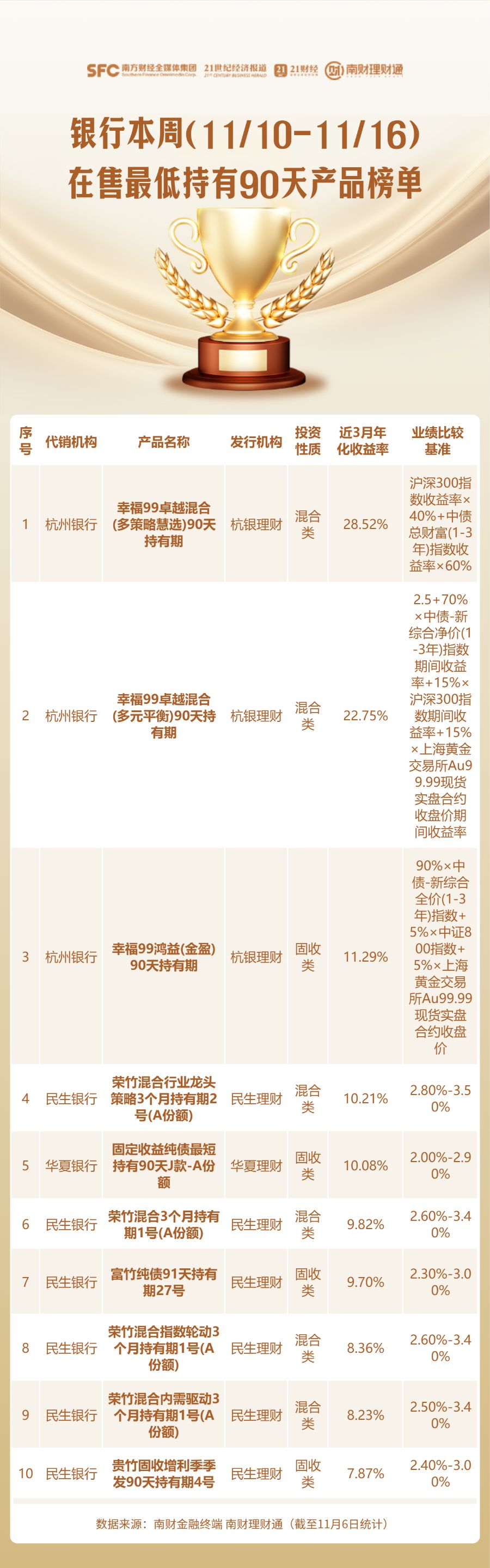
Core Insights - The article emphasizes the importance of distinguishing between various bank wealth management products, which often have similar names and vague characteristics, to help investors make informed choices [1] - The South Finance Wealth Management team compiles a weekly performance ranking of wealth management products available through different distribution channels, focusing on those with the best performance [1] Product Performance Summary - The report categorizes products based on minimum holding periods of 90 days, 180 days, and 365 days, calculating annualized returns for each category [1] - A total of 28 distribution institutions are involved in the ranking, including major banks such as Industrial and Commercial Bank of China, Bank of China, and Agricultural Bank of China [1] - The ranking is based on the assumption of the product's "on-sale" status, but actual availability may vary due to factors like sold-out quotas or differences in product listings for different customers [1] 90-Day Holding Period Products - The top-performing product for a 90-day holding period is from Hangzhou Bank, with an annualized return of 22.75% [4] - Other notable products include those from Minsheng Bank and Huaxia Bank, with returns of 10.21% and 10.08%, respectively [5] 180-Day Holding Period Products - For the 180-day holding period, Hangzhou Bank's product leads with a return of 14.04% [7] - Minsheng Bank also features prominently with products yielding 12.26% and 10.26% [7] 365-Day Holding Period Products - The report indicates that products with a 365-day holding period are also being evaluated, with specific performance data yet to be detailed in the provided excerpts [9]





农业银行(601288):业绩持续领跑大行 维持“买入”评级
Xin Lang Cai Jing· 2025-11-10 08:32
Core Insights - Agricultural Bank of China reported a revenue of 550.9 billion yuan for the first nine months of 2025, representing a year-on-year growth of 2.0%, and a net profit attributable to shareholders of 220.9 billion yuan, up 3.0% year-on-year [1][2] Financial Performance - The bank's revenue growth accelerated in 9M25 compared to 1H25, with a revenue increase of 2.0% (1H25: 0.8%) and a net profit growth of 3.0% (1H25: 2.7%) [1][2] - Non-interest income saw a significant increase of 20.7% year-on-year in 9M25, contributing 3.9 percentage points to revenue growth, driven by a 31.7% increase in investment-related non-interest income [1][2] - The bank's non-performing loan (NPL) ratio slightly decreased to 1.27% in 3Q25, with a provision coverage ratio improving to 295.1%, the highest among major banks [3] Deposit and Loan Growth - Deposits grew by 9.3% year-on-year in 3Q25, up from 8.3% in 2Q25, supporting credit expansion [2] - Loan growth in 3Q25 was also 9.3%, slightly lower than the previous quarter's 9.6%, but still above the average for state-owned banks [2] Interest Margin and Risk Management - The net interest margin for 9M25 was 1.30%, down 15 basis points year-on-year, with a stable margin of 1.28% in 3Q25 [3] - The cost of interest-bearing liabilities decreased by 7 basis points to 1.45% in 3Q25, benefiting from an improved liability structure [3] Investment Outlook - The bank is expected to enter a new valuation reassessment cycle, with a stock price increase of nearly 60% year-to-date, leading the banking sector [4] - The bank's dividend payout ratio for 1H25 was 32.1%, indicating potential for mid-term dividends to be realized within the year [2][4] - Future net profit growth is projected at 3.0%, 3.4%, and 4.3% for 2025-2027, with a current price-to-book ratio of 1.02 for 2025 [4]