AGRICULTURAL BANK OF CHINA(601288)

Search documents
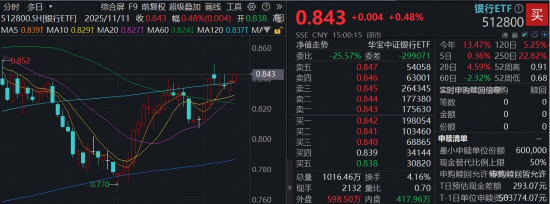
逆市上涨!农业银行涨超2%,逼近前高!双百亿银行ETF(512800)站稳所有均线,资金寻求“当下确定性”
Xin Lang Ji Jin· 2025-11-11 11:59
Core Viewpoint - The banking sector is experiencing a resurgence, with the bank ETF (512800) showing positive performance amidst market volatility, indicating strong buying interest and a favorable medium to long-term outlook [1][4]. Group 1: Market Performance - The bank ETF (512800) closed up 0.48% today, with intraday premium trading reflecting positive buying sentiment [1]. - The ETF has shown a two-day consecutive increase and is positioned above all moving averages, suggesting an optimistic medium to long-term trend [1]. - The ETF's latest scale exceeds 20.4 billion, with an average daily trading volume of over 800 million this year, making it the largest and most liquid bank ETF in A-shares [4]. Group 2: Stock Performance - Individual bank stocks are mostly performing well, with Xi'an Bank rising nearly 3%, Agricultural Bank up over 2%, and several others, including Qingdao Bank and China Merchants Bank, also showing gains [2][3]. - Over 10 listed banks have seen significant share purchases by shareholders or executives this year, indicating strong market confidence [3]. Group 3: Investment Sentiment - The current market environment has led to a shift towards stable cash flow and high-dividend sectors, with banks expected to attract more investment due to their stable and high dividend characteristics [3]. - The banking sector is perceived as being in a high cost-performance zone, with the bank ETF tracking a price-to-book ratio of only 0.72, indicating a mid-low range compared to the past decade [4]. - The dividend yield of the index tracked by the bank ETF is 4.02%, significantly exceeding the risk-free rate of 1.8%, highlighting its "quasi-fixed income" nature [4].


银行直销“不动产” 折价加速去化
Zhong Guo Jing Ying Bao· 2025-11-11 10:32
Core Viewpoint - The article discusses the accelerated disposal of non-performing real estate assets by banks in China, driven by the need to enhance asset liquidity amid rising bad debts and stricter regulatory requirements during an economic downturn [1][2][4]. Group 1: Market Dynamics - Banks are auctioning properties at prices significantly below market valuation, with some properties starting at over 40% lower than assessed values, as seen in the case of a two-bedroom apartment in Langfang, Hebei [1]. - The trend of banks selling real estate directly is gaining traction, with various banks, including Agricultural Bank and Industrial Bank, actively promoting their properties through online platforms and bank channels [2][3]. Group 2: Challenges and Solutions - Concerns from buyers regarding legal disputes over auctioned properties are being addressed through agreements that ensure original owners vacate the premises by a specified date [2]. - The traditional judicial auction process is criticized for being lengthy and inefficient, prompting banks to seek alternative methods for quicker asset recovery, such as direct sales of non-performing loans [2][4]. Group 3: Innovations in Asset Disposal - Banks are exploring innovative approaches to asset disposal, including leveraging technology for faster transactions and creating flexible sales models like "rent-to-buy" and asset package sales [5]. - The use of big data and blockchain technology is being implemented to enhance transparency and streamline the transaction process, marking a shift from passive asset disposal to proactive asset management [5].

研报掘金丨申万宏源研究:维持农业银行“买入”评级,预计农行估值有望再创新高
Ge Long Hui A P P· 2025-11-11 09:41
Core Viewpoint - Agricultural Bank of China (ABC) has demonstrated strong financial performance in its Q3 2025 report, with revenue and net profit growth, positioning itself for a new valuation reassessment cycle [1] Financial Performance - For the first nine months of 2025, ABC achieved revenue of 550.9 billion yuan, reflecting a year-on-year increase of 2.0% [1] - The net profit attributable to shareholders reached 220.9 billion yuan, marking a year-on-year growth of 3.0% [1] - The non-performing loan (NPL) ratio slightly decreased by 1 basis point to 1.27% quarter-on-quarter [1] - The provision coverage ratio improved by 0.1 percentage points to 295% quarter-on-quarter [1] Market Position and Growth - ABC's deposit growth has accelerated, supporting its balance sheet expansion, with credit issuance in the first three quarters matching that of Industrial and Commercial Bank of China (ICBC) [1] - The marginal improvement in NPL generation indicates a positive trend in asset quality [1] - ABC stands out among state-owned banks with the best combination of revenue and profit performance, leading to a significant stock price increase of nearly 60% since the beginning of the year [1] Future Outlook - The bank is expected to achieve new valuation highs, supported by anticipated volume-driven pricing, solid provisioning, and steady capital accumulation [1] - China Ping An has recently entered the top ten shareholders with a holding ratio of 1.4% as of Q3 2025, indicating confidence in ABC's prospects [1] - Mid-term dividend distribution is expected to materialize within the year, further solidifying ABC's high dividend advantage [1] - The rating for ABC is maintained at "Buy" [1]
8.08亿元资金今日流入银行股
Zheng Quan Shi Bao Wang· 2025-11-11 09:08
Market Overview - The Shanghai Composite Index fell by 0.39% on November 11, with 15 out of the 28 sectors rising, led by retail and real estate, which increased by 1.43% and 0.81% respectively [1] - The banking sector rose by 0.35%, while the telecommunications and electronics sectors experienced declines of 2.20% and 1.74% respectively [1] Capital Flow Analysis - The main capital outflow from the two markets totaled 56.242 billion yuan, with five sectors seeing net inflows [1] - The banking sector had the largest net inflow of 808 million yuan, followed by the steel sector with a 0.62% increase and a net inflow of 391 million yuan [1] Banking Sector Performance - Within the banking sector, 42 stocks were tracked, with 22 rising and 12 falling [2] - The top three banks by net inflow were Agricultural Bank with 302 million yuan, followed by China Merchants Bank and Ping An Bank with inflows of 224 million yuan and 128 million yuan respectively [2] - The banks with the highest net outflows included Chongqing Rural Commercial Bank, Minsheng Bank, and Industrial Bank, with outflows of 79.83 million yuan, 66.40 million yuan, and 23.17 million yuan respectively [2] Individual Bank Performance - Agricultural Bank saw a price increase of 2.22% with a turnover rate of 0.11% and a net capital flow of 301.97 million yuan [2] - China Merchants Bank increased by 0.56% with a net capital flow of 223.84 million yuan [2] - Ping An Bank rose by 0.34% with a net capital flow of 128.05 million yuan [2] - Other notable performances included Jiangsu Bank with a slight decline of 0.18% and a net capital flow of 90.38 million yuan [2]


国有大型银行板块11月11日涨1.1%,农业银行领涨,主力资金净流入4.13亿元
Zheng Xing Xing Ye Ri Bao· 2025-11-11 08:46
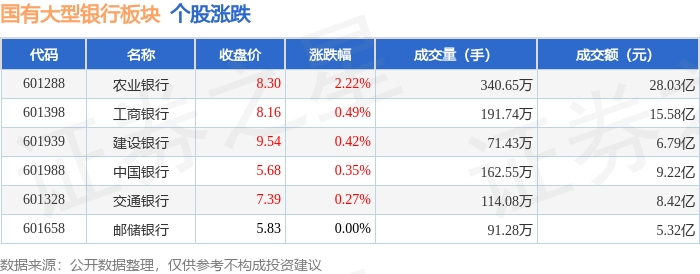
Core Insights - The state-owned large bank sector saw a 1.1% increase on November 11, with Agricultural Bank leading the gains [1] - The Shanghai Composite Index closed at 4002.76, down 0.39%, while the Shenzhen Component Index closed at 13289.0, down 1.03% [1] Bank Performance Summary - Agricultural Bank (601288) closed at 8.30, up 2.22%, with a trading volume of 3.41 million shares and a transaction value of 2.80 billion [1] - Industrial and Commercial Bank (601398) closed at 8.16, up 0.49%, with a trading volume of 1.92 million shares and a transaction value of 1.56 billion [1] - China Construction Bank (601939) closed at 9.54, up 0.42%, with a trading volume of 714,300 shares and a transaction value of 679 million [1] - Bank of China (601988) closed at 5.68, up 0.35%, with a trading volume of 1.63 million shares and a transaction value of 922 million [1] - Bank of Communications (601328) closed at 7.39, up 0.27%, with a trading volume of 1.14 million shares and a transaction value of 842 million [1] - Postal Savings Bank (601658) closed at 5.83, unchanged, with a trading volume of 912,800 shares and a transaction value of 532 million [1] Capital Flow Analysis - The state-owned large bank sector experienced a net inflow of 413 million in main funds, while retail investors saw a net outflow of 224 million [1] - Agricultural Bank had a main fund net inflow of 324 million, while retail investors had a net outflow of 189 million [2] - Industrial and Commercial Bank had a main fund net inflow of 69.98 million, with retail investors experiencing a net outflow of 30.40 million [2] - China Construction Bank had a main fund net outflow of 205.81 thousand, but retail investors had a net inflow of 2.46 million [2] - Postal Savings Bank had a main fund net outflow of 15.66 million, while it attracted a net inflow of 2.83 million from retail investors [2] - Bank of China had a main fund net outflow of 23.30 million, but retail investors had a net inflow of 1.79 million [2]



走进沪上这家养老金融特色银行
Jin Rong Shi Bao· 2025-11-11 03:37
Core Insights - Agricultural Bank of China (ABC) Shanghai Branch is pioneering in the elderly finance sector, establishing various innovative financial products and services to meet the needs of the aging population [1][7] Group 1: Innovations in Elderly Finance - ABC Shanghai Branch has launched specialized loan products, such as the "Elderly Batch Loan," to address financing challenges faced by elderly care institutions, with a single credit limit of up to 10 million yuan [2][3] - The bank has successfully provided a total of 25 million yuan in working capital loans to a corporate group and its affiliated care stations, demonstrating its commitment to supporting the elderly care industry [3] - The establishment of the "Elderly Finance Center" and the "Elderly Finance Innovation Laboratory" reflects the bank's focus on integrating academic research with practical applications in elderly finance [7] Group 2: Service Models and Digital Solutions - ABC Shanghai Branch has developed a comprehensive digital management platform for elderly care institutions, enhancing operational efficiency and service quality through features like online signing and elder assessments [5] - The bank has created several industry-first models, including the first online smart elderly care ecosystem and the first community bank focused on elderly finance, setting benchmarks for the industry [5][6] - The bank's initiatives have led to a significant increase in its elderly finance service metrics, with over 10 billion yuan in elderly industry loans and more than 300 billion yuan in occupational pension custody [7]
中国农业银行将在11月15日至次日凌晨实施生产系统维护
Jin Tou Wang· 2025-11-11 03:19
Core Points - China Agricultural Bank (601288) announced a scheduled maintenance of its production system to enhance service efficiency [1] - The maintenance will cause a temporary service interruption affecting various loan applications and credit card services [1] - The service disruption is expected to occur on November 15 from 23:00 to 01:00 the next day, lasting no more than 30 minutes [1] Summary by Category - **Service Impact** - Personal e-loan and Hui Nong e-loan applications, repayments, renewals, and related services will be affected [1] - Personal consumption loans, loans for service industry entities with government subsidies, and adjustments to existing housing loan interest rates will also experience interruptions [1] - Credit card special installment services, including one-click credit assessment and progress inquiries, will be temporarily unavailable [1] - **Customer Communication** - The bank has advised customers to plan their transactions accordingly to minimize inconvenience [1] - An apology has been issued for any disruptions caused, with a commitment to restore services promptly [1] - Customers are encouraged to contact the bank's customer service hotline for assistance [1]
“流量”如何变“留量”? 银行业借势“双11”发力零售业务
Jin Rong Shi Bao· 2025-11-11 02:03
Core Insights - The article highlights the increasing competition among banks during the "Double 11" shopping festival, with a focus on credit and debit card promotions to boost consumer spending and market share [1][2][3] - Banks are leveraging the shopping season to enhance customer loyalty and optimize revenue structures through targeted marketing strategies [1][3][6] Group 1: Bank Promotions and Strategies - Major banks, including state-owned banks, are launching various promotional activities for credit and debit cards during the "Double 11" event, such as discounts and cashback offers [2][3] - Specific promotions include "full reduction" offers on credit cards and random discounts on debit card transactions, aimed at increasing transaction volumes and customer engagement [2][3] - The promotional activities are seen as a response to the intensifying competition in retail banking and a strategy to activate dormant accounts [3][4] Group 2: Policy Support and Market Trends - The Chinese government has introduced policies to stimulate consumer spending, encouraging financial institutions to develop innovative financial products tailored to service consumption needs [1][6] - Data indicates a significant increase in the total number of bank cards, with a total of 10.068 billion cards issued by mid-2025, although the credit card market is nearing saturation [3][6] - The retail banking sector is undergoing a transformation from aggressive customer acquisition to a more refined approach focused on customer retention and engagement [3][6][7] Group 3: Future Outlook and Challenges - Banks are expected to face challenges in converting short-term promotional activities into long-term customer relationships, necessitating a shift from broad promotional strategies to more targeted, data-driven approaches [7] - The emphasis will be on creating differentiated membership systems and enhancing customer experiences to foster loyalty and increase the lifetime value of customers [7]



农业银行:积极满足美丽中国建设多元融资需求
Jin Rong Shi Bao· 2025-11-11 01:16
Core Viewpoint - The article emphasizes the significant role of Agricultural Bank of China in promoting ecological civilization and green finance during the "14th Five-Year Plan" period, highlighting its commitment to sustainable development and support for the construction of a beautiful China [1][4]. Group 1: Green Finance Initiatives - As of mid-2023, Agricultural Bank's green loan balance reached 5.72 trillion yuan, reflecting a 14.6% increase from the previous year [1][4]. - The bank integrates green low-carbon requirements into its credit policies, optimizing financing for clean energy sectors such as wind, solar, and hydropower [5]. - The bank has supported various enterprises in their transition to low-carbon operations, exemplified by a loan of 130 million yuan to an aluminum company aiming for a 15% reduction in carbon intensity by 2024 [4][5]. Group 2: Green Branch Development - Agricultural Bank has established green branches, such as the South-to-North Water Diversion themed branch in Hubei, which incorporates low-carbon and environmentally friendly practices [2][3]. - Over 1,000 branches have been upgraded to meet green standards, enhancing energy efficiency and carbon reduction [3]. Group 3: Support for Rural Development - The bank focuses on integrating green development with rural revitalization, providing financial support for agricultural technology, seed industry revitalization, and high-standard farmland construction [6]. - It has developed unique financial products tailored to the needs of rural areas, expanding financing channels for green development in agriculture [6].

银行直接下场抛售超7万套房产 部分单价比市场价低50%
Sou Hu Cai Jing· 2025-11-11 00:55
Core Viewpoint - The banking system is increasingly engaging in "direct property sales," offering properties at prices significantly lower than market rates, which is attracting attention and may impact the second-hand housing market [1][10]. Group 1: Direct Property Sales by Banks - Major banks, including Agricultural Bank, Construction Bank, and others, are actively selling properties online, with a noticeable increase in the speed of asset disposal [3][4]. - As of 2024, the number of properties listed for direct sale by banks has exceeded 70,000, with significant contributions from various regional banks [9][10]. - The properties being sold are primarily non-performing assets, with banks aiming to enhance debt recovery rates through direct sales [10][11]. Group 2: Pricing and Market Impact - "Bank direct supply properties" are often priced 50% lower than market rates, making them attractive to buyers, although some properties still fail to sell despite significant price reductions [14][15]. - The introduction of bank direct sales may exert downward pressure on second-hand housing prices in specific regions, potentially delaying the recovery of the real estate market [18]. - The pricing strategy of banks involves lowering prices after failed sales attempts, which can lead to a competitive pricing environment within communities [14][18]. Group 3: Market Dynamics and Trends - The current trend of banks selling properties directly is partly driven by a cooling legal auction market, prompting banks to seek alternative methods for asset liquidation [12][13]. - The rise in non-performing loans among major banks has led to an increase in the sale of properties as a means to manage financial stability [11][12]. - The overall impact of bank direct sales on the real estate market is expected to be limited in scope, affecting only certain areas rather than the national market as a whole [18].