PING AN OF CHINA(601318)

Search documents
从金融生态到服务生态:中国平安2025年报里藏着一个“新故事”
第一财经网· 2026-03-30 11:09
Core Insights - China Ping An has demonstrated impressive performance in 2025, achieving rapid profit growth and enhanced operational resilience, marking a shift from a product-oriented to a service-oriented model [1][2] - The company's growth strategy focuses on "comprehensive finance + healthcare and elderly care," emphasizing internal growth through deep customer value exploration rather than mere scale expansion [1][4] Financial Performance - In 2025, China Ping An reported a parent operating profit of 134.415 billion yuan, a year-on-year increase of 10.3%, and a net profit of 134.778 billion yuan, up 6.5% [2] - The parent net asset exceeded 1 trillion yuan for the first time, growing by 7.7% from the beginning of the year [2] - The operating profit and net profit growth rates significantly outpaced revenue growth, indicating a shift in the insurance industry towards internal growth strategies [2] Business Segments - The life and health insurance segment was the core growth engine, with new business value increasing by 29.3% year-on-year, achieving double-digit growth for three consecutive years [2] - The property insurance segment showcased strong underwriting control, with a combined cost ratio optimized to 96.8%, and the auto insurance cost ratio further reduced to 95.8% [3] - In the investment sector, the insurance fund investment portfolio reached 6.49 trillion yuan, growing by 13.2%, with a comprehensive investment return rate of 6.3%, the highest in five years [3] Strategic Direction - The strategic focus on "comprehensive finance + healthcare and elderly care" aims to create a closed-loop ecosystem that integrates financial services with healthcare, enhancing customer value [4][5] - The company has established a comprehensive network that integrates online and offline services, enhancing customer experience through a four-dimensional service system [5][6] Service Innovation - In 2026, China Ping An aims to enhance service differentiation, focusing on customer experience, safety, and health value [8][9] - The integration of over 700 million internet users into a unified service platform will streamline access to various services, improving efficiency and customer satisfaction [8][9] - The company's goal is to leverage financial and service integration to create a competitive advantage in a saturated market [9]

险资2025大幅增配红利、成长股
HTSC· 2026-03-30 10:56
Investment Rating - The report maintains an "Overweight" rating for the insurance sector [2] Core Insights - In 2025, insurance companies are expected to significantly increase their allocation to high-dividend and growth stocks, with a notable rise in the average FVOCI stock allocation to 5.4%, up 2.5 percentage points year-on-year, totaling an increase of 633.8 billion RMB [5][12][10] - The net investment yield is projected to face pressure, declining by 0.4 percentage points to 3.0%, while the overall investment return remains stable at 5.0% [6][39] - The trend of increasing allocation to dividend stocks is expected to continue, with an estimated 1.8 trillion RMB allocated to dividend stocks by the end of 2025, indicating a long-term trend towards higher dividend stock allocation [7][10] Summary by Sections Investment Allocation - In 2025, insurance companies are increasing their allocation to high-yield stocks, with major companies like Ping An and China Life leading the increase, accounting for 44% and 31% of the total allocation respectively [5][12] - The allocation to secondary equity investments (stocks and funds) has risen to a historical high of 17.9% by the end of 2025, reflecting a shift towards equities in a favorable market environment [10][25] Investment Returns - The net investment yield is under pressure, with a decrease to 3.0% due to declining interest contributions, while dividend contributions remain stable at 0.9% [6][40] - The total investment return is expected to remain stable at 5.0%, with capital gains from equity investments contributing positively to the profit statement [6][39] Dividend Strategy - The motivation for increasing allocation to dividend stocks persists, driven by the need for stable cash yields in a low-interest environment [7][10] - The insurance sector is estimated to have an under-allocation of 1.1 to 1.9 trillion RMB in dividend stocks, indicating potential future growth in this area [7][10] Bond Allocation - In 2025, there is a slight decrease in bond allocation by approximately 3 percentage points to 57%, as companies adjust their strategies in response to fluctuating interest rates [8][10] - The focus on timing and structural optimization in bond investments is becoming more pronounced, with a preference for long-term bonds [8][10]


中国平安郭晓涛:要在周期风浪里“寻找确定性”
Xin Lang Cai Jing· 2026-03-30 09:17
Core Viewpoint - China Ping An's 2025 performance report highlights a resilient financial performance despite market uncertainties, with a focus on strategic investments in emerging industries and a commitment to enhancing service offerings [1][4][12]. Financial Performance - In 2025, China Ping An achieved an operating profit of CNY 134.41 billion, a year-on-year increase of 10.3%, and a net profit attributable to shareholders of CNY 143.77 billion, up 22.5% [7][10]. - The company's net asset scale surpassed CNY 1 trillion for the first time, reaching CNY 1,000.42 billion [7]. - The company plans to distribute a cash dividend of CNY 1.75 per share for 2025, totaling CNY 48.89 billion, marking 14 consecutive years of steady growth in dividends [9][11]. Investment Strategy - The core investment strategy for 2025 is to "find certainty in uncertainty," focusing on sectors like infrastructure, healthcare, and high-dividend assets [4][6]. - The company aims to deepen its investment in emerging industries such as GPUs, robotics, semiconductors, and brain-machine interfaces [1][12]. - Over CNY 900 billion in floating profits are not included in current profits, providing a solid foundation for the company's financial health [9]. Business Segments - The life and health insurance business showed robust growth, with new business value increasing by 29.3%, becoming a key driver of performance [9][11]. - The property insurance and banking sectors experienced slight declines in net profit, down 2.82% and 4.2% respectively [11]. - The company’s solvency ratio has been declining, with figures of 208%, 204.1%, and 193.3% for 2023 to 2025 [9][11]. Customer Growth and Service Focus - By the end of 2025, the number of customers in protection, asset, and service categories grew by 3.9%, 2.5%, and 4.0% respectively, indicating a shift towards integrated financial and service offerings [12][13]. - 2026 has been designated as the "Service Year," emphasizing the integration of financial services with enhanced customer service capabilities [13][14]. Technological Advancements - The company is committed to AI and technology investments, viewing them as essential for strategic implementation [14]. - A significant technology platform upgrade, the "Nine to One" project, aims to unify various customer accounts and services into a single platform, enhancing user experience [14].

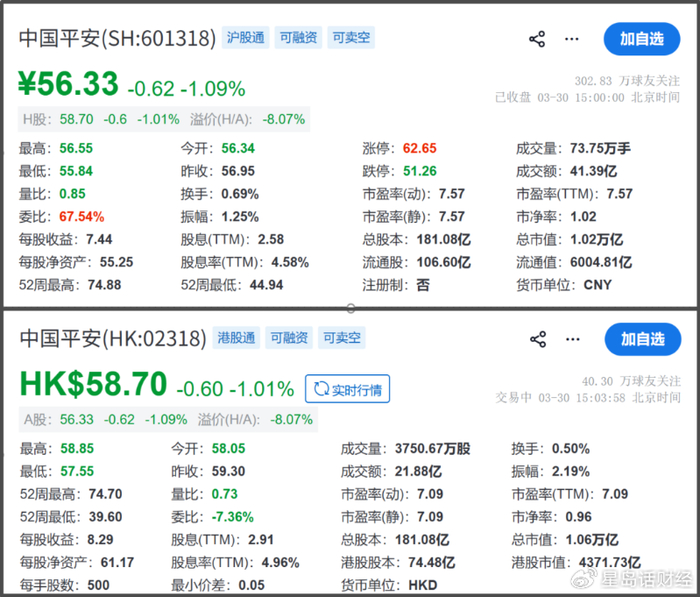
万亿家底、5亿客户!中国平安咋还跑不过同行?
Xin Lang Cai Jing· 2026-03-30 07:00
Core Viewpoint - China Ping An's 2025 financial results show a revenue exceeding 1 trillion RMB, with net assets also surpassing 1 trillion RMB, and a 22% increase in net profit excluding non-recurring items, but the growth rate lags behind competitors [2][17]. Financial Performance - Revenue for 2025 reached 1,050.5 billion RMB, a year-on-year increase of 2.1% [3][18]. - Net profit attributable to shareholders was 134.8 billion RMB, up 6.5% year-on-year, while net profit excluding non-recurring items increased by 22.5% to 143.8 billion RMB [11][26]. - Total assets grew to 13,898.5 billion RMB, a 7.3% increase from the previous year [3][18]. - The weighted average return on equity (ROE) rose to 14.0%, an increase of 0.2 percentage points [3][18]. Business Segments - The life and health insurance segment generated an operating profit of 103.3 billion RMB, contributing over 65% of the group's operating profit, with a new business value (NBV) of 36.9 billion RMB, up 29.3% [4][19]. - The property insurance segment reported an operating profit of 17.0 billion RMB, a 13.2% increase, despite a 2.8% decline in net profit due to one-time losses from asset sales [6][21]. - Banking operations saw a decline in both revenue and profit, with net profit at 42.6 billion RMB, down 4.2%, and operating income at 131.4 billion RMB, down 10.4% [8][24]. Investment Performance - The total investment income for 2025 was 234.3 billion RMB, a 13.5% increase, with a comprehensive investment return rate of 6.3%, up 0.5 percentage points [11][26]. - The company achieved a significant increase in investment service performance, with a 55.5% rise in related profits [20][25]. Strategic Insights - China Ping An aims to leverage its comprehensive financial services and healthcare strategy to become a leading international service group, although challenges in scaling and profitability remain [13][28]. - The company faces contradictions in its growth strategy, including the inability of scale expansion to support profit growth and the insufficient conversion of competitive advantages into profit [29][30].

券商业绩陆续披露,头部券商业绩领跑行业
AVIC Securities· 2026-03-30 06:36
Investment Rating - The industry investment rating is "Overweight," indicating that the growth level of the industry is expected to exceed that of the CSI 300 index over the next six months [3][46]. Core Views - The securities sector has shown a decline of 3.61% in the recent week, underperforming the CSI 300 index by 2.20 percentage points. The current price-to-book (PB) ratio for the brokerage sector stands at 1.18 times [1]. - Major brokerages like CITIC Securities and CITIC Construction Investment have reported significant revenue growth, with CITIC Securities achieving a revenue of 748.54 billion yuan, up 28.79% year-on-year, and a net profit of 300.76 billion yuan, marking a 38.58% increase [2][40]. This reflects a broader recovery trend in the brokerage industry, driven by increased trading activity and improved market conditions [2]. - The regulatory environment is encouraging industry consolidation, with mergers and acquisitions seen as effective means for brokerages to enhance competitiveness and optimize resource allocation [3][6]. - The insurance sector has also experienced a decline of 1.99%, but it has outperformed the CSI 300 index by 0.20 percentage points [7]. The recent policy on long-term care insurance is expected to create a significant demand in related sectors, potentially leading to a trillion-yuan industry space [8][43]. Summary by Sections Securities Weekly Data Tracking - The average daily trading volume for A-shares was 21,116 billion yuan, reflecting a 4.50% decrease week-on-week, indicating reduced market activity [13]. - As of March 27, 2026, the total equity financing scale reached 2,481.24 billion yuan, with IPOs contributing 224 billion yuan [15]. - The margin trading balance was reported at 26,165.30 billion yuan, showing a slight decrease from the previous week [25]. Insurance Weekly Data Tracking - As of March 27, 2026, the 10-year bond yield was 1.8172%, down by 1.27 basis points [28]. - The long-term care insurance policy is set to establish a comprehensive system that will stimulate demand across various sectors, including elderly care and commercial insurance [8][43]. Industry Dynamics - The regulatory framework is evolving to support high-quality development in the securities industry, with a focus on enhancing service quality and operational efficiency [39].




对话中国平安路昊阳:过滤短期波动坚定配置权益资产,未来加大“硬科技”领域投资
Xin Lang Cai Jing· 2026-03-30 04:09
Core Viewpoint - The insurance industry is increasingly focusing on "hard technology" as a key investment area, with major companies like China Ping An and China Life actively allocating resources to this sector [1][2][3]. Investment Trends - By the end of 2025, China Ping An's equity investment proportion rose from 11% in 2024 to 20%, indicating a significant increase in equity investments, particularly in high-dividend stocks and technology growth stocks [1]. - Other insurance companies, including China Life and China Pacific Insurance, have also expressed intentions to invest in new productive forces [1]. Strategic Focus Areas - The insurance sector is aligning its investments with national policies that encourage emerging industries, particularly in hard technology and new productive forces [2][3]. - Key emerging industries identified include integrated circuits, aerospace, biomedicine, low-altitude economy, new energy storage, and intelligent robotics, along with future industries like quantum technology and 6G [2]. Investment Scale and Support - China Ping An has invested over 11.5 billion yuan in the national major semiconductor industry to support domestic chip development, with total investments in AI, semiconductors, robotics, and biomedicine exceeding 10 billion yuan [3]. - The company is actively participating in strategic emerging industries and supporting technological innovation through both equity and debt investments [3]. Challenges and Regulatory Environment - While investment in hard technology is generally smooth under current policies, challenges remain, particularly regarding equity investments in non-listed companies, which carry higher solvency risk factors [4][5]. - Recent regulatory adjustments have optimized solvency capital requirements for investments in listed companies, but the risk factor for investments in non-listed strategic emerging industries remains unchanged at 0.4 [4][5]. Future Outlook - The insurance sector is expected to continue increasing its focus on hard technology investments, with companies like Ping An committed to enhancing their investment capabilities and risk management in this area [5].
光大证券晨会速递-20260330




EBSCN· 2026-03-30 03:25
Macro Analysis - Industrial enterprises' profits continued to show a strong start in January-February 2026, driven by accelerated industrial production, rising prices, and improved profit margins [1] - Profit distribution is skewed towards the midstream and upstream sectors due to rising resource prices and global capital expenditure [1] - The recovery in PPI readings is expected to support overall corporate profit recovery, although high oil prices may lead to differentiated impacts on profitability across sectors [1] Bond Market - The convertible bond market has resumed its upward trend, with investors advised to track market supply, policy rhythms, and geopolitical disturbances while making refined selections based on bond terms and underlying stock conditions [2] REITs Market - The secondary market for publicly listed REITs has continued to experience price declines for five consecutive weeks, with the CSI REITs index closing at 778.53, reflecting a return rate of -0.83% [3] Banking Sector - Qingdao Bank reported a revenue of 14.6 billion, a year-on-year increase of 8%, and a net profit of 5.2 billion, up 22%, indicating accelerated revenue and profit growth [4] - Wuxi Bank achieved a revenue of 4.8 billion, a 2% increase, and a net profit of 2.3 billion, up 2.5%, showcasing resilient profit growth driven by corporate business [5] - Industrial Bank reported a revenue of 212.7 billion, a slight increase of 0.2%, and a net profit of 77.5 billion, up 0.3%, with a focus on expanding new business areas [7] - Postal Savings Bank's revenue growth improved sequentially, with a 2% increase in revenue and a 6.6% increase in PPOP [8] Non-Banking Financials - China Pacific Insurance reported a net profit increase of 25.5%, with future non-auto insurance business expected to maintain a leading position [9] - New China Life Insurance's net profit reached 36.28 billion, a 38.3% increase, with expectations for continued growth in new business value [10] - Ping An Insurance's net profit grew by 6.5%, with a slight downward adjustment in future profit forecasts [11] - China Insurance's net profit increased by 8.8%, with expectations for stable performance in both property and life insurance segments [12] Real Estate and Property Management - Jianfa Property achieved a revenue of 3.881 billion, a 17.8% increase, with a significant rise in property management service revenue [14][15] Chemical and Semiconductor Sector - Dinglong Co. reported a revenue of 3.66 billion, a 9.66% increase, and a net profit of 720 million, up 38.32%, with expectations for continued growth in the semiconductor sector [16] Oil and Gas Sector - China National Petroleum Corporation reported total revenue of 2864.5 billion, a decrease of 2.5%, and a net profit of 157.3 billion, down 4.5%, with a focus on increasing reserves and production [17] - CNOOC's total revenue was 398.2 billion, down 5.3%, with a net profit of 122.1 billion, down 11.5%, but with a positive outlook for future profit growth [18] Utilities Sector - China General Nuclear Power Corporation reported a revenue of 756.97 billion, down 4.11%, and a net profit of 97.65 billion, down 9.9%, with an upward revision in future profit forecasts [20] Food and Beverage Sector - Haitian Flavor Industry achieved a revenue of 28.873 billion, a 7.3% increase, and a net profit of 7.04 billion, up 10.9%, indicating strong performance in the food sector [48] - Qingdao Beer reported a revenue of 32.47 billion, a 1% increase, and a net profit of 4.59 billion, up 5.6%, with a focus on maintaining strong brand advantages [51]
西部证券晨会纪要-20260330
Western Securities· 2026-03-30 02:44
Group 1: Jin Hui Jiu (金徽酒) - The company reported a revenue of 2.918 billion yuan in 2025, a decrease of 3.40% year-on-year, with a net profit of 354 million yuan, down 8.70% [6][7] - The company’s contract liabilities increased by 28.4% year-on-year to 820 million yuan, indicating a strong sales cash collection of 3.502 billion yuan, up 2.42% [6][8] - High-end product sales above 300 yuan increased by 25.21% to 709 million yuan, contributing to an improved product structure [7][8] Group 2: Jin Li Yong Ci (金力永磁) - The company achieved a total revenue of 7.718 billion yuan in 2025, a year-on-year increase of 14.11%, with a net profit of 706 million yuan, up 142.44% [10][11] - The main revenue source was from new energy vehicles and components, generating 3.941 billion yuan, a growth of 30.31% [11] - The company’s gross margin improved significantly to 21.18%, an increase of 10.05 percentage points year-on-year [10] Group 3: He Huang Yi Yao (和黄医药) - The company reported a revenue of 548.5 million USD in 2025, a decrease of 13%, with a net profit of 456.9 million USD [14][15] - The ATTC platform shows potential, with expected revenue growth of 14.9% to 8.34 billion USD by 2028 [16] - The company has a strong cash position and is focusing on international expansion [16] Group 4: Kai Li Yi Liao (开立医疗) - The company’s revenue for the first three quarters of 2025 was 1.459 billion yuan, a year-on-year increase of 4.37% [18][19] - New product lines are driving growth, with significant increases in sales for minimally invasive surgical products [19][20] - The company is expected to achieve EPS of 0.34, 0.82, and 1.07 yuan for 2025, 2026, and 2027 respectively [20] Group 5: Yi Hai Guo Ji (颐海国际) - The company reported a revenue of 6.613 billion yuan in 2025, a slight increase of 1.12%, with a net profit of 854 million yuan, up 15.49% [22][23] - The overseas market showed strong growth, with third-party overseas sales increasing by 45.4% [23] - The company’s gross margin improved to 32.7%, an increase of 1.5 percentage points year-on-year [24] Group 6: Hai Tian Wei Ye (海天味业) - The company achieved a revenue of 28.87 billion yuan in 2025, a year-on-year increase of 7.3%, with a net profit of 7.04 billion yuan, up 11% [26][27] - The company’s three main product categories saw stable pricing trends, with soy sauce revenue increasing by 8.5% [27][28] - The gross margin improved to 40.22%, an increase of 3.2 percentage points year-on-year [28] Group 7: Hai Er Zhi Jia (海尔智家) - The company reported a revenue of 302.3 billion yuan in 2025, a year-on-year increase of 5.7%, with a net profit of 19.6 billion yuan, up 4.4% [30][31] - The company announced a dividend payout ratio of 55%, an increase of 7 percentage points year-on-year [31] - The company is focusing on AI and smart home innovations, aiming to lead in the smart household sector [31] Group 8: Xing Ye Zheng Quan (兴业证券) - The company achieved a revenue of 11.841 billion yuan in 2025, a year-on-year increase of 21%, with a net profit of 2.87 billion yuan, up 32.6% [33][34] - The brokerage business saw a significant increase in market share, with trading volumes reaching 13.74 trillion yuan, up 81.4% [34] - The company’s asset management scale expanded, with public fund sizes growing by 15% [34] Group 9: Dong Fang Zheng Quan (东方证券) - The company reported a revenue of 15.358 billion yuan in 2025, a year-on-year increase of 26.2%, with a net profit of 5.634 billion yuan, up 68.2% [37][38] - The asset management business showed positive growth, with a significant increase in client accounts [38] - The company completed 15 A-share equity financing projects, ranking 7th in the industry [38] Group 10: Hua Xin Jian Cai (华新建材) - The company achieved a revenue of 35.348 billion yuan in 2025, a year-on-year increase of 3.31%, with a net profit of 2.853 billion yuan, up 18.09% [41][42] - The overseas business contributed significantly, with overseas sales increasing by 25.3% [42] - The company’s gross margin improved to 30.22%, an increase of 5.53 percentage points year-on-year [43] Group 11: Xi Bu Kuang Ye (西部矿业) - The company reported a revenue of 61.69 billion yuan in 2025, a year-on-year increase of 23.3%, with a net profit of 3.64 billion yuan, up 24.3% [45][46] - The company’s copper production decreased by 5.65%, while zinc and lead production increased significantly [46] - The company is expanding its resource reserves, with new exploration projects underway [46][47] Group 12: Shen Huo Gu Fen (神火股份) - The company achieved a revenue of 41.241 billion yuan in 2025, a year-on-year increase of 7.47%, with a net profit of 4.005 billion yuan, down 7% [49] - The electrolytic aluminum business performed well, with production increasing by 8.95% [49] - The company’s gross margin improved to 23.36%, an increase of 2.13 percentage points year-on-year [49]





中国平安(601318):多元渠道助推价值高增 资管减亏夯实基础
Xin Lang Cai Jing· 2026-03-30 00:32
Core Viewpoint - The company reported stable growth in its annual performance, with a net profit attributable to shareholders increasing by 6.5% year-on-year, while the new business value (NBV) saw a significant rise of 29.3% [1][2]. Group 1: Financial Performance - The net profit attributable to shareholders increased by 6.5% year-on-year, aligning with expectations, although it showed a decline from 11.5% in the first three quarters, primarily due to a Q4 profit of 1.92 billion, which was down 74% year-on-year [1]. - The operating profit after tax (OPAT) grew by 10.3% year-on-year, an improvement from 7.2% in the previous three quarters, with life insurance and property insurance OPAT growth rates of 6.5% and 13.2%, respectively [1]. - The company declared a dividend of 2.7 yuan per share, representing a year-on-year increase of 5.9%, maintaining stable growth over the years [1]. Group 2: New Business Value (NBV) and Value Metrics - The NBV increased by 29.3% year-on-year, with individual insurance and bank insurance NBV growth rates of 10.4% and 137.9%, respectively. New single premiums rose by 1.5%, with bank insurance first-year premiums (FYP) increasing by 92.2% to offset a slight decline in individual insurance channels [2]. - The NBV margin (NBVM) improved to 23.4%, up 4.9 percentage points year-on-year, despite adjustments to non-economic assumptions. The bank insurance and individual insurance NBVM increased by 6.4 and 4.4 percentage points, respectively, with bank insurance achieving the highest value rate in the industry at 24.5% [2]. - The embedded value (EV) rose by 5.7% year-on-year, with life insurance EV increasing by 11.2%, showing significant improvement compared to the previous year's growth rates of 2.3% and 0.5% [2]. Group 3: Cost of Risk (COR) and Profitability - The property insurance combined ratio (COR) improved by 1.5 percentage points to 96.8%, outperforming industry peers, with the auto insurance COR decreasing by 2.3% [3]. - Earnings per share (EPS) forecasts for 2026-2028 are projected at 7.75, 8.15, and 9.18 yuan per share, with an estimated valuation of 0.9 times the embedded value for A-shares and 0.8 times for H-shares, corresponding to a fair value of 80.14 yuan per share for A-shares and 80.76 Hong Kong dollars per share for H-shares, maintaining a "buy" rating for both A and H shares [3].
晓数点丨一周个股动向:最牛股周涨超50% 赣锋锂业获主力加仓居首
Di Yi Cai Jing· 2026-03-29 13:55
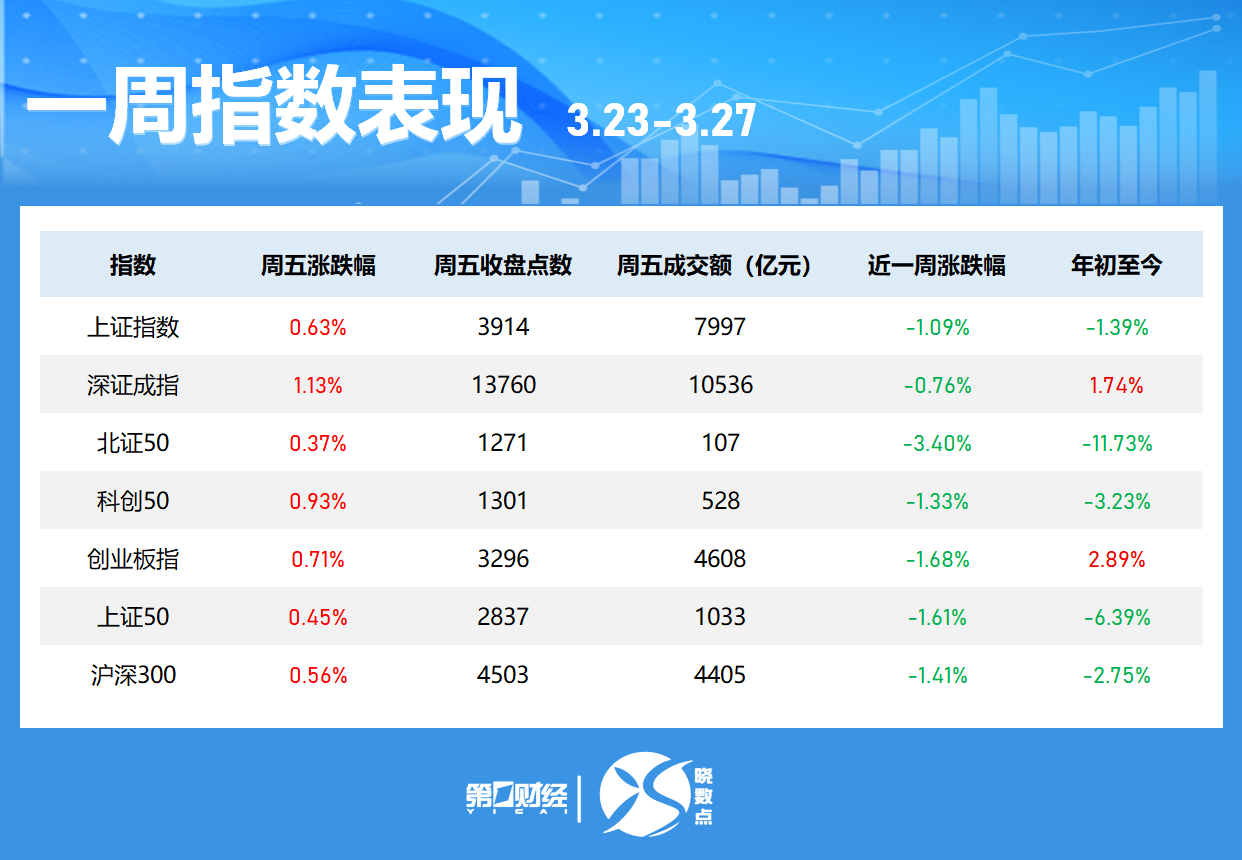
Market Overview - The A-share indices collectively declined during the week from March 23 to March 27, with the Shanghai Composite Index down by 1.09%, the Shenzhen Component Index down by 0.76%, the ChiNext Index down by 1.68%, and the Sci-Tech Innovation Index down by 0.43% [1][2]. Stock Performance - A total of 7 stocks saw gains exceeding 40%, with Haike Xinyuan leading at a weekly increase of 51.02%. Other notable gainers included Lianxiang Co. (48.26%), Rongjie Co. (46.95%), and Huadian Liaoning Energy (43.61%) [3][4]. - Conversely, 30 stocks experienced declines over 20%, with Huada Technology leading the drop at 32.34%, followed by Zhonghuan Hailu (29.59%) and Shenhua Fa A (28.03%) [3][4]. Trading Activity - 47 stocks had a turnover rate exceeding 100%, with Shouhang New Energy at the top with a turnover rate of 236.08%, followed by Nabichuan (199.27%) and Jiuzhou Group (177.88%) [5][6]. - The majority of stocks with high turnover rates were from the electric equipment, public utilities, and basic chemicals sectors [5]. Capital Flow - The sectors that attracted significant capital inflow included non-ferrous metals, basic chemicals, and building materials, while the electronics sector faced a net outflow exceeding 250 billion yuan [8]. - Ganfeng Lithium received the highest net inflow of 27.20 billion yuan, with a weekly increase of 18.15%. Other stocks with notable inflows included Demingli (15.88 billion yuan) and Yunnan Zhiye (14.20 billion yuan) [8][9]. Margin Trading - A total of 1399 stocks received net margin purchases, with 582 stocks having net purchases exceeding 10 million yuan. Luxshare Precision topped the list with a net purchase of 10.94 billion yuan, while NIO and Zijin Mining faced significant net sell-offs [10][11]. Institutional Research - During the week, 163 listed companies were researched by institutions, with Sanhua Intelligent Control receiving the most attention from 284 institutions. Other companies like Yuanjie Technology and Yuntianhua also attracted significant institutional interest [12][14]. Analyst Ratings - Several companies received new ratings from analysts, including Kaige Precision Machinery with a "Buy" rating and a target price of 207.84 yuan, and Daqin Railway with an "Overweight" rating and a target price of 5.95 yuan [15][16].