
BANK COMM(601328)

Search documents
交通银行陕西省分行被罚253万元:发放固定资产贷款不审慎等
Xin Lang Cai Jing· 2026-01-06 11:11
Core Viewpoint - The Shaanxi Regulatory Bureau of the National Financial Supervision Administration has imposed a fine of 2.53 million yuan on the Shaanxi branch of Bank of Communications and related personnel for various violations in loan management practices [1][2]. Group 1: Penalties and Violations - The Shaanxi branch of Bank of Communications was fined 2.53 million yuan for imprudent issuance of fixed asset loans, inadequate management of bank acceptance bills after credit issuance, issuing working capital loans exceeding the actual needs of borrowers, and poor post-loan management of project loans [1][2]. - Individuals involved, namely Niu Bo and Yao Shufang, received warnings, while Lin Yaxin was given a warning and fined 50,000 yuan [1][2].


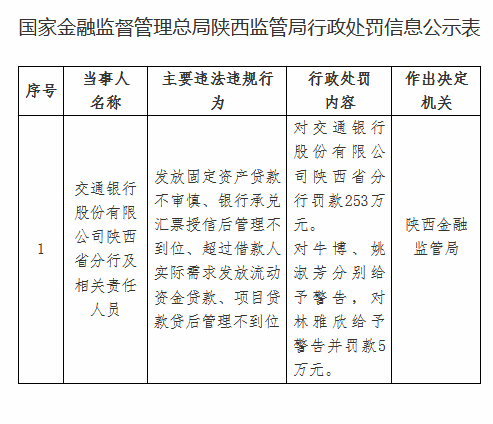
因贷款业务存多项违规,交通银行陕西省分行被罚253万元
Bei Jing Shang Bao· 2026-01-06 10:41
北京商报讯(记者 宋亦桐)1月6日,国家金融监督管理总局陕西监管局公布的行政处罚信息公示表显 示,交通银行股份有限公司陕西省分行因"发放固定资产贷款不审慎、银行承兑汇票授信后管理不到 位、超过借款人实际需求发放流动资金贷款、项目贷款贷后管理不到位"违法违规行为,被罚款253万 元;监管机构对相关责任人员牛博、姚淑芳分别给予警告,对林雅欣给予警告并罚款5万元。 ...
939亿增持狂潮!523家A股公司扫货,多家银行股将披露业绩
21世纪经济报道· 2026-01-06 10:10
Core Viewpoint - The banking sector in A-shares is expected to perform well in 2026, driven by stable fundamentals and increased dividend attractiveness, despite a less impressive performance in 2025 compared to previous years [4][9][10]. Group 1: Annual Report Disclosure - Ping An Bank will be the first to disclose its annual report on March 21, followed by CITIC Bank on the same day [1]. - A total of 10 banks will disclose their 2025 annual reports on March 31, marking the highest number of disclosures on a single day [3]. - The total market capitalization of 42 A-share banks exceeded 15 trillion yuan, increasing by approximately 2.1 trillion yuan from the end of 2024 [2][3]. Group 2: Market Performance - The banking sector index rose by 12.05% in 2025, underperforming the CSI 300 index, which increased by 17.66% [3]. - Among the 42 banks, 35 experienced stock price increases, with Agricultural Bank of China leading at a 52.66% rise [3]. - The overall market sentiment towards bank annual reports is positive, with expectations of continued growth in 2026 [4][9]. Group 3: Investment Drivers - The strong performance of the banking sector in 2025 was supported by both funding and fundamental factors, including inflows from passive index funds and insurance [4]. - Significant shareholder buybacks have also contributed to the rise in bank stocks, with 523 companies increasing their holdings, totaling 939.6 billion yuan [6]. - Analysts predict that the demand for high-dividend stocks will remain strong, particularly for state-owned banks known for stable returns [10]. Group 4: Future Outlook - Analysts expect the banking sector to maintain stable performance in 2026, supported by a recovering real economy and high dividend yields [9]. - The issuance of ETFs linked to broad indices and dividend indices is expected to continue, attracting more passive fund inflows into the banking sector [9]. - The differentiation in performance among various banks is anticipated to become a key theme, with larger banks likely to see more consistent revenue growth compared to smaller banks [10]. Group 5: Seasonal Trends - Historical data shows that the banking sector has a high success rate for absolute and excess returns before the Spring Festival, with an average absolute return of 4.4% [11]. - The upcoming Spring Festival in 2026 is expected to see continued strong performance in bank stocks, driven by balanced market styles and robust demand for high-dividend stocks [12]. - Recommendations for stock allocation include a stable base in state-owned banks and a more aggressive approach with quality joint-stock and city commercial banks [12].



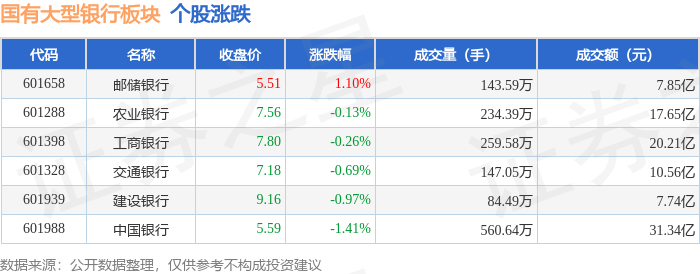
国有大型银行板块1月6日跌0.37%,中国银行领跌,主力资金净流出7.27亿元
Zheng Xing Xing Ye Ri Bao· 2026-01-06 09:00
证券之星消息,1月6日国有大型银行板块较上一交易日下跌0.37%,中国银行领跌。当日上证指数报收 于4083.67,上涨1.5%。深证成指报收于14022.55,上涨1.4%。国有大型银行板块个股涨跌见下表: 从资金流向上来看,当日国有大型银行板块主力资金净流出7.27亿元,游资资金净流入4.2亿元,散户资 金净流入3.07亿元。国有大型银行板块个股资金流向见下表: | 代码 | 名称 | 主力净流入 (元) | 主力净占比 游资净流入 (元) | | 游资净占比 散户净流入 (元) | | 散户净占比 | | --- | --- | --- | --- | --- | --- | --- | --- | | 601658 邮储银行 | | 4820.08万 | 6.14% | -4386.57万 | -5.59% | -433.51万 | -0.55% | | 601398 工商银行 | | 592.09万 | 0.29% | 583.85万 | 0.29% | -1175.94万 | -0.58% | | 601288 农业银行 | | -2728.64万 | -1.55% | -1928.45万 | - ...



银行业2026年度策略:新起点下的结构性机遇
China Post Securities· 2026-01-06 08:23
Core Insights - The report maintains a strong market rating for the banking sector, highlighting structural opportunities amid a new economic starting point in 2026 [3][5] - The macroeconomic environment is expected to support credit growth, with fiscal policies becoming more proactive and monetary policies remaining moderately accommodative [3][4] - The banking sector is anticipated to experience a stabilization in net interest margins, with a narrowing space of less than 5 basis points expected in 2026 [4][40] Macroeconomic Fundamentals - The GDP growth target for 2026 is projected to remain stable at around 5%, supported by structural improvements in financing demand from enterprises and households [12][14] - The fiscal deficit rate is expected to increase from 4% in 2025, with proactive fiscal policies aimed at stabilizing growth and expectations [14][16] - Monetary policy will continue to be moderately accommodative, with social financing growth expected to maintain above 8% [16][17] Industry Core Policy Guidance - Regulatory bodies are focusing on protecting net interest margins, with measures in place to guide banks in pricing management and alleviate margin pressures [25][26] - New supportive policies, including interest subsidies for personal consumption loans, are expected to create favorable asset deployment scenarios for banks [27][28] - Capital supplementation policies are being optimized to enhance banks' credit expansion capabilities and risk resilience [28][29] 2026 Profitability Outlook - Corporate loan growth is expected to be a key driver of credit expansion, while retail credit improvements will depend on policy support for income and consumption [4][34] - The net interest margin is projected to stabilize, with a potential bottoming out in 2026, supported by regulatory measures and market conditions [40][41] - Fee income is anticipated to recover, particularly for city commercial banks, as market sentiment improves [42][43] 2026 Asset Quality Outlook - The overall asset quality of the banking sector is expected to stabilize, with non-performing loan ratios remaining low for corporate lines, while retail lines may still face risks [4][20] - The trend of provisioning coverage is expected to improve, providing banks with more flexibility in managing their asset quality [20][21] 2026 Industry Landscape Outlook - Differentiation among banks is likely to become a dominant theme, with larger banks expected to see more stable revenue growth compared to smaller banks facing complex operating environments [4][5] - Regional economic vitality will significantly influence the performance of local banks, with areas of strong economic growth presenting better investment opportunities [5][6] Investment Recommendations - The insurance sector is projected to see over 2 trillion yuan in new market funds in 2026, increasing demand for high-dividend assets [5] - Focus on state-owned banks with stable operations, such as Industrial and Commercial Bank of China and China Construction Bank, as attractive investment targets [5] - Attention should be given to regional banks in economically vibrant areas, such as Jiangsu Bank and Chongqing Bank, which are expected to perform well [5][6]

交通银行金融市场部副总经理唐建伟:人民币已告别单边贬值预期,企业顺势结汇或为关键变量
Sou Hu Cai Jing· 2026-01-06 07:00
Core Viewpoint - The roundtable discussion at Fudan University highlighted a significant shift in market expectations regarding the RMB exchange rate, indicating a transition from a one-sided depreciation to a dual-directional fluctuation pattern supported by fundamentals and policy expectations [1][4]. External Environment Analysis - The expansion of the U.S. fiscal deficit and the debt burden from the "Great Beautiful Act" will likely force the Federal Reserve to lower interest rates and halt balance sheet reduction, weakening the long-term credit support for the dollar [2]. - Global capital is flowing out of dollar assets due to differentiated monetary policies among developed economies and the high valuation of U.S. stocks facing risks of disillusionment [2]. - China's economic growth target remains stable, with exports showing unexpected resilience under tariff pressures, supported by a healthy current account surplus [2]. Internal Factors - The RMB's attractiveness is increasing, leading to a trend of capital inflow that will further strengthen the RMB's performance [2]. - The RMB exchange rate is expected to exhibit "moderate appreciation, dual-directional fluctuation, and range-bound operation" in the future [2]. RMB Exchange Rate Characteristics - In 2025, the RMB is expected to show an overall appreciation against the dollar, driven by a fundamental reversal in market expectations [4]. - The RMB's volatility is characterized by a high-to-low pattern, with implied volatility decreasing significantly in the latter half of the year [6]. - The convergence of onshore and offshore RMB prices indicates a strengthened market expectation for a stable and slightly stronger RMB [8]. Future Outlook for RMB Exchange Rate - The dollar is expected to remain weak in 2026 due to ongoing fiscal pressures and the need for the Federal Reserve to align with fiscal policy through interest rate cuts [9][10]. - China's economic resilience is anticipated to support a stronger RMB, with a GDP growth target around 5% and continued positive export growth [10][11]. - The People's Bank of China aims to maintain the RMB at a reasonable and balanced level, using policy tools to prevent one-sided betting behavior in the market [11]. Strategies for Managing Exchange Rate Fluctuations - Companies are advised to adopt a risk-neutral approach, focusing on core business and managing exchange rate risks through professional financial tools [15]. - Innovative financing and hedging solutions should be developed to lower the cost of currency risk management for small and medium-sized enterprises [15]. - A proactive approach to asset-liability management and trading strategies is recommended, avoiding one-sided bets and focusing on range trading opportunities [15]. Long-term Considerations - The sustainable appreciation of the RMB is contingent upon the stability and resilience of the real economy, emphasizing the need for a strong macroeconomic foundation [16][18].

交通银行增资至883.6亿,增幅约19%
Zhong Guo Neng Yuan Wang· 2026-01-06 06:33
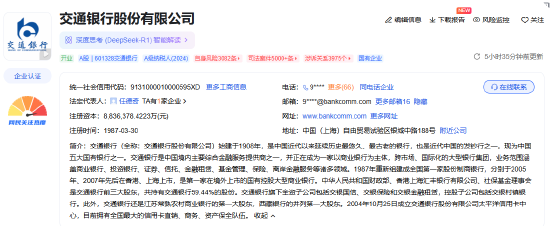
天眼查工商信息显示,近日,交通银行(601328)(601328)发生工商变更,注册资本由约742.6亿人 民币增至约883.6亿人民币,增幅约19%。 交通银行股份有限公司成立于1987年3月,法定代表人为任德奇,经营范围含吸收公众存款,发放短 期、中期和长期贷款,办理国内外结算,办理票据承兑与贴现,发行金融债券,代理发行、代理兑付、 承销政府债券等。股东信息显示,该公司由中国证券金融股份有限公司、首都机场集团有限公司、香港 中央结算有限公司等共同持股。 ...
交通银行注册资本变更至883.64亿元
Xin Lang Cai Jing· 2026-01-06 04:07
Group 1 - The core point of the news is that Bank of Communications has increased its registered capital from approximately 74.26 billion RMB to about 88.36 billion RMB, representing an increase of approximately 19% [1][4]. - The increase in registered capital was approved by the National Financial Regulatory Administration, with the specific amount of increase being 14,101,057,578 RMB [3][5]. - The new registered capital is now 88,363,784,223 RMB, reflecting the bank's growth and potential for further expansion in the financial sector [3][5].
各家银行提前布局年终奖专属理财
Jin Rong Shi Bao· 2026-01-06 02:17
作为职场人翘首以盼的"年终大礼",规模可观的年终奖成为各家银行及理财公司的必争之地。 《金融时报》记者梳理发现,2025年末至今,邮储银行、交通银行、平安理财等多家机构已抢先布 局,通过线上专属活动、全品类产品矩阵、个性化资产配置方案等多元策略加码年终奖理财营销。 在业内人士看来,银行角逐年终奖理财市场,既是负债端"吸金"的关键布局,也是拓展中间业务、 增强客户黏性的重要契机,但投资者也需要锚定自身需求理性投资,谨慎选择。 银行发力年终奖理财 "距离发放年终奖还有一个多月,手机银行就接连收到理财推荐了。"在北京从事互联网运营工作的 赵先生对记者说,自己的年终奖预计在2026年1月底发放,最近有不少银行陆续推出了年终奖专属理财 活动,他已经提前开始考虑这笔资金的打理方式。 记者注意到,国有大行凭借客群规模优势,率先打响了年终奖理财营销战,线上专属活动成为主要 阵地。 "年终红利,'理'在交行。"2025年末,交通银行为投资者推出了"专'薪'定制,期限多样"的年终奖 专享理财产品,产品均为R2(稳健型)。其中,"灵动添利6号新薪宝"理财近3个月年化收益率达 4.76%。 此外,交通银行各家分支机构推出了"'薪'动 ...
交通银行股份有限公司(03328.HK)公布最新董事会成员名单及职责
Xin Lang Cai Jing· 2026-01-06 00:11
来源:中访网 中访网数据 交通银行股份有限公司于2026年1月5日在中国上海正式公布了其最新的董事会成员名单及 各成员所担任的委员会职务。根据公告,董事会由董事长任德奇领衔,共包括15名成员。核心决策层架 构显示,任德奇同时担任执行董事及战略委员会主任委员;张宝江担任副董事长、执行董事及社会责任 (ESG)与消费者权益保护委员会主任委员;殷久勇与周万阜同为执行董事。董事会亦设有五名非执行 董事,包括常保升、廖宜建、陈绍宗、穆国新及艾栋。此外,公司还委任了张向东、李晓慧、马骏、王 天泽、肖伟及刘瑞霞六位独立非执行董事,以确保公司治理的独立性与专业性。公告明确了各位董事在 战略、审计、风险管控、人事薪酬及社会责任等关键委员会的任职情况,构建了完整的公司治理与监督 体系。此次董事会名单的公布,标志着交通银行公司治理结构的稳定与完善,相关职责安排将指导该行 未来的战略发展与日常运营管理。 ...