银行板块投资价值

Search documents
万联证券:单季净利润同比增速继续回升 银行板块高股息投资价值更加凸显
Zhi Tong Cai Jing· 2026-02-26 06:05
Core Insights - The banking industry is expected to maintain stable growth in asset scale, with large state-owned banks and city commercial banks showing relatively high year-on-year growth rates, likely continuing into 2026 [1][3] - The net interest margin remained stable quarter-on-quarter, with expectations for an increase in net interest income growth in 2026 due to narrowing declines in net interest margin [1] - The overall asset quality of the banking sector has shown slight improvement, although the generation of non-performing loans has not seen a significant decline [1][4] Group 1: Profit Growth - As of the end of Q4 2025, the cumulative year-on-year net profit growth for commercial banks was 2.3%, with state-owned banks, joint-stock banks, city commercial banks, and rural commercial banks showing growth rates of 2.3%, -2.8%, 12.9%, and 4.6% respectively [1] - The year-on-year net profit growth for commercial banks in Q4 2025 was 12%, with significant increases in city commercial banks (431.7%) and rural commercial banks (333%) [1] Group 2: Net Interest Margin - The net interest margin for Q4 2025 was 1.42%, remaining unchanged quarter-on-quarter, with slight variations among different types of banks [2] Group 3: Asset Scale Growth - The total asset year-on-year growth rate for commercial banks was 9% as of Q4 2025, a slight increase from 8.8% at the end of Q3 2025, with state-owned banks and city commercial banks showing higher growth rates of 10.8% and 9.7% respectively [3] - The year-on-year loan growth rate for the industry was 6.3%, a decrease of 1.3% compared to 2024 [3] Group 4: Asset Quality - As of Q4 2025, the non-performing loan ratio and attention ratio for commercial banks were 1.50% and 2.18%, respectively, both showing a quarter-on-quarter decline [4] - The provision coverage ratio was 205.21%, down by 1.94 percentage points quarter-on-quarter, with variations in non-performing loan ratios and provision coverage ratios among different bank types [4]
资金大幅流出后银行为何逆势回升?机构点出 4.4% 高分红率+信贷开门红
Mei Ri Jing Ji Xin Wen· 2026-02-02 07:20
Core Viewpoint - The banking sector experienced significant capital outflows in January 2026, with a notable recovery in stock prices despite the outflows, indicating a potential increase in long-term institutional investor interest [1]. Group 1: Market Performance - As of February 2, 2026, the China Securities Banking Index (399986) rose by 0.15%, with notable increases in individual bank stocks such as CITIC Bank (up 2.64%), Shanghai Bank (up 1.62%), and Huaxia Bank (up 1.42%) [1]. - The Bank ETF Huaxia (515020) increased by 0.18%, with the latest price at 1.65 yuan [1]. Group 2: Capital Flows - In January 2026, there was a substantial net outflow of passive funds from the banking sector, totaling 9,102 billion yuan for the month and 3,773 billion yuan for the week of January 26 to 30 [1]. - CITIC Securities estimated that the net outflow of funds from bank stocks was approximately 1,051 billion yuan in January and 485 billion yuan for the last week of January [1]. Group 3: Future Outlook - Despite the significant capital outflows, the banking index saw a 1% rebound, suggesting a strong willingness for long-term institutional investment [1]. - The banking sector is expected to benefit from a positive operating environment in the first quarter of 2026, with stable net interest margins and asset quality, leading to a recovery in revenue and profit growth [1]. - The current dividend yield of 4.4% in the sector is considered to be in a high cost-performance range, enhancing the attractiveness of core equity assets [1].




银行ETF基金、银行ETF、银行AH优选ETF上涨,Q3险资加力布局银行板块
Ge Long Hui A P P· 2025-11-20 04:08
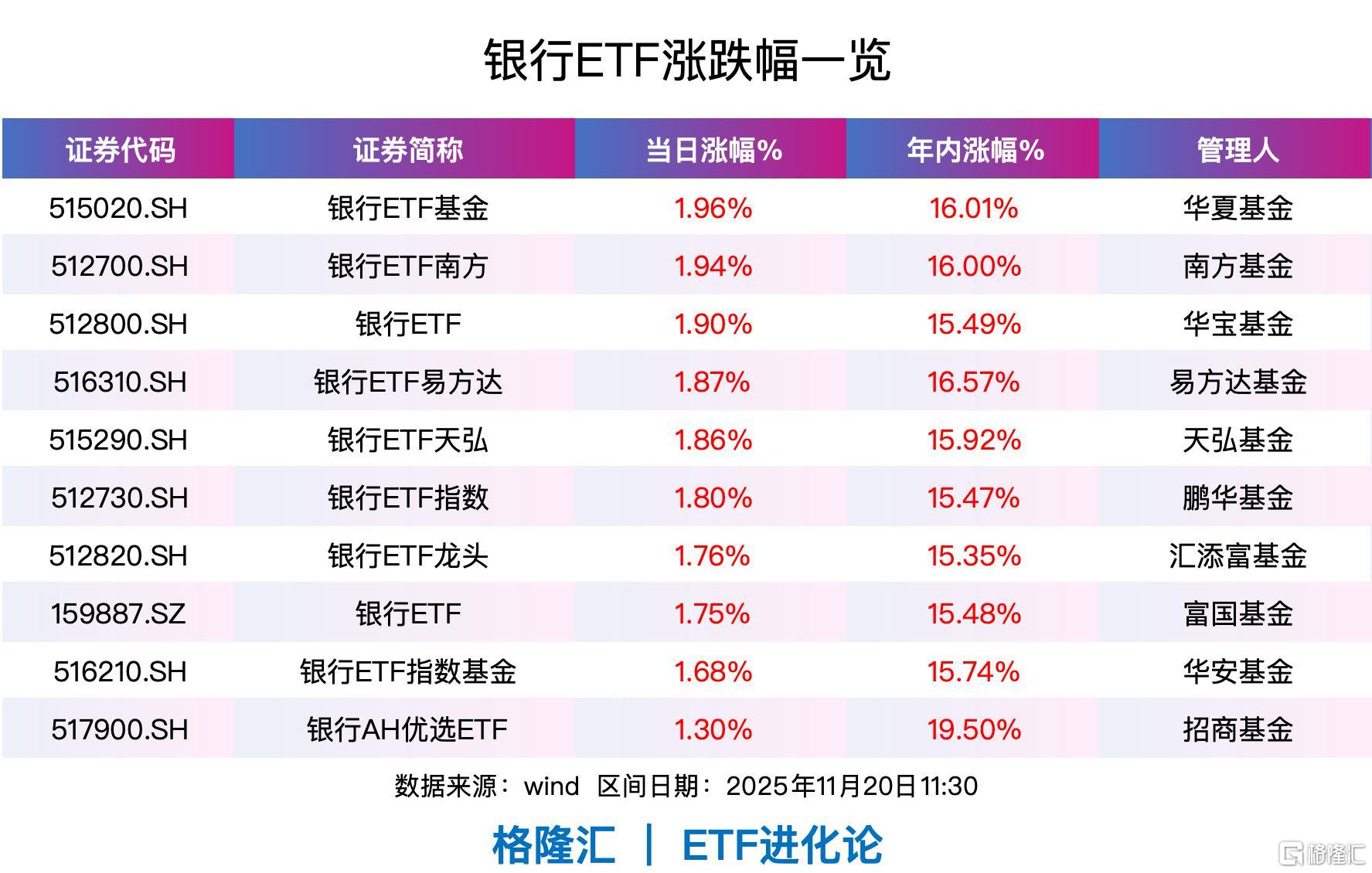
Core Viewpoint - The A-share market has seen a significant rise in bank stocks, with notable increases in major banks such as China Bank and Construction Bank, indicating a positive sentiment towards the banking sector [1][4]. Group 1: Stock Performance - China Bank rose over 5%, Construction Bank over 4%, and Postal Savings Bank over 3%, with several other banks also showing gains of over 2% [1]. - Bank ETFs, including various Southern and E-Fund ETFs, have also experienced upward movement, reflecting the overall positive trend in the banking sector [3]. Group 2: ETF Insights - Bank ETFs track the China Securities Bank Index, with nearly 30% of their holdings in major state-owned banks like Industrial and Agricultural Bank, while about 70% focuses on high-growth banks [3]. - The Bank AH Preferred ETF tracks the Bank AH Index, utilizing a monthly security category conversion strategy based on AH prices [4]. Group 3: Institutional Investment Trends - As of Q3 2025, insurance capital has increased its holdings in the banking sector, with a holding ratio of 27.95% and a market value accounting for 3.99% of circulating A-shares [5]. - Insurance capital has increased its positions in 23 banks, with 10 banks seeing increased holdings, indicating a growing interest in the banking sector [6]. Group 4: Market Dynamics - The A-share market is experiencing a style shift, influenced by factors such as the approaching end-of-year assessments for institutions and the central bank's implementation of a moderately loose monetary policy [4]. - The decline in the proportion of bank holdings among public funds suggests a potential opportunity for reallocation towards undervalued financial stocks [4]. Group 5: Future Outlook - The insurance sector is expected to continue increasing its investment in banks, driven by stable dividends and low valuations, with a focus on high ROE small and medium-sized banks [6]. - The ongoing improvement in net profits for banks and the potential for valuation reconstruction through increased capital inflows are seen as positive indicators for the banking sector's future [6].







多重因素支撑 银行板块配置价值凸显
Shang Hai Zheng Quan Bao· 2025-11-12 17:51
Core Viewpoint - The banking sector has shown signs of recovery, with major banks like Agricultural Bank of China and Industrial and Commercial Bank of China reaching historical highs in stock prices. This recovery is supported by shareholder and executive confidence in the long-term investment value of these banks [1][2]. Group 1: Shareholder and Executive Actions - Over ten A-share listed banks have announced plans for share buybacks by shareholders and executives this year, indicating confidence in the future development and long-term investment value of these banks [1][2]. - For instance, Su Nong Bank announced that three executives plan to increase their holdings by at least 1.8 million yuan within six months, citing confidence in the bank's future [1]. - Nanjing Bank's major shareholder, Nanjing High-Tech, increased its stake from 9.00% to 9.99% between August 7 and September 18, reflecting a strong belief in the bank's growth potential [2]. Group 2: Financial Performance - The overall profitability of listed banks has improved, with 35 out of 42 A-share listed banks reporting a year-on-year increase in net profit for the first three quarters, and seven of these banks achieving double-digit growth [2]. - The net interest margin has shown signs of stabilization, providing strong support for the recovery of bank performance [2]. Group 3: Valuation and Investment Appeal - The banking sector is currently at a historically low valuation since 2010, with significant dividend yield advantages, making it attractive for institutional investors seeking high dividends and stability [3]. - Insurance capital continues to show a strong preference for long-term investments in the banking sector, focusing on low valuation, high dividends, and stable performance [3]. - Recent reports indicate that insurance capital has increased its holdings in bank stocks, demonstrating a commitment to long-term investment strategies [3].
大盘回调,银行“扛鼎”逆市上扬!银行ETF龙头(512820)强势收涨1.86%!中报最全汇总,有何看点?银行高股息配置仍存
Sou Hu Cai Jing· 2025-09-02 09:16
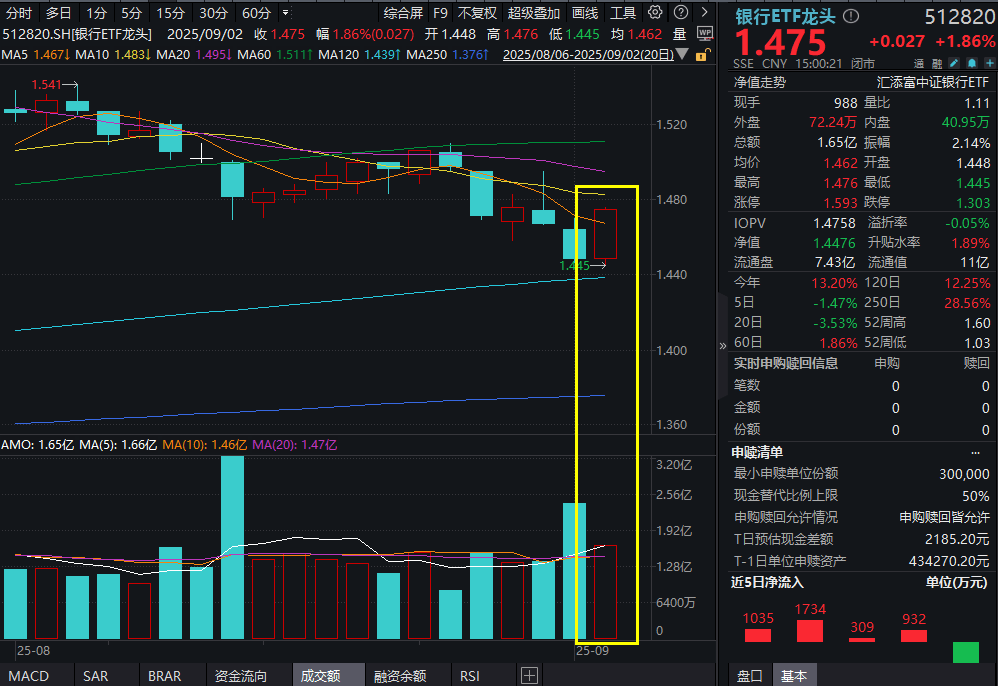
Core Viewpoint - The banking sector shows resilience with a notable increase in the Bank ETF leader (512820) by 1.86%, indicating a rebound after two consecutive declines, while the tech sector experiences a pullback [1][3]. Banking Sector Performance - The Bank ETF leader (512820) saw nearly all constituent stocks rise, with notable gains from Chongqing Rural Commercial Bank (over 4%), Shanghai Rural Commercial Bank, and China Merchants Bank (over 3%), and several others exceeding 2% [3][4]. - The top ten constituent stocks of the Bank ETF leader include major banks like China Merchants Bank, Industrial and Commercial Bank of China, and Agricultural Bank of China, all showing positive performance [5][4]. Financial Results - As of August 29, 42 A-share banks reported their semi-annual results, with revenue, PPOP, and net profit attributable to shareholders increasing by 1.03%, 1.13%, and 0.77% year-on-year, respectively, showing an improvement compared to Q1 [7][10]. - 17 listed banks have announced interim dividends, reinforcing the high dividend yield logic within the banking sector [10]. Market Valuation - The banking sector's price-to-earnings (PE) ratio is approximately 7 times, significantly lower than the overall market PE of about 21 times, suggesting a favorable valuation for long-term returns [11]. - The banking sector is viewed as a stable investment option due to its low valuation and relatively high return on equity (ROE) compared to the market, making it attractive for long-term investors [11]. Future Outlook - The banking sector is expected to benefit from a stable expansion trend, with decreasing liability costs and a recovery in non-interest income, although asset quality remains a concern with rising overdue rates [10][11]. - The sector is anticipated to attract more long-term capital as market conditions evolve, particularly with the potential for increased passive index fund investments [11].


行业承压期下,平安银行(000001.SZ)做对了“加减法”
Ge Long Hui A P P· 2025-08-28 06:49
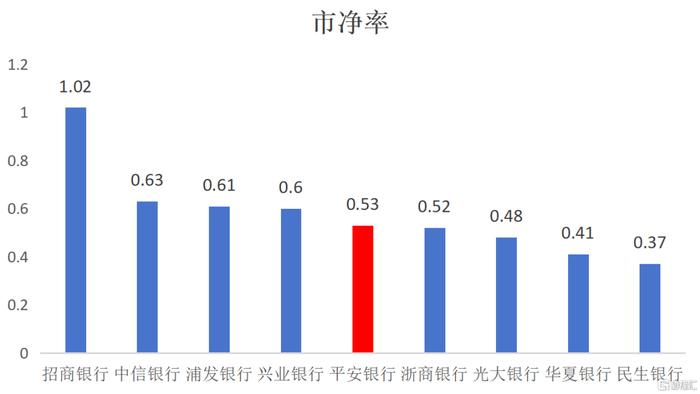
Core Viewpoint - The A-share market is experiencing a steady bull trend, with the Shanghai Composite Index breaking through 3800 points and aiming for 4000 points, highlighting the importance of the banking sector as a stabilizing force in the current macroeconomic environment [1] Group 1: Financial Performance - In the first half of 2025, Ping An Bank reported operating income of 69.385 billion yuan and net profit of 24.870 billion yuan, showing a year-on-year decline in both metrics, although the decline has narrowed compared to the first quarter [1] - The net interest margin for Ping An Bank in the first half of 2025 was 1.80%, a decrease of 16 basis points year-on-year, primarily due to the downward trend in market interest rates [2] - Despite the decline, Ping An Bank's net interest margin remains above the average for joint-stock banks, which was 1.55% in the same period [2] Group 2: Asset Quality and Risk Management - As of June 2025, Ping An Bank's non-performing loan ratio was 1.05%, a slight decrease of 0.01 percentage points year-on-year, indicating effective credit risk management [3] - The bank's credit and other asset impairment losses were 19.450 billion yuan, down 16.0% year-on-year, reflecting improved efficiency in handling non-performing assets [3] - Key capital adequacy ratios, including the core Tier 1 capital adequacy ratio, Tier 1 capital adequacy ratio, and total capital adequacy ratio, showed increases of 0.19, 0.16, and 0.15 percentage points respectively compared to the end of the previous year [3] Group 3: Business Strategy and Growth - Ping An Bank is focusing on balancing quality and quantity in its business expansion, shifting from a scale-oriented approach to a quality-oriented strategy [2][4] - The bank's wealth management fee income reached 2.466 billion yuan in the first half of 2025, a year-on-year increase of 12.8%, indicating a successful transformation in retail banking [7] - The bank has increased its support for key sectors such as advanced manufacturing, green finance, and rural revitalization, with new loans in emerging industries amounting to 123.817 billion yuan, a year-on-year growth of 16.7% [8] Group 4: Valuation and Market Position - The banking sector has been facing a persistent issue of trading below book value, but improvements in asset quality and performance metrics could lead to a valuation recovery for banks like Ping An Bank [5] - As of August 22, 2025, Ping An Bank's price-to-book ratio was 0.53, positioning it in the middle range among joint-stock banks [8]

银行强势背后,又见股东增持,险资继续扫货!百亿银行ETF(512800)单日再度吸金超3亿元
Xin Lang Ji Jin· 2025-08-05 01:36
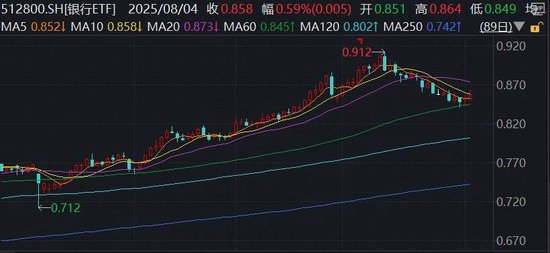
Core Viewpoint - The banking sector has shown significant recovery, with Agricultural Bank of China reaching a new historical high and major bank ETFs experiencing positive price movements [1][4]. Group 1: Market Performance - On August 4, the banking sector supported the overall market, with Agricultural Bank of China rising over 2% [1]. - The bank ETF (512800) saw an intraday price increase of over 1%, closing up 0.59% and recovering above the 10-day moving average [1]. - The bank ETF has recorded a net inflow of over 300 million yuan in a single day, with cumulative net inflows of 972 million yuan and 1.225 billion yuan over the past 5 and 10 days, respectively [4]. Group 2: Shareholder Activity - Nanjing Bank announced that a major shareholder, Nanjing Gaoke, increased its stake by 7.5077 million shares between July 24 and August 4, reflecting confidence in the bank's future [3]. - Several banks, including Everbright Bank, Jiangsu Bank, Suzhou Bank, and Bank of China, have disclosed significant shareholder buyback plans this year, indicating positive market sentiment [3]. Group 3: Institutional Investment - Insurance companies have been actively purchasing bank stocks, with Hongkang Life buying 30.386 million shares of Zhengzhou Bank H-shares and Peace Asset Management increasing its holdings in China Merchants Bank and Postal Savings Bank [3]. - The banking sector is favored by institutional investors due to high and stable dividends, with a solid performance base amid economic fluctuations [3]. Group 4: ETF Details - The bank ETF (512800) has grown to a scale of 14.99 billion yuan, more than doubling since the beginning of the year, with an average daily trading volume of 574 million yuan [6]. - The ETF tracks the CSI Bank Index and includes 42 listed banks, serving as an efficient investment tool for the banking sector [6].
银行股指数年内涨超10%创新高,机构热议板块投资价值
Huan Qiu Wang· 2025-06-09 01:29
Group 1 - The bank stock index has seen a cumulative increase of over 10% year-to-date, reaching a historical high between June 2 and June 6, with several banks like CITIC Bank, Industrial Bank, and Bank of Beijing hitting record highs [1] - The public fund reform is expected to reshape the A-share ecosystem, bringing in incremental funds to the financial sector, which includes banks, insurance, and securities, with a recovery in fundamentals and valuation [1] - The shift in pricing power for bank stocks is moving from active public funds to passive public funds and long-term capital, indicating a mid-term trend that will influence bank stock valuations [1] Group 2 - The overall positioning in the banking sector is expected to increase due to the influx of medium to long-term capital and public fund reforms, which will drive additional funds into the sector [2] - High dividend yield banks with strong asset quality are anticipated to provide absolute returns, highlighting the importance of their cost-effectiveness in investment [2] - Financial policies combined with loose fiscal measures are expected to enhance bank credit supply, maintaining stable credit growth and improving asset quality in the retail banking sector [2]
银行研思录之八:银行股回报有多高?
CMS· 2025-05-20 14:34
Investment Rating - The report maintains a "Recommended" rating for the banking sector, indicating a positive outlook for the industry [3]. Core Insights - The banking sector has consistently outperformed the market in most years since the end of 2008, with a cumulative return significantly higher than that of the broader market indices [6][10]. - The report highlights that the banking sector benefits from a shift in institutional investment styles, favoring long-term performance and actual profitability, which is expected to lead to a valuation recovery for the sector [6][10]. - High-profit growth banks have shown exceptional performance, with a cumulative increase of 2322% and an annualized return of 21.5% since the end of 2008, indicating the potential for higher returns through selective investment within the banking sector [6][10]. Summary by Sections Industry Scale - The banking sector comprises 41 listed companies, with a total market capitalization of 9875 billion and a circulating market capitalization of 9784.5 billion [3]. Performance Metrics - The absolute performance of the banking sector over different time frames is as follows: 1 month: 4.7%, 6 months: 11.8%, and 12 months: 24.3% [5]. - The banking index has outperformed the market indices, with the A-share banking index showing a cumulative increase of 404% and an annualized return of 10.4% since 2018 [6][10]. Historical Returns - From 2008 to the present, the banking sector has outperformed the CSI 300 Total Return Index in 10 out of 17 years, demonstrating a high success rate for investments in this sector [6][10]. - The report provides detailed cumulative return data, showing that the banking sector's returns have generally exceeded those of the broader market indices in most years since 2008 [12][14].
泰信基金关闭线上直销平台;又有基金管理人出手自购
Mei Ri Jing Ji Xin Wen· 2025-05-15 07:09
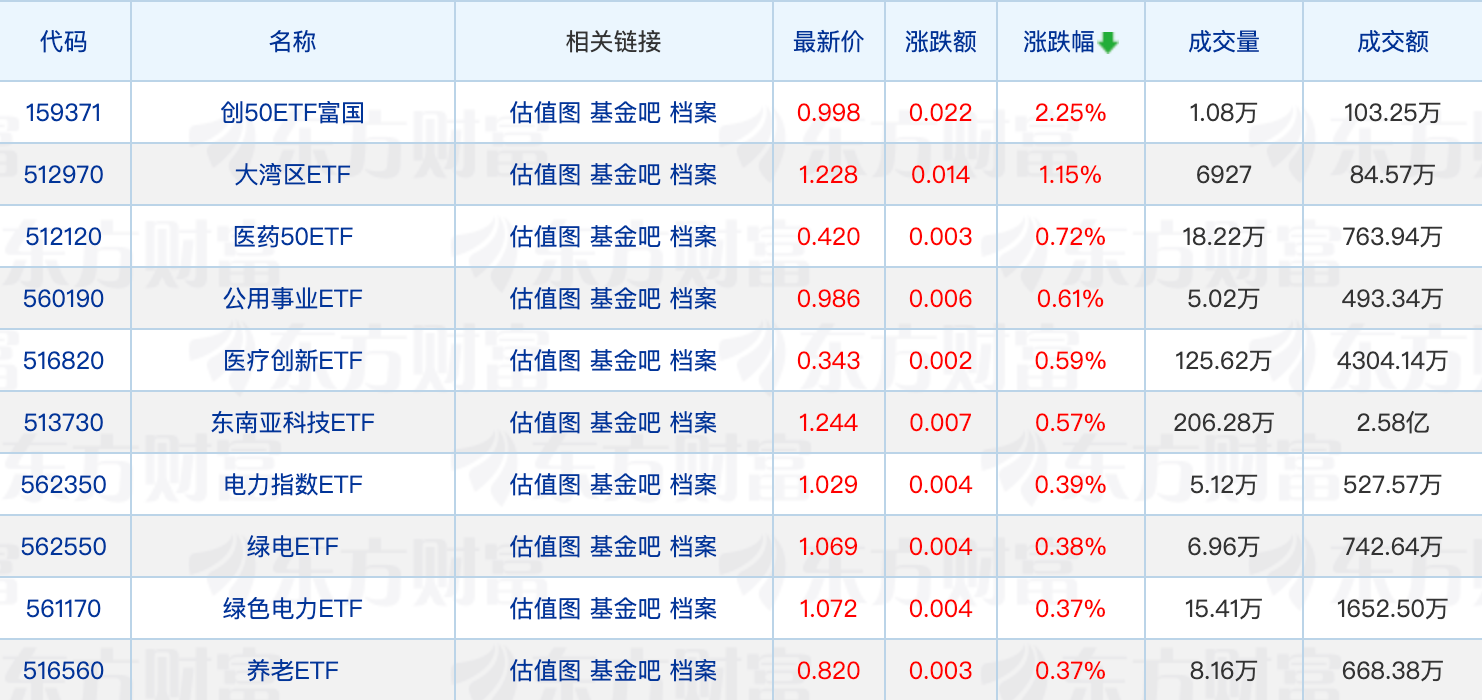
Group 1: Fund News - Taixin Fund announced the closure of its online direct sales platform, effective May 30, which includes services such as account opening, subscription, redemption, and regular investment [1] - China Merchants Asset Management plans to use its own funds to subscribe to its equity securities investment funds, with a total investment amount of no less than 25 million yuan, holding for at least six months [2] - Over 60% of the 66 newly established active equity products have seen a cumulative net value growth rate of over 1% since their inception, indicating significant buying activity [2] Group 2: Fund Manager Insights - Hu Jie, a well-known fund manager at Huabao Fund, expressed a positive outlook on the long-term investment value of the banking sector, highlighting its stable fundamentals and attractive dividend yield of approximately 6.1%, ranking second among all Shenwan primary industries [2] - The current PE ratio of the banking sector is 6.1 times, and the PB ratio is around 0.54 times, both of which are the lowest among various sectors [2] - Historical data shows that the banking sector's PE percentile is about 35%, and the PB percentile is around 26%, indicating a favorable safety margin and cost-effectiveness [2] Group 3: ETF Market Overview - The market experienced fluctuations, with the Shanghai Composite Index down by 0.68%, the Shenzhen Component Index down by 1.62%, and the ChiNext Index down by 1.91%, with total trading volume at 1.15 trillion yuan, a decrease of 164.3 billion yuan from the previous trading day [3] - Sectors such as beauty care, food and beverage, and agriculture showed gains, while software development, internet services, and power equipment sectors faced declines [3] - Notable performances were observed in the Chuang 50 ETF and Greater Bay Area ETF, with several power-related ETFs also performing well [3] Group 4: ETF Thematic Opportunities - The livestock industry is undergoing a critical transformation towards quality improvement and efficiency, driven by the rural revitalization strategy, with a focus on smart, ecological, and integrated approaches to pig farming [6] - This transformation is essential for ensuring meat supply safety and increasing farmers' income, suggesting potential investment opportunities in livestock and agriculture-related ETFs [6]