Workflow
Bank of RuiFeng(601528)
icon
Search documents
银行业周度追踪2025年第21周:房地产贷款增速转正,按揭多增-20250603
Changjiang Securities· 2025-06-02 23:30
Investment Rating - The investment rating for the banking industry is "Positive" and maintained [11] Core Insights - The banking index increased by 0.1% as of May 30, 2025, outperforming the CSI 300 index by 1.2% and the ChiNext index by 1.5%. The market's focus on bank stocks has increased significantly due to active fund allocation, with a continued upward trend in the sector, particularly for city commercial banks with relatively strong performance [2][6][19] - The growth rate of real estate loans turned positive for the first time since Q3 2023, with a year-on-year increase of 0.04% as of the end of March. This was primarily driven by a recovery in mortgage demand, with new personal housing loans amounting to 2,144 billion, a year-on-year increase of 2,093 billion [7][34][40] - The inclusion of Chongqing Rural Commercial Bank and Shanghai Rural Commercial Bank into the CSI 300 index is expected to attract more index funds, providing a positive outlook for these constituent stocks [8][47] Summary by Sections Market Performance - As of May 30, 2025, the banking index has shown a cumulative increase of 0.1%, with significant gains in city commercial banks like Hangzhou Bank, which saw its stock price rise after triggering a strong redemption condition for its convertible bonds [2][6][19] Loan Trends - In Q1 2025, the growth of corporate medium and long-term loans decreased, with industrial loans adding 1.52 trillion, down 140 billion year-on-year, and service sector loans adding 2.99 trillion, down 550 billion year-on-year. However, personal housing loans saw a significant increase, indicating a recovery in the housing market [7][34][40] Index Adjustments - The adjustment of the CSI 300 index, which includes Chongqing Rural Commercial Bank and Shanghai Rural Commercial Bank, is expected to lead to increased capital inflow into these stocks, enhancing their market performance [8][47] Convertible Bonds - The recent surge in bank stocks has narrowed the price gap to the strong redemption price for banks issuing convertible bonds. Hangzhou Bank's stock price has remained above the strong redemption price for 15 consecutive trading days, indicating strong investor confidence [9][48]
创新场景金融推动农村数字普惠金融走深走实
Zheng Quan Ri Bao· 2025-05-25 15:19
Core Viewpoint - Zhejiang Ruifeng Rural Commercial Bank's exploration and practice in the field of rural digital inclusive finance provides a valuable example for the industry, particularly through its innovation in scenario finance, which integrates financial services into various scenarios such as government affairs and people's livelihoods, thereby broadening service boundaries and offering more convenient and efficient comprehensive services to rural residents [1][2]. Group 1: Scenario Finance Innovation - Scenario finance combines financial services with specific commercial service scenarios, closely linking customer needs with financial solutions to provide more convenient, efficient, and personalized services [1]. - Financial institutions are focusing on breakthroughs in scenario finance services, achieving certain results in recent years, with innovative scenario finance becoming a key path to promote rural digital inclusive finance development [1][2]. Group 2: Agricultural Production Scene - In the agricultural production scene, financial institutions can utilize big data, IoT, and satellite remote sensing technologies to integrate data on land, crops, and agricultural materials, conducting credit assessments and risk predictions [2]. - This approach can lead to the introduction of precision credit services such as agricultural big data credit, meteorological loans, agricultural machinery loans, and IoT + supply chain finance, effectively alleviating issues like information asymmetry and insufficient collateral in traditional financial services [2]. Group 3: Rural Life Scene - In the rural life scene, financial institutions can focus on rural consumption areas, providing differentiated financial products related to family education, medical expenses, and housing improvement [2]. - Collaborations with public service units can enable online handling of livelihood payments, while partnerships with rural supermarkets and individual businesses can facilitate electronic payment solutions and financial services for fund management and value-added needs [2]. Group 4: Business Scene - In the business scene, financial institutions can design comprehensive financial solutions for emerging industries such as rural tourism, leisure agriculture, and green ecological agriculture, including project financing, consumer credit, and settlement services [2]. - For instance, financing can be provided for rural tourism projects to build facilities like guesthouses and farm stays, while also offering consumer credit services to tourists [2]. Group 5: Challenges and Solutions - Currently, innovative scenario finance faces challenges such as data integration and sharing difficulties, with rural data being dispersed, of varying quality, and a lagging credit system [2]. - Financial institutions need to build rural data sharing platforms within a legal framework, integrate multi-source data, enhance data governance, and improve data quality, while leveraging financial technology to optimize credit evaluation models and conduct credit education [2]. Group 6: Overall Perspective - Financial institutions should expand service areas and optimize service processes under controllable risks, providing higher quality and efficient financial services to rural residents and business entities, thereby injecting financial vitality into rural revitalization and supporting the prosperous development of the rural economy [3].
“数”写农村普惠金融新篇章的瑞丰样板——访浙江瑞丰农商银行党委书记、董事长吴智晖
■本报记者 王爱静 发展农村数字普惠金融在推动农村经济发展、缩小城乡差距、助力乡村振兴等方面具有重要意义。前不 久,浙江瑞丰农商银行试点探索发展农村数字普惠金融任务成功入选全国农村改革试验区拓展试验任 务,为行业提供了可借鉴的范例。近日,本报记者专访浙江瑞丰农商银行党委书记、董事长吴智晖,深 入探讨该行在农村数字普惠金融方面的试点探索情况、具体措施等。 记者:当前农村金融市场需求和供给现状如何?您认为数字普惠金融的介入能够解决哪些痛点问题? 二是深化全客群服务模式,推进"农户+小微"全触达。通过数字化提供批量化、标准化、精准化服务, 提高农村重点客群服务效率和质量,实现客群覆盖更广、融资成本更低。深化"农户小额普惠贷款工 程"成效,提升农户数字信贷可得性,解决农村长尾客户服务难问题,力争做到"人人可贷"。 吴智晖:从本地情况来看,浙江绍兴市柯桥区民营经济发达,产业集聚,农村金融服务需求多,30余家 银行业金融机构云集于此,金融服务不断下沉,同业竞争白热化。同时,农村金融服务的供给仍存在一 些不足之处。 数字普惠金融介入能够较好地解决以下三个痛点:一是解决农村客户可用数据少、更新难度高、信息不 对称的问题,让农 ...
本周聚焦:多家银行下调存款挂牌利率
GOLDEN SUN SECURITIES· 2025-05-25 06:18
Investment Rating - The report indicates a positive outlook for the banking sector, suggesting that certain stocks may have alpha potential due to policy catalysts and a cyclical recovery [4]. Core Insights - Multiple banks have lowered their deposit rates, with the one-year and five-year Loan Prime Rate (LPR) reduced by 10 basis points on May 20, 2025. This trend reflects a broader market-driven decline in deposit costs [1][2]. - The average deposit cost rate for China Merchants Bank decreased significantly by 25 basis points to 1.29% in Q1 2025, indicating a trend of improving deposit costs across the sector [1]. - The report highlights that banks like Chongqing Bank, Minsheng Bank, and CITIC Bank have substantial room for further deposit cost reductions, suggesting a favorable environment for banks to optimize their funding costs [2]. Summary by Sections Section 1: Focus of the Week - Several banks have adjusted their deposit rates downward, with over half of listed banks participating in this trend by May 24, 2025 [1]. - The report notes that the average deposit cost rate for China Merchants Bank has shown improvement since Q2 2024, aligning with previous forecasts of enhanced cost reduction in liabilities [1]. Section 2: Sector Perspective - The banking sector is expected to benefit from expansionary policies aimed at stabilizing the economy, with specific banks like Ningbo Bank, Postal Savings Bank, and China Merchants Bank highlighted as potential investment opportunities [4]. - The report emphasizes that the cyclical recovery may take time, but the ongoing interest rate cuts could sustain the dividend strategy for banks like Shanghai Bank and Jiangsu Bank [4]. Section 3: Key Data Tracking - The report tracks various financial metrics, including the issuance of interbank certificates and the average rates for different types of bank notes, indicating a dynamic market environment [9][8]. - It also notes the increase in the proportion of deposits with a remaining maturity of less than one year, which rose by 3 percentage points to 37.4% by the end of 2024, suggesting a trend towards concentrated deposit maturities [2][16].
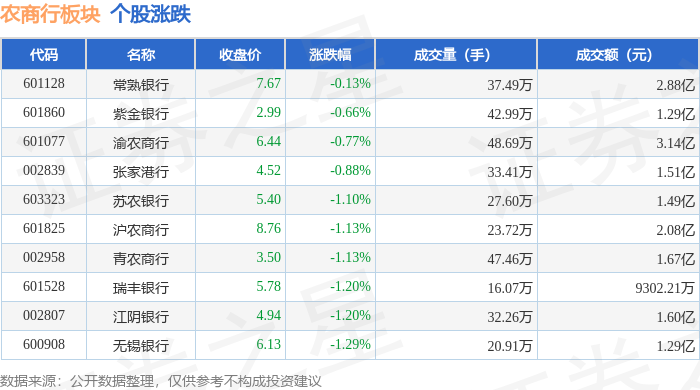
聚焦10家A股农商行一季报:沪农商行营收降超7%,紫金银行净息差仅1.23%
Xin Lang Cai Jing· 2025-05-23 00:34
Core Viewpoint - The A-share listed rural commercial banks demonstrated strong resilience in Q1 2025, with all 10 banks achieving positive net profit growth, highlighting their robust financial performance despite market pressures [1][5][6]. Financial Performance - All 10 A-share listed rural commercial banks reported positive net profit growth in Q1 2025, with Changshu Bank leading at a 13.81% year-on-year increase [1][7]. - Eight banks experienced positive revenue growth, while two banks, Shanghai Rural Commercial Bank and Zijin Bank, reported declines in revenue [1][5][6]. - Revenue figures for major banks include: - Chongqing Rural Commercial Bank: 72.24 billion yuan, up 1.35% - Shanghai Rural Commercial Bank: 65.60 billion yuan, down 7.41% - Qingnong Bank: 30.57 billion yuan, up 0.99% - Changshu Bank: 29.71 billion yuan, up 10.04% [3][5][6]. Asset Quality - As of the end of March, seven banks had non-performing loan (NPL) ratios below 1%, with Changshu Bank, Wuxi Bank, and Jiangyin Bank all below 0.9% [1][15]. - Qingnong Bank had the highest NPL ratio at 1.77%, despite a slight decrease from the previous year [1][15]. Asset Scale - Chongqing Rural Commercial Bank and Shanghai Rural Commercial Bank both exceeded 1.5 trillion yuan in total assets, with Chongqing leading at 1.61 trillion yuan, a 6.3% increase [9][11]. - Qingnong Bank ranked third in total assets at 511.58 billion yuan, while Changshu Bank followed closely with 389.01 billion yuan [11][12]. Interest Margin - The net interest margin for several banks has narrowed, with Zijin Bank reporting the lowest at 1.23%, below the industry average of 1.52% [4][7].
银行业周度追踪2025年第19周:4月信贷同比少增,关注优质城商行-20250520
Changjiang Securities· 2025-05-20 02:12
Investment Rating - The report maintains a "Positive" investment rating for the banking sector [12] Core Insights - The Yangtze Bank Index increased by 1.5% this week, outperforming the CSI 300 Index by 0.3% and the ChiNext Index by 0.1%. The recent public fund regulations are expected to drive long-term fund allocations towards the banking sector, which has been underrepresented compared to its weight in the CSI 300 [2][6] - The report highlights that the average dividend yield of the five major state-owned banks in A-shares is 4.47%, with a significant spread of 279 basis points over the 10-year government bond yield. The H-shares have an even higher average dividend yield of 5.77%, indicating a notable valuation discount compared to A-shares [7][22] - In April, new social financing totaled 1.16 trillion yuan, primarily driven by government bonds, while new RMB loans were only 280 billion yuan, reflecting a year-on-year decrease of 450 billion yuan. The report anticipates a continuation of weak credit issuance in May, with banks expected to increase lending intensity by the end of June [8][29] - The report notes a significant decline in net interest margins for commercial banks, with an overall decrease of 9 basis points to 1.43% in Q1 2025. State-owned banks saw a drop of 11 basis points to 1.33%, marking a historical low, while city commercial banks performed better due to lower mortgage ratios and strong local credit demand [9][39] Summary by Sections Market Performance - The Yangtze Bank Index's performance this week indicates a positive trend, with specific banks like Ruifeng Bank leading the gains [2][6] Dividend Yields and Valuation - The report emphasizes the attractive dividend yields of state-owned banks compared to government bonds, suggesting potential investment opportunities in H-shares due to their valuation discount [7][22] Credit and Financing Trends - April's financing data shows a reliance on government bonds for social financing growth, with a notable decline in new loans, indicating a cautious lending environment [8][29] Banking Sector Profitability - The decline in net interest margins across the banking sector highlights challenges in profitability, particularly for state-owned banks, while city commercial banks show resilience [9][39]
上市银行25Q1业绩总结:其他非息拖累盈利,息差下行压力趋缓
Dongxing Securities· 2025-05-19 07:45
Investment Rating - The report indicates a cautious outlook for the banking sector, with expected revenue and net profit growth rates for listed banks in 2025 projected at approximately -1% and 0% respectively [3][9]. Core Insights - The overall revenue and net profit growth rates for listed banks in Q1 2025 were -1.7% and -1.2% year-on-year, reflecting a decline compared to Q4 2024 [3][9]. - The performance of different types of banks varied significantly, with city and rural commercial banks leading in growth due to improved scale and net interest margin, while state-owned banks showed weaker performance [3][10]. - The net interest margin for listed banks in Q1 2025 was 1.37%, a decrease of 13 basis points year-on-year, but the decline was less severe than in the previous year [3][9]. Summary by Sections Revenue and Profit Overview - Listed banks experienced a decline in revenue and net profit growth rates, with Q1 2025 figures at -1.7% and -1.2% respectively, marking a drop of 1.8 percentage points and 3.5 percentage points from Q4 2024 [3][9]. - The decline in net interest income was attributed to a narrowing interest margin and challenges in volume compensating for price [9]. Asset Quality and Provisioning - The asset quality remained stable, with a decrease in non-performing loan ratios and a reduction in provisioning pressure, as banks continued to report lower provisions in a challenging income environment [3][9]. - The provision coverage ratio for listed banks decreased to 238% in Q1 2025, reflecting a trend of reduced provisioning amid stable asset quality [3][9]. Investment Recommendations - The report suggests that the banking sector's configuration value is enhanced by both fundamental and liquidity factors, with a focus on key index-weighted stocks such as China Merchants Bank and Industrial and Commercial Bank of China [3][9]. - The report highlights the potential for mid-sized banks to attract capital for growth, particularly in the context of capital replenishment and profitability [3][9].
A股银行市值首破10万亿,公募调仓、险资加持“故事”能否持续?
Di Yi Cai Jing· 2025-05-15 14:00
Core Viewpoint - The recent surge in bank stocks has made them a prominent feature in the A-share market, driven by high dividends, low valuations, and their safe-haven characteristics amid uncertainty [2][4]. Group 1: Market Performance - The China Securities Bank Index reached a high of 7751.80 points on May 15, 2023, following a nearly 7% increase over the previous six trading days [2]. - The total market capitalization of A-share banks surpassed 10 trillion yuan, increasing by 600 billion yuan from the beginning of the year [3]. - Year-to-date, the bank sector has risen over 8%, ranking fifth among all primary industries, with several banks experiencing gains exceeding 20% [5]. Group 2: Investment Drivers - Recent policy changes, including interest rate cuts and the expansion of financial asset investment companies, have contributed to the positive sentiment towards bank stocks [6][7]. - The new public fund assessment mechanism is expected to increase the allocation of funds to bank stocks, as active equity funds are likely to reduce their deviation from benchmark indices [8]. Group 3: Institutional Buying - Insurance funds have been actively increasing their holdings in bank stocks, with significant purchases noted in several banks this year [9]. - High dividend yields remain a key attraction for insurance investors, with many bank stocks offering yields above 4% [9]. Group 4: Risks and Challenges - Despite the positive outlook, there are concerns regarding the sustainability of bank stock performance, as factors such as narrowing interest margins and asset quality issues in retail lending pose risks [11][12]. - The overall non-performing loan ratio is rising, particularly in personal loans, indicating potential stress in the banking sector [12].
银行配置策略报告系列一:四维度再看当下银行配置机会-20250515
Huachuang Securities· 2025-05-15 06:11
Core Insights - The report maintains a positive outlook on bank sector investments, emphasizing the stability and dividend attributes of bank stocks, with an average dividend yield exceeding 4.3% [6][16] - The banking sector is expected to benefit from structural changes in the economy, leading to improved return on equity (ROE) and overall performance [7][10] Dimension One: Stability and Dividend Attributes of Bank Stocks - The core revenue growth of banks showed marginal improvement in Q1 2025, with a projected stable annual performance despite a slowdown in revenue and profit growth [10][11] - The average dividend payout ratio for listed banks increased to 26.1%, with an average dividend yield of over 4.3%, indicating strong dividend sustainability [16] - Major banks have received capital injections, enhancing asset quality and stabilizing market expectations, with non-performing loan ratios remaining steady at 1.16% [10][11] Dimension Two: Public Fund Reform and Increased Bank Allocations - The recent public fund reforms are expected to increase allocations to the banking sector, with potential incremental capital of approximately 222.7 billion yuan if funds align with industry benchmarks [10][12] Dimension Three: Influx of Long-term Capital - The acceleration of long-term capital inflows, particularly from insurance funds, is anticipated to provide additional support to bank stocks, with 14 cases of insurance fund acquisitions in 2025 [10][12] Dimension Four: Structural Economic Transformation and ROE Improvement - The banking sector's ROE is projected to stabilize between 8-9%, with potential for upward movement if economic conditions improve and structural transformations accelerate [7][10] Investment Recommendations - Emphasis on bank sector allocation, particularly focusing on state-owned banks and quality regional banks with strong provisioning coverage [7][10] - The report suggests a diversified investment strategy, highlighting the importance of dividend strategies and the potential for valuation improvements in selected banks [7][10]
航运行业重大事项点评:产业转移、贸易碎片化或催生亚洲集运机遇,解析海丰、德翔、锦江差异化布局图谱
Huachuang Securities· 2025-05-14 10:15
Investment Rating - The report maintains a recommendation for the shipping industry, particularly focusing on the opportunities in the Asian container shipping market [2]. Core Insights - The Asian shipping market is experiencing a balanced supply and demand, with a projected CAGR of 6.85% for container transport volume from 2001 to 2024, driven by regional economic growth and trade agreements like RCEP [2][14]. - The report highlights the differentiated strategies of major players such as SeaLand, Yang Ming, and Jin Jiang, emphasizing their operational strengths and market positioning [2][3]. Summary by Sections Supply and Demand in the Asian Market - Demand: The Asian route is the second-largest segment in global container shipping, with a projected volume of 65.29 million TEU in 2024, accounting for 30.7% of global container trade [14][16]. - Supply: The growth rate of container ships under 3000 TEU is expected to be lower than the global average, with a forecasted capacity growth of 0.59% in 2025 and a decline of 2.97% in 2026 [19][20]. Comparison of Major Shipping Companies - Capacity: SeaLand leads with a total capacity of 180,000 TEU, followed by Yang Ming with 113,000 TEU and Jin Jiang with 53,000 TEU [3][53]. - Growth Rates: From 2020 to 2024, Jin Jiang's total capacity grew by 102%, Yang Ming by 59%, and SeaLand by 39% [54][59]. - Revenue Structure: SeaLand's revenue distribution in 2024 is 48% from Greater China, 29% from Southeast Asia, and 17% from Japan [4][68]. Financial Performance and Efficiency - Profitability: SeaLand's net profit margin fluctuated between 21% and 47% from 2020 to 2024, while Yang Ming's ranged from 2% to 54% [5][6]. - Asset Turnover: SeaLand's total asset turnover ranged from 0.85 to 1.42, indicating efficient asset utilization compared to its peers [5][6]. Investment Recommendations - The report suggests that the Asian shipping market is a high-quality segment within the industry, with companies like SeaLand and Yang Ming expected to benefit from ongoing trade dynamics and regional demand growth [6][52].