Bank of RuiFeng(601528)

Search documents
A股收评:午后拉升!沪指重回3900点,创业板指涨1.36%
Ge Long Hui A P P· 2025-12-05 07:31
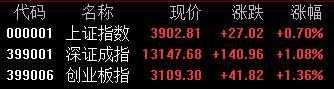
Market Performance - The A-share market saw a collective rise in the three major indices, with the Shanghai Composite Index up 0.7% to 3902 points, the Shenzhen Component Index up 1.08%, and the ChiNext Index up 1.36% [1][2] - The total market turnover reached 1.74 trillion yuan, an increase of 177.3 billion yuan compared to the previous trading day, with nearly 4400 stocks rising [1] Insurance Sector - The insurance sector experienced significant gains, with China Pacific Insurance rising over 6.85%, Ping An Insurance up nearly 6%, and China Life Insurance up nearly 5% [4][5] - Morgan Stanley added Ping An Insurance to its core recommended list and raised its target price for Ping An's H-shares to 89 HKD and A-shares to 85 CNY, maintaining an industry top pick rating [4] Gold Sector - Gold-related stocks saw substantial increases, with companies like Xiaocheng Technology rising over 14% and Nankun Group hitting the daily limit [5][6] - The expectation of interest rate cuts by the Federal Reserve has strengthened predictions for gold prices, with the World Gold Council forecasting a potential increase of 15%-30% by 2026 due to declining U.S. Treasury yields and heightened geopolitical risks [5] Commercial Aerospace Sector - The commercial aerospace sector saw multiple stocks hit the daily limit, including Lixing Co. and Hongxiang Co., with Lixing Co. rising 20.02% [10] - The "Qianfan Constellation" market cooperation was signed between Yanshin Satellite and Airbus, marking a significant step towards global application [9] Superconducting Sector - The superconducting sector experienced a surge, with stocks like Baosheng Co. and Xibu Materials hitting the daily limit [8] - A breakthrough in nickel-based high-temperature superconductors was reported by a research team led by Shandong University, with results published in the journal Nature [7] Rare Earth Sector - The rare earth sector saw gains, with Ningbo Yunsheng and Jinkeli Yongci hitting the daily limit [12] - The Chinese government has been conducting export control work on rare earth-related items, approving compliant export applications promptly [11]







12家上市银行迎调研高峰!年末资金布局关注哪些方向?
Guo Ji Jin Rong Bao· 2025-12-03 15:33
Core Viewpoint - The recent increase in institutional research on local listed banks, particularly city and rural commercial banks, is driven by improving fundamental indicators, investment value, and market performance, with a generally optimistic outlook on net interest margins and dividend prospects [1][3]. Group 1: Institutional Research Activity - As of December 3, 12 listed banks have received 195 research visits from 81 institutions since November, a significant increase from October's 58 visits [1][2]. - The banks involved in this round of research are all regional institutions, including Ningbo Bank, Hangzhou Bank, and others [2]. - Year-to-date, 25 banks have been researched, with Ningbo Bank and Hangzhou Bank leading in the number of visits, receiving 323 and 285 visits respectively [3]. Group 2: Outlook on Net Interest Margins - Institutions are focusing on dividend plans, net interest margin outlooks, and response measures during their research [4]. - Despite a historical low net interest margin of 1.42% as of Q3, many banks express optimism about future trends, citing potential stabilization [4][5]. - Banks are adjusting their asset-liability structures and reducing deposit rates to manage the pressure on net interest margins [5]. Group 3: Dividend Stability and Plans - The upcoming mid-term dividends for A-share listed banks in 2025 have become a focal point for institutions, with banks like Ningbo Bank and Zhangjiagang Bank implementing mid-term dividends for the first time [6]. - Several banks, including Suzhou Bank, maintain a stable cash dividend ratio of over 30%, indicating a commitment to providing consistent returns to shareholders [6]. - Banks are advised to balance their operational performance with dividend frequency, ensuring that dividend policies are aligned with profitability and capital adequacy [7].



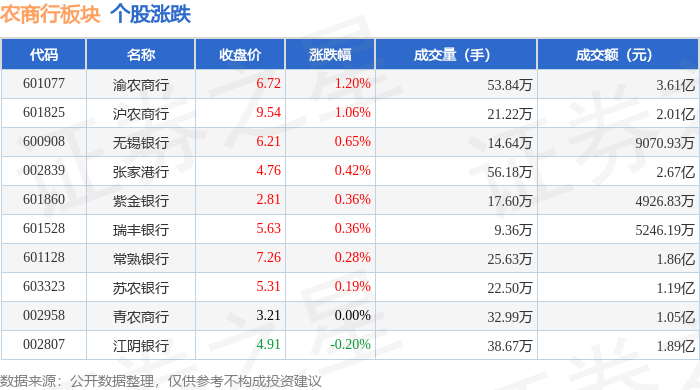
农商行板块12月2日涨0.75%,渝农商行领涨,主力资金净流出8304.93万元
Zheng Xing Xing Ye Ri Bao· 2025-12-02 09:05
Core Viewpoint - The rural commercial bank sector experienced a 0.75% increase on December 2, with Yunnan Rural Commercial Bank leading the gains, while the Shanghai Composite Index and Shenzhen Component Index saw declines of 0.42% and 0.68%, respectively [1] Group 1: Market Performance - The closing price of Yunnan Rural Commercial Bank was 6.72, up by 1.20%, with a trading volume of 538,400 shares and a transaction value of 361 million [1] - Other banks in the sector, such as Shanghai Rural Commercial Bank and Wuxi Bank, also reported gains of 1.06% and 0.65%, respectively [1] - The overall trading volume and transaction values for various banks indicate active market participation, with Zhangjiagang Bank and Suzhou Rural Bank also showing positive performance [1] Group 2: Fund Flow Analysis - The rural commercial bank sector saw a net outflow of 83.05 million from institutional investors and 32.37 million from speculative funds, while retail investors contributed a net inflow of 115 million [1] - Yunnan Rural Commercial Bank had a net inflow of 13.21 million from institutional investors, despite a net outflow of 21.98 million from speculative funds [2] - The fund flow data indicates varying levels of investor confidence, with some banks like Zhangjiagang Bank experiencing significant net outflows from institutional and speculative investors, while retail investors showed strong interest [2]
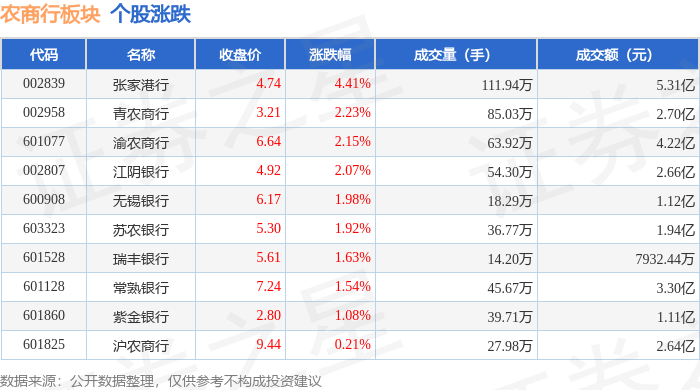
农商行板块12月1日涨1.44%,张家港行领涨,主力资金净流出8378.27万元
Zheng Xing Xing Ye Ri Bao· 2025-12-01 09:10
Market Performance - The rural commercial bank sector increased by 1.44% on December 1, with Zhangjiagang Bank leading the gains [1] - The Shanghai Composite Index closed at 3914.01, up 0.65%, while the Shenzhen Component Index closed at 13146.72, up 1.25% [1] Individual Stock Performance - Zhangjiagang Bank (002839) closed at 4.74, up 4.41% with a trading volume of 1.1194 million shares and a transaction value of 5.31 billion [1] - Qingnong Commercial Bank (002958) closed at 3.21, up 2.23% with a trading volume of 850,300 shares and a transaction value of 270 million [1] - Yunnan Agricultural Bank (601077) closed at 6.64, up 2.15% with a trading volume of 639,200 shares and a transaction value of 422 million [1] - Jiangyin Bank (002807) closed at 4.92, up 2.07% with a trading volume of 543,000 shares and a transaction value of 266 million [1] - Other notable performances include Yuanxi Bank (600908) at 6.17 (+1.98%), Sunong Bank (603323) at 5.30 (+1.92%), and Ruifeng Bank (601528) at 5.61 (+1.63%) [1] Fund Flow Analysis - The rural commercial bank sector experienced a net outflow of 83.7827 million from institutional investors, while retail investors saw a net inflow of 1.7564 million [1] - Notable net inflows from speculative funds amounted to 82.0263 million [1] Detailed Fund Flow for Individual Stocks - Yunnan Agricultural Bank (601077) had a net inflow of 24.4028 million from institutional investors, while retail investors had a net outflow of 36.2857 million [2] - Jiangyin Bank (002807) saw a net inflow of 17.2582 million from institutional investors, with retail investors experiencing a net outflow of 4.7439 million [2] - Other banks like Zijin Bank (601860) and Ruifeng Bank (601528) also showed varied fund flows, with Zijin Bank having a net inflow of 2.9176 million from speculative funds [2]

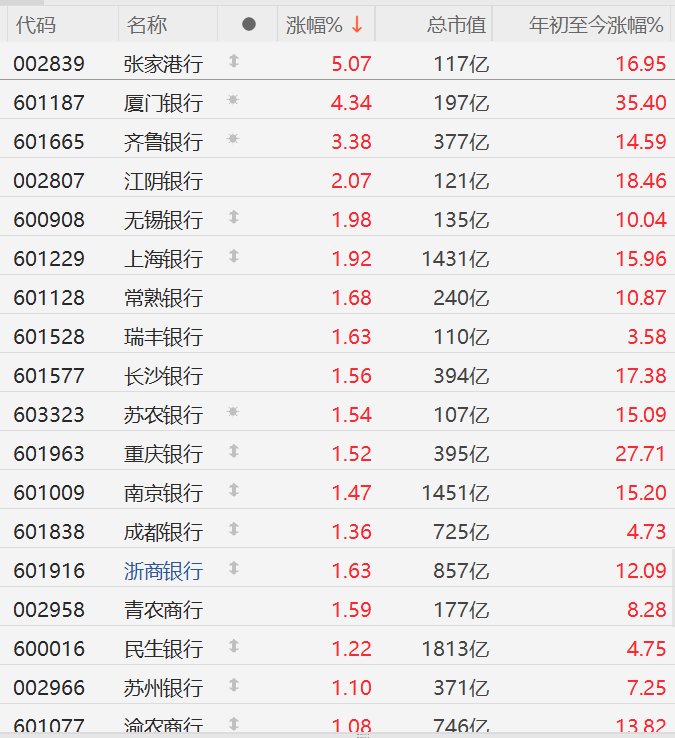
A股银行股普涨,张家港行涨5%,厦门银行涨超4%
Ge Long Hui A P P· 2025-12-01 03:10
Core Viewpoint - The A-share market has seen a significant increase in bank stocks, with notable gains in several banks on December 1st, indicating positive market sentiment towards the banking sector [1]. Summary by Category Stock Performance - Zhangjiagang Bank increased by 5.07%, with a total market capitalization of 11.7 billion and a year-to-date increase of 16.95% [2]. - Xiamen Bank rose by 4.34%, with a market cap of 19.7 billion and a year-to-date increase of 35.40% [2]. - Qilu Bank saw a 3.38% increase, with a market cap of 37.7 billion and a year-to-date increase of 14.59% [2]. - Jiangyin Bank increased by 2.07%, with a market cap of 12.1 billion and a year-to-date increase of 18.46% [2]. - Wuxi Bank and Shanghai Bank both rose nearly 2%, with market caps of 13.5 billion and 143.1 billion respectively, and year-to-date increases of 10.04% and 15.96% [1][2]. Technical Indicators - The formation of a MACD golden cross signal suggests a positive trend for these bank stocks, contributing to their upward momentum [1].


银行股,再度发力
Di Yi Cai Jing· 2025-12-01 02:45
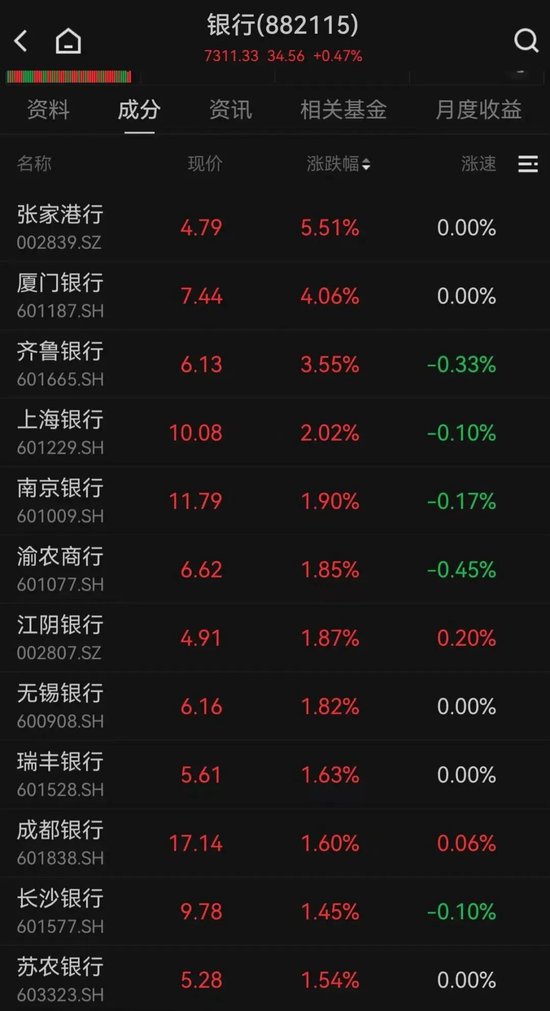
Core Viewpoint - The banking sector experienced a notable upward trend on December 1, with several banks showing significant gains in their stock prices, indicating positive market sentiment towards the banking industry [1][2]. Group 1: Stock Performance - Zhangjiagang Bank saw an increase of over 5%, reaching a price of 4.79 [2]. - Xiamen Bank rose by more than 4%, with its stock priced at 7.44 [2]. - Qilu Bank experienced a gain of over 3.5%, with its stock priced at 6.13 [2]. - Other banks such as Nanjing Bank, Chongqing Rural Commercial Bank, and Jiangyin Bank also reported increases in their stock prices, contributing to the overall positive performance of the banking sector [1][2].

区域经济转型升级系列(四):浙江民营经济活跃,改革发展领先,培育金融沃土
Huachuang Securities· 2025-11-29 07:48
Investment Rating - The report maintains a "Recommend" rating for the banking industry in Zhejiang Province, highlighting its strong potential due to the active private economy and favorable financial environment [2]. Core Insights - The banking sector in Zhejiang, particularly Hangzhou Bank, is positioned as a high-potential financial partner, benefiting from the region's economic vitality and robust growth in various financial services [3][8]. - The report emphasizes the resilience of Zhejiang's economy, with a GDP growth rate consistently above the national average, despite challenges such as trade friction [9][20]. - The analysis identifies several unlisted banks in Zhejiang as potential investment opportunities, focusing on their profitability, growth potential, and asset quality [8][9]. Summary by Sections 1. Overview of Zhejiang's Private Economy - Zhejiang's private economy reached 6.1 trillion yuan in 2024, accounting for 67.4% of the province's GDP, contributing over 70% of tax revenue and 80% of imports and exports [13][20]. - The province has a strong entrepreneurial culture, with a historical reliance on private economic forces due to limited state support [19][20]. 2. Economic Structure - The primary industries in Zhejiang are wholesale and retail, and manufacturing, with the service sector contributing approximately 60% to the GDP [26][30]. - The province's export dependency is significant, with over 40% of GDP derived from exports, and a notable reliance on the U.S. market [35][39]. 3. Banking Sector Characteristics - Zhejiang has a diverse banking landscape with 168 legal entities, including 13 city commercial banks and 82 rural commercial banks, primarily serving small and medium-sized enterprises [56][57]. - The report highlights the strong profitability and asset quality of listed city commercial banks like Hangzhou Bank and Ningbo Bank, which focus on different customer segments [57][59]. 4. Hidden Gems in Banking - The report identifies six unlisted city commercial banks and 25 rural commercial banks in Zhejiang with strong ROE and low non-performing loan ratios as potential investment targets [8][9][56]. 5. Investment Recommendations - Investors are encouraged to focus on the high-growth potential of banks in Zhejiang, particularly listed banks that may be undervalued, as well as exploring opportunities in unlisted banks [8][9].
农商行板块11月28日涨0.53%,沪农商行领涨,主力资金净流入2952.17万元
Zheng Xing Xing Ye Ri Bao· 2025-11-28 09:05
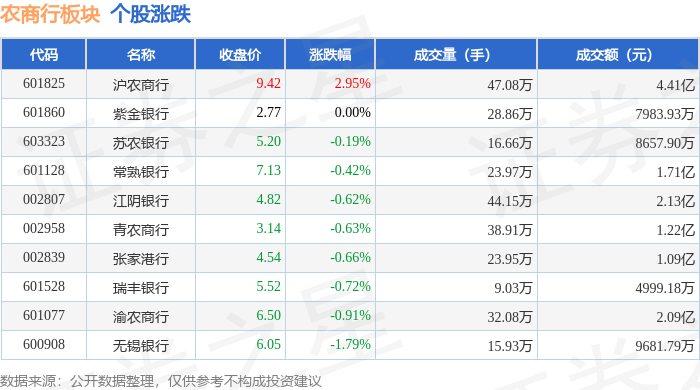
Market Performance - The agricultural commercial bank sector increased by 0.53% compared to the previous trading day, with Hu Nong Bank leading the gains [1] - The Shanghai Composite Index closed at 3888.6, up 0.34%, while the Shenzhen Component Index closed at 12984.08, up 0.85% [1] Individual Stock Performance - Hu Nong Bank (601825) closed at 9.42, with a rise of 2.95% and a trading volume of 470,800 shares, totaling a transaction value of 441 million yuan [1] - Other banks such as Zijin Bank (601860) remained unchanged at 2.77, while Su Nong Bank (603323) decreased by 0.19% to 5.20 [1] - Jiangyin Bank (002807) and Qingnong Bank (002958) saw declines of 0.62% and 0.63%, respectively, with closing prices of 4.82 and 3.14 [1] Capital Flow Analysis - The agricultural commercial bank sector experienced a net inflow of 29.52 million yuan from main funds, while retail investors saw a net outflow of 76.19 million yuan [1] - Notable net inflows from speculative funds were recorded at 46.67 million yuan [1] Detailed Capital Flow for Individual Stocks - Jiangyin Bank (002807) had a main fund net inflow of 27.00 million yuan, but a net outflow of 17.94 million yuan from retail investors [2] - Su Nong Bank (603323) reported a main fund net inflow of 12.32 million yuan, with retail investors experiencing a net outflow of 6.88 million yuan [2] - Wuxi Bank (600908) had a main fund net inflow of 10.91 million yuan, while retail investors faced a net outflow of 12.60 million yuan [2]
农商行板块11月26日涨0.17%,江阴银行领涨,主力资金净流出1257.83万元
Zheng Xing Xing Ye Ri Bao· 2025-11-26 09:05
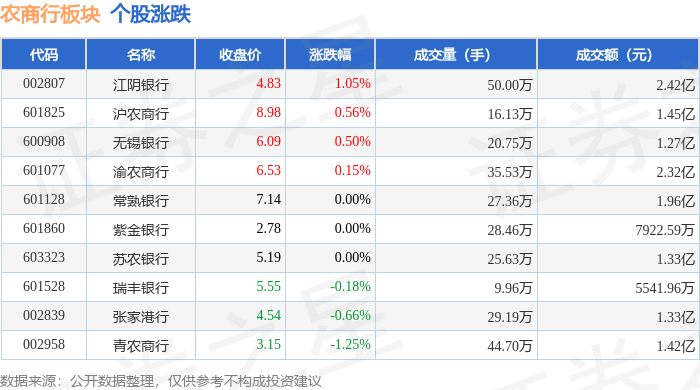
Core Insights - The rural commercial bank sector experienced a slight increase of 0.17% on November 26, with Jiangyin Bank leading the gains [1] - The Shanghai Composite Index closed at 3864.18, down 0.15%, while the Shenzhen Component Index rose by 1.02% to 12907.83 [1] Stock Performance - Jiangyin Bank (002807) closed at 4.83, up 1.05% with a trading volume of 500,000 shares and a transaction value of 2.42 billion [1] - Other notable performances include: - Hu Nong Commercial Bank (601825) at 86.8, up 0.56% with a transaction value of 145 million - Wuxi Bank (600908) at 6.09, up 0.50% with a transaction value of 127 million - Yunnan Agricultural Commercial Bank (601077) at 6.53, up 0.15% with a transaction value of 232 million [1] Capital Flow - The rural commercial bank sector saw a net outflow of 12.58 million from institutional investors, while retail investors experienced a net outflow of 46.30 million [1] - Notably, speculative funds had a net inflow of 58.87 million [1] Individual Stock Capital Flow - Jiangyin Bank had a net inflow of 34.67 million from institutional investors, but a net outflow of 22.04 million from retail investors [2] - Qingnong Commercial Bank (002958) saw a net inflow of 4.52 million from institutional investors, while retail investors had a net outflow of 5.52 million [2] - Zhangjiagang Bank (002839) experienced a net inflow of 4.19 million from institutional investors and a net outflow of 15.75 million from retail investors [2]
农商行板块11月25日涨0.72%,XD无锡银领涨,主力资金净流入1421.15万元
Zheng Xing Xing Ye Ri Bao· 2025-11-25 09:09
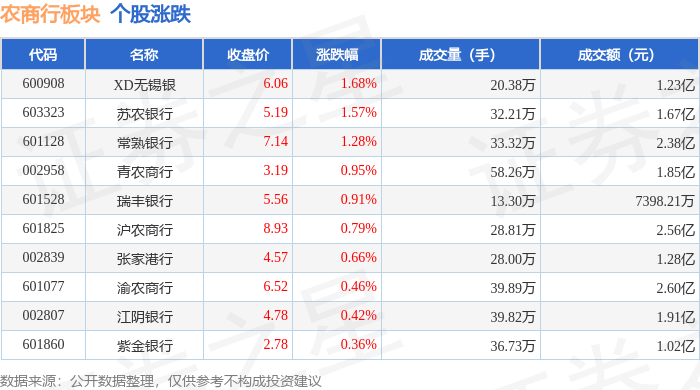
Core Points - The rural commercial bank sector saw an increase of 0.72% on November 25, with XD Wuxi leading the gains [1] - The Shanghai Composite Index closed at 3870.02, up 0.87%, while the Shenzhen Component Index closed at 12777.31, up 1.53% [1] Summary by Category Stock Performance - XD Wuxi Bank (600908) closed at 6.06, up 1.68% with a trading volume of 203,800 shares and a turnover of 123 million yuan [1] - Su Nong Bank (603323) closed at 5.19, up 1.57% with a trading volume of 322,100 shares and a turnover of 167 million yuan [1] - Changshu Bank (601128) closed at 7.14, up 1.28% with a trading volume of 333,200 shares and a turnover of 238 million yuan [1] - Other notable performances include Qingnong Commercial Bank (002958) at 3.19, up 0.95%, and Ruifeng Bank (601528) at 5.56, up 0.91% [1] Capital Flow - The rural commercial bank sector experienced a net inflow of 14.21 million yuan from institutional investors, while retail investors saw a net outflow of 56.75 million yuan [2] - Speculative funds had a net inflow of 42.54 million yuan into the sector [2]