
YONGHUI SUPERSTORES(601933)

Search documents
永辉全国门店客流销售同店双增,熟食烘培增长超220%
Bei Jing Shang Bao· 2026-02-26 05:32
Group 1 - The core viewpoint of the articles highlights the significant sales growth and customer traffic at Yonghui Supermarket during the Chinese New Year period, with a notable performance from its private label products [1][2] - From January 28 to February 7, same-store sales and customer traffic at Yonghui Supermarket experienced a year-on-year increase, with the "Quality Yonghui" series seeing over 70% sales growth for nearly 60 products [1] - Key categories such as cooked food and baking saw over 220% year-on-year growth, supported by the establishment of a "central kitchen" in stores [1] Group 2 - Yonghui Supermarket's CEO Wang Shoucheng outlined three strategic directions for deepening operations by 2026, including establishing a quality ecosystem with long-term partnerships with 200 core production areas and factories [2] - The company aims to transform stores from transaction-focused environments to "lifestyle" spaces, enhancing the shopping experience with concepts like "community kitchens" and "neighborhood living rooms" [2] - Organizational changes will focus on empowering employees and increasing training investments, shifting from control to empowerment [2]

永辉春节档成绩单:熟食、烘焙重点分类增超220%,天津SM广场店1月至今日均销售额突破130万元
Cai Jing Wang· 2026-02-25 09:34
Core Insights - Yonghui Supermarket reported strong performance during the Spring Festival period, with both same-store sales and customer traffic showing year-on-year growth [1] Group 1: Sales Performance - From the 28th day of the lunar month to the 7th day of the lunar new year, Yonghui's nationwide same-store sales and customer traffic both achieved year-on-year growth [1] - The company implemented a "New Yonghui·New Year Flavor" strategy, introducing a "four-phase" supply strategy that significantly boosted sales in key categories [1] Group 2: Category Growth - The cooked food segment, baked goods, and freshly baked items saw sales growth exceeding 220%, while hot pot series sales increased by over 140% [1] - Sales of landmark and organic vegetables, categorized as "Spring Festival Good Dishes," grew nearly 200%, and seafood sales increased by over 60% [1] - The self-owned brand "Quality Yonghui" saw nearly 60 products experience a sales surge, with a month-on-month increase of over 70% during the Spring Festival [1] Group 3: Gift Box Market - Yonghui's customized nut gift boxes, developed in collaboration with Three Squirrels and Senbao, became two of the top-selling items during the Spring Festival, with the customized series accounting for 50% of overall gift box sales [1] - Key categories in cooked food and baked goods also saw significant growth, with the YHBakery Strawberry Box Cake ranking first in the baking category [1] Group 4: Store Performance - The Fuzhou Olympic Center store achieved daily sales exceeding 1 million yuan during the Spring Festival [1] - The Henan Xinmi Zhongqiangguang store reported nearly a threefold increase in sales compared to the same period last year, with customer traffic growing over 230% [1] - In the northern market, the Tianjin SM Plaza store in the Bohai Bay region achieved an average daily sales of over 1.3 million yuan from January to date [1]


商贸零售行业周报:马年春节消费稳健恢复,老铺黄金宣布2月底调价
KAIYUAN SECURITIES· 2026-02-24 01:25
Investment Rating - The industry investment rating is "Positive" (maintained) [1] Core Viewpoints - The report highlights a steady recovery in consumer spending during the Spring Festival, with significant increases in payment transactions and retail sales compared to the previous year [4][26] - The report emphasizes the importance of high-quality companies in high-growth sectors driven by emotional consumption themes [7][35] Summary by Sections Industry Dynamics - The Spring Festival saw a robust recovery in social consumption, with payment transactions on New Year's Eve reaching 4.931 billion, a 21.64% increase from the previous year [4][26] - Key regions like Hainan and cities such as Tianjin and Zhenjiang showed strong performance in retail and dining, with Hainan's duty-free shopping amounting to 1.03 billion yuan, up 20.9% year-on-year [4][27] - Domestic travel orders surged by 60%, and outbound travel orders increased by over 180% during the holiday period [4][26] Investment Recommendations - Investment Theme 1: Focus on high-end gold and fashion jewelry brands, recommending companies like Laopai Gold and Chaohongji for their differentiated product offerings [7][35] - Investment Theme 2: Emphasize retail companies adapting to trends and AI-enabled cross-border e-commerce leaders, with recommendations for Yonghui Supermarket and Aiyingshi [7][35] - Investment Theme 3: Highlight domestic beauty brands that cater to emotional value and innovative safe ingredients, recommending brands like Maogeping and Proya [7][35] - Investment Theme 4: Focus on differentiated medical beauty product manufacturers and leading medical beauty institutions, recommending companies like Meilitiantian Medical Health and Aimeike [7][35] Market Performance - The retail and social service indices reported declines of 1.59% and 0.78% respectively during the week from February 9 to February 13, 2026 [6][15] - The report notes that the education sector saw the highest growth among sub-sectors, while the watch and jewelry sector led the year-to-date performance with an 11.29% increase [6][18] Company Highlights - Laopai Gold reported a significant revenue increase of 250.9% in the first half of FY2025, driven by strong consumer demand and brand expansion [37] - Chaohongji is expected to achieve a net profit growth of 125% to 175% in FY2025, supported by its differentiated product strategy [37] - Maogeping and Proya are highlighted for their strong performance in the beauty sector, with Maogeping achieving a revenue increase of 31.3% in FY2025 [37]




五年亏光116亿!关停381家门店,又一商超扛不住,跟风胖东来失败
Sou Hu Cai Jing· 2026-02-22 10:45
Core Viewpoint - Yonghui Supermarket has been facing continuous losses for five years, with a projected loss of 2.14 billion yuan in 2025, marking a 45.6% increase in loss compared to the previous year, raising questions about its strategic decisions and operational effectiveness [2][4][31]. Group 1: Financial Performance - Yonghui has accumulated losses of 11.6 billion yuan over five years, indicating severe operational pressure [4]. - The company closed 381 underperforming stores and renovated 315 existing ones, with a total renovation area exceeding 2 million square meters, yet these efforts led to increased losses [6][31]. - The projected loss for 2025 includes over 1.2 billion yuan in costs related to store renovations and asset write-offs, highlighting the financial strain from strategic adjustments [8][31]. Group 2: Strategic Adjustments - Yonghui attempted to emulate the successful model of regional competitor, Pang Donglai, which achieved a sales figure of 23.5 billion yuan in 2024 with a limited number of stores [10]. - The company initiated a comprehensive transformation by adopting Pang Donglai's operational strategies, including introducing popular products and redesigning store layouts to enhance customer experience [18][21]. - Despite initial positive results from the transformation, including increased customer traffic and sales, the long-term sustainability of these changes remains uncertain due to rising prices and customer dissatisfaction [20][23]. Group 3: Challenges and Criticism - The transformation has been criticized as superficial, with observers noting that Yonghui failed to grasp the core operational logic of Pang Donglai, leading to ineffective imitation [25][38]. - Employee compensation issues have arisen, with Yonghui's pay structure not aligning with the employee-centric model of Pang Donglai, resulting in dissatisfaction among staff [25][40]. - The introduction of self-branded products has not resonated with consumers, as they are perceived as lacking uniqueness and being overly derivative, which poses risks for long-term sales [29][44]. Group 4: Future Outlook - Yonghui's CEO has acknowledged past mistakes and outlined a shift in focus towards sustainable system capabilities, aiming to develop 100 high-quality products and refine store management [35][37]. - The company plans to achieve profitability between May 2026 and May 2027, indicating a strategic pivot towards long-term viability rather than immediate scale [37].
于东来退休幕后:3年放权,永不上市,接班人须60岁退休
创业家· 2026-02-18 09:33
Core Viewpoint - The retirement of Yu Donglai, founder and chairman of Pang Donglai Group, marks a significant shift in the company's governance structure, transitioning from personal leadership to a committee-based management model, emphasizing institutional continuity over individual authority [5][12][44]. Group 1: Retirement Announcement and Governance Changes - Yu Donglai announced his retirement on February 11, 2026, stating he would transition to an advisory role, with daily operations managed by a decision-making committee [8][12]. - The decision to retire is not sudden but part of a long-term strategy to empower a professional management team, moving away from family succession to a system of shared leadership [12][16]. - The decision-making committee will consist of core internal members, implementing a rotating management system to ensure diverse leadership [12][16]. Group 2: Institutional Reforms and Management Philosophy - Over the past three years, Yu has initiated a system reform aimed at decentralizing decision-making and fostering a culture of autonomy among employees [13][15]. - The company has established a culture of democratic decision-making, with middle management positions filled through public competitions, ensuring transparency and alignment with core values [19]. - Yu's retirement aligns with the company's long-term strategy of maintaining a youthful management team, with a rule that the highest management must retire before the age of 60 [21][24]. Group 3: Financial Performance and Employee Welfare - As of November 2025, Pang Donglai's sales exceeded 20.035 billion yuan, with a cash reserve of 4.1 billion yuan, indicating strong financial health [26]. - Employee compensation is robust, with an average monthly salary of 9,886 yuan and a protection system for personal dignity, including compensation for mental and physical harm [26][27]. - The company emphasizes customer service stability, allowing employees to autonomously resolve minor disputes, reinforcing a customer-centric approach [27][29]. Group 4: Challenges and Market Position - Despite Yu's efforts to share his successful model, competitors like Yonghui Supermarket have struggled to replicate Pang Donglai's success, highlighting the unique cultural and operational environment of the company [32][33]. - The company's focus on regional depth and long-term value creation contrasts with the short-term profit pressures faced by publicly traded companies, which can hinder similar initiatives [32][33]. - The transition to a committee-based management model presents challenges, including decision-making efficiency and the potential dilution of the company's core values and service standards [40][41]. Group 5: Future Outlook and Industry Implications - The retirement of Yu Donglai raises questions about the future identity of Pang Donglai, with employees expressing confidence in the institutional safeguards that have been established [37][41]. - The company's approach serves as a case study for other Chinese private enterprises facing succession challenges, emphasizing the importance of institutional resilience over individual leadership [42][44]. - The ongoing commitment to a non-public listing and regional focus positions Pang Donglai as a model for sustainable growth in the retail sector, challenging the prevailing norms of rapid expansion and profit maximization [42][44].



千亿超市巨头陨落,市值蒸发840亿,皆因转型时,兄弟内斗分家?
Sou Hu Cai Jing· 2026-02-17 08:31
Core Viewpoint - Yonghui Supermarket, once a leading player in the retail industry with a market value peaking at 117.9 billion yuan, has faced significant challenges leading to a drastic decline in its market value to 33.94 billion yuan, losing nearly 84 billion yuan in value due to various operational and competitive pressures [3][19]. Company Overview - Yonghui Supermarket operates over 1,200 stores across 16 provinces in China, maintaining a strong market presence [1]. - The company was listed on the Shanghai Stock Exchange in November 2013, experiencing a five-year growth period where its market value exceeded 117.9 billion yuan [3][14]. Historical Background - The founders, Zhang Xuanning and Zhang Xuansong, started their entrepreneurial journey in the 1990s as beer distributors before transitioning into the supermarket industry in the mid-1990s [4][11]. - The first Yonghui Supermarket was established in 1998, focusing on fresh produce and quickly gaining popularity among consumers [12]. Business Model and Strategy - Yonghui Supermarket initially thrived by emphasizing fresh products and a clean shopping environment, becoming a model for government-promoted agricultural reforms [12][14]. - The company adopted a strategy of combining fresh food with other retail offerings, which helped build consumer trust and brand recognition [12]. Challenges and Decline - The rise of e-commerce platforms like JD.com and Tmall has significantly impacted Yonghui's market share, as the company struggled to adapt to the changing retail landscape [14][16]. - Attempts to enter the online market through initiatives like Yonghui Weidian and partnerships with JD.com did not yield the expected results, leading to further operational difficulties [16][17]. - Internal conflicts between the founders regarding the company's direction contributed to a split in management and strategy, further complicating the company's recovery efforts [17][19]. Financial Performance - As of the latest reports, Yonghui Supermarket's net profit for Q3 2021 was -2.178 billion yuan, reflecting a significant decline compared to previous periods [9]. - The company's market value has plummeted from a peak of 117.9 billion yuan to 33.94 billion yuan, indicating a loss of nearly 84 billion yuan [3][19].
研判2026!中国休闲食品饮料零售行业发展背景、产业链图谱、市场规模、竞争格局及发展趋势分析:CR5市场占有率仅6%[图]
Chan Ye Xin Xi Wang· 2026-02-16 01:07
Core Insights - The retail market for leisure food and beverages in China is evolving from a traditional "snack" category to a high-frequency necessity, driven by rising consumer income and changing consumption patterns [1][3][5] - By 2025, the market size of China's leisure food and beverage retail industry is projected to reach 39,653 billion yuan, with a year-on-year growth of 6.1% [1][5] - The market is characterized by a fragmented competitive landscape, with a CR5 market share of only 6% in 2024, indicating a large number of small to medium-sized enterprises [6][7] Industry Overview - Leisure food and beverage retail focuses on convenience and entertainment, catering to individual and family consumers through both offline and online channels [2] - The industry can be categorized into leisure food retail and leisure beverage retail, with further segmentation based on retail channels [2] Development Background - Rising national income and consumption levels are foundational for the growth of the leisure food and beverage retail industry, with per capita consumption expenditure expected to reach 29,476 yuan in 2025, a nominal increase of 4.4% [3][4] - There is a shift in consumer demand from mere indulgence to a combination of health and indulgence, with health-oriented products becoming mainstream [3][5] Industry Chain - The industry chain includes upstream manufacturers of various leisure foods and beverages, midstream retail channels such as supermarkets and e-commerce, and downstream consumers across all age groups [5] Current Market Status - The retail industry has expanded its scope to cover various consumption scenarios, becoming a key part of daily life, with significant growth in consumption frequency and penetration [1][5] - The distribution of market channels by 2025 is projected to be approximately 44.8% for supermarkets, 22.6% for grocery stores, 14.1% for e-commerce, and 12.2% for specialty stores [1][5] Competitive Landscape - The market is highly fragmented, with major players including Hunan Mingming Hen Mang Commercial Chain Co., Ltd., Walmart (China), Yonghui Supermarket, and others [6][7] - Hunan Mingming Hen Mang reported a total revenue of 463.71 billion yuan for the first nine months of 2025, with its two brands contributing significantly to this figure [7] Development Trends - The industry is expected to focus on health and functionality as core competitive advantages, with consumers increasingly favoring products with natural ingredients and minimal additives [8][9] - There is a growing emphasis on quality-price ratio and emotional value in consumer demand, with products serving not just as snacks but also as means for emotional comfort and social interaction [9] - The retail landscape is moving towards a multi-channel approach, integrating online and offline strategies to enhance consumer convenience and engagement [10][11]





永辉超市:公司已于2025年10月31日披露第三季度报告,报告期末普通股股东总数309386户
Zheng Quan Ri Bao· 2026-02-13 12:44
Group 1 - The company disclosed that it has reported its third-quarter results for the year ending October 31, 2025 [2] - As of the end of the reporting period, the total number of common stock shareholders was 309,386 [2]
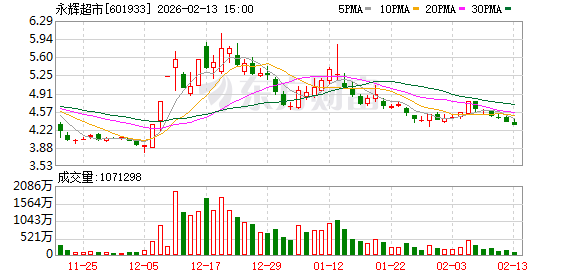
永辉超市:截至2025年12月31日,公司已完成315家门店的调改工作
Zheng Quan Ri Bao· 2026-02-13 10:12
Group 1 - The core point of the article is that Yonghui Supermarket has announced the completion of the renovation work for 315 stores by December 31, 2025 [2]
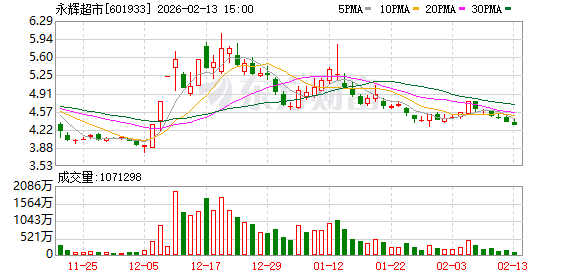
永辉超市:正在努力提供高质价比商品,夯实品质零售路线
Zheng Quan Ri Bao Wang· 2026-02-13 09:44
Group 1 - The company is focusing on providing high-quality and cost-effective products to strengthen its quality retail strategy [1]