
Kelida(603828)

Search documents
多只ST股拉响退市警报
Di Yi Cai Jing Zi Xun· 2026-02-03 04:32
Core Insights - The article discusses the performance of ST stocks in the Chinese capital market, highlighting a significant number of companies facing delisting risks due to poor financial results [2][3]. Group 1: Performance of ST Stocks - As of February 2, 178 ST stocks were under risk warnings, with 176 having released earnings forecasts, indicating a trend of companies struggling to meet performance expectations [2][3]. - Only 24% of ST stocks reported improved performance, with 118 continuing to incur losses, while 93 stocks under delisting risk showed that 58 were expected to continue losing money [3][4]. Group 2: Major Losses and Financial Indicators - ST晨鸣 (000488.SZ) is projected to incur the largest loss, estimated between 8.2 billion to 8.8 billion yuan, marking its third consecutive year of losses totaling 16.9 billion yuan [3][4]. - ST柯利达 (603828.SH) anticipates a net loss of 160 million to 200 million yuan, a drastic decline of 1964.13% to 2430.16% compared to the previous year [4]. Group 3: Delisting Risks - Companies like *ST岩石 and *ST精伦 are at risk of delisting due to failing to meet financial criteria, with *ST岩石 expected to have an operating income below 300 million yuan [5][6]. - Several ST stocks are likely to receive non-standard audit opinions, which could further jeopardize their listing status, such as *ST观典 and *ST太和 [5][6]. Group 4: Recovery Efforts - Some ST stocks are attempting to turn around their fortunes through restructuring and asset sales, with *ST金科 (000656.SZ) projecting a net profit of 30 billion to 35 billion yuan for 2025 after a significant debt restructuring [7][8]. - *ST松发 is also expected to achieve a net profit of 2.4 billion to 2.7 billion yuan, following a major asset restructuring that shifted its business focus [8][9].






多只ST股拉响退市警报
第一财经· 2026-02-03 04:23
Core Viewpoint - The article discusses the performance of risk warning stocks in the market, highlighting that a significant number of these stocks are facing delisting risks due to poor financial results and the implementation of stricter delisting regulations [3][5]. Group 1: Performance of Risk Warning Stocks - As of February 2, 2026, out of 178 risk warning stocks, 176 have released performance forecasts, with only 24% of ST stocks showing positive performance [4][7]. - Among the 93 stocks under delisting risk, 58 are expected to continue losing money, accounting for 69% of the group [7]. - ST晨鸣 (000488.SZ) is projected to incur a loss of between 8.2 billion to 8.8 billion yuan, marking its third consecutive year of losses totaling 16.9 billion yuan [7][8]. Group 2: Companies Facing Delisting Risks - Companies like *ST岩石 and *ST精伦 are expected to report negative net profits and insufficient revenue, leading to potential delisting [10]. - Some companies are already facing non-standard audit opinions, indicating further risks of delisting, such as *ST观典 and *ST太和 [11]. Group 3: Companies on the Path to Recovery - Certain ST stocks are attempting to turn around their fortunes through restructuring and asset sales, such as *ST金科, which is expected to report a net profit of 30 billion to 35 billion yuan after a successful restructuring [13]. - *ST松发 is projected to achieve a net profit of 2.4 billion to 2.7 billion yuan, following a significant asset restructuring that shifted its business focus [14].

ST股极限狂奔:业绩预告现原形 退市锁定与惊天逆转同台上演
Di Yi Cai Jing· 2026-02-03 03:09
Core Insights - The article highlights the significant number of companies facing delisting risks due to poor financial performance, with only 24% of ST stocks showing positive results [1][2] - A total of 178 ST stocks were analyzed, with 118 continuing to incur losses, indicating a concerning trend in the market [2][3] Group 1: Financial Performance of ST Stocks - Among the 178 ST stocks, 118 reported continued losses, while only 33 managed to turn a profit, and 12 reported first-time losses [2] - The largest projected loss comes from ST Chenming, with an estimated loss of 8.2 billion to 8.8 billion yuan, marking its third consecutive year of losses totaling 16.9 billion yuan [2][3] - ST Keli Da expects a net loss of 160 million to 200 million yuan for 2025, a drastic decline of 1964.13% to 2430.16% compared to the previous year [3] Group 2: Delisting Risks - Several companies, including ST Yanshi and ST Jinglun, have triggered financial delisting indicators, with ST Yanshi expected to have an operating income below 300 million yuan for 2025 [4] - ST Jinglun anticipates a negative net profit for 2025, with its stock facing potential delisting risks due to financial performance [4][5] - Audit firms have indicated that some ST stocks may receive non-standard audit opinions, further increasing delisting risks [4] Group 3: Recovery Efforts - Some ST stocks are attempting to recover through restructuring and asset sales, with ST Jinke projecting a turnaround with a net profit of 30 billion to 35 billion yuan for 2025 after completing a restructuring plan [6] - ST Songfa expects a net profit of 2.4 billion to 2.7 billion yuan for 2025, following a significant asset restructuring that shifted its business focus [6][7] - ST Weir has also seen positive impacts on its performance through strategic asset acquisitions and divestitures, projecting a net profit of 19 million to 22 million yuan [7]


ST柯利达(603828) - 柯利达关于公司股票触及其他风险警示相关事项的进展公告
2026-01-30 12:03
证券代码:603828 证券简称:ST 柯利达 公告编号:2026-009 苏州柯利达装饰股份有限公司 公司 2023 年度内部控制被出具否定意见审计报告,根据《上海证券交易 所股票上市规则》第 9.8.1 条规定,公司股票于 2024 年 5 月 6 日起被实施其他风 险警示。公司 2024 年度内部控制被出具否定意见审计报告,公司被继续实施其 他风险警示。 根据《上海证券交易所股票上市规则》第 9.8.5 条:"上市公司股票因 9.8.1 条第(二)项至第(五)项规定情形被实施其他风险警示的,在被实施其他风险 警示期间,公司应当至少每月发布 1 次提示性公告,分阶段披露涉及事项的解决 进展情况"。公司将每月披露一次其他风险警示相关事项的进展情况,提示相关 风险。 一、关于公司被实施其他风险警示的基本情况 因2023年度容诚会计师事务所(特殊普通合伙)出具了否定意见的《内部控 制审计报告》,触及《上海证券交易所股票上市规则》第9.8.1条第(三)项规定 的"最近一个会计年度内部控制被出具无法表示意见或否定意见审计报告,或未 按照规定披露内部控制审计报告"的情形,苏州柯利达装饰股份有限公司(以下 简称 "公司 ...

ST柯利达(603828) - 柯利达关于第二期员工持股计划存续期即将届满的提示性公告
2026-01-30 12:00
证券代码:603828 证券简称:ST 柯利达 公告编号:2026-008 苏州柯利达装饰股份有限公司 关于第二期员工持股计划存续期即将届满 的提示性公告 根据中国证监会《关于上市公司实施员工持股计划试点的指导意见(2025 年修订)》及《上海证券交易所上市公司自律监管指引第 1 号——规范运作(2025 年 5 月修订)》等规定,上市公司应当在员工持股计划届满前 6 个月公告到期计 划持有的股票数量以及占公司股本总额的比例,现将相关情况公告如下: 一、公司第二期员工持股计划基本情况 1、公司第二期员工持股计划的存续期为24个月,自本员工持股计划草案经 公司股东大会审议通过且公司公告最后一笔标的股票过户至本员工持股计划名 下之日起计算(即2019年8月2日起算)。 2、2019年7月30日,公司回购专用证券账户所持有的7,026,870股公司股票 全部非交易过户至公司第二期员工持股计划,过户价格为8.610元/股(四舍五入 保留三位小数)。根据《苏州柯利达装饰股份有限公司第二期员工持股计划》, 本次员工持股计划所获标的股票的锁定期为12个月,自公司公告最后一笔标的股 票过户至本员工持股计划名下之日起计算(即2 ...
柯利达(603828) - 2025 Q4 - 年度业绩预告
2026-01-30 12:00
Financial Performance Expectations - The company expects a net profit attributable to shareholders of the parent company for 2025 to be between -160 million and -200 million yuan, indicating an increase in losses compared to the previous year by 169 million to 209 million yuan [2][4]. - The projected net profit attributable to shareholders of the parent company, after deducting non-recurring gains and losses, is expected to be between -240 million and -310 million yuan [2][4]. - In the previous year, the total profit was 11.269 million yuan, with a net profit attributable to shareholders of the parent company of 8.5831 million yuan, and a net profit of -35.715 million yuan after deducting non-recurring gains and losses [5]. - The company reported a basic earnings per share of 0.01 yuan in the previous year [6]. Reasons for Expected Loss - The main reasons for the expected loss include significant downward pressure in the domestic construction industry due to a weak macroeconomic environment and intensified market competition, leading to reduced operating income and further decline in project gross margins [7]. - The company has proactively reduced its market scope and focused on the local market, resulting in a decrease in construction volume [7]. - There has been an increase in the impairment provision for receivables, leading to higher impairment losses on receivables during the reporting period [8]. Forecast Accuracy and Data - As of the announcement date, there are no significant uncertainties affecting the accuracy of this earnings forecast [9]. - The forecast data is preliminary and subject to final audited financial data to be disclosed in the 2025 annual report [10].
ST柯利达:2025年全年预计净亏损16000万元—20000万元
2 1 Shi Ji Jing Ji Bao Dao· 2026-01-30 11:50
Core Viewpoint - ST Keli Da has announced a projected net loss for the fiscal year 2025, estimating a loss between 160 million to 200 million yuan due to significant downward pressure in the domestic construction industry and intensified market competition [1] Group 1: Company Performance - The company expects to report a net profit attributable to the parent company in the range of -160 million to -200 million yuan for the year 2025 [1] - Revenue is anticipated to decline as the company reduces its market scope and focuses on local markets, resulting in a decrease in the volume of ongoing projects [1] - The increase in market competition has led to a further decline in project gross margins [1] Group 2: Industry Context - The domestic construction industry is experiencing significant downward pressure due to a weak macroeconomic environment and tightening market conditions [1] - The competition within the market is becoming increasingly fierce, impacting overall profitability for companies in the sector [1] - The company has increased its provisions for impairment losses on receivables, indicating a rise in the risk associated with outstanding payments [1]
装修装饰板块1月29日跌0.99%,ST柯利达领跌,主力资金净流出1.36亿元
Zheng Xing Xing Ye Ri Bao· 2026-01-29 09:03
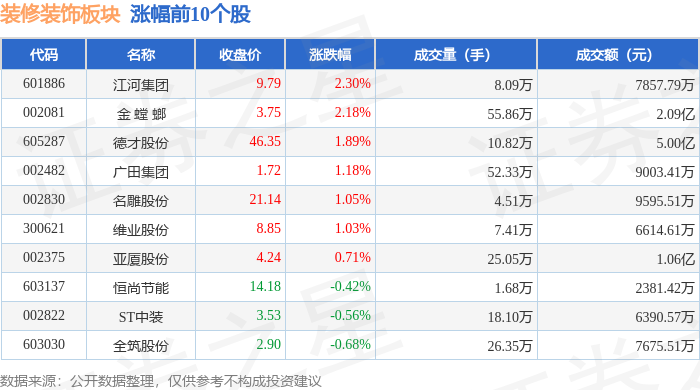
Group 1 - The decoration and renovation sector experienced a decline of 0.99% on January 29, with ST Keli Da leading the drop [1] - The Shanghai Composite Index closed at 4157.98, up 0.16%, while the Shenzhen Component Index closed at 14300.08, down 0.3% [1] - Key stocks in the decoration sector showed varied performance, with Jianghe Group rising by 2.30% and ST Keli Da falling by 5.03% [1][2] Group 2 - The decoration sector saw a net outflow of 136 million yuan from major funds, while retail investors contributed a net inflow of 134 million yuan [2] - Major funds showed a net inflow in stocks like Jin Tangle and Yasha Group, while ST Keli Da and ST Ruida experienced significant net outflows [3] - The trading volume and turnover for various stocks in the sector varied, with Jinbi Group achieving a turnover of 209 million yuan [1][2]


上海智元航智能终端有限公司成立,注册资本1000万人民币
Sou Hu Cai Jing· 2026-01-28 11:03
天眼查显示,近日,上海智元航智能终端有限公司成立,法定代表人为何利民,注册资本1000万人民 币,由苏州柯利达装饰股份有限公司全资持股。 序号股东名称持股比例1苏州柯利达装饰股份有限公司100% 经营范围含移动终端设备销售;计算机软硬件及外围设备制造;电子产品销售;计算机软硬件及辅助设 备批发;计算机软硬件及辅助设备零售;通信设备销售;货物进出口;技术进出口;集成电路销售;集 成电路芯片及产品销售;半导体器件专用设备销售;计算机及通讯设备租赁;互联网销售(除销售需要 许可的商品);市场营销策划;软件开发;信息系统集成服务;信息技术咨询服务;计算机系统服务; 数字技术服务;技术服务、技术开发、技术咨询、技术交流、技术转让、技术推广;信息系统运行维护 服务;云计算装备技术服务。(除依法须经批准的项目外,凭营业执照依法自主开展经营活动) 企业名称上海智元航智能终端有限公司法定代表人何利民注册资本1000万人民币国标行业制造业>计算 机、通信和其他电子设备制造业>电子器件制造地址上海市松江区新桥镇新格路9556号企业类型有限责 任公司(自然人投资或控股的法人独资)营业期限2026-1-27至无固定期限登记机关松江分局 ...
ST柯利达成立智能终端公司,含集成电路业务
Qi Cha Cha· 2026-01-28 07:06
Core Viewpoint - ST Keli Da has established a new company, Shanghai Zhiyuanhang Intelligent Terminal Co., Ltd., focusing on integrated circuit and semiconductor device sales [1] Group 1 - The newly formed company has a registered capital of 10 million yuan [1] - The business scope includes sales of integrated circuits, integrated circuit chips and products, semiconductor device specialized equipment sales, and leasing of computer and communication equipment [1] - ST Keli Da holds 100% ownership of Shanghai Zhiyuanhang Intelligent Terminal Co., Ltd. [1]