
产业整合

Search documents
李嘉诚的石油帝国:布局40年,日产百万桶
投中网· 2026-03-26 07:10AI Processing
以下文章来源于邱处机 ,作者邱鑫浩 邱处机 . 抄底加拿大 专门研究商业牛人 将投中网设为"星标⭐",第一时间收获最新推送 李嘉诚家族的石油帝国,已相当于一个中等产油国的体量。 作者丨 邱鑫浩 来源丨 邱处机 2026年3月,香港。长和系业绩发布会现场,闪光灯连成一片。 当长和系掌舵人李泽钜说出"我们的石油日产量已接近100万桶"时,台下不少分析师下意识地翻了一页报表——这个数字,高于部分石油输出国组织成 员国的全国产量。 很少有人注意到,这句话背后,是一盘跨越40年的棋局。 从1986年那个油价跌至每桶11美元的冬天,到2025年Cenovus吞下MEG Energy的最后一刻,李嘉诚家族的石油帝国版图,终于浮出水面。 1986年,国际油价崩盘,每桶仅11美元。西方石油公司哀鸿遍野,纷纷抛售资产。 李嘉诚出手了。这年12月,他通过和记黄埔斥资32亿港元,收购了加拿大老牌石油公司赫斯基能源52%的股权。 彼时的赫斯基,拥有5000余口石油及天然气生产井的开采权,还持有重油精炼厂26.67%的股权以及343间汽油站。 但这笔交易在当时并不被看好。油价暴跌、能源行业前景黯淡,很多人认为李嘉诚"抄底抄在了半山腰"。 ...



上海,落地了全国首只 AIC 产业并购基金
母基金研究中心· 2026-03-24 09:18
Group 1 - The first AIC industrial merger fund in China was launched in Shanghai with an initial fundraising scale of 5.702 billion yuan, focusing on key areas of integrated circuit equipment to support industrial mergers and resource integration [2] - The establishment of the AIC industrial merger fund signifies a shift from financial investor to industrial organizer, indicating a more diversified approach to participating in the primary market [2] - The investment logic has evolved from single project focus to cluster-based layouts around industrial chain maps, enhancing the full-cycle service capability of fundraising, investment, management, exit, and nurturing [2] Group 2 - Shanghai is actively developing its merger ecosystem, with government initiatives including a 100 billion yuan integrated circuit design merger fund and a 100 billion yuan biopharmaceutical merger fund to attract market-oriented merger fund managers [3] - The Shanghai municipal government has initiated a 500 billion yuan industrial transformation upgrade fund, targeting new-generation electronic information, high-end equipment, and other key industries [4] - The establishment of a national-level merger fund is expected to mobilize over 1 trillion yuan in various funds, marking a strategic shift towards market-driven mergers and industry integration [5][6] Group 3 - The current landscape of China's merger funds presents a historic structural development opportunity, driven by the need for industry consolidation and the emergence of new integration models [6][7] - The development of merger funds is seen as a solution to the "exit difficulty" faced by private equity investments, with only 7% of exits in 2024 occurring through mergers compared to more mature markets [7] - The active participation of private equity funds in mergers is increasing, with a 22.88% year-on-year growth in transaction value involving private equity funds [8] Group 4 - The establishment of a national-level merger fund is viewed as a milestone, signaling a new development paradigm that integrates national strategic capital with market-driven operations to enhance industrial competitiveness [9] - The focus on deep integration and upgrading of industries aims to foster globally competitive industry leaders in key sectors such as integrated circuits, biomedicine, and artificial intelligence [9]

东莞A股上市公司市值站上8000亿元,不再只拼上市数量
Sou Hu Cai Jing· 2026-02-28 02:24
Core Viewpoint - Dongguan is launching the 2.0 version of the "Kunpeng Plan" to enhance local enterprises' growth, listing, and development through a comprehensive "1133" service system, marking a strategic adjustment in capital policy [1][5]. Group 1: Overview of the "Kunpeng Plan" - The 2.0 version emphasizes "capital empowering the entire lifecycle of enterprises," integrating listing services into a more complete industrial ecosystem [6]. - The previous 1.0 version focused on increasing the number of listings, while 2.0 shifts the focus to supporting enterprises in becoming stronger and more competitive [6][9]. - Dongguan has seen rapid growth in its listed companies, with a total of 87 companies, including 64 on A-shares, and a market capitalization increase from approximately 300 billion to over 800 billion [1]. Group 2: Key Features of the "1133" Service System - The "1133" system includes the establishment of one listing task force, one listing service base, optimization of three service mechanisms, and implementation of three major support plans [7]. - The three major support plans address critical issues for enterprises: land assurance, capital empowerment, and collaborative advancement [8]. - The plan aims to allocate at least 2,000 acres of land annually and exempt listed companies from economic benefit reviews for fundraising projects [8]. Group 3: Strategic Focus and Future Goals - The 2.0 plan aims to resolve quality and retention issues rather than just quantity, viewing listing as a starting point for industrial upgrading and resource integration [9][10]. - Dongguan's capital market is integrated into the overall planning of its "8+8+4" modern industrial system, with a focus on strategic emerging industries and future industries [9][10]. - The goal is to increase the number of listed companies to over 100 and market capitalization to reach one trillion by the future [12].
从放量到深化:2026年中国并购市场九个关键趋势
投中网· 2026-02-26 06:27
Group 1 - The core viewpoint of the article is that after a significant increase in control transactions, China's M&A market is entering a new observation window, with a shift from mere volume to deeper industry integration and collaboration [2][4][25] - In 2025, the number of control transactions among A-share listed companies reached 141, which is 2.5 times that of 2024, indicating a notable increase in market activity [4] - The driving force behind the current wave of M&A is shifting from "expansion demands" to "survival instincts," as many companies face pressure to reassess their assets through strategic partnerships or control transfers [4][5] Group 2 - The M&A financing environment is expected to become more flexible and abundant in 2026, with historical low interest rates and favorable RMB exchange rate expectations providing competitive advantages for domestic M&A financing [6][7] - The introduction of new regulations, such as the revised "Commercial Bank M&A Loan Management Measures," is expected to support a more robust M&A ecosystem, potentially marking 2026 as the year of China's version of leveraged buyouts (LBOs) [7] Group 3 - Control transactions are anticipated to exhibit a pattern of high activity followed by a decline, with the first half of 2026 maintaining high levels of activity while the second half may see a decrease in new supply [8][9] - The proportion of terminated or obstructed M&A transactions is expected to rise, influenced by factors such as mismatched transaction structures and regulatory requirements [10][11] Group 4 - Large-scale transactions are predicted to reshape industry dynamics, with potential billion-level mergers that could set precedents for future integration waves [12][13] - The emergence of diverse capital forms, including corporate venture capital and local government-led funds, is blurring traditional boundaries and enhancing the integration of capital and industry [14][15][16] Group 5 - Regulatory emphasis is shifting towards the effectiveness of industry integration rather than just the reasonableness of transaction prices, signaling a focus on genuine value creation [17][18] - Chinese buyers are expected to find opportunities in overseas markets, particularly in Southeast Asia, the Middle East, and Africa, as they navigate structural adjustments in global supply chains [19][20] Group 6 - The M&A market is entering a phase of deep differentiation, where the ability to secure assets, complete integrations, and achieve long-term returns will be critical [21][22] - The article emphasizes that M&A is not merely about completing transactions but about fostering real industry value creation through effective integration and resource reallocation [23][26]

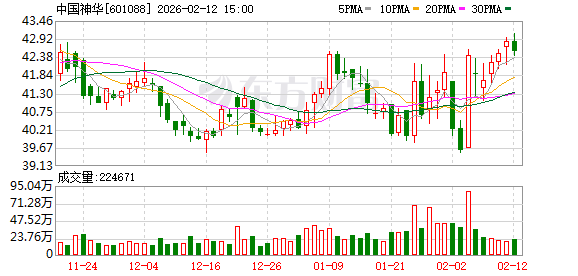
仅12天!中国神华千亿级收购火速获批
Shang Hai Zheng Quan Bao· 2026-02-12 13:28
Group 1 - China Shenhua Energy Co., Ltd. has received approval from the China Securities Regulatory Commission for the acquisition of equity in 12 core enterprises under its controlling shareholder, China Energy Group, for a total consideration of 133.598 billion yuan [2] - This transaction is notable as it is the first A-share merger and acquisition project to apply the simplified review process, marking the largest scale issuance of shares for asset purchases in the A-share market [5][6] - The acquisition involves a payment structure of 30% in shares and 70% in cash, with the cash payment amounting to approximately 93.519 billion yuan and the share issuance price set at 29.40 yuan per share [6][7] Group 2 - Post-restructuring, China Shenhua's coal reserves will increase to 68.49 billion tons, with recoverable coal reserves rising to 34.5 billion tons and annual production capacity increasing to 512 million tons [8] - The restructuring will enhance the company's asset scale and profitability, with total assets expected to increase by over 200 billion yuan, and will create a more efficient logistics network to minimize costs and improve supply stability [8][9] - The merger is expected to facilitate a transition towards a greener and smarter coal industry, enhancing the stability of supply and the level of clean conversion in coal mining and related sectors [9]

华虹公司股东大会通过收购华力微议案
Zheng Quan Ri Bao Zhi Sheng· 2026-02-11 05:37
Core Viewpoint - Huahong Semiconductor Co., Ltd. is making significant progress in acquiring a controlling stake in Shanghai Huahong Microelectronics Co., Ltd., as evidenced by the approval of 26 proposals at its first extraordinary shareholders' meeting in 2026, which is a key step in addressing industry competition and fulfilling its listing commitments [1][2]. Group 1 - The transaction aims to achieve deep synergy and complementarity between Huahong and Huahong Micro, leveraging Huahong Micro's over 15 years of semiconductor manufacturing technology and its operation of China's first fully automated 12-inch integrated circuit foundry with a monthly design capacity of 38,000 wafers [2]. - The integration is expected to expand Huahong's 12-inch capacity, enabling it to better meet diverse customer demands and seize future market growth opportunities [2]. - The collaboration is anticipated to generate synergies in process optimization, yield improvement, and device structure innovation, enhancing the companies' technological innovation and core competitiveness [2]. Group 2 - Huahong Micro is projected to achieve nearly 5 billion yuan in revenue and over 500 million yuan in net profit for the fiscal year 2024, which will likely enhance Huahong's revenue base, reduce operational costs, and cultivate new profit growth points post-transaction [2]. - More than 50% of the funds raised in this transaction will be allocated directly to Huahong Micro for technology upgrades, specialized process research and development, and industrialization, which will significantly support its technological iteration and competitiveness enhancement [2].
主导权交接之后:2025汽车产业的核心命题与答案
Xin Lang Cai Jing· 2026-02-04 01:13
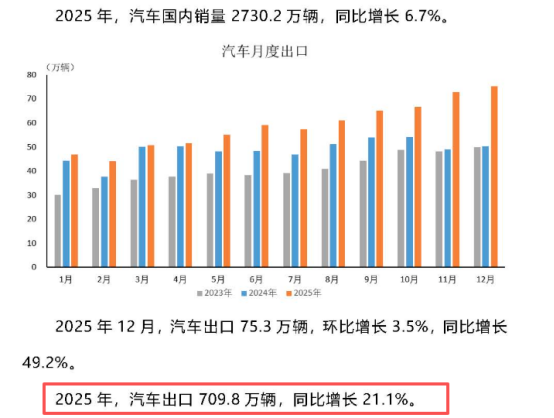
Group 1 - The core point of the article is that the Chinese automotive industry underwent significant transformation in 2025, marked by the integration of electrification and intelligence, leading to a restructured global competitive landscape [2][3][40] - The penetration rate of new energy vehicles (NEVs) in China surpassed 50% for the first time, indicating a shift from optional to mainstream status, driven by policy support, corporate efforts, and consumer acceptance [4][41] - The automotive export volume reached 7.098 million units in 2025, a year-on-year increase of 21.1%, reflecting a structural change in the export market towards higher-end models and a focus on established markets like Europe [7][44] Group 2 - The issuance of L3 autonomous driving licenses marked a transition from technical demonstrations to commercial availability, indicating that L3 technology is now accessible to consumers [10][49] - The establishment of the new Changan Automobile Group represents a significant milestone in the Chinese automotive industry's evolution, aimed at enhancing global competitiveness and driving high-quality development [12][52] - The trend of internal restructuring among automotive companies signifies a shift from expansion to efficiency, focusing on resource optimization and reducing redundancy in operations [14][55] Group 3 - The rapid growth of the six-seat SUV market in 2025, with monthly sales increasing from 25,000 to nearly 100,000 units, reflects changing family travel needs in China [22][68] - The decline of the range-extended electric vehicle (EREV) market, with a cumulative sales growth of only 10.2% compared to 34.2% for battery electric vehicles (BEVs), indicates a clear shift towards pure electric vehicles as the dominant technology [30][75] - The introduction of new battery safety standards emphasizes the importance of safety in the development of new energy vehicles, marking a maturation of the industry [21][65][66]
解码“工业航母”广州工控集团的千亿级产业资本版图
2 1 Shi Ji Jing Ji Bao Dao· 2026-01-23 05:15
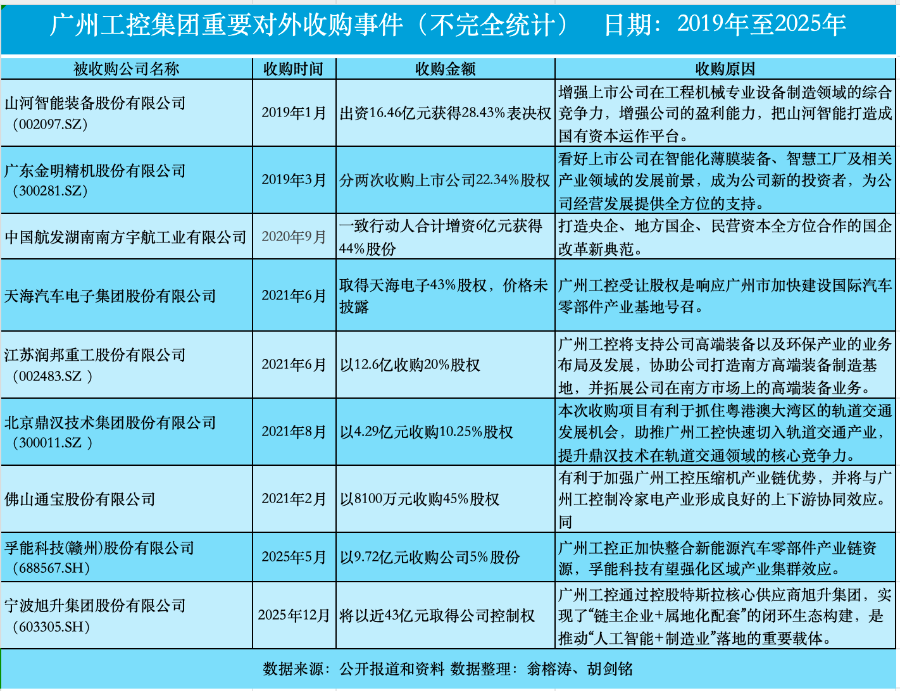
Core Viewpoint - Guangzhou Industrial Investment Holding Group Co., Ltd. (Guangzhou Gongkong Group) has announced its operational targets for 2025, projecting a year-on-year revenue growth of 14%, industrial output growth of 13%, and export growth of 12% [1] Group Summary - In 2024, Guangzhou Gongkong Group achieved a revenue of 123.82 billion yuan and a net profit of 1.51 billion yuan, indicating that the company is expected to exceed 140 billion yuan in revenue for 2025 [1] - The company has been actively expanding its industrial scale through mergers and acquisitions, extending its investment footprint from Guangdong to other provinces such as Zhejiang, Jiangsu, Jiangxi, Hunan, and Henan [1][2] - Guangzhou Gongkong Group has been listed on the Fortune Global 500 for three consecutive years, with its ranking continuously improving [1] Acquisition Strategy - Since its reorganization in 2019, Guangzhou Gongkong Group has undergone two main phases: the initial integration phase and the strategic expansion phase, becoming a significant player in local state-owned capital operations in China [2] - The company has acquired several listed subsidiaries, including Shanhe Intelligent (002097.SZ), Runbang Shares (002483.SZ), and Funeng Technology (688567.SH), covering various sectors such as equipment manufacturing, automotive parts, building materials, and home appliances [2] Financial Performance - The company reported steady growth in asset scale and revenue, with revenues of 111.2 billion yuan, 121.7 billion yuan, and 123.82 billion yuan from 2022 to 2024, while net profits were 1.74 billion yuan, 2.06 billion yuan, and 1.51 billion yuan during the same period [14] - In the first half of 2025, the company recorded a revenue of 61.98 billion yuan, an 8% year-on-year increase, but net profit decreased by nearly 20% to 999 million yuan [15] CVC Investment Platform - Guangzhou Gongkong Group's CVC investment platform, Gongkong Capital, has a management scale exceeding 20 billion yuan and focuses on industrial capital, mergers and acquisitions, industrial funds, and investments [10][11] - The platform has been involved in various strategic investments, with a total of 14 funds managed, primarily targeting sectors such as new energy, high-end equipment manufacturing, and artificial intelligence [11][12] Market Position and Future Goals - The company aims to have 10-15 listed companies by 2025, striving to become a world-class industrial investment group [6] - The acquisition strategy is characterized by high premium purchases, with some transactions exceeding a 30% premium, reflecting the company's commitment to industry consolidation and the cultivation of emerging industries [9]
索尼委身TCL,日企时代终落幕了
阿尔法工场研究院· 2026-01-23 04:09
Core Viewpoint - The collaboration between Sony and TCL marks a significant shift in the consumer electronics industry, highlighting the transition from traditional Japanese brands to Chinese manufacturers as key players in the market [5][24]. Group 1: Sony and TCL Collaboration - TCL announced a memorandum of understanding with Sony to establish a joint venture for Sony's home entertainment business, with TCL holding 51% and Sony 49% of the shares [5][7]. - The joint venture will focus on an integrated model for operating television and home audio businesses globally, indicating a shift in control from Sony to TCL [7][22]. - This partnership aims to combine Sony's high-quality audio-visual technology and brand value with TCL's advanced display technology and cost efficiency [20][22]. Group 2: Historical Context of Sony - Sony was once a dominant player in the television market, with its Trinitron technology setting the standard for picture quality in the 1980s and 1990s [9][10]. - The company enjoyed a long period of brand loyalty in China, despite higher prices compared to local brands [12]. - However, the rise of Chinese brands like TCL and Hisense, which offered lower prices and competitive technology, began to erode Sony's market share starting in the early 2000s [12][17]. Group 3: Challenges Faced by Sony - Sony's television business has faced significant challenges, including complaints about product reliability and a decline in brand trust among consumers [17]. - By 2025, Sony's television shipments had dropped to 2.6 million units, ranking it tenth in the market, far behind Chinese competitors [22][24]. - The company has been shifting its focus away from hardware to more profitable sectors like gaming, music, and image sensors, indicating a strategic realignment [24]. Group 4: Rise of Chinese Brands - Chinese brands have transitioned from being price competitors to leaders in technological innovation, with TCL and Hisense achieving significant market shares globally [31][33]. - By 2025, TCL's global television shipments reached 20.8 million units, marking a 4.1% increase year-on-year, while Hisense led the Chinese market in shipments [31][33]. - The collaboration between Sony and TCL symbolizes a broader trend of power shifting in the consumer electronics industry, with Chinese companies increasingly defining market standards [22][24].

买方锁定期5年、高自有资金门槛,上市公司控制权转让现新变化
Di Yi Cai Jing· 2026-01-22 12:00
Core Viewpoint - Recent changes in control rights transfer of listed companies aim to address past issues such as short-term speculation, leverage risks, and interest encroachment, promoting a more structured and responsible acquisition environment [1][7][8] Group 1: Changes in Control Rights Transfer - The transfer of control rights has seen a significant increase, with new practices emerging, such as the relinquishment of voting rights by original shareholders and extended lock-up periods for both old and new shareholders [1][3] - Companies like ST Keli Da and Tian Chuang Fashion have implemented commitments for a 60-month lock-up period and a 36-month prohibition on share pledging, with a requirement that at least 50% of the acquisition funds come from the acquirer's own capital [4][5] Group 2: Market Implications - Analysts suggest that these changes are designed to prevent market chaos and ensure that only capable and genuine buyers acquire control of listed companies, thereby restructuring the evaluation standards and transaction designs in the control rights market [2][6] - The new regulations are expected to lead to a more competitive environment where long-term capital with industrial backgrounds, state-owned platforms, and private equity funds will dominate the acquisition landscape [2][7] Group 3: Regulatory and Governance Aspects - The recent regulatory proposals indicate a shift away from allowing voting rights to be delegated, which could eliminate the practice of control rights transfer through voting rights delegation [5][8] - The emphasis on governance responsibility over mere control rights signifies a transition towards valuing long-term shareholder interests and corporate governance, moving away from speculative trading practices [7][8]
