
TRANSSION(688036)

Search documents
中国制造业500强榜单发布,23家深企上榜
2 1 Shi Ji Jing Ji Bao Dao· 2025-09-21 07:49
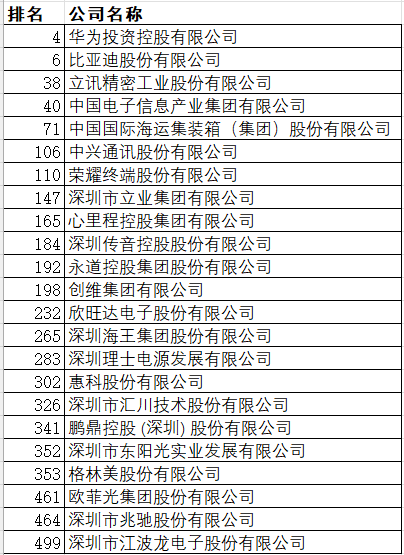
Core Insights - The "2025 China Manufacturing Enterprises Top 500" list was released, highlighting Shenzhen's strength with 23 companies listed, showcasing its status as the "Industrial First City" [1][5] - Huawei and BYD ranked 4th and 6th respectively, with revenues of 862.1 billion and 777.1 billion yuan, indicating strong performance among leading companies [2][3] Company Performance - Shenzhen's top companies include Huawei, BYD, Luxshare Precision, China Electronics Corporation, and ZTE, among others, reflecting a diverse industrial base [2][5] - The overall revenue scale of the top 500 companies remains stable, with R&D investment as a growing focus, reaching a research intensity of 2.45%, up by 0.03 percentage points from the previous year [2][3] R&D and Innovation - Shenzhen companies are characterized by high R&D intensity, with five out of the top ten companies in R&D intensity being from Shenzhen, led by Huawei at 20.84% [3] - The emphasis on R&D is evident as these companies continue to invest significantly in innovation, contributing to their competitive edge [3][5] Global Expansion - Shenzhen companies are increasingly expanding internationally, with notable mentions of Transsion Holdings, Pegatron, and Jiangbolong Electronics, which have high overseas revenue ratios [3] - Transsion Holdings leads with 99.73% of its revenue from overseas markets, particularly in Africa and Southeast Asia, indicating successful global strategies [3] Industry Landscape - The listed Shenzhen companies span multiple strategic industries, including electronics, new energy, high-end equipment manufacturing, and smart terminals, creating a collaborative industrial ecosystem [5] - Shenzhen's commitment to high-end, intelligent, and green manufacturing continues to drive its industrial development, supporting the overall growth of China's manufacturing sector [5]






传音控股(688036) - 传音控股关于召开2025年半年度业绩说明会的公告
2025-09-19 08:00
证券代码:688036 证券简称:传音控股 公告编号:2025-032 深圳传音控股股份有限公司 关于召开 2025 年半年度业绩说明会的公告 本公司董事会及全体董事保证本公告内容不存在任何虚假记载、误导性陈述 或者重大遗漏,并对其内容的真实性、准确性和完整性依法承担法律责任。 重要内容提示: 投资者可于 2025 年 09 月 23 日(星期二)至 09 月 29 日(星期一)16:00 前登 录 上 证 路 演 中 心 网 站 首 页 点 击 " 提 问 预 征 集 " 栏 目 或 通 过 公 司 邮 箱 investor@transsion.com 进行提问。公司将在业绩说明会上对投资者普遍关注的问 题进行回答。 深圳传音控股股份有限公司(以下简称"公司")已于 2025 年 8 月 28 日在 上海证券交易所网站披露了公司《2025 年半年度报告》及其摘要,为便于广大 投资者更全面深入地了解公司经营成果、财务状况等,公司计划于 2025 年 09 月 30 日(星期二)15:00-16:00 举行 2025 年半年度业绩说明会,就投资者关心 的问题进行交流。 一、 说明会类型 本次业绩说明会以网络互动 ...
传音控股涨2.02%,成交额3.27亿元,主力资金净流入3075.39万元
Xin Lang Cai Jing· 2025-09-19 02:11
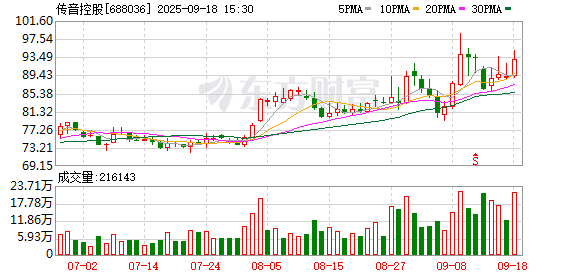
Core Viewpoint - Transsion Holdings has shown a positive stock performance recently, with a notable increase in share price and trading volume, despite a decline in revenue and net profit for the first half of 2025 [1][2]. Group 1: Stock Performance - On September 19, Transsion Holdings' stock rose by 2.02%, reaching 94.88 CNY per share, with a trading volume of 327 million CNY and a turnover rate of 0.31%, resulting in a total market capitalization of 108.196 billion CNY [1]. - Year-to-date, the stock price has increased by 2.35%, with a 9.87% rise over the last five trading days, a 14.26% increase over the last 20 days, and a 21.67% increase over the last 60 days [1]. Group 2: Financial Performance - For the first half of 2025, Transsion Holdings reported a revenue of 29.077 billion CNY, representing a year-on-year decrease of 15.86%, and a net profit attributable to shareholders of 1.213 billion CNY, down 57.48% year-on-year [2]. - Since its A-share listing, the company has distributed a total of 13.230 billion CNY in dividends, with 10.620 billion CNY distributed over the past three years [3]. Group 3: Shareholder Information - As of June 30, 2025, the number of shareholders for Transsion Holdings was 22,500, a decrease of 3.60% from the previous period, with an average of 50,756 shares held per shareholder, an increase of 3.74% [2]. - Among the top ten circulating shareholders, Hong Kong Central Clearing Limited holds 32.1805 million shares, an increase of 2.2557 million shares compared to the previous period [3].
科创50ETF增强(588450)开盘跌0.17%,重仓股中芯国际涨0.70%,海光信息涨1.71%
Xin Lang Cai Jing· 2025-09-19 01:41
Core Viewpoint - The article discusses the performance of the Kexin 50 ETF Enhanced (588450) on September 19, highlighting its opening price and the performance of its major holdings [1] Group 1: ETF Performance - Kexin 50 ETF Enhanced (588450) opened down 0.17% at 1.730 yuan [1] - Since its inception on May 6, 2024, the fund has achieved a return of 73.25% [1] - The fund's return over the past month is reported at 20.17% [1] Group 2: Major Holdings Performance - Major holdings include: - SMIC (中芯国际) up 0.70% [1] - Haiguang Information (海光信息) up 1.71% [1] - Lanke Technology (澜起科技) up 2.66% [1] - Zhongwei Company (中微公司) up 4.94% [1] - Kingsoft Office (金山办公) down 0.96% [1] - Cambrian (寒武纪) down 2.04% [1] - Transsion Holdings (传音控股) up 0.54% [1] - Zhongkong Technology (中控技术) down 0.31% [1] - Stone Technology (石头科技) unchanged [1] - United Imaging Healthcare (联影医疗) up 0.59% [1] Group 3: Management Information - The fund is managed by China Merchants Fund Management Co., Ltd. [1] - The fund manager is Deng Tong [1]





传音控股:关于调整2022年限制性股票激励计划限制性股票授予价格的公告
Zheng Quan Ri Bao· 2025-09-18 13:12
Core Points - The company announced an adjustment to the stock grant price in its 2022 restricted stock incentive plan, reducing the price from 30.1429 yuan per share to 26.3429 yuan per share [2] Summary by Category - **Company Announcement** - The company will hold its third board meeting and the fourteenth supervisory board meeting on September 18, 2025, to review the adjustment of the stock grant price [2] - The adjustment is in accordance with the relevant provisions of the company's 2022 restricted stock incentive plan draft [2] - **Stock Price Adjustment** - The grant price for both initial and reserved shares has been adjusted from 30.1429 yuan per share to 26.3429 yuan per share [2]
传音控股拟用不超5000万元闲置募集资金进行现金管理
Xin Lang Cai Jing· 2025-09-18 11:50
Group 1 - The company held its 18th board meeting and 14th supervisory board meeting on September 18, approving the proposal to use part of the temporarily idle raised funds for cash management [1] - The company raised a total of 281,200 million RMB by issuing 80 million shares at a price of 35.15 RMB per share, with a net amount of 267,465.61 million RMB after deducting issuance costs [2] - The cash management aims to improve the efficiency of fund usage without affecting the implementation of investment projects, thereby maximizing shareholder benefits [2] Group 2 - The company plans to use no more than 50 million RMB of temporarily idle raised funds for cash management, with the funds being allowed for cyclical use within a 12-month authorization period [2] - The company has implemented multiple risk control measures to ensure effective risk management while conducting cash management, including compliance with laws and regulations, timely analysis of product investments, and independent oversight by the supervisory board [3] - The supervisory board and the sponsor institution have agreed that the cash management is in compliance with relevant laws and regulations, beneficial for improving the efficiency of raised fund usage, and does not harm the interests of the company or minority shareholders [3]
传音控股:9月18日召开董事会会议
Mei Ri Jing Ji Xin Wen· 2025-09-18 11:04
Group 1 - The company, Transsion Holdings, announced that its 18th meeting of the third board of directors was held on September 18, 2025, combining in-person and remote participation [1] - The meeting reviewed the proposal regarding the use of part of the temporarily idle raised funds for cash management [1]
传音控股(688036) - 传音控股2022年限制性股票激励计划首次授予部分第二个归属期符合归属条件的公告
2025-09-18 11:02
证券代码:688036 证券简称:传音控股 公告编号:2025-026 深圳传音控股股份有限公司 2022 年限制性股票激励计划首次授予部分 第二个归属期符合归属条件的公告 本公司董事会及全体董事保证本公告内容不存在任何虚假记载、误导性陈述 或者重大遗漏,并对其内容的真实性、准确性和完整性依法承担法律责任。 重要内容提示: 一、本次股权激励计划批准及实施情况 (一)本次股权激励计划方案及履行的程序 (5)具体的归属安排如下: 1、本次股权激励计划主要内容 (1)股权激励方式:第二类限制性股票。 (2)授予数量:公司于 2022 年 9 月 13 日召开第二届董事会第十七次会议 与第二届监事会第十七次会议,审议通过了《关于调整 2022 年限制性股票激励 计划相关事项的议案》,对本次激励计划的首次授予激励对象名单和激励数量进 行调整。本次调整后,首次授予激励对象人数由 932 人调整为 926 人,首次授予 的限制性股票数量由 1,379.85 万股调整为 1,375.05 万股;激励总量由 1,722.85 万股调整为 1,718.05 万股。 2023 年 9 月 7 日,公司召开第二届董事会第二十五次会议 ...
传音控股(688036) - 传音控股关于作废部分已授予尚未归属的2022年限制性股票的公告
2025-09-18 11:02
深圳传音控股股份有限公司 证券代码:688036 证券简称:传音控股 公告编号:2025-028 关于作废部分已授予尚未归属的 2022 年限制性股票 的公告 本公司董事会及全体董事保证本公告内容不存在任何虚假记载、误导性陈 述或者重大遗漏,并对其内容的真实性、准确性和完整性依法承担法律责任。 深圳传音控股股份有限公司(以下简称"公司")于2025年9月18日召开第三 届董事会第十八次会议、第三届监事会第十四次会议,审议通过了《关于作废部分 已授予尚未归属的2022年限制性股票的议案》,现将相关事项公告如下: 一、公司股权激励计划已履行的程序 2、2022 年 9 月 1 日,公司监事会披露了《监事会关于公司 2022 年限制性 股票激励计划首次授予激励对象名单的审核意见及公示情况说明》。 3、2022 年 9 月 13 日,公司召开 2022 年第一次临时股东大会,审议并通过 了《关于公司<2022 年限制性股票激励计划(草案)>及其摘要的议案》、《关 于公司<2022 年限制性股票激励计划实施考核管理办法>的议案》、《关于提请 股东大会授权董事会办理股权激励相关事宜的议案》等议案。次日,公司于上海 证券交 ...
传音控股(688036) - 传音控股关于调整 2022年限制性股票激励计划限制性股票授予价格的公告
2025-09-18 11:02
证券代码:688036 证券简称:传音控股 公告编号:2025-025 本公司董事会及全体董事保证本公告内容不存在任何虚假记载、误导性陈述或者 重大遗漏,并对其内容的真实性、准确性和完整性依法承担法律责任。 深圳传音控股股份有限公司(以下简称 "公司")于2025年9月18日召开第三届董 事会第十八次会议、第三届监事会第十四次会议,审议通过了《关于调整2022年限 制性股票激励计划限制性股票授予价格的议案》,同意董事会根据公司《2022年限 制性股票激励计划(草案)》(以下简称"《激励计划》")的有关规定,对2022年限 制性股票激励计划限制性股票授予价格进行调整,授予价格(首次和预留)由30.1429 元/股调整为26.3429元/股。具体情况如下: 一、公司股权激励计划基本情况 1、2022 年 8 月 19 日,公司召开第二届董事会第十六次会议,审议通过了《关于 公司<2022 年限制性股票激励计划(草案)>及其摘要的议案》、《关于公司<2022 年 限制性股票激励计划实施考核管理办法>的议案》、《关于提请股东大会授权董事会 办理股权激励相关事宜的议案》等议案。公司独立董事就本激励计划相关议案发表了 独 ...