Qi An Xin Technology (688561)

Search documents
奇安信(688561) - 北京市金杜律师事务所关于奇安信科技集团股份有限公司2022年股票期权激励计划第三个行权期行权条件未成就及注销股票期权相关事项的法律意见书
2025-08-28 11:21
北京市朝阳区东三环中路1号 环球金融中心办公楼东楼18层 邮编:100020 北京市金杜律师事务所 关于奇安信科技集团股份有限公司 2022 年股票期权激励计划第三个行权期行权条件未成就 及注销股票期权相关事项的 法律意见书 致:奇安信科技集团股份有限公司 北京市金杜律师事务所(以下简称金杜、本所)接受奇安信科技集团股份有 限公司(以下简称公司或奇安信)委托,作为公司 2022 年股票期权激励计划(以 下简称本计划或本激励计划)的专项法律顾问,根据《中华人民共和国公司法》(以 下简称《公司法》)、《中华人民共和国证券法》(以下简称《证券法》)、中国证券 监督管理委员会(以下简称中国证监会)《上市公司股权激励管理办法》(以下简 称《管理办法》)、《上海证券交易所科创板股票上市规则》(以下简称《科创板股 票上市规则》)《科创板上市公司自律监管指南第 4 号——股权激励信息披露》(以 下简称《自律监管指南》)等法律、行政法规、部门规章及规范性文件(以下简称 法律法规)、《奇安信科技集团股份有限公司章程》(以下简称《公司章程》)和《奇 安信科技集团股份有限公司 2022年股票期权激励计划(修订稿)》(以下简称《激 励 ...

奇安信(688561) - 北京市金杜律师事务所关于奇安信科技集团股份有限公司2023年股票期权激励计划第二个行权期行权条件未成就及注销股票期权相关事项的法律意见书
2025-08-28 11:21
北京市朝阳区东三环中路1号 环球金融中心办公楼东楼18层 邮编:100020 18th Floor, East Tower, World Financial Center 1 Dongsanhuan Zhonglu Chaovang District Beijing, 100020 P.R. China T +86 10 5878 5588 +86 10 5878 5566 www.kwm.com 北京市金杜律师事务所 关于奇安信科技集团股份有限公司 2023 年股票期权激励计划第二个行权期行权条件未成就 及注销股票期权相关事项的 法律意见书 致:奇安信科技集团股份有限公司 北京市金杜律师事务所(以下简称金杜、本所)接受奇安信科技集团股份有 限公司(以下简称公司或奇安信)委托,作为公司 2023年股票期权激励计划(以 下简称本计划或本激励计划)的专项法律顾问,根据《中华人民共和国公司法》(以 下简称《公司法》)、《中华人民共和国证券法》(以下简称《证券法》)、中国证券 监督管理委员会(以下简称中国证监会)《上市公司股权激励管理办法》(以下简 称《管理办法》)、《上海证券交易所科创板股票上市规则》(以下简称《科 ...
奇安信:上半年营收17.42亿元,同比下降2.30%
Xin Lang Cai Jing· 2025-08-28 11:05
Group 1 - The core viewpoint of the article is that Qi Anxin reported a decline in revenue and a net loss for the first half of 2025, although the loss has narrowed compared to the same period in 2024 [1] Group 2 - For the reporting period, the company achieved operating revenue of 1.742 billion yuan, representing a year-on-year decrease of 2.30% [1] - The net profit attributable to shareholders of the listed company was -770 million yuan, indicating a reduction in the loss margin compared to the first half of 2024 [1]
奇安信2025年半年报:营收17.42亿元,盘中一度放量涨停
Xin Lang Cai Jing· 2025-08-28 11:01
Core Viewpoint - Qianxin (688561.SH) reported significant improvements in multiple core financial indicators for the first half of 2025, boosting market confidence [1] Financial Performance - The company achieved operating revenue of 1.742 billion yuan in the first half of 2025 [1] - Net profit attributable to shareholders increased by 6.16% year-on-year [1] - Deducting non-recurring gains and losses, net profit grew by 9.82% year-on-year [1] - Revenue per employee rose by 14.93% year-on-year [1] - Total expenses decreased by 257 million yuan year-on-year, with the expense ratio declining by 12.38 percentage points [1] Operational Efficiency - Qianxin's systematic reforms have enhanced operational efficiency [1] - The integration of AI technology and overseas expansion is driving strong growth potential [1] Market Reaction - Following the report, Qianxin's stock price hit the daily limit, surging by 18%, marking the largest single-day increase of the year [1]
奇安信(688561) - 2025 Q2 - 季度财报
2025-08-28 10:45
[Important Notice](index=2&type=section&id=%E9%87%8D%E8%A6%81%E6%8F%90%E7%A4%BA) This section highlights significant risks faced by the company during the reporting period, including unprofitability, performance decline, and financial risks, with a statement of responsibility from management [Significant Risk Warning](index=2&type=section&id=%E4%BA%8C%E3%80%81%20%E9%87%8D%E5%A4%A7%E9%A3%8E%E9%99%A9%E6%8F%90%E7%A4%BA) The company faces multiple significant risks, including unprofitability, performance decline, and financial challenges, which could adversely impact operations [Risk of Sustained Losses](index=2&type=section&id=%EF%BC%88%E4%B8%80%EF%BC%89%20%E5%B0%9A%E6%9C%AA%E7%9B%88%E5%88%A9%E7%9A%84%E9%A3%8E%E9%99%A9) The company reported a net loss of CNY 773 million and an accumulated undistributed loss of CNY 5.073 billion during the period - During the reporting period, the company's net profit was **-CNY 773 million**, net profit attributable to shareholders of the listed company was **-CNY 770 million**, and accumulated undistributed profit was **-CNY 5.073 billion**[3](index=3&type=chunk) - First-half losses were primarily due to revenue concentration in the second half, evenly distributed expenses, macroeconomic factors, government fiscal impacts, and intense industry price competition[3](index=3&type=chunk) - The company continues to invest heavily in R&D, products, and services, maintaining high R&D expenditures with uncertain prospects for profitability[3](index=3&type=chunk) [Risk of Performance Decline or Loss](index=2&type=section&id=%EF%BC%88%E4%BA%8C%EF%BC%89%20%E4%B8%9A%E7%BB%A9%E4%B8%8B%E6%BB%91%E6%88%96%E4%BA%8F%E6%8D%9F%E7%9A%84%E9%A3%8E%E9%99%A9) The company's operating revenue is influenced by macroeconomic conditions, industrial policies, market competition, technology, and product promotion - In H1 2025, operating revenue decreased by **2.30%** to **CNY 1.742 billion**, with net profit attributable to shareholders narrowing to **-CNY 770 million** compared to H1 2024[4](index=4&type=chunk) - The company's operating revenue is influenced by macroeconomic conditions, industrial policies, industry competition, technology R&D, product market promotion, and sales factors[4](index=4&type=chunk) - Failure to develop and expand new markets in a timely manner, or if revenue does not grow as planned, may lead to sustained losses and reduced growth potential[4](index=4&type=chunk) [Financial Risks](index=2&type=section&id=%EF%BC%88%E4%B8%89%EF%BC%89%20%E8%B4%A2%E5%8A%A1%E9%A3%8E%E9%99%A9) The company faces financial risks including high R&D investment, declining gross profit margins, and persistent tight cash flow [Risk of High R&D Investment to Operating Revenue and Continuous Capital Demand](index=2&type=section&id=1%E3%80%81%E7%A0%94%E5%8F%91%E6%8A%95%E5%85%A5%E5%8D%A0%E8%90%A5%E4%B8%9A%E6%94%B6%E5%85%A5%E6%AF%94%E9%87%8D%E8%BE%83%E9%AB%98%EF%BC%8C%E6%8C%81%E7%BB%AD%E8%B5%84%E9%87%91%E9%9C%80%E6%B1%82%E8%BE%83%E5%A4%A7%E7%9A%84%E9%A3%8E%E9%99%A9) The cybersecurity industry's technological evolution, closely tied to IT, necessitates continuous adoption of new technologies, resulting in high R&D expenditures - The technological development of the cybersecurity industry is closely related to the IT industry, requiring continuous adoption of new technologies, which leads to the company's R&D expenditures remaining at a high level[5](index=5&type=chunk) - Significant R&D investment is still required when there are major changes in attack-defense roles, models, or technologies[5](index=5&type=chunk) [Risk of Declining Gross Profit Margin](index=2&type=section&id=2%E3%80%81%E6%AF%9B%E5%88%A9%E7%8E%87%E4%B8%8B%E9%99%8D%E7%9A%84%E9%A3%8E%E9%99%A9) Declining gross profit margin is primarily due to intensified price competition, shifts in revenue mix towards cybersecurity services, and incomplete channel reforms - During the reporting period, the company's gross profit margin was **52.68%**, a year-over-year decrease of **4.40 percentage points**[5](index=5&type=chunk) - The decline in gross profit margin is mainly due to intensified industry price competition, changes in revenue structure (increased proportion of cybersecurity services), and channel reforms not yet fully effective[5](index=5&type=chunk)[6](index=6&type=chunk) - Future cybersecurity projects of a system integration nature may involve third-party hardware procurement, which typically has relatively lower gross profit margins[6](index=6&type=chunk) [Risk of Persistent Tight Cash Flow](index=3&type=section&id=3%E3%80%81%E5%85%AC%E5%8F%B8%E7%8E%B0%E9%87%91%E6%B5%81%E6%8C%81%E7%BB%AD%E7%B4%A7%E5%BC%A0%E7%9A%84%E9%A3%8E%E9%99%A9) The company's cash flow remains in a net outflow state, with tight internal funds, potentially leading to insufficient operating capital - As the business scale expands, the proportion of government and enterprise accounts receivable to operating revenue increases, negatively impacting the company's cash flow operations[6](index=6&type=chunk) - The company's cash flow is currently in a continuous net outflow state, with relatively tight self-owned funds, which may lead to insufficient production and operating capital[6](index=6&type=chunk) - During the reporting period, the company's net profit was **-CNY 773 million**, net profit attributable to shareholders of the listed company was **-CNY 770 million**, and accumulated undistributed profit was **-CNY 5.073 billion**, primarily due to revenue concentration in the second half with evenly distributed expenses, macroeconomic factors, industry competition, and continuous R&D investment[3](index=3&type=chunk) 2025 H1 Key Loss Data | Metric | Amount (CNY billion) | | :--- | :--- | | Net Profit | -0.773 | | Net Profit Attributable to Parent Company Shareholders | -0.770 | | Net Profit Attributable to Parent Company Shareholders After Deducting Non-recurring Gains and Losses | -0.770 | | Accumulated Undistributed Profit (as of June 30, 2025) | -5.073 | - In H1 2025, operating revenue was **CNY 1.742 billion**, a year-over-year decrease of **2.30%**; net profit attributable to shareholders of the listed company was **-CNY 770 million**, with the loss narrowing compared to H1 2024[4](index=4&type=chunk) 2025 H1 Operating Revenue and Net Profit Comparison | Metric | H1 2025 (CNY billion) | Year-over-year Change (%) | | :--- | :--- | :--- | | Operating Revenue | 1.742 | -2.30 | | Net Profit Attributable to Parent Company Shareholders | -0.770 | Narrowed loss | - During the reporting period, the company's gross profit margin was **52.68%**, a year-over-year decrease of **4.40 percentage points**, primarily due to intensified industry price competition, an increased proportion of cybersecurity services, and the impact of channel reforms[5](index=5&type=chunk) Gross Profit Margin Change | Metric | H1 2025 | Year-over-year Change (percentage points) | | :--- | :--- | :--- | | Gross Profit Margin | 52.68% | -4.40 | [Definitions](index=5&type=section&id=%E7%AC%AC%E4%B8%80%E8%8A%82%20%E9%87%8A%E4%B9%89) This section defines common terms used in the report, including company names, related parties, government bodies, industry jargon, financial units, and reporting periods, ensuring consistent understanding - "Qi An Xin" and "the Company" refer to Qi An Xin Technology Group Co., Ltd[12](index=12&type=chunk) - Key industry terms such as APT (Advanced Persistent Threat), SOAR (Security Orchestration, Automation and Response), SaaS (Software as a Service), and SD-WAN (Software-Defined Wide Area Network) are explained[12](index=12&type=chunk) - The reporting period is defined as January 1, 2025, to June 30, 2025[12](index=12&type=chunk) [Company Profile and Key Financial Indicators](index=6&type=section&id=%E7%AC%AC%E4%BA%8C%E8%8A%82%20%E5%85%AC%E5%8F%B8
奇安信(688561) - 奇安信关于2025年半年度计提资产减值准备的公告
2025-08-28 10:43
证券代码:688561 证券简称:奇安信 公告编号:2025-035 奇安信科技集团股份有限公司 关于 2025 年半年度计提资产减值准备的公告 本公司董事会及全体董事保证本公告内容不存在任何虚假记载、误导性陈述 或者重大遗漏,并对其内容的真实性、准确性和完整性依法承担法律责任。 | 项目 | 年半年度 2025 计提金额 | 备注 | | --- | --- | --- | | 信用减值损失 | 14,997.71 | 应收票据坏账损失、应收账款坏 账损失、其他应收款坏账损失。 | | 资产减值损失 | 96.85 | 合同资产减值损失、存货跌价损 失及合同履约成本减值损失。 | | 总计 | 15,094.56 | | 二、计提资产减值准备事项的具体说明 (一)信用减值损失 公司以预期信用损失为基础,结合当前状况及对未来经济状况的预测,以单 项或组合的方式对应收票据、应收账款及其他应收款的预期信用损失进行预测计 算。经测算,2025 年半年度共计提信用减值损失 14,997.71 万元。 (二)资产减值损失 根据会计准则相关规定,公司基于合同资产(单项评估信用风险的合同资产 除外)的信用风险特征将其划分为 ...
奇安信(688561) - 奇安信关于中国电子财务有限责任公司的风险持续评估报告
2025-08-28 10:43
奇安信科技集团股份有限公司 关于中国电子财务有限责任公司的风险持续评估报告 根据《关于规范上市公司与企业集团财务公司业务往来的通知》等有关规定的 要求,奇安信科技集团股份有限公司(以下简称"本公司")通过查验中国电子财 务有限责任公司(以下简称"中电财务")的《金融许可证》《营业执照》等证件 资料及取得并审阅中电财务2025年6月30日财务报表,对中电财务的经营资质、业 务和风险状况进行了评估,具体情况报告如下: 一、中电财务基本情况 中国电子财务有限责任公司前身是中国信息信托投资公司。中国信息信托投资公 司1988年3月15日经中国人民银行批准,同年4月21日在国家工商行政管理局登记注册, 为全国性非银行金融机构,是电子工业部的直属企业,业务受中国人民银行、国家外 汇管理局领导、管理、监督、协调和稽核。2000年11月6日经中国人民银行批准,中 国信息信托投资公司改组为企业财务公司,并更名为中国电子财务有限责任公司, 2001 年 起 开 始 正 式 运 营 , 并 领 取 《 金 融 机 构 法 人 许 可 证 》 ( 编 号 : L0014H211000001),并获得由北京工商行政管理局颁发的营业执照 ...
奇安信(688561) - 奇安信2025年度“提质增效重回报”行动方案的半年度评估报告
2025-08-28 10:43
奇安信科技集团股份有限公司 2025 年度"提质增效重回报"行动方案的 半年度评估报告 为切实响应国务院《关于进一步提高上市公司质量的意见》(国发〔2020〕 14 号)的政策导向,积极践行上海证券交易所"提质增效重回报"专项行动理 念,切实履行推动公司高质量发展及提升自身内在投资价值的核心主体责任,奇 安信科技集团股份有限公司(以下简称"公司")立足于公司中长期战略发展图 景与当前具体经营实况,经深入研究与充分论证,审慎制订了《奇安信科技集团 股份有限公司 2025 年度"提质增效重回报"行动方案》(以下简称"《行动方 案》"),该方案已经公司于 2025 年 4 月 28 日召开的第二届董事会第二十五次 会议审议通过。进入 2025 年,公司依据《行动方案》要求,积极开展和落实各 项工作,现将上半年的主要工作成果报告如下: 一、 落实高质量发展战略,聚焦经营主业,努力提升经营效益 公司成立于 2014 年,专注于网络空间安全市场,向政府、企业用户提 供新一代企业级网络安全产品和服务。目前,公司已经从"快速上规模"进入"高 质量发展"的战略阶段。2025 年度公司执行"四个聚焦"战略,已经初见成效: 第一, ...
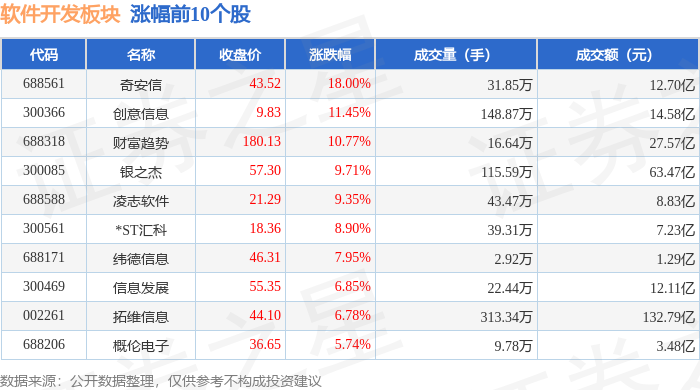
软件开发板块8月28日涨2.51%,奇安信领涨,主力资金净流出54.42亿元
Zheng Xing Xing Ye Ri Bao· 2025-08-28 08:42
Market Overview - On August 28, the software development sector rose by 2.51%, with Qihoo 360 leading the gains [1] - The Shanghai Composite Index closed at 3843.6, up 1.14%, while the Shenzhen Component Index closed at 12571.37, up 2.25% [1] Top Gainers in Software Development Sector - Qihoo 360 (688561) closed at 43.52, up 18.00% with a trading volume of 318,500 shares and a turnover of 1.27 billion [1] - Chuangyi Information (300366) closed at 9.83, up 11.45% with a trading volume of 1,488,700 shares [1] - Caifutong (688318) closed at 180.13, up 10.77% with a trading volume of 166,400 shares [1] - Yinzhijie (300085) closed at 57.30, up 9.71% with a trading volume of 1,155,900 shares [1] - Lingzhi Software (688588) closed at 21.29, up 9.35% with a trading volume of 434,700 shares [1] Top Losers in Software Development Sector - Jinxian Modern (300830) closed at 12.44, down 6.68% with a trading volume of 525,600 shares [2] - Dingjie Zhizhi (300378) closed at 58.00, down 5.54% with a trading volume of 346,600 shares [2] - Jiahe Meikang (688246) closed at 33.85, down 5.10% with a trading volume of 87,200 shares [2] Capital Flow Analysis - The software development sector experienced a net outflow of 5.442 billion from institutional investors, while retail investors saw a net inflow of 5.293 billion [2] - The top stocks by net inflow from retail investors included Yinzhijie (300085) with a net inflow of 5.40 million [3] - Qihoo 360 (688561) had a net inflow of 1.66 million from institutional investors, but a net outflow of 10.7 million from retail investors [3]


国务院“人工智能+”新政落地:六大领域投资机遇全解析
Xin Lang Cai Jing· 2025-08-27 00:23
Policy Background and Core Logic - The State Council released the "Opinions on Deepening the Implementation of 'Artificial Intelligence+' Action" on August 26, 2025, aiming to promote AI empowerment across six dimensions: technology, industry, consumption, livelihood, governance, and global cooperation [1] - The policy outlines three stages: achieving deep integration in six fields by 2027 (with smart terminal penetration exceeding 70%), establishing smart economy as a growth driver by 2030 (with penetration exceeding 90%), and entering a new stage of intelligent society by 2035 [1] - This policy is expected to reshape China's AI industry chain and create trillion-level investment opportunities [1] Computing Infrastructure: The "Water, Electricity, and Coal" of the AI Era - The policy emphasizes "strengthening intelligent computing power coordination," focusing on breakthroughs in liquid cooling technology, optical modules, and AI chips [3] - Inspur Information holds a 47% global market share in AI servers, with a revenue increase of 165% year-on-year in Q1 2025, benefiting from accelerated construction of intelligent computing centers [4] - The company has received over 20 billion yuan in national computing network orders, with a 40% year-on-year increase in net profit in Q2 2025 [4] Industry Applications: Accelerated Penetration in Vertical Scenarios - The policy encourages deep integration of AI with manufacturing, government, and healthcare, accelerating commercialization in vertical scenarios [5] - Weining Health's AI-assisted diagnostic system covers 3,000 hospitals with a diagnostic accuracy rate of 93.6%, and its medical AI revenue doubled in Q2 2025 [5] - The company has won over 20 provincial government projects, enhancing processing efficiency by 70% through its NLP capabilities [5] Consumer-Level AI: Revolution in Smart Terminals - Wanxing Technology's AI model has improved video creation efficiency by five times, with a revenue increase of 180% in H1 2025 [6] - The company is a core chip supplier for Alibaba's AI glasses, with a market share exceeding 60% in smart wearable chips [6] - AI subscription services are becoming a new growth driver, with net profit increasing by 120% year-on-year in Q2 2025 [6] Data Elements and Security: The Foundation of the AI Ecosystem - The policy highlights the need for "data element circulation and security governance," making data labeling and privacy computing essential [6] - Companies like Haitan Ruisheng and Qi Anxin are positioned to benefit from this trend [6] Intelligent Agents and Ecosystem: The Core of Next-Generation Interaction - The policy promotes "human-machine collaborative organizational structures," making intelligent agent platforms standard for enterprises [6] - Companies such as Tuowei Information are expected to play a significant role in this area [6] Global Cooperation and Open Source Ecosystem - The policy emphasizes "AI for all," with open-source communities and global standard-setting being crucial [6] - Companies like Cambrian are involved in this global cooperation effort [6] Investment Strategy - Short-term focus on computing hardware (e.g., Zhongji Xuchuang, Inspur Information) and government intelligent agents (e.g., Tuowei) [7] - Long-term attention to companies with high technical barriers and deep scenario implementation (e.g., Zhongke Shuguang, Weining Health) [7]