Qi An Xin Technology (688561)

Search documents
中国东信与奇安信集团签署战略合作协议
news flash· 2025-07-21 10:53
Group 1 - The core viewpoint of the article highlights the strategic cooperation between Qi Anxin Technology Group Co., Ltd. and China-ASEAN Information Harbor Co., Ltd. focusing on artificial intelligence, ASEAN scenario applications, and digital security [1] Group 2 - The visit by Qi Anxin's chairman, Qi Xiangdong, signifies a commitment to deepen collaboration in technology and security sectors [1] - The partnership aims to leverage both companies' strengths to enhance digital safety and innovation in the ASEAN region [1]

奇安信: 奇安信2025年第一次临时股东大会决议公告
Zheng Quan Zhi Xing· 2025-07-14 12:18
| 证券代码:688561 证券简称:奇安信 公告编号:2025-029 | | | | | | | | | --- | --- | --- | --- | --- | --- | --- | --- | | 奇安信科技集团股份有限公司 | | | | | | | | | 本公司董事会及全体董事保证公告内容不存在任何虚假记载、误导性陈述或 | | | | | | | | | 者重大遗漏,并对其内容的真实性、准确性和完整性依法承担法律责任。 | | | | | | | | | 重要内容提示: | | | | | | | | | 本次会议是否有被否决议案:无 | ? | | | | | | | | 一、 会议召开和出席情况 | | | | | | | | | 14 (一) 股东大会召开的时间:2025 月 | | 7 年 | 日 | | | | | | (二) 股东大会召开的地点:北京市西城区西直门外南路 26 号院奇安信安全中 | | | | | | | | | 心多功能厅 | | | | | | | | | (三) 出席会议的普通股股东、特别表决权股东、恢复表决权的优先股股东及 | | | | | | | | ...
奇安信: 奇安信关于注销回购股份并减少注册资本暨通知债权人的公告
Zheng Quan Zhi Xing· 2025-07-14 12:18
证券代码:688561 证券简称:奇安信 公告编号:2025-030 奇安信科技集团股份有限公司 关于注销回购股份并减少注册资本 公司本次回购方案所回购的股份用于减少注册资本,根据《中华人民共和国 公司法》等法律法规的有关规定,公司特此通知债权人:公司债权人自接到公司 通知之日起 30 日内,未接到通知者自本公告披露之日起 45 日内,均有权凭有效 债权文件及相关凭证要求公司清偿债务或者提供相应担保。债权人未在规定期限 内行使上述权利的,不会影响其债权的有效性,相关债务将由公司根据原债权文 件的约定继续履行,本次回购注销将按法定程序继续实施。公司债权人如要求公 司清偿债务或提供相应担保的,应根据《中华人民共和国公司法》等法律法规的 有关规定向公司提出书面要求,并随附有关证明文件。 债权申报所需材料:公司债权人可持证明债权债务关系存在的合同、协议及 其他凭证的原件及复印件到公司申报债权。债权人为法人的,需同时携带法人营 业执照副本原件及复印件、法定代表人身份证明文件并加盖公章;委托他人申报 的,除上述文件外,还需携带法定代表人授权委托书和代理人有效身份证的原件 及复印件。债权人为自然人的,需同时携带有效身份证的 ...
奇安信(688561) - 奇安信关于注销回购股份并减少注册资本暨通知债权人的公告
2025-07-14 12:00
证券代码:688561 证券简称:奇安信 公告编号:2025-030 奇安信科技集团股份有限公司 关于注销回购股份并减少注册资本 暨通知债权人的公告 本公司董事会及全体董事保证本公告内容不存在任何虚假记载、误导性陈述 或者重大遗漏,并对其内容的真实性、准确性和完整性依法承担法律责任。 一、通知债权人的原由 奇安信科技集团股份有限公司(以下简称"公司")于 2025 年 6 月 24 日召开 了第三届董事会第二次会议和第三届监事会第二次会议,并于 2025 年 7 月 14 日召开了 2025 年第一次临时股东大会,分别审议通过了《关于变更回购股份用 途并注销暨减少注册资本的议案》,同意将存放于公司回购专用证券账户中的 2,919,652 股回购股份的用途进行变更,由"用于员工持股计划或股权激励"变更 为"用于注销并减少注册资本"。 本次注销回购专用证券账户股份后,公司股份总数相应减少 2,919,652 股, 占公司当前总股本的 0.43%,公司总股本预计将由 685,172,377 股变更为 682,252, 725 股,注册资本预计将由人民币 68,517.2377 万元减少至人民币 68,225.272 ...
奇安信(688561) - 北京市金杜律师事务所关于奇安信科技集团股份有限公司2025年第一次临时股东大会的法律意见书
2025-07-14 12:00
金杜律师事务所 KING&WODD MALLESONS 北京市金杜律师事务所 关于奇安信科技集团股份有限公司 2025年第一次临时股东大会的法律意见书 致:奇安信科技集团股份有限公司 北京市金杜律师事务所(以下简称本所)接受奇安信科技集团股份有限公司 (以下简称公司)的委托,根据《中华人民共和国证券法》(以下简称《证券法》)、 《中华人民共和国公司法》(以下简称《公司法》)、中国证券监督管理委员会(以 下简称中国证监会 )《上市公司股东会规则(2025年修订》(以下简称《股东会规 则》)等中华人民共和国境内(以下简称中国境内,为本法律意见书之目的,不包 括中国香港特别行政区、中国澳门特别行政区和中国台湾省)现行有效的法律、行 政法规、规章和规范性文件和现行有效的公司章程有关规定,指派律师出席了公司 于 2025 年 7 月 14 日召开的 2025 年第一次临时股东大会(以下简称本次股东大 会 ),并就本次股东大会相关事项出具本法律意见书。 北京市朝阳区东三环中路1号 环球金融中心办公楼东楼18层 邮编100020 18th Floor, East Tower, World Financial Center ...
奇安信(688561) - 奇安信2025年第一次临时股东大会决议公告
2025-07-14 12:00
重要内容提示: 本次会议是否有被否决议案:无 证券代码:688561 证券简称:奇安信 公告编号:2025-029 奇安信科技集团股份有限公司 2025年第一次临时股东大会决议公告 本公司董事会及全体董事保证公告内容不存在任何虚假记载、误导性陈述或 者重大遗漏,并对其内容的真实性、准确性和完整性依法承担法律责任。 一、 会议召开和出席情况 (一) 股东大会召开的时间:2025 年 7 月 14 日 (二) 股东大会召开的地点:北京市西城区西直门外南路 26 号院奇安信安全中 心多功能厅 (三) 出席会议的普通股股东、特别表决权股东、恢复表决权的优先股股东及 其持有表决权数量的情况: | 1、出席会议的股东和代理人人数 | 245 | | --- | --- | | 普通股股东人数 | 245 | | 2、出席会议的股东所持有的表决权数量 | 403,849,127 | | 普通股股东所持有表决权数量 | 403,849,127 | | 3、出席会议的股东所持有表决权数量占公司表决权数量的比例(%) | 59.1935 | | 普通股股东所持有表决权数量占公司表决权数量的比例(%) | 59.1935 | (四 ...
存量32家未盈利企业进入科创成长层(附名单)


财联社· 2025-07-13 07:59
Group 1 - The Shanghai Stock Exchange has released the "Self-Regulatory Supervision Guidelines for Companies Listed on the Sci-Tech Innovation Board No. 5 - Sci-Tech Growth Tier" [1] - The reform does not impose additional listing thresholds for unprofitable companies entering the Sci-Tech Growth Tier, allowing 32 existing unprofitable companies to enter immediately upon the guideline's implementation [1] - Newly registered unprofitable companies will enter the Sci-Tech Growth Tier from the date of their listing [1] Group 2 - Investors participating in the subscription and trading of newly registered stocks in the Sci-Tech Growth Tier must sign a "Risk Disclosure Statement for the Sci-Tech Growth Tier" [2] - The 32 existing companies that have not yet removed the "U" designation include: Zejing Pharmaceutical, Junshi Biosciences, Frontier Biotech, Qingyun Technology, Hehui Optoelectronics, Jingjin Electric, BeiGene, Dize Pharmaceutical, Maiwei Biotech, Aojie Technology, Yuhong Pharmaceutical, Shouyao Holdings, Haichuang Pharmaceutical, CloudWalk Technology, Yifang Biotech, Obsidian Optics, Mengke Pharmaceutical, Nuo Cheng Jianhua, Xinke Mobile, Xinghuan Technology, Yutai Micro, Yuntian Lifa, Tianzhihang, Qi Anxin, Hanwujin, Yihua Tong, Aifute, Huizhiwei, Xinlian Integrated, Zhixiang Jintai, Shengke Communication, and Zhongjuxin [2]


陈华平:筑牢绿色智算生态的安全基石
Xin Hua Cai Jing· 2025-07-12 09:35
Core Viewpoint - The 2025 Green Computing (Artificial Intelligence) Conference emphasizes the importance of cybersecurity as a foundation for the sustainable development of the green computing ecosystem, highlighting the need for a robust security framework to protect sensitive data and ensure efficient utilization of computing resources [1][2]. Group 1: Conference Overview - The conference is hosted by the Hohhot Municipal Government and organized by several institutions, including the China Academy of Information and Communications Technology [2]. - The event features a main opening ceremony, keynote speeches, one thematic activity, and nine specialized meetings [2]. Group 2: Key Insights from Chen Huaping - Chen Huaping, Vice President of Qi Anxin Group, stresses that achieving "zero accidents" in cybersecurity is crucial for the effective use of computing resources [1]. - He describes the computing network as the "nervous system" of the digital society, where the failure of security can lead to widespread impacts across various industries, including data breaches and business interruptions [1]. - Chen identifies three critical areas for security focus: vulnerabilities, insider threats, and cloud environments [1]. Group 3: Recommendations for a Secure Green Computing Ecosystem - Chen proposes a systematic "four management" model to safeguard the green computing ecosystem: 1. Establish an internal security system tailored for large model application scenarios [1]. 2. Develop a "zero trust" system to effectively eliminate insider threats [1]. 3. Create a SASE system that integrates network connectivity, data security, compliance control, and endpoint security [1]. 4. Build a practical "three-level linkage" situational awareness command system for collaboration among computing nodes, data integration, and regulatory authorities [1].
高盛:奇安信_管理层电话会议_生成式人工智能为网络安全带来机遇;成本及现金流优化
Goldman Sachs· 2025-07-09 02:40
Investment Rating - The report maintains a "Sell" rating on both Sangfor and Venustech, indicating a cautious outlook on the cybersecurity sector [2][17]. Core Insights - The management of Qi An Xin sees generative AI as a significant opportunity in the cybersecurity market, which could lead to increased demand for upgraded cybersecurity solutions due to the intensification of cyber attacks [4][9]. - The integration of generative AI is expected to enhance the accuracy and efficiency of cybersecurity software, particularly in risk detection and analysis, which could attract more clients [4][7]. - There is a noted trend of clients shifting their software budgets from functional tools to generative AI software, which is anticipated to drive average revenue per user (ARPU) and attract new paying customers [2][4]. Summary by Sections Company Profile - Qi An Xin, founded in 2014, specializes in cybersecurity, providing software and services to government and enterprise clients. The company has advanced capabilities in endpoint security, cloud security, threat intelligence, and situation awareness [3]. Generative AI Opportunities - Management believes that generative AI will trigger an increase in cyber attacks, creating a potential for upgrading cybersecurity solutions. The company plans to launch the QAX-GPT Security Robot in 2024, which will utilize its self-developed QAX security foundation model to assist security professionals [4][7]. Integrated Cybersecurity Framework - Establishing an integrated cybersecurity framework is deemed more critical than deploying standalone security products. Management emphasizes that platform-based solutions with broad coverage and interoperability will enhance user experience [8]. 2025 Performance Outlook - The management expresses low visibility on near-term demand recovery in the cybersecurity market due to macroeconomic constraints affecting client budgets, particularly in government sectors. However, there is a positive outlook for demand from certain enterprise clients, such as financial institutions and telecom operators [9]. The company is focusing on leveraging generative AI to enhance product offerings and reduce operational costs while improving cash flow [9].
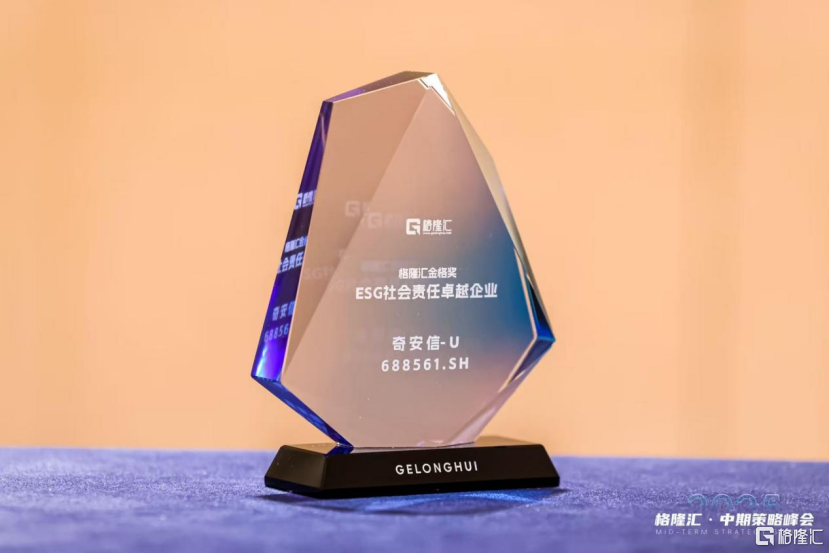
奇安信(688561.SH)获ESG社会责任卓越企业奖,多维发力守护网络安全与责任
Ge Long Hui· 2025-07-08 03:28
Core Viewpoint - Cybersecurity has become an essential element for the orderly operation of modern society, directly impacting public trust, social stability, and national security [1][3] Group 1: National Security and Major Events - Qihoo 360 has completed 87 national security tasks, including major events like the 100th anniversary of the founding of the Communist Party and the 2022 Beijing Winter Olympics, achieving a "zero incident" goal for the first time in Olympic history [4][5] - During the 2024 National Two Sessions, Qihoo 360 formed the "Qihoo 360 Red Cloud Team" to ensure zero network interruptions through real-time threat monitoring [5] Group 2: Digital Transformation and Technological Innovation - The company provides security protection, monitoring, and hosting services to over 4,000 industrial internet enterprises, facilitating their digital transformation [5] - Qihoo 360 has invested heavily in AI, with key products like AISOC and Tianyan already incorporating AI capabilities, enhancing its position in cybersecurity technology [6] Group 3: Social Responsibility and Talent Development - Qihoo 360 emphasizes social responsibility through various initiatives, including partnerships with over 70 universities to develop cybersecurity courses and training programs [7] - The company donated 8 million yuan to its foundation in 2024, supporting rural revitalization and healthcare initiatives [7] Group 4: Environmental Commitment - Qihoo 360 actively responds to national "dual carbon" goals, integrating green development into its corporate strategy and disclosing verified greenhouse gas emissions data [8] Group 5: Recognition and Awards - The company has received multiple accolades for its social responsibility practices, including a "three-star" rating for data security and personal information protection [9] - Qihoo 360 was the only cybersecurity company listed in the S&P Global "Sustainability Yearbook (China Edition) 2025," highlighting its leadership in sustainable development [9]