
CNPCCCL(000617)

Search documents
沪深300综合金融服务指数报4635.22点,前十大权重包含中油资本等
Jin Rong Jie· 2025-08-18 07:44
Group 1 - The Shanghai Composite Index opened high and rose, with the CSI 300 Comprehensive Financial Services Index reported at 4635.22 points [1] - The CSI 300 Comprehensive Financial Services Index has increased by 0.23% in the past month, 26.24% in the past three months, and 29.17% year-to-date [1] - The CSI 300 Index samples are categorized into 11 primary industries, 35 secondary industries, over 90 tertiary industries, and more than 200 quaternary industries for comprehensive analysis [1] Group 2 - The Shenzhen Stock Exchange accounts for 100.00% of the holdings in the CSI 300 Comprehensive Financial Services Index [2] - The index sample is adjusted every six months, with adjustments implemented on the next trading day after the second Friday of June and December [2] - Weight factors are generally fixed until the next scheduled adjustment, with temporary adjustments made in response to changes in the CSI 300 Index samples [2]

非银金融行业资金流出榜:东吴证券、国盛金控等净流出资金居前
Zheng Quan Shi Bao Wang· 2025-08-14 09:16
非银金融行业今日上涨0.59%,全天主力资金净流出3.83亿元,该行业所属的个股共83只,今日上涨的 有29只,涨停的有1只;下跌的有52只,跌停的有1只。以资金流向数据进行统计,该行业资金净流入的 个股有29只,其中,净流入资金超亿元的有7只,净流入资金居首的是中国平安,今日净流入资金4.70 亿元,紧随其后的是长城证券、中油资本,净流入资金分别为3.67亿元、3.50亿元。非银金融行业资金 净流出个股中,资金净流出超亿元的有9只,净流出资金居前的有东吴证券、国盛金控、海南华铁,净 流出资金分别为2.61亿元、2.53亿元、1.78亿元。(数据宝) 非银金融行业资金流向排名 沪指8月14日下跌0.46%,申万所属行业中,今日上涨的有1个,涨幅居前的行业为非银金融,涨幅分别 为0.59%。非银金融行业位居今日涨幅榜首位。跌幅居前的行业为综合、国防军工,跌幅分别为 2.66%、2.15%。 资金面上看,两市主力资金全天净流出750.81亿元,主力资金净流入的行业仅有2个,银行行业净流入 资金1.88亿元;建筑材料行业净流入资金5937.93万元。 主力资金净流出的行业有29个,国防军工行业主力资金净流出规模居首 ...





28.84亿主力资金净流入,跨境支付(CIPS)概念涨0.67%
Zheng Quan Shi Bao Wang· 2025-08-14 09:09
截至8月14日收盘,跨境支付(CIPS)概念上涨0.67%,位居概念板块涨幅第5,板块内,35股上涨,吉大 正元、京北方等涨停,四方精创、新国都、普联软件等涨幅居前,分别上涨15.29%、6.68%、5.42%。 跌幅居前的有凯撒旅业、零点有数、亚信安全等,分别下跌4.81%、3.95%、3.92%。 | 概念 | 今日涨跌幅(%) | 概念 | 今日涨跌幅(%) | | --- | --- | --- | --- | | 电子身份证 | 1.44 | 兵装重组概念 | -4.69 | | 芬太尼 | 1.24 | 中船系 | -4.10 | | 脑机接口 | 0.92 | 房屋检测 | -3.26 | | 数字货币 | 0.74 | 共封装光学(CPO) | -3.07 | | 跨境支付(CIPS) | 0.67 | 特钢概念 | -3.04 | | 移动支付 | 0.48 | 成飞概念 | -2.98 | | 蚂蚁金服概念 | -0.01 | PET铜箔 | -2.95 | | 高压氧舱 | -0.04 | 太赫兹 | -2.85 | | 期货概念 | -0.20 | F5G概念 | -2.83 | | ...



中油资本收盘上涨3.87%,滚动市盈率26.71倍,总市值1120.09亿元
Sou Hu Cai Jing· 2025-08-14 08:33
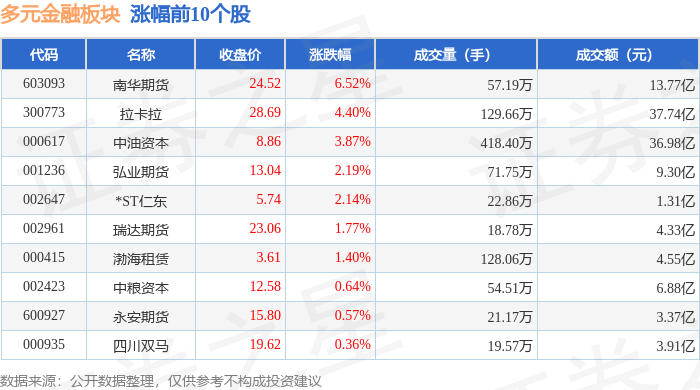
Group 1 - The core viewpoint of the articles highlights the performance and valuation of Zhongyou Capital, which closed at 8.86 yuan, up 3.87%, with a rolling PE ratio of 26.71, marking a new low in 12 days, and a total market capitalization of 112.009 billion yuan [1][2] - Zhongyou Capital ranks 12th in the multi-financial industry, which has an average PE ratio of 48.52 and a median of 29.68 [1][2] - As of March 31, 2025, Zhongyou Capital had 179,183 shareholders, a decrease of 26,205 from the previous count, with an average holding value of 352,800 yuan and an average holding of 27,600 shares per shareholder [1] Group 2 - The main business of Zhongyou Capital includes the production, sales, and research and development of financial products, focusing on external investment, investment management, and investment consulting [1] - The latest quarterly report for Q1 2025 shows that the company achieved operating revenue of 8.947 billion yuan, a year-on-year decrease of 7.77%, and a net profit of 1.269 billion yuan, down 26.57%, with a sales gross margin of 0.59% [1]
多元金融板块8月14日涨0.38%,南华期货领涨,主力资金净流入4912.39万元
Zheng Xing Xing Ye Ri Bao· 2025-08-14 08:32
Group 1 - The diversified financial sector increased by 0.38% on August 14, with Nanhua Futures leading the gains [1] - The Shanghai Composite Index closed at 3666.44, down 0.46%, while the Shenzhen Component Index closed at 11451.43, down 0.87% [1] - Key stocks in the diversified financial sector showed varied performance, with Nanhua Futures rising by 6.52% to a closing price of 24.52 [1] Group 2 - Major stocks that declined included Jiuding Investment, which fell by 9.98% to a closing price of 19.48 [2] - The overall net capital flow in the diversified financial sector showed a net inflow of 49.12 million yuan from main funds, while retail investors contributed a net inflow of 15.2 million yuan [2] - The trading volume and turnover for various stocks in the sector varied significantly, with Lakala achieving a turnover of 3.774 billion yuan [1][2]




中油资本收盘上涨1.07%,滚动市盈率25.69倍,总市值1077.11亿元
Sou Hu Cai Jing· 2025-08-12 09:29
Group 1 - The core viewpoint of the articles highlights the performance and valuation of Zhongyou Capital, which closed at 8.52 yuan with a PE ratio of 25.69 times, indicating a relatively lower valuation compared to the industry average of 48.31 times [1][2] - Zhongyou Capital's total market capitalization is reported at 107.71 billion yuan, ranking 12th in the multi-financial industry based on PE ratio [1][2] - As of March 31, 2025, Zhongyou Capital has 179,183 shareholders, with an average holding value of 352,800 yuan and an average shareholding of 27,600 shares [1] Group 2 - The company's main business includes the production, sales, and research of financial products, focusing on external investments, investment management, and investment consulting [1] - Recent awards received by the company include recognition for excellent cases in financial aging services and digital transformation in the insurance industry for 2024 [1] - The latest financial results for the first quarter of 2025 show a revenue of 8.947 billion yuan, a year-on-year decrease of 7.77%, and a net profit of 1.269 billion yuan, down 26.57% year-on-year, with a sales gross margin of 0.59% [1]
基金8月7日参与12家公司的调研活动
Zheng Quan Shi Bao Wang· 2025-08-08 06:16
Group 1 - On August 7, a total of 16 companies were investigated by institutions, with 12 companies being surveyed by funds, indicating strong interest in specific firms like Tapa Group, Shunbo Alloy, and Baotong Technology [1] - Tapa Group received the most attention, with 19 funds participating in its survey, while Shunbo Alloy and Baotong Technology were surveyed by 10 and 9 funds respectively [1] - Among the surveyed companies, 7 are from the Shenzhen Main Board, 4 from the ChiNext Board, and 1 from the Sci-Tech Innovation Board [1] Group 2 - The total market capitalization of the surveyed companies includes 1 company with a market cap over 500 billion, and 1 company exceeding 1 trillion, while 5 companies have a market cap below 100 billion [1] - In terms of market performance, 10 out of the surveyed stocks increased in value over the past 5 days, with Baotong Technology, Jereh Holdings, and Zhongke Information showing the highest gains of 19.74%, 13.79%, and 13.13% respectively [1] - Conversely, 2 stocks experienced declines, with Yabao Chemical and Zhongyou Capital falling by 7.95% and 3.35% respectively [1] Group 3 - Among the surveyed companies, 3 have released their semi-annual reports, with Shunbo Alloy and Tapa Group showing the highest net profit growth rates of 110.56% and 92.47% respectively [2] - Additionally, 3 companies have announced their performance forecasts, with the highest expected net profit growth being 160.00% for Sitwei, projecting a median net profit of 390 million [2] - A detailed list of surveyed companies includes Tapa Group, Shunbo Alloy, and Baotong Technology, with their respective fund participation and recent stock performance [2]



中油资本分析师会议-20250807
Dong Jian Yan Bao· 2025-08-07 15:00
Group 1: Report Overview - The report is about the institutional research on CNPC Capital on August 7, 2025, with the research industry being diversified finance [1][2][17] Group 2: Research Details 1. Basic Research Information - Research object: CNPC Capital [17] - Industry: Diversified finance [17] - Reception time: 2025 - 08 - 07 [17] - Reception staff: Securities Affairs Representative Wang Yungang and staff from the Securities Affairs Department [17] 2. Detailed Research Institutions - Fund management company: Wells Fargo Fund, with related personnel Xu Jianrong [20] 3. Research Institution Proportion - No specific content provided [21] 4. Main Content Data - **Business development strategy**: CNPC Capital has established an "11445" strategic system, aiming to be an internationally well - known and domestically first - class financial service enterprise integrating industry and finance, and an expert and leader in energy financial services. It implements four major strategies and fulfills four platform functions, and develops five major businesses [22] - **Dividend policy**: The company has adopted a continuous and stable cash dividend policy for many years. Since its restructuring and listing in 2017, it has distributed cash dividends at a standard of not less than 30% of the net profit attributable to the parent company each year. In 2024, it implemented an interim dividend for the first time, with the dividend ratio increasing to 31.8%. As of 2024, the cumulative cash dividend was 1.5044 billion yuan [22] - **Stablecoin business**: The company currently does not involve related businesses. It is organizing research on relevant policies and will conduct business in a legally compliant, prudent and stable manner [24]
中油资本股价下跌1.06% 公司回应稳定币业务传闻
Jin Rong Jie· 2025-08-07 13:32
Group 1 - The stock price of Zhongyou Capital on August 7 was 8.37 yuan, down 0.09 yuan or 1.06% from the previous trading day [1] - The trading volume on that day was 1.439 million shares, with a transaction amount of 1.205 billion yuan [1] - Zhongyou Capital is a diversified financial platform under China National Petroleum Corporation, covering banking, trust, financial leasing, insurance, and securities [1] Group 2 - In Q1 2025, the company achieved operating revenue of 8.947 billion yuan and a net profit attributable to shareholders of 1.269 billion yuan [1] - On August 7, the company announced that it is currently not involved in stablecoin-related businesses and is researching policies in this area [1] - On August 6, a block trade occurred involving 390,000 shares with a transaction amount of 2.9796 million yuan, at a discount of 9.69% compared to the closing price [1] Group 3 - On August 7, the net outflow of main funds from Zhongyou Capital was 119 million yuan, accounting for 0.11% of the circulating market value [1] - Over the past five days, the net outflow of main funds totaled 396 million yuan, representing 0.37% of the circulating market value [1]
中油资本(000617) - 000617中油资本投资者关系管理信息20250807
2025-08-07 09:00
Group 1: Company Development Strategy - The company has established a "11445" strategic system, aiming to become an internationally renowned and domestically first-class financial service enterprise, focusing on "innovation, market, service, and green" strategies [1] - The four major platform functions include financial asset supervision, financial business integration, financial equity investment, and financial risk control [1] Group 2: Market Value Management and Dividend Policy - The company has maintained a stable cash dividend policy, distributing no less than 30% of the net profit attributable to the parent company as cash dividends since its restructuring in 2017 [2] - In 2024, the dividend payout ratio increased to 31.8%, with cumulative cash dividends amounting to 150.44 million yuan [2] - The company aims to balance performance growth with shareholder returns while ensuring stable cash dividends for investors [2] Group 3: Business Development and Trends - The company currently does not engage in stablecoin-related businesses but is researching relevant policies due to investor interest [2]