CITIC Steel(000708)

Search documents
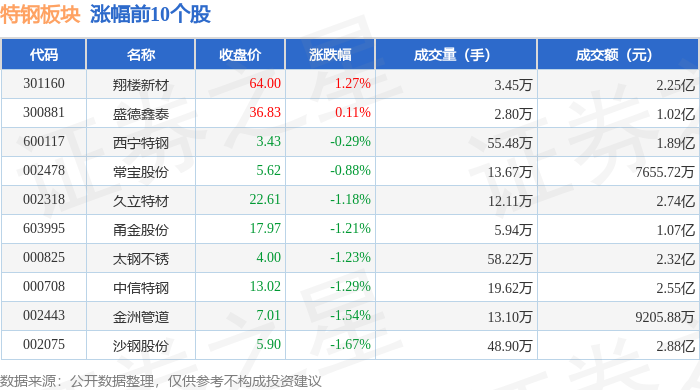
特钢板块9月15日跌1.51%,方大特钢领跌,主力资金净流出2.68亿元
Zheng Xing Xing Ye Ri Bao· 2025-09-15 08:43
Market Overview - On September 15, the special steel sector declined by 1.51%, with Fangda Special Steel leading the drop [1] - The Shanghai Composite Index closed at 3860.5, down 0.26%, while the Shenzhen Component Index closed at 13005.77, up 0.63% [1] Stock Performance - Key stocks in the special steel sector showed varied performance, with notable declines in Fangda Special Steel, which fell by 5.50% to a closing price of 5.50 [2] - Other significant declines included Sha Steel Co., down 1.67% to 5.90, and Jiu Li Special Materials, down 1.18% to 22.61 [2] Trading Volume and Capital Flow - The special steel sector experienced a net outflow of 268 million yuan from main funds, while retail funds saw a net inflow of 85.74 million yuan [2] - The trading volume for Fangda Special Steel was 575,800 shares, with a transaction value of 320 million yuan [2] Individual Stock Capital Flow - Major stocks like Tai Steel and CITIC Special Steel saw significant net outflows from main funds, with Tai Steel experiencing a net outflow of 53.12 million yuan [3] - Conversely, retail investors showed a net inflow into stocks like Sha Steel, with a net inflow of 891.85 million yuan [3]


研判2025!中国低空经济+巡检行业发展背景、产业链、市场规模、代表企业及前景展望:低空经济赋能巡检智能化多元化,有望推动行业规模突破千亿元[图]
Chan Ye Xin Xi Wang· 2025-09-15 01:20
Core Viewpoint - The low-altitude economy in China is experiencing rapid growth, with the overall market size surpassing 500 billion yuan in 2023, and is projected to reach 1 trillion yuan in the near future, driven by market demand and supportive policies [1][11]. Summary by Sections Low-altitude Economy + Inspection Overview - The low-altitude economy + inspection refers to economic activities utilizing low-altitude aircraft such as drones and helicopters for various inspection tasks below 1,000 meters, with potential extensions up to 3,000 meters [3][4]. - This sector is characterized by the integration of advanced technologies like AI, blockchain, and VR/AR for real-time monitoring and data management [3]. Market Size and Growth - The market size for the low-altitude economy + inspection is estimated to be approximately 53.62 billion yuan in 2024, with expectations to grow to 120 billion yuan by 2025 [1][11]. - The overall low-altitude economy market is projected to reach about 670.25 billion yuan in 2024, with forecasts of 1.5 trillion yuan by 2025 and 3.5 trillion yuan by 2035 [4][5]. Policy Support - The Chinese government has introduced a series of policies to support the development of the low-altitude economy, including the inclusion of low-altitude economy in national planning and specific implementation plans for innovation in general aviation equipment [5][6]. - Key policies include financial support for critical technologies and products, aiming to enhance the industry's growth and technological capabilities [5]. Industry Chain - The low-altitude economy + inspection industry chain includes upstream hardware (materials, chips, engines), midstream manufacturing and services, and downstream applications in sectors like security, environmental protection, and energy [6][7]. - Chips are identified as a core component, essential for flight control, data processing, and communication in drones and eVTOLs [9]. Key Enterprises - Major companies in the low-altitude economy + inspection sector include DJI, Chengdu Zongheng Automation Technology Co., and several others specializing in industrial drones and related technologies [12][13]. - These companies are leveraging their technological expertise to provide innovative solutions across various applications, including public safety and environmental monitoring [12][13]. Development Trends - The industry is witnessing a trend towards increased technological integration and intelligence, with advancements in AI and machine vision enhancing operational capabilities [14]. - Application scenarios are diversifying, expanding from traditional inspections to areas like smart city management and emergency response [15]. - There is a significant enhancement in system integration and platform services, providing comprehensive solutions from data collection to intelligent analysis [16].





中央督察组反馈钢铁产能乱象,反内卷背景下行业供给管理或加强
Xinda Securities· 2025-09-14 09:52
Investment Rating - The investment rating for the steel industry is "Positive" [2] Core Viewpoints - The steel sector has shown resilience with a 3.70% increase this week, outperforming the broader market [10] - The report highlights that the central inspection team has pointed out issues with steel production capacity, indicating a potential tightening of supply management in the industry [3] - Despite current challenges, the demand for steel is expected to stabilize or slightly increase due to government policies aimed at economic growth, particularly in real estate and infrastructure [3] Supply Situation - As of September 12, the capacity utilization rate for blast furnaces in sampled steel companies is 90.2%, an increase of 4.39 percentage points week-on-week [23] - The average daily pig iron production is 2.4055 million tons, which is an increase of 117,100 tons week-on-week [23] - The total production of five major steel products is 7.448 million tons, a decrease of 51,800 tons week-on-week [23] Demand Situation - The consumption of five major steel products reached 8.433 million tons as of September 12, an increase of 155,000 tons week-on-week [31] - The transaction volume of construction steel by mainstream traders is 103,000 tons, reflecting a week-on-week increase of 6.32% [31] Inventory Situation - Social inventory of five major steel products is 10.951 million tons, an increase of 174,100 tons week-on-week [39] - Factory inventory of five major steel products is 4.195 million tons, a decrease of 35,000 tons week-on-week [39] Price & Profit Situation - The comprehensive index for ordinary steel is 3,489.7 yuan/ton, a slight increase of 0.71 yuan/ton week-on-week [45] - The profit for rebar produced in blast furnaces is -14 yuan/ton, a decrease of 8.0 yuan/ton week-on-week [54] - The average cost of pig iron is 2,379 yuan/ton, a decrease of 17.0 yuan/ton week-on-week [54] Raw Material Prices - The spot price index for Australian iron ore (62% Fe) is 796 yuan/ton, an increase of 11.0 yuan/ton week-on-week [68] - The price for primary metallurgical coke is 1,770 yuan/ton, remaining stable week-on-week [68]


钢铁行业2025中报综述:成本让利的开端,供给收缩的起点
Changjiang Securities· 2025-09-14 05:16
Investment Rating - The investment rating for the steel industry is Neutral, maintained [5] Core Insights - The steel industry continues to experience an oversupply situation, leading to a decline in steel prices and a year-on-year revenue decrease of 9% for the first half of 2025 and 8% for Q2 2025, although there was a quarter-on-quarter increase of 4% in Q2 [2][21] - On the cost side, the decline in raw material prices has been greater than that of finished steel, resulting in a year-on-year cost reduction of 11% for the first half of 2025 and 10% for Q2 2025, with a quarter-on-quarter increase of 3% in Q2 [2][24] - Profitability has significantly improved, with a year-on-year increase of 2540% in non-recurring profit for the first half of 2025 and 211% for Q2 2025, alongside a quarter-on-quarter increase of 47% [2][24] - The return on equity (ROE) for listed steel companies has shown recovery, with an ROE of 2.67% for the first half of 2025, up by 2.01 percentage points year-on-year, and 3.22% for Q2 2025, up by 1.87 percentage points year-on-year [2][24] Summary by Sections Revenue - The steel industry continues to face an oversupply, with revenues decreasing by 9% year-on-year in the first half of 2025 and 8% in Q2 2025, despite a quarter-on-quarter increase of 4% in Q2 [2][21][22] Cost - The cost of steel companies has decreased by 11% year-on-year in the first half of 2025 and by 10% in Q2 2025, with a quarter-on-quarter increase of 3% in Q2, driven by a larger decline in raw material prices compared to finished steel [2][24] Profit - Non-recurring profits have seen a substantial increase, with a year-on-year growth of 2540% in the first half of 2025 and 211% in Q2 2025, along with a quarter-on-quarter increase of 47% in Q2 [2][24] Return on Equity - The ROE for the steel industry has improved, reaching 2.67% in the first half of 2025, an increase of 2.01 percentage points year-on-year, and 3.22% in Q2 2025, an increase of 1.87 percentage points year-on-year [2][24]


钢铁周报20250914:铁水回升至高位,卷螺表现分化-20250914
Minsheng Securities· 2025-09-14 02:41
Investment Rating - The report maintains a "Buy" recommendation for several companies in the steel sector, including Hualing Steel, Baosteel, Nanjing Steel, Xianglou New Materials, CITIC Special Steel, Yongjin Co., Ltd., Jiuli Special Materials, Youfa Group, and Wujin Stainless Steel [3]. Core Viewpoints - The report indicates that pig iron production has rebounded to high levels, with daily production exceeding 2.4 million tons. Steel production has slightly decreased, but inventory accumulation has narrowed, suggesting a recovery in demand, although year-on-year demand remains weak. Steel profits are fluctuating around the breakeven point [2][3]. - The report highlights that the long-term focus will be on capacity regulation, which is expected to be more precise this time, promoting the survival of the fittest among steel companies. The profitability of steel enterprises is anticipated to recover as new iron ore capacities are gradually released [2][3]. Price Trends - As of September 12, 2025, steel prices showed mixed trends: rebar (20mm HRB400) at 3,210 CNY/ton (down 50 CNY), high line (8.0mm) at 3,360 CNY/ton (down 40 CNY), hot-rolled (3.0mm) at 3,450 CNY/ton (up 30 CNY), cold-rolled (1.0mm) at 3,800 CNY/ton (unchanged), and medium plate (20mm) at 3,460 CNY/ton (unchanged) [1][9][10]. Production and Inventory - As of September 12, 2025, the total production of five major steel products was 8.57 million tons, a decrease of 34,100 tons week-on-week. The total inventory of these products increased by 174,100 tons to 10.9391 million tons [2][5]. - The apparent consumption of rebar was estimated at 1.9807 million tons, down 40,000 tons week-on-week, while the average daily transaction volume of construction steel was 103,100 tons, up 6.32% week-on-week [2][5]. Profitability - The report estimates that the gross profit margins for rebar, hot-rolled, and cold-rolled steel have changed by -31 CNY/ton, +12 CNY/ton, and -8 CNY/ton respectively compared to the previous week. The gross profit margin for electric arc furnace steel decreased by 11 CNY/ton [1][2]. Investment Recommendations - The report recommends focusing on the following companies: 1. General Steel Sector: Hualing Steel, Baosteel, Nanjing Steel 2. Special Steel Sector: Xianglou New Materials, CITIC Special Steel, Yongjin Co., Ltd. 3. Pipe Materials: Jiuli Special Materials, Youfa Group, Wujin Stainless Steel 4. High-Temperature Alloy: Fushun Special Steel [2][3].

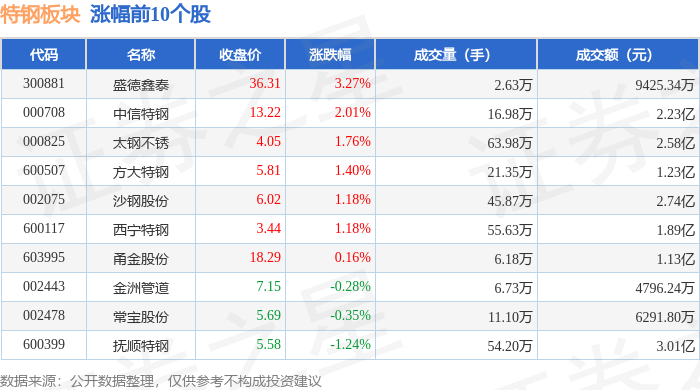
特钢板块9月12日涨0.76%,盛德鑫泰领涨,主力资金净流入6619.84万元
Zheng Xing Xing Ye Ri Bao· 2025-09-12 08:31
Market Performance - On September 12, the special steel sector rose by 0.76% compared to the previous trading day, with Shengde Xintai leading the gains [1] - The Shanghai Composite Index closed at 3883.69, up 0.22%, while the Shenzhen Component Index closed at 12996.38, up 0.13% [1] Individual Stock Performance - Shengde Login (300881) closed at 36.31, up 3.27% with a trading volume of 26,300 lots and a transaction value of 94.25 million [1] - CITIC Special Steel (000708) closed at 13.22, up 2.01% with a trading volume of 169,800 lots [1] - Taiyuan Iron & Steel (000825) closed at 4.05, up 1.76% with a trading volume of 639,800 lots [1] - Fangda Special Steel (600507) closed at 5.81, up 1.40% with a trading volume of 213,500 lots [1] - Shagang Group (002075) closed at 6.02, up 1.18% with a trading volume of 458,700 lots [1] - Xining Special Steel (600117) closed at 3.44, up 1.18% with a trading volume of 556,300 lots [1] - Jiao Jin Co. (603995) closed at 18.29, up 0.16% with a trading volume of 61,800 lots [1] - Jinzhou Pipeline (002443) closed at 7.15, down 0.28% with a trading volume of 67,300 lots [1] - Changbao Co. (002478) closed at 5.69, down 0.35% with a trading volume of 111,000 lots [1] - Fushun Special Steel (600399) closed at 5.58, down 1.24% with a trading volume of 542,000 lots [1] Capital Flow Analysis - The special steel sector saw a net inflow of 66.19 million from main funds, while retail investors experienced a net outflow of 78.48 million [2] - The main funds' net inflow for Taiyuan Iron & Steel was -53.34 million, while CITIC Special Steel had a net inflow of 34.88 million [3] - Shagang Group had a net inflow of 19.80 million from main funds, while retail investors had a net outflow of 24.90 million [3]


中信特钢涨2.01%,成交额1.28亿元,主力资金净流入884.35万元
Xin Lang Cai Jing· 2025-09-12 03:23
Core Viewpoint - CITIC Special Steel has shown a positive stock performance with a year-to-date increase of 21.25% and a market capitalization of 66.723 billion yuan as of September 12 [1] Financial Performance - For the first half of 2025, CITIC Special Steel reported operating revenue of 54.715 billion yuan, a year-on-year decrease of 4.02%, while net profit attributable to shareholders was 2.798 billion yuan, reflecting a year-on-year growth of 2.67% [2] - Cumulative cash dividends since the A-share listing amount to 20.927 billion yuan, with 8.943 billion yuan distributed over the past three years [3] Shareholder Information - As of June 30, 2025, the number of CITIC Special Steel shareholders increased by 5.17% to 43,400, while the average circulating shares per person decreased by 4.92% to 116,344 shares [2] - The top ten circulating shareholders include significant institutional investors, with Hong Kong Central Clearing Limited holding 48.1504 million shares, a decrease of 23.90 million shares from the previous period [3]
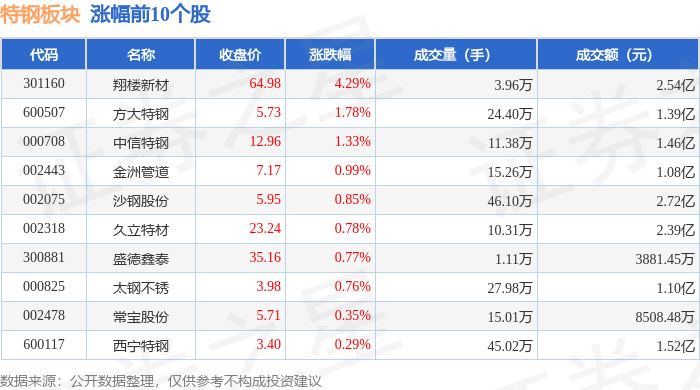
特钢板块9月11日涨1.04%,翔楼新材领涨,主力资金净流出1.12亿元
Zheng Xing Xing Ye Ri Bao· 2025-09-11 08:40
Market Performance - On September 11, the special steel sector rose by 1.04%, with Xianglou New Materials leading the gains [1] - The Shanghai Composite Index closed at 3875.31, up 1.65%, while the Shenzhen Component Index closed at 12979.89, up 3.36% [1] Individual Stock Performance - Xianglou New Materials (301160) closed at 64.98, with a gain of 4.29% and a trading volume of 39,600 lots, amounting to a transaction value of 254 million [1] - Fangda Special Steel (600507) closed at 5.73, up 1.78%, with a trading volume of 244,000 lots [1] - CITIC Special Steel (000708) closed at 12.96, up 1.33%, with a trading volume of 113,800 lots [1] - Other notable stocks include Jinzhou Pipeline (002443) at 7.17 (+0.99%), Shagang Group (002075) at 5.95 (+0.85%), and Jiuli Special Materials (002318) at 23.24 (+0.78%) [1] Fund Flow Analysis - The special steel sector experienced a net outflow of 112 million from main funds, while retail investors saw a net inflow of 110 million [1] - The detailed fund flow for individual stocks shows that Changbao Co. (002478) had a main fund net inflow of 6.82 million, while it faced a net outflow from speculative funds of 8.26 million [2] - Fangda Special Steel (600507) had a significant main fund net outflow of 12.08 million, with retail investors contributing a net inflow of 28.79 million [2]

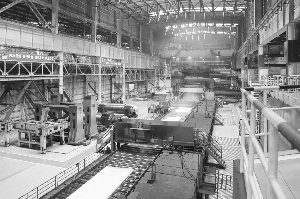
中信特钢旗下兴澄特钢厚板分厂 公司供图
Zhong Guo Zheng Quan Bao - Zhong Zheng Wang· 2025-09-09 22:38
Core Insights - The article discusses significant developments in the industry, highlighting key trends and potential impacts on market dynamics [1] Group 1 - The industry is experiencing a shift due to recent regulatory changes, which may affect operational strategies for companies involved [1] - Companies are adapting to new consumer preferences, leading to innovative product offerings and marketing strategies [1] - Financial performance metrics indicate a positive growth trajectory, with several companies reporting increased revenues and market share [1] Group 2 - The competitive landscape is evolving, with emerging players challenging established firms, prompting a reevaluation of market positioning [1] - Investment trends show a growing interest in sustainable practices, influencing capital allocation decisions across the sector [1] - Analysts predict that these trends will continue to shape the industry over the next few years, creating both opportunities and challenges for stakeholders [1]
中信特钢运营管控中心 本报记者 于蒙蒙 摄
Zhong Guo Zheng Quan Bao - Zhong Zheng Wang· 2025-09-09 22:38
Core Insights - The article discusses a significant decline in production levels, indicating a potential downturn in the industry [1] Group 1: Company Performance - The company experienced a production decrease of 6% [1] - There is a notable reduction in output, which may impact overall financial performance [1] Group 2: Industry Trends - The industry is facing challenges that could lead to further declines in production [1] - Market conditions appear to be unfavorable, contributing to the negative production trends [1]