
Suning Universal(000718)

Search documents
苏宁环球:股票交易异常波动公告
Zheng Quan Ri Bao Zhi Sheng· 2025-09-10 12:41
Core Viewpoint - Suning Universal announced that its stock price experienced an abnormal fluctuation, with a cumulative increase of 22.06% over two consecutive trading days (September 9 and 10, 2025) [1] Summary by Relevant Sections - **Stock Performance** - The company's stock price showed a cumulative increase of 22.06% over two trading days, indicating significant volatility [1] - **Company Disclosure** - The company confirmed that there are no corrections or supplements needed for previously disclosed information [1] - No recent media reports have been identified that could have significantly impacted the company's stock price [1] - **Operational Status** - The company stated that there have been no significant changes in its operational situation or external business environment recently [1]

苏宁环球:股价两日涨幅达 22.06%
Xin Lang Cai Jing· 2025-09-10 10:32
Core Viewpoint - Suning Universal announced an abnormal fluctuation in its stock price, with a cumulative increase of 22.06% over two consecutive trading days on September 9 and 10, 2025 [1] Summary by Relevant Sections - Stock Price Movement - The company's stock price experienced a significant deviation, with a cumulative increase of 22.06% over two trading days [1] - Company Response - The company conducted an internal review and confirmed that there was no need to correct or supplement previously disclosed information [1] - No undisclosed significant information that could impact the stock price was found [1] - Operational Stability - The company's operational situation and external environment have not undergone significant changes [1] - The controlling shareholder and actual controller have not disclosed any significant matters that should have been disclosed [1] - During the period of stock price fluctuation, there were no transactions involving the company's stock by the controlling shareholder [1]
苏宁环球(000718) - 股票交易异常波动公告
2025-09-10 10:18
证券代码:000718 证券简称:苏宁环球 公告编号:2025-028 苏宁环球股份有限公司 股票交易异常波动公告 本公司及董事会全体成员保证信息披露的内容真实、准确、完整,没有虚假记载、 误导性陈述或重大遗漏。 一、股票交易异常波动的情况介绍 1 二、公司关注及核实情况说明 针对公司股票交易异常波动情况,公司对有关事项进行核查,现将 相关情况说明如下: 1、公司前期披露的信息不存在需要更正、补充之处; 2、公司未发现近期公共传媒报道了可能或已经对公司股票交易价 格产生较大影响的未公开重大信息; 3、近期公司经营情况及内外部经营环境未发生重大变化; 4、公司、控股股东和实际控制人不存在关于公司的应披露而未披 露的重大事项,或处于筹划阶段的重大事项; 5、股票异常波动期间,控股股东和实际控制人不存在买卖本公司 股票的行为。 三、是否存在应披露而未披露信息的说明 苏宁环球股份有限公司(以下简称"公司")(证券简称:苏宁环 球,证券代码:000718)股票连续 2 个交易日内(2025 年 9 月 9 日、9 月 10 日)日收盘价格涨幅偏离值累计达 22.06%,根据《深圳证券交易 所交易规则》的相关规定,属于股 ...
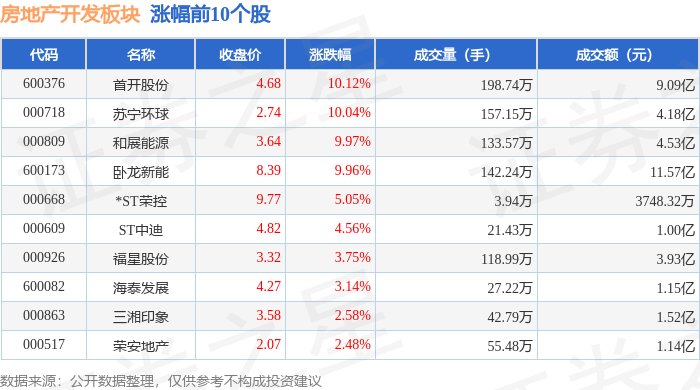
房地产开发板块9月10日涨0.44%,首开股份领涨,主力资金净流出12.13亿元
Zheng Xing Xing Ye Ri Bao· 2025-09-10 08:30
Market Performance - On September 10, the real estate development sector rose by 0.44% compared to the previous trading day, with Shouke Co. leading the gains [1] - The Shanghai Composite Index closed at 3812.22, up 0.13%, while the Shenzhen Component Index closed at 12557.68, up 0.38% [1] Top Gainers in Real Estate Sector - Shouke Co. (600376) closed at 4.68, with a gain of 10.12% and a trading volume of 1.9874 million shares, amounting to a transaction value of 909 million yuan [1] - Suning Universal (000718) closed at 2.74, up 10.04%, with a trading volume of 1.5715 million shares [1] - Hezhan Energy (000809) closed at 3.64, gaining 9.97%, with a trading volume of 1.3357 million shares [1] - Wolong New Energy (600173) closed at 8.39, up 9.96%, with a trading volume of 1.4224 million shares [1] Other Notable Stocks - ST Rongkong (000668) closed at 9.77, with a gain of 5.05% [1] - ST Zhongdi (000609) closed at 4.82, up 4.56% [1] - Fuxing Co. (000926) closed at 3.32, gaining 3.75% [1] Market Capital Flow - The real estate development sector experienced a net outflow of 1.213 billion yuan from major funds, while retail investors saw a net inflow of 1.149 billion yuan [2] - Speculative funds had a net inflow of 64.198 million yuan [2]


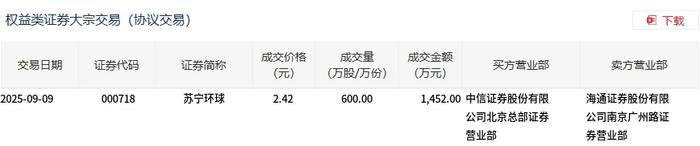
苏宁环球今日大宗交易折价成交600万股,成交额1452万元
Xin Lang Cai Jing· 2025-09-09 09:18
Group 1 - On September 9, Suning Universal executed a block trade of 6 million shares, with a transaction value of 14.52 million yuan, accounting for 4.14% of the total trading volume for that day [1][2] - The transaction price was 2.42 yuan per share, which represents a discount of 2.81% compared to the market closing price of 2.49 yuan [1][2] - The buyer of the shares was CITIC Securities, while the seller was Haitong Securities [2]
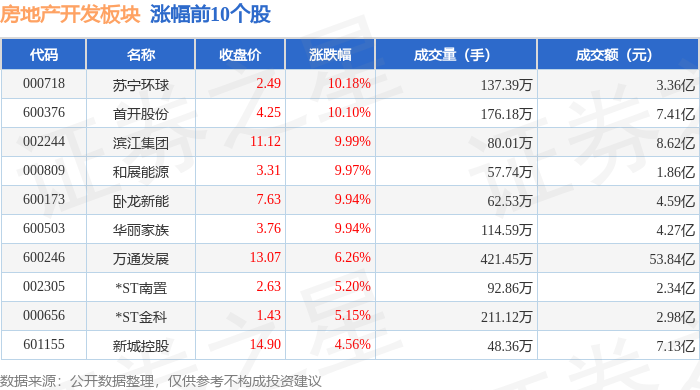
房地产开发板块9月9日涨1.55%,苏宁环球领涨,主力资金净流入3.63亿元
Zheng Xing Xing Ye Ri Bao· 2025-09-09 08:39
证券之星消息,9月9日房地产开发板块较上一交易日上涨1.55%,苏宁环球领涨。当日上证指数报收于 3807.29,下跌0.51%。深证成指报收于12510.6,下跌1.23%。房地产开发板块个股涨跌见下表: | 代码 | 名称 | 收盘价 | 涨跌幅 | 成交量(手) | 成交额(元) | | | --- | --- | --- | --- | --- | --- | --- | | 000718 | 示宁环球 | 2.49 | 10.18% | 137.39万 | | 3.36亿 | | 600376 | 首开股份 | 4.25 | 10.10% | 176.18万 | | 7.41亿 | | 002244 | 滨江集团 | 11.12 | 9.99% | C 80.01万 | | 8.62亿 | | 000809 | 和展能源 | 3.31 | 9.97% | 57.74万 | | 1.86亿 | | 600173 | 卧龙新能 | 7.63 | 9.94% | 62.53万 | | 4.59亿 | | 600503 | 华丽家族 | 3.76 | 9.94% | 114.59万 | | 4.27亿 | ...
苏宁环球:地产稳基医美提速,双主业协同穿越周期
Zheng Quan Shi Bao Wang· 2025-09-01 11:23
Core Viewpoint - Suning Universal (000718.SZ) reported a stable performance in the first half of 2025, achieving operating revenue of 934 million yuan and a net profit of 137 million yuan, supported by its dual business strategy of real estate and medical aesthetics [1] Group 1: Real Estate Performance - The real estate industry is in a transition phase towards high-quality development, with a steady adjustment in market demand [2] - Suning Universal maintains a low debt ratio of 29.74%, significantly below the industry average of 74.98%, reflecting a focus on financial safety [2] - The company emphasizes high-quality products and efficiency, targeting the Yangtze River Delta region to strengthen its real estate business [2] Group 2: Project Development - The company focuses on "delivery reputation" to mitigate market fluctuations, with successful project deliveries enhancing customer satisfaction [3] - The Nanjing Rongjin Ruifu project received high praise for its quality, with subsequent phases progressing as planned [3] - The Nanjing Binjiang Jingyuan project, aimed at first-time buyers, has commenced construction, further diversifying the product matrix [3] Group 3: Sales Strategy - The company employs a "step discount + multi-channel customer acquisition" strategy around key sales periods, effectively matching customer needs [4] - Sales in residential and commercial projects in Nanjing, Wuxi, and Wuhu saw a year-on-year increase of 100.47%, indicating a successful dual sales strategy [4] - Cost control measures have reduced construction costs by 2%-3% and shortened project timelines by 10%-15%, enhancing profitability [4] Group 4: Medical Aesthetics Growth - The medical aesthetics segment is a key growth driver, with revenue reaching 91.72 million yuan, a year-on-year increase of 4.44% [5] - The number of new customers surged by 50.4%, indicating strong market demand and customer recognition [5] - The company plans to expand its medical aesthetics presence in economically developed cities, enhancing its market share [6] Group 5: Management and Risk Control - The company has upgraded its internal management through clearer responsibilities and streamlined processes, improving operational efficiency [7] - A comprehensive risk control system has been established to ensure stable operations during industry fluctuations [7] - The real estate sector is expected to benefit from policies aimed at stabilizing the market, while the medical aesthetics industry is poised for growth driven by consumer recovery and technological innovation [7][8] Group 6: Future Outlook - Suning Universal aims to leverage its development experience, land reserves, and robust financial structure to expand market share in both real estate and medical aesthetics [8] - The company will continue to prioritize quality in its real estate offerings and accelerate its medical aesthetics market expansion [8]
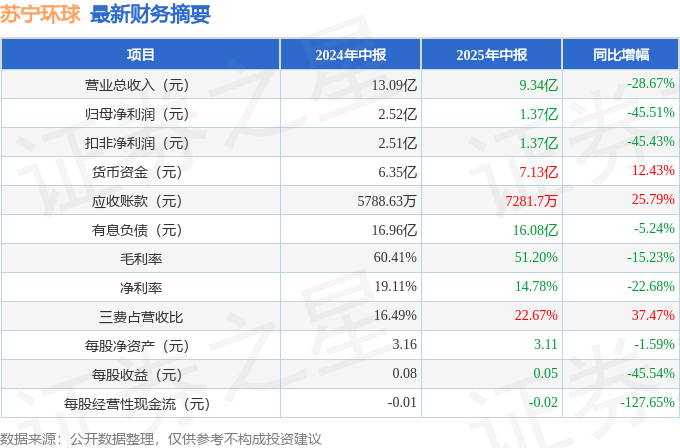
苏宁环球2025年中报简析:净利润同比下降45.51%,三费占比上升明显
Zheng Quan Zhi Xing· 2025-08-30 23:27
Core Viewpoint - Suning Universal (000718) reported a significant decline in financial performance for the first half of 2025, with total revenue and net profit both decreasing substantially compared to the previous year [1][3]. Financial Performance Summary - Total revenue for the first half of 2025 was 934 million yuan, a decrease of 28.67% year-on-year [1]. - Net profit attributable to shareholders was 137 million yuan, down 45.51% year-on-year [1]. - In Q2 2025, total revenue was 541 million yuan, a decline of 36.67% year-on-year, with net profit of 90.37 million yuan, down 43.93% [1]. - Gross margin was 51.2%, a decrease of 15.23% year-on-year, while net margin was 14.78%, down 22.68% [1]. - The total of financial, sales, and management expenses reached 212 million yuan, accounting for 22.67% of total revenue, an increase of 37.47% year-on-year [1]. Cash Flow and Debt Analysis - Operating cash flow per share was -0.02 yuan, a decrease of 127.65% year-on-year, attributed to a decline in sales collections [1][6]. - The net increase in cash and cash equivalents was down 144.45%, also due to decreased sales collections [1][8]. - Interest-bearing debt decreased by 5.24% year-on-year, totaling 1.608 billion yuan [1]. Business Model and Strategy - The company primarily relies on real estate development and sales, focusing on the Yangtze River Delta region while adhering to a "long-termism" philosophy [10]. - The business strategy emphasizes "low debt, high returns" and aims for sustainable development in both real estate and medical aesthetics sectors [10]. - Historical data indicates a weak business model with a median Return on Invested Capital (ROIC) of 8.33% over the past decade, and a particularly low ROIC of 2.08% in 2024 [9][10].
苏宁环球: 2025年半年度财务报告
Zheng Quan Zhi Xing· 2025-08-29 18:30
Core Viewpoint - The financial report of Suning Universal Co., Ltd. for the first half of 2025 shows a decline in total revenue and net profit compared to the same period in 2024, indicating potential challenges in the company's financial performance. Financial Statements Assets - Total assets decreased from ¥14,374,947,268.45 at the beginning of the period to ¥13,803,828,378.84 at the end of the period, a reduction of approximately ¥571 million [2][3]. - Current assets decreased from ¥10,303,989,131.46 to ¥9,814,186,795.55, a decline of about ¥490 million [2][3]. - Non-current assets also saw a decrease from ¥4,070,958,136.99 to ¥3,989,641,583.29, a reduction of approximately ¥81 million [2][3]. Liabilities - Total liabilities decreased from ¥4,692,561,470.82 to ¥4,104,858,004.56, a decline of about ¥588 million [3][4]. - Current liabilities decreased from ¥3,600,837,531.27 to ¥3,178,145,308.40, a reduction of approximately ¥422 million [3][4]. - Non-current liabilities decreased from ¥1,091,723,939.55 to ¥926,712,696.16, a decline of about ¥165 million [3][4]. Equity - Total equity increased slightly from ¥9,682,385,797.63 to ¥9,698,970,374.28, an increase of approximately ¥16 million [3][4]. - The retained earnings increased from ¥4,666,653,349.20 to ¥4,682,576,362.57, an increase of about ¥16 million [3][4]. Income Statement - Total operating revenue for the first half of 2025 was ¥933,641,824.08, down from ¥1,308,905,701.68 in the same period of 2024, a decrease of approximately 28.6% [5][6]. - Total operating costs decreased from ¥953,265,806.72 to ¥750,904,206.28, a reduction of about 21.2% [5][6]. - Net profit for the first half of 2025 was ¥137,970,032.01, down from ¥250,149,279.98 in the previous year, a decrease of approximately 44.8% [6][7]. Cash Flow Statement - Net cash flow from operating activities was negative at -¥62,583,631.40, compared to -¥27,491,220.89 in the previous year, indicating a worsening cash flow situation [8][9]. - Net cash flow from investing activities was positive at ¥127,631,465.44, an increase from ¥118,478,466.93 in the previous year [8][9]. - Net cash flow from financing activities was negative at -¥83,858,133.48, compared to -¥48,671,521.38 in the previous year, indicating increased cash outflows [8][9].
苏宁环球: 关于修订《公司章程》的公告
Zheng Quan Zhi Xing· 2025-08-29 18:30
Group 1 - The company has decided to amend its Articles of Association to enhance corporate governance effectiveness, specifically transferring the powers previously held by the Supervisory Board to the Audit Committee of the Board of Directors [1][2] - The Supervisory Board will be dissolved, and its responsibilities will be assumed by the Audit Committee once the resolution is approved at the upcoming extraordinary general meeting [2][3] - The company expresses gratitude to the Supervisory Board members for their contributions during their tenure and confirms that there are no unfulfilled commitments by the Supervisors [2][3] Group 2 - A series of governance system revisions and formulations will be implemented to improve the company's operational standards, in accordance with the latest regulations and guidelines [2][3] - Certain governance documents, such as the Shareholders' Meeting Rules and the Board of Directors' Meeting Rules, will require approval from the shareholders' meeting, while other documents will take effect immediately after the Board's approval [3]