
Valin Steel(000932)

Search documents
中美博弈或升温,关注避险需求与战略小金属
East Money Securities· 2025-10-13 12:30
Investment Rating - The report maintains an "Outperform" rating for the industry [2][9]. Core Insights - The report highlights the increasing geopolitical tensions between China and the U.S., which may elevate demand for safe-haven assets like gold and strategic metals such as rare earths and tungsten [5][9]. - The copper market is experiencing supply disruptions, with prices trending upward due to tight supply conditions [5]. - Aluminum demand is expected to continue, with potential opportunities for investment following market corrections [5]. - The strategic importance of rare earths and tungsten is emphasized due to recent export controls and geopolitical developments [5][9]. Summary by Sections Copper Sector - Supply disruptions are ongoing, with LME copper prices at $10,735 per ton, reflecting a week-on-week increase of 1.9% [5]. - The processing fee for imported copper concentrate is negative, indicating tight supply [5]. - Companies with rich copper reserves are recommended for investment [9]. Aluminum Sector - LME aluminum prices reached $2,800 per ton, up 3.6% week-on-week [5]. - The operating rate for aluminum processing enterprises has slightly decreased, but demand is expected to remain stable [5]. - Investment opportunities are suggested for companies in the aluminum sector following market corrections [9]. Gold Sector - Gold prices are rising, with SHFE gold at 901.6 RMB per gram, up 3.1% week-on-week [5]. - The report suggests that geopolitical tensions may enhance gold's strategic position as a safe-haven asset [5]. - Investment in gold-related companies is recommended due to their undervalued resource potential [9]. Rare Metals Sector - Rare earth prices remain stable, with praseodymium-neodymium oxide at 683,000 RMB per ton [5]. - Recent export controls on rare earths have heightened their strategic importance amid U.S.-China tensions [5][9]. - Investment opportunities are highlighted in companies involved in rare earth production [9]. Steel Sector - Steel prices are stable, with SHFE rebar at 3,103 RMB per ton, reflecting a week-on-week increase of 1.0% [6]. - The report notes frequent disruptions in iron ore supply negotiations, which may impact future prices [6]. - Companies with high self-sufficiency in iron ore are recommended for investment [9].




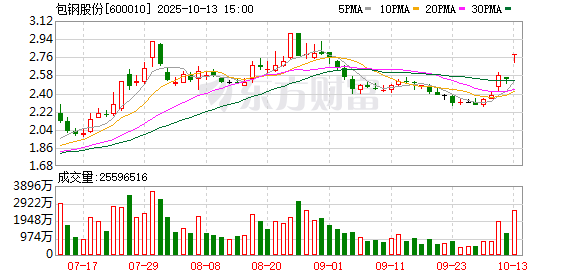
钢铁行业资金流入榜:包钢股份等6股净流入资金超千万元
Zheng Quan Shi Bao Wang· 2025-10-13 09:16
Market Overview - The Shanghai Composite Index fell by 0.19% on October 13, with six industries experiencing gains, led by non-ferrous metals and environmental protection, which rose by 3.35% and 1.65% respectively [2] - The steel industry ranked third in terms of daily gains, increasing by 1.49% [2] Capital Flow - The main capital outflow from the two markets totaled 38.169 billion yuan, with nine industries seeing net inflows [2] - The steel industry had the highest net inflow of main capital, amounting to 1.351 billion yuan, followed by the non-ferrous metals industry with a net inflow of 1.087 billion yuan [2] Steel Industry Performance - The steel industry saw a total of 44 stocks, with 20 stocks rising and 20 stocks falling; two stocks hit the daily limit up [3] - Among the stocks with net inflows, 13 stocks had positive capital flow, with six stocks receiving over 10 million yuan in net inflow [3] - Baogang Co. led the net inflow with 1.860 billion yuan, followed by Hualing Steel and Dazhong Mining with net inflows of 17.177 million yuan and 15.225 million yuan respectively [3] Individual Stock Analysis - The top stocks in terms of capital flow included: - Baogang Co. with a daily increase of 9.84% and a turnover rate of 8.16%, receiving 1.860 billion yuan in main capital [3][4] - Hualing Steel with a decrease of 1.07% and a turnover rate of 1.53%, receiving 17.177 million yuan [3][4] - Dazhong Mining with an increase of 0.69% and a turnover rate of 1.85%, receiving 15.225 million yuan [3][4] - The stocks with the highest capital outflow included: - Guangdong Mingzhu with a net outflow of 79.2103 million yuan [3][4] - Hangang Co. with a net outflow of 64.1359 million yuan [3][4] - Chongqing Steel with a net outflow of 49.729 million yuan [3][4]


2025年1-4月中国钢材产量为4.8亿吨 累计增长6%
Chan Ye Xin Xi Wang· 2025-10-13 01:26
Core Viewpoint - The report highlights the growth in China's steel production, indicating a positive trend in the industry with a year-on-year increase in output. Group 1: Industry Overview - In April 2025, China's steel production reached 130 million tons, marking a year-on-year growth of 6.6% [1] - From January to April 2025, the cumulative steel production in China totaled 480 million tons, reflecting a cumulative growth of 6% [1] Group 2: Companies Mentioned - The report lists several key companies in the steel industry, including Baosteel Co., Ltd. (600019), Ansteel Co., Ltd. (000898), and others [1]




证券研究报告行业周报:纷争的世界-20251012
GOLDEN SUN SECURITIES· 2025-10-12 09:44
Investment Rating - The industry investment rating is maintained as "Buy" for several key companies [6]. Core Insights - The steel industry is experiencing a slight decline in daily molten iron production, with an average of 241.5 thousand tons, down by 0.3 thousand tons [12]. - Total steel inventory is showing seasonal accumulation post the National Day holiday, with a week-on-week increase of 8.7% [24]. - Apparent consumption of steel products has decreased seasonally, with a notable drop in rebar demand [37]. - Iron ore prices have risen, influenced by changes in shipping volumes from Australia and Brazil [46]. - Steel prices are stable with slight improvements in immediate profit margins, indicating a potential for continued industry recovery [70]. Summary by Sections Supply - Daily molten iron production has slightly decreased to 241.5 thousand tons, with a decline in rebar and hot-rolled coil production [12][17]. Inventory - Total steel inventory has increased by 8.7% week-on-week, with steel mill inventories rising more than social inventories [24][26]. Demand - Apparent consumption of the five major steel products has decreased by 17.0% week-on-week, with rebar consumption down by 36.5% [48][37]. Raw Materials - Iron ore prices have increased, with the Platts 62% iron ore price index at $107.4 per ton, up by 3.4% week-on-week [58]. Prices and Profits - The comprehensive steel price index remains stable at 122.7, with slight improvements in immediate profit margins for long-process steel products [70][71].


钢厂利润承压,海外贸易摩擦升级
Minsheng Securities· 2025-10-12 05:11
Investment Rating - The report maintains a "Buy" recommendation for several steel companies, including Hualing Steel, Baosteel, Nanjing Steel, and others in the special steel and pipe sectors [5]. Core Viewpoints - Steel mill profits are under pressure due to rising inventory levels and escalating overseas trade frictions, with production remaining high during the National Day holiday [5]. - The EU has proposed to cut tax-free steel import quotas by 47% to 18.3 million tons per year, increasing tariffs on excess imports from 25% to 50%, which may suppress steel exports from China and the US [5]. - Long-term capacity regulation is expected to be a key theme, with potential recovery in profitability for steel companies under precise control measures [5]. Price Trends - As of October 10, steel prices have increased, with rebar prices at 3,260 CNY/ton (up 50 CNY), hot-rolled prices at 3,400 CNY/ton (up 60 CNY), and cold-rolled prices at 3,810 CNY/ton (up 10 CNY) [3][12]. - The overall steel inventory has risen, with total social inventory increasing by 691,100 tons to 11,268,900 tons [4]. Production and Inventory - Total production of major steel products decreased to 8.63 million tons, a reduction of 37,600 tons week-on-week, with rebar production down to 2.034 million tons [4]. - The apparent consumption of rebar fell to 1.4601 million tons, a decrease of 950,600 tons week-on-week [4]. Profitability - Steel margins have declined, with long-process rebar, hot-rolled, and cold-rolled margins decreasing by 11 CNY/ton, 10 CNY/ton, and 15 CNY/ton respectively [3][5]. Key Company Forecasts and Valuations - Hualing Steel (EPS: 0.29 CNY, PE: 22), Baosteel (EPS: 0.34 CNY, PE: 21), and Nanjing Steel (EPS: 0.37 CNY, PE: 15) are highlighted as recommended stocks [5].


强势股追踪 主力资金连续5日净流入86股
Zheng Quan Shi Bao Wang· 2025-10-10 09:50
Core Insights - A total of 86 stocks on the Shanghai, Shenzhen, and Beijing exchanges have experienced net inflows of main funds for five consecutive days or more as of October 10 [1] - The stock "寒武纪-U" has seen the longest streak of net inflows, with 32 consecutive days and a total net inflow of 4.377 billion [1] - "振德医疗" ranks second with 10 consecutive days of net inflows [1] Summary by Category Main Fund Inflows - "寒武纪-U" has the highest total net inflow amounting to 4.377 billion over 32 days, with a net inflow ratio of 0.72% and a cumulative increase of 33.52% [1] - "上海电力" follows with a net inflow of 1.521 billion over 6 days, achieving a cumulative increase of 32.91% [1] - "农业银行" and "万华化学" also show significant inflows, with net inflows of 1.078 billion and 540 million respectively over 6 and 7 days [1] Performance Metrics - "国电南自" has the highest net inflow ratio at 14.99% over 5 days, with a cumulative increase of 18.03% [1] - "振德医疗" has a cumulative increase of 40.10% over 10 days, indicating strong performance alongside its net inflow of 424 million [1] - Other notable stocks include "白银有色" with a cumulative increase of 35.11% and "东吴证券" with a 7.07% increase over 5 days [1]



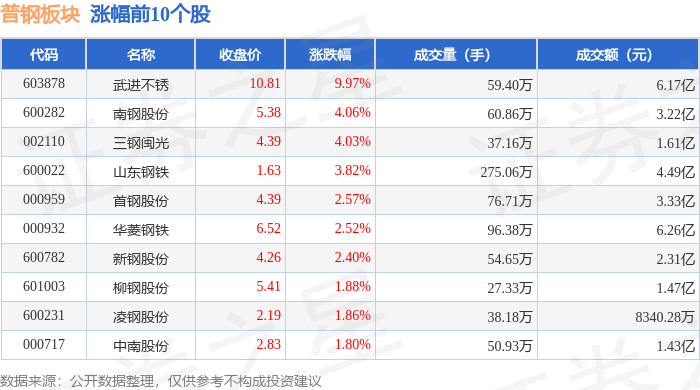
普钢板块10月10日涨1.09%,武进不锈领涨,主力资金净流出7.67亿元
Zheng Xing Xing Ye Ri Bao· 2025-10-10 08:45
Market Overview - On October 10, the general steel sector rose by 1.09%, led by Wujin Stainless Steel, while the Shanghai Composite Index closed at 3897.03, down 0.94% [1] - The Shenzhen Component Index closed at 13355.42, down 2.7% [1] Individual Stock Performance - Wujin Stainless Steel (603878) closed at 10.81, up 9.97% with a trading volume of 594,000 shares and a turnover of 617 million yuan [1] - Nanjing Steel (600282) closed at 5.38, up 4.06% with a trading volume of 608,600 shares and a turnover of 322 million yuan [1] - Other notable performers include: - Sansteel Minguang (002110) at 4.39, up 4.03% [1] - Shandong Steel (600022) at 1.63, up 3.82% [1] - Shougang Group (000959) at 4.39, up 2.57% [1] Capital Flow Analysis - The steel sector experienced a net outflow of 767 million yuan from institutional investors, while retail investors saw a net inflow of 582 million yuan [2] - Notable capital flows include: - Wujin Stainless Steel had a net outflow of 38.74 million yuan from institutional investors [3] - Liugang (601003) saw a net inflow of 20.04 million yuan from institutional investors [3] - New Steel (600782) had a net inflow of 15.20 million yuan from institutional investors [3]


A股钢铁股拉升,武进不锈触及涨停
Ge Long Hui· 2025-10-10 05:26
Core Viewpoint - The A-share market has seen a rally in steel stocks, with notable performances from several companies [1] Group 1: Company Performance - Wujin Stainless Steel reached its daily limit up [1] - Guangdong Mingzhu previously hit the limit up [1] - Jinling Mining, Shandong Steel, Changbao Co., Sansteel Minguang, and Hualing Steel also experienced gains [1]


华菱钢铁涨2.04%,成交额1.51亿元,主力资金净流入63.68万元
Xin Lang Cai Jing· 2025-10-10 02:07
Core Viewpoint - Hualing Steel has shown significant stock performance with a year-to-date increase of 59.03%, reflecting strong market interest and potential growth opportunities in the steel industry [1][2]. Financial Performance - For the first half of 2025, Hualing Steel reported operating revenue of 630.92 billion yuan, a year-on-year decrease of 16.93%, while net profit attributable to shareholders increased by 31.31% to 17.48 billion yuan [2]. - Cumulative cash dividends since the A-share listing amount to 104.36 billion yuan, with 39.34 billion yuan distributed over the last three years [3]. Stock Market Activity - As of October 10, Hualing Steel's stock price reached 6.49 yuan per share, with a market capitalization of 448.37 billion yuan [1]. - The stock has experienced a trading volume of 1.51 billion yuan, with a turnover rate of 0.34% [1]. - Recent trading data indicates a net inflow of 63.68 million yuan from main funds, with significant buying and selling activity from large orders [1]. Shareholder Structure - As of June 30, 2025, the number of shareholders increased to 90,300, a rise of 19.94%, while the average circulating shares per person decreased by 16.63% to 76,500 shares [2]. - Among the top ten circulating shareholders, Hong Kong Central Clearing Limited holds 134 million shares, an increase of 2.43 million shares from the previous period [3].
有色金属观点更新
2025-10-09 14:47
Summary of Key Points from Conference Call Records Industry Overview - The conference call primarily discusses the non-ferrous metals industry, particularly focusing on iron ore, copper, cobalt, tin, and antimony markets, as well as the implications of geopolitical factors on these sectors [1][2][3][4][5][6][19][21]. Core Insights and Arguments Guinea Simandou Iron Ore Project - The Guinea Simandou iron ore project is expected to export without the need for a supporting smelting plant due to inadequate local power infrastructure [1][4]. - The project is projected to start logistics in 2025, with potential exports reaching 30 million to 60 million tons in 2026, and possibly 120 million tons in the next 2-3 years, significantly impacting global shipping trade [3]. Iron Ore Trade and Market Reactions - A potential pause in cooperation between China and BHP over settlement currency issues could significantly affect iron ore trade, although current overseas market reactions are muted [1][5]. - Domestic investors are more sensitive to these developments, as evidenced by stock movements in related companies [5]. Steel Industry Dynamics - Short-term control of iron ore imports to manage steel production is unlikely, with supply-side reforms being crucial for long-term industry health [1][6]. - High-quality companies like Baosteel and Hualing Steel are identified as having medium to long-term investment value due to low valuations and high dividend yields [6]. Copper Market Supply and Demand - The copper market is expected to face significant supply disruptions, with major producers like Teck Resources and Efenhau Mine lowering production forecasts [1][8]. - Global copper supply is projected to be tight in the first half of 2026, with prices potentially reaching historical highs of $12,000 to $14,000 per ton [1][12]. AI and Data Center Demand for Copper - The demand for copper is significantly driven by AI and data centers, with each cabinet now using approximately 300 kg of copper, leading to an annual increase in demand of about 100,000 tons from AI-related equipment alone [9][12]. Cobalt Market Trends - Cobalt prices have risen to around 350,000 RMB per ton, with expectations to reach 400,000 to 450,000 RMB in Q4 2025 [1][16]. - Companies like Huayou Cobalt are expected to see profit increases due to rising cobalt prices [1][16]. Tin and Antimony Market Outlook - China's antimony exports have shown a significant increase since August 2025, highlighting its strategic value amid U.S. supply chain concerns [2][19]. - Huaxi Nonferrous is projected to increase tin production by 66%, with profits potentially reaching 1.6 billion RMB [2][19]. Strategic Metal Valuation - The valuation of strategic metals like copper and silver is expected to rise due to increased global focus on these resources [13]. - Companies like Zijin Mining are projected to have significant profit potential based on current market conditions [13]. Other Important Insights - The overall performance of the non-ferrous metals market has been strong, with steel markets also showing positive trends influenced by the Guinea Simandou project [3]. - The importance of supply chain security and strategic resource management is emphasized, particularly in light of geopolitical tensions and trade restrictions [21][25]. - The recovery of tin and antimony supply chains is critical, with disruptions in Indonesia and Myanmar affecting global supply [19][20]. This summary encapsulates the key points discussed in the conference call, providing insights into market dynamics, company performance, and future trends in the non-ferrous metals industry.

