Visionox(002387)

Search documents
维信诺(002387) - 维信诺科技股份有限公司关于深圳证券交易所《关于维信诺科技股份有限公司发行股份购买资产并募集配套资金申请的第二轮审核问询函》之回复(修订稿)
2025-06-25 11:45
维信诺科技股份有限公司 关于深圳证券交易所 独立财务顾问 签署日期:二〇二五年六月 《关于维信诺科技股份有限公司发行股份购买资产并募 集配套资金申请的第二轮审核问询函》之回复 (修订稿) 深圳证券交易所上市审核中心: 维信诺科技股份有限公司(以下简称"上市公司"、"公司"或"维信诺")于 2023 年 8 月 23 日收到深圳证券交易所上市审核中心下发的《关于维信诺科技股份有限 公司发行股份购买资产并募集配套资金申请的第二轮审核问询函》[审核函〔2023〕 130014 号](以下简称"审核问询函")。公司及相关中介机构就审核问询函所提问题进 行了认真讨论分析,并按照要求在《维信诺科技股份有限公司发行股份及支付现金购买 资产并募集配套资金暨关联交易报告书(草案)(修订稿)》(以下简称"重组报告书") 中进行了补充披露,现将相关回复说明如下。 如无特别说明,本审核问询函回复中的简称或名词释义与重组报告书所定义的词语 或简称具有相同的含义。在本审核问询函回复中,若合计数与各分项数值相加之和在尾 数上存在差异,均为四舍五入所致。本审核问询函回复所引用的财务数据和财务指标, 如无特殊说明,指合并报表口径的财务数据和根 ...

维信诺(002387) - 维信诺科技股份有限公司发行股份及支付现金购买资产并募集配套资金暨关联交易报告书(草案)摘要(修订稿)
2025-06-25 11:45
股票代码:002387.SZ 股票简称:维信诺 上市地点:深圳证券交易所 维信诺科技股份有限公司 发行股份及支付现金购买资产 并募集配套资金暨关联交易报告书(草案)摘要 (修订稿) | 发行股份及支付现金购买资产交易对方 | 合肥合屏投资有限公司 | | --- | --- | | | 合肥芯屏产业投资基金(有限合伙) | | | 合肥兴融投资有限公司 | | 募集配套资金交易对方 | 不超过35名特定对象 | 独立财务顾问 签署日期:二〇二五年六月 维信诺科技股份有限公司 发行股份及支付现金购买资产并募集配套资金暨关联交易报告书(草案)摘要(修订稿) 交易各方声明 一、上市公司声明 本公司及全体董事、监事、高级管理人员保证重组报告书及其摘要内容的真实、 准确、完整,保证不存在虚假记载、误导性陈述或者重大遗漏,并对其内容的真实性、 准确性、完整性承担相应的法律责任。 本公司全体董事、监事、高级管理人员承诺,如本次重组所提供或披露的信息涉 嫌虚假记载、误导性陈述或者重大遗漏,被司法机关立案侦查或者被中国证监会立案 调查的,在形成调查结论以前,不转让在上市公司拥有权益的股份(如有),并于收 到立案稽查通知的两个交 ...
维信诺(002387) - 关于向深圳证券交易所申请恢复审核公司发行股份及支付现金购买资产并募集配套资金暨关联交易的公告
2025-06-25 11:45
本公司及董事会全体成员保证信息披露的内容真实、准确、完整,无虚 假记载、误导性陈述或者重大遗漏。 维信诺科技股份有限公司(以下简称"公司")拟发行股份及支付现金购买 参股子公司合肥维信诺科技有限公司(以下简称"标的公司")控股权并募集配套 资金暨关联交易(以下简称"本次重组")。本次重组已经公司2023年第二次临时 股东大会审议通过,并及时向深圳证券交易所(以下简称"深交所")报送了相 关申报材料。 维信诺科技股份有限公司 关于向深圳证券交易所申请恢复审核公司发行股份及支付现金 购买资产并募集配套资金暨关联交易的公告 证券代码:002387 证券简称:维信诺 公告编号:2025-067 截至目前,相关交易方案已调整完毕,并已根据相关法律法规的规定履行 完毕审议披露程序。根据《深圳证券交易所上市公司重大资产重组审核规则》 的相关规定,公司已向深交所提交了恢复审核的申请。 本次重组尚需深交所审核通过并报中国证监会注册,能否获得审核通过与注 册尚存在不确定性,公司将根据该事项的审核进展情况及时履行信息披露义务。 公司将根据本次重组的审核进展情况及时履行信息披露义务,敬请广大投资者认 真阅读有关内容。公司郑重提示投资 ...
维信诺(002387) - 第七届监事会第十八次会议决议公告
2025-06-25 11:45
证券代码:002387 证券简称:维信诺 公告编号:2025-064 维信诺科技股份有限公司 第七届监事会第十八次会议决议公告 本公司及监事会全体成员保证信息披露的内容真实、准确、完整,无虚 假记载、误导性陈述或者重大遗漏。 一、监事会召开情况 维信诺科技股份有限公司(以下简称"公司")第七届监事会第十八次会议 (以下简称"会议")通知于2025年6月20日以电子邮件及专人通知的方式发出, 会议于2025年6月25日下午以通讯表决的方式举行。会议应出席监事3名,实际 出席的监事3人,会议由公司监事会主席任华女士主持,公司董事会秘书列席了 会议。本次会议的召集和召开符合有关法律、行政法规、部门规章、规范性文 件和《公司章程》的规定,所作决议合法有效。 二、监事会审议情况 (一) 会议以3票同意,0票反对,0票弃权审议通过了《关于调整公司发 行股份及支付现金购买资产暨关联交易方案的议案》 公司拟发行股份及支付现金购买参股子公司合肥维信诺科技有限公司(以下 简称"标的公司")控股权并募集配套资金暨关联交易(以下简称"本次重组"、 "本次交易"),本次交易方案对业绩补偿承诺事项进行了调整,具体调整如下: | 序 号 ...
维信诺(002387) - 第七届董事会第二十次会议决议公告
2025-06-25 11:45
证券代码:002387 证券简称:维信诺 公告编号:2025-063 维信诺科技股份有限公司 第七届董事会第二十次会议决议公告 本公司及董事会全体成员保证信息披露的内容真实、准确、完整,无虚 假记载、误导性陈述或者重大遗漏。 一、董事会召开情况 维信诺科技股份有限公司(以下简称"公司")第七届董事会第二十次会议 (以下简称"会议")通知于2025年6月20日以电子邮件及专人通知的方式发出, 会议于2025年6月25日下午以通讯表决的方式举行。会议由公司董事长张德强先 生主持,应出席董事7名,实际出席的董事7人,公司部分监事、高级管理人员 和董事会秘书列席了会议。会议的召集和召开符合有关法律、行政法规、部门 规章、规范性文件和《公司章程》的规定,所作决议合法有效。 二、董事会审议情况 (一) 会议以7票同意,0票反对,0票弃权审议通过了《关于调整公司发 行股份及支付现金购买资产暨关联交易方案的议案》 公司拟发行股份及支付现金购买参股子公司合肥维信诺科技有限公司(以下 简称"标的公司")控股权并募集配套资金暨关联交易(以下简称"本次重组"、 "本次交易"),本次交易方案对业绩补偿承诺事项进行了调整,具体调整如下: ...
研判2025!中国柔性显示行业产业链、相关政策及市场现状分析:受益于产能扩张、成本下降,柔性显示发展迅速[图]
Chan Ye Xin Xi Wang· 2025-06-20 01:16
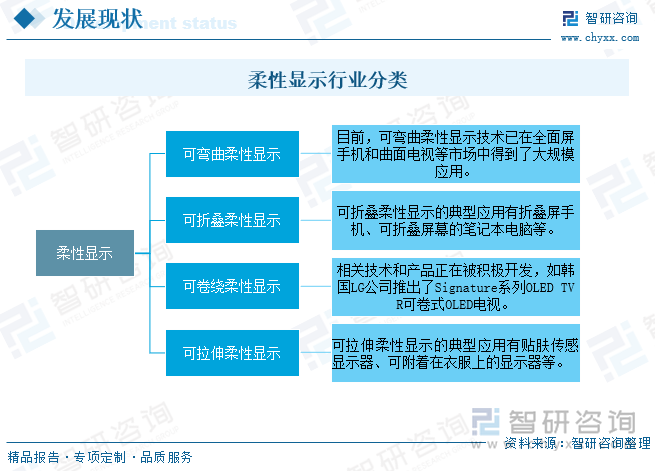
Core Insights - Flexible display technology is revolutionizing the display industry by enabling devices to be curved, folded, and rolled, breaking the traditional rigid display limitations [1][17] - The global flexible display market is projected to grow from $23.2 billion in 2024 to over $173 billion by 2031, driven by advancements in 5G, AI, and VR technologies [1][17] - The flexible OLED segment is expected to see significant growth, with global shipments estimated at approximately 617 million units in 2024, reflecting a year-on-year increase of 21.5% [21] Industry Overview - Flexible displays are made from soft materials and are characterized by low energy consumption, lightweight, durability, and shape variability [2][7] - The main types of flexible displays include bendable, foldable, rollable, and stretchable displays, with bendable and foldable displays already seeing large-scale applications in consumer electronics [2][4] Technology Landscape - The leading technology for flexible displays is flexible OLED, known for its high contrast, wide viewing angles, and rapid response times [4][6] - Other technologies include flexible LCD, electronic paper, quantum dot LEDs, and Micro-LEDs, with flexible OLED being the most widely adopted [4][6] Market Dynamics - The Asia-Pacific region dominates the flexible display market, accounting for over 65% of the global market share, with China, South Korea, and Japan as key contributors [17] - The flexible AMOLED market share in smartphones is expected to rise from 28% in 2022 to 40% in 2024, driven by the demand for high-end smartphone models [19][21] Competitive Landscape - Samsung is the leading global supplier of flexible OLED displays, while BOE Technology Group is the largest producer in China, having broken the international monopoly in 2017 [23] - Chinese companies like BOE, Visionox, Tianma, and TCL Huaxing have made significant technological advancements, enhancing their competitiveness and gradually reducing Samsung's market dominance [23]



总投资550亿,合肥国显第8.6代AMOLED项目更新进度
WitsView睿智显示· 2025-06-19 09:50
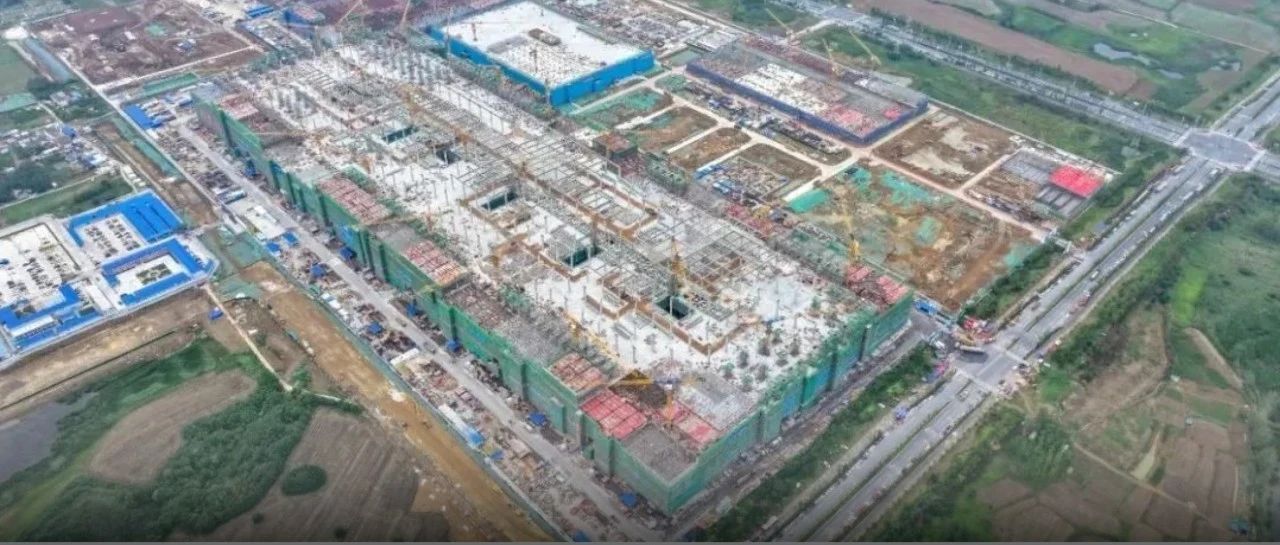
Core Viewpoint - The article highlights the advancements in the 8.6 generation AMOLED production lines in China, particularly focusing on the projects by Hefei Guoxian, Samsung Display, and BOE, which are set to meet the growing demand for OLED technology in various applications, including laptops and tablets. Group 1: Hefei Guoxian Project - The Hefei Guoxian 8.6 generation AMOLED project has a total investment of 55 billion yuan and a construction area of approximately 800,000 square meters, with a designed capacity of 32,000 glass substrates per month [2] - The project is notable for being the world's first 8.6 generation AMOLED production line to adopt the FMM-free technology (ViP technology), targeting medium-sized applications such as displays for tablets and vehicles [2] - The project is expected to commence construction in September 2024, with the main structure already entering the final construction phase [1] Group 2: Samsung Display Project - Samsung Display's A6 factory in Asan, South Korea, is set to begin trial operations of its 8.6 generation OLED production line by the end of this year, with full-scale production planned for the second quarter of 2026 [2][3] - The A6 line, which is a modification of the existing L8 line, has a total investment of 4.1 trillion Korean won (approximately 21.279 billion yuan) and aims to produce 10 million laptop panels annually [3] - The timing of the A6 line's mass production aligns with Apple's anticipated release of OLED MacBook Pro and iPad models in the second half of 2026 [3] Group 3: BOE Project - BOE's first domestic 8.6 generation AMOLED production line has commenced equipment installation four months ahead of schedule, with a total investment of 63 billion yuan and a designed capacity of 32,000 glass substrates per month [4] - The production line is focused on medium-sized AMOLED panels for mid-to-high-end laptops and tablets, with capabilities to produce flexible OLED smartphone panels [4] - The project broke ground on March 27, 2024, and achieved full structural completion by September 26, 2024, with mass production expected by the end of 2026 and full capacity by 2029 [4]
维信诺(002387) - 2025年6月11日投资者关系活动记录表
2025-06-12 09:08
Group 1: Company Overview - Visionox is a leading innovative supplier of new display overall solutions, focusing on AMOLED and Micro-LED displays for various applications including smartphones, wearables, and automotive displays [2] - The company maintains strong partnerships with major brands such as Honor, Xiaomi, OPPO, and Google [2] Group 2: Market Trends and Projections - The AMOLED market is experiencing rapid expansion, with a projected compound annual growth rate (CAGR) of 56% for IT product AMOLED panel shipments from 2023 to 2028, and 49% for automotive displays [4] - In 2025, the demand for AMOLED smartphone panels is expected to remain strong, with stable product prices [3] Group 3: Financial Performance - In Q1 2025, Visionox achieved a revenue of 1.815 billion CNY, with a recovering gross margin [3] Group 4: Technological Advancements - The company has introduced solid-state laser annealing (SLA) technology, which improves screen uniformity and reduces production costs compared to traditional methods [8] - The ViP technology developed by the company allows for high pixel density and enhanced color performance, with applications ranging from smartwatches to large displays [10][11] Group 5: Strategic Initiatives - Visionox plans to repurchase shares to enhance investor confidence and support long-term value, with shares intended for future employee stock ownership plans [9] - The company is actively localizing its supply chain, significantly increasing the localization rate of upstream materials and equipment [7]
中尺寸显示器需求增长,无FMM OLED技术迎新机会
WitsView睿智显示· 2025-06-05 09:34
Core Viewpoint - The OLED technology is expanding its market share due to its self-emissive, high contrast, and lightweight advantages, primarily in small-sized applications like smartphones. However, the large-sized market faces slow growth due to cost and capacity constraints. The mid-sized market, including monitors, laptops, tablets, and automotive displays, is experiencing renewed competition driven by consumer demand for high-quality displays. TrendForce forecasts an 80.6% annual increase in OLED display shipments by 2025, with overall market penetration rising to 2% and potentially reaching 5% by 2028 [1][2]. Group 1 - TrendForce predicts that the penetration rate of OLED displays in the overall market will increase significantly, with a forecasted shipment growth of 80.6% by 2025 [1]. - The mid-sized display market is becoming increasingly competitive as consumers seek higher display quality, leading to new market dynamics [1][2]. - Companies like TCL Huaxing and Visionox are developing new technologies such as ViP and printed OLED to differentiate themselves from traditional FMM OLED technologies [2][3]. Group 2 - TCL Huaxing plans to introduce its self-developed printed OLED products into the medical display market by the end of 2024, showcasing a complete product line at the SID Display Week in May 2025 [2][3]. - The printed OLED technology aims to overcome limitations of FMM and vacuum environments, improving material usage efficiency and reducing investment costs by approximately 25% compared to similar vapor-deposited products [3][4]. - Despite challenges in yield, pixel density, and reliability, printed OLED panels have achieved a resolution of 326 PPI, meeting the needs of laptops and monitors [3][4]. Group 3 - Visionox is actively promoting its ViP technology, which utilizes lithography to achieve pixel graphic design, eliminating FMM limitations and supporting high aperture ratios and various pixel arrangements [4][5]. - A comparison of different OLED technologies highlights that printed OLED has lower equipment investment costs and is expected to achieve mass production by the end of 2024, while still facing yield challenges [5][7]. - The industry is moving towards more flexible and cost-effective OLED solutions, with non-vapor deposition technologies gaining traction [7].


研报 | 中尺寸显示器需求增长,无FMM OLED技术迎新机会
TrendForce集邦· 2025-06-05 08:30
Core Insights - OLED technology is expanding its market share due to advantages like self-emission, high contrast, and lightweight design, primarily in small-sized applications such as smartphones. However, large-sized market penetration is slow due to cost and capacity constraints [1] - The mid-size market, including monitors, laptops, tablets, and automotive displays, is experiencing renewed competition as consumers seek high-end display effects [1] - TrendForce forecasts that OLED display shipments will grow by 80.6% annually by 2025, with overall market penetration reaching 2%, and potentially challenging 5% by 2028 [1] Group 1: Market Dynamics - TCL Huaxing is set to mass-produce medical-grade printed OLED displays, while Visionox is expected to introduce ViP technology in its new production line [2] - Printed OLED technology aims to overcome limitations of FMM and vacuum environments, enhancing material usage efficiency and reducing equipment investment costs by approximately 25% compared to similar vapor-deposited products [2] - Despite challenges in yield, pixel density, and reliability, printed OLED panels have achieved a resolution of 326 PPI, meeting the needs of laptops and monitors [2] Group 2: Technological Innovations - TCL Huaxing is balancing technological innovation and mass production by supplying high-end smartphones and flagship laptops with FMM OLED while gradually introducing printed OLED for medical and gaming displays [2] - By the end of 2024, TCL Huaxing will begin small-scale production of 21.6-inch medical printed OLED displays, marking a significant step into commercial application [2] - Visionox is actively promoting its proprietary ViP technology, which utilizes lithography to achieve pixel graphics, freeing itself from FMM's size and resolution constraints [3] Group 3: Comparative Analysis - A comparison of OLED technologies shows that printed OLED has lower equipment investment costs and high material usage efficiency, while FMM OLED is more established but has higher costs [4] - The pixel density of ViP OLED can reach 1700-2000 PPI, significantly higher than the approximately 326 PPI of printed OLED, indicating a trade-off between technology maturity and performance [4] - The market is expected to see a shift towards more flexible and cost-effective OLED solutions as non-vapor deposition technologies gain traction [3][4]