WINBASE(002492)

Search documents
恒基达鑫(002492) - 关于计提资产减值准备的公告
2025-10-29 12:10
证券代码:002492 证券简称:恒基达鑫 公告编号:2025-042 珠海恒基达鑫国际化工仓储股份有限公司 关于计提资产减值准备的公告 本公司及董事会全体成员保证信息披露的内容真实、准确、完整,没有虚假记载、 误导性陈述或重大遗漏。 一、本次计提减值准备情况概述 (一)本次计提减值准备的原因 珠海恒基达鑫国际化工仓储股份有限公司(以下简称"公司""本公司") 为更加真实、准确、客观地反映公司资产负债状况和经营成果,根据《企业 会计准则》以及相关文件的要求,对截至 2025 年 9 月 30 日的应收款项、应收 票据、其他应收款和一年内到期的应收账款进行减值测试,对可能发生减值 损失的资产计提了资产减值准备。 (二)本次计提减值准备的资产范围及金额 (三)本次计提资产减值准备及信用减值准备拟计入的报告期间为 1 单位:万元 资产减值项目 期初金额 本期计提 本期转回 其他 期末金额 可回收金额 应收账款 2,633.79 2,334.19 4,967.98 3,239.91 应收票据 0.004 0.004 0.004 应收利息 239.24 0.26 239.50 0.00 其他应收款 223.74 2.4 ...

恒基达鑫(002492) - 第六届董事会第十八次会议决议公告
2025-10-29 12:06
证券代码:002492 证券简称:恒基达鑫 公告编号:2025-040 珠海恒基达鑫国际化工仓储股份有限公司 第六届董事会第十八次会议决议公告 本公司及董事会全体成员保证信息披露的内容真实、准确、完整,没有虚假 记载、误导性陈述或重大遗漏。 报 告 全 文 内 容 详 见 2025 年 10 月 30 日 的 巨 潮 资 讯 网 (http://www.cninfo.com.cn)。 珠海恒基达鑫国际化工仓储股份有限公司(以下简称"公司") 第六届董事会第十八次会议通知于 2025 年 10 月 22 日以电子邮件通 知形式发出,于 2025 年 10 月 28 日以现场结合通讯表决方式召开。 本次会议的召集、召开符合《中华人民共和国公司法》、公司章程和 二、会议以 7 票同意, 0 票反对, 0 票弃权的表决结果,审议通 过了《关于制定<董事、高级管理人员离职管理制度>的议案》 制 度 具 体 内 容 详 见 2025 年 10 月 30 日 的 巨 潮 资 讯 网 (http://www.cninfo.com.cn)。 1 备查文件: 珠海恒基达鑫国际化工仓储股份有限公司第六届董事会第十八 次会议决议。 ...
恒基达鑫:2025年前三季度净利润约5281万元
Mei Ri Jing Ji Xin Wen· 2025-10-29 11:50
Group 1 - Company Hengji Daxin reported Q3 performance, with revenue of approximately 260 million yuan for the first three quarters of 2025, a year-on-year decrease of 1.34% [1] - The net profit attributable to shareholders of the listed company was approximately 52.81 million yuan, reflecting a year-on-year decrease of 5.2% [1] - As of the report date, Hengji Daxin's market capitalization stood at 3.2 billion yuan [2] Group 2 - The A-share market has surpassed 4000 points, marking a significant resurgence after a decade of stagnation, with technology as the main driver reshaping the market [2] - A new "slow bull" market pattern is emerging, indicating a shift in market dynamics [2]
恒基达鑫:10月28日召开董事会会议
Mei Ri Jing Ji Xin Wen· 2025-10-29 11:49
Group 1 - The core point of the article is that Hengji Daxin (SZ 002492) held its 18th meeting of the sixth board of directors on October 28, 2025, where it reviewed the proposal for establishing a senior management personnel resignation management system [1] - For the first half of 2025, Hengji Daxin's revenue composition was as follows: warehousing accounted for 45.82%, loading and unloading accounted for 34.87%, other businesses accounted for 15.79%, and management services accounted for 3.52% [1] - As of the time of reporting, Hengji Daxin's market capitalization was 3.2 billion yuan [1] Group 2 - The A-share market has surpassed 4000 points, marking a significant resurgence after a decade of stagnation, with technology leading the market's transformation and a new "slow bull" pattern emerging [1]
恒基达鑫(002492) - 董事、高级管理人员离职管理制度
2025-10-29 11:30
珠海恒基达鑫国际化工仓储股份有限公司 董事、高级管理人员离职管理制度 第一条 为规范珠海恒基达鑫国际化工仓储股份有限公司(以下 简称"公司")董事、高级管理人员离职管理,保障公司治理结构的 稳定性和连续性,维护公司及股东的合法权益,根据《中华人民共和 国公司法》(以下简称"《公司法》")、《中华人民共和国证券法》 (以下简称"《证券法》")、《上市公司治理准则》《深圳证券交 易所股票上市规则》《上市公司董事和高级管理人员所持本公司股份 及其变动管理规则》等法律法规、规范性文件、证券交易所业务规则 及《珠海恒基达鑫国际化工仓储股份有限公司章程》(以下简称"《公 司章程》")的有关规定,结合公司实际情况,特制定本制度。 2025 年 10 月 | | | 第一章 总则 第二条 本制度适用于公司全体董事(含独立董事)和高级管理 人员因任期届满、辞职、被解除职务或其他原因离职的情形。 第三条 公司董事、高级管理人员离职管理应遵循以下原则: (一)合法合规原则:严格遵守国家法律法规、监管规定及《公 司章程》的要求; (二)公开透明原则:及时、准确、完整地披露董事、高级管理 人员离职相关信息; (三)平稳过渡原则:确保董 ...
恒基达鑫(002492) - 2025 Q3 - 季度财报
2025-10-29 11:25
Financial Performance - The company's operating revenue for Q3 2025 was ¥87,960,840.06, an increase of 2.43% compared to the same period last year[7]. - The net profit attributable to shareholders decreased by 50.05% to ¥8,364,107.25 for Q3 2025[7]. - The net profit attributable to shareholders after deducting non-recurring gains and losses fell by 73.64% to ¥3,827,662.23[7]. - The company's basic earnings per share for Q3 2025 was ¥0.0207, down 49.88% year-on-year[7]. - Net profit for the current period is ¥53,991,229.35, a decrease of 2.7% compared to ¥55,478,895.82 in the previous period[23]. - Earnings per share (EPS) decreased to ¥0.1304 from ¥0.1375 in the previous period[25]. - Total operating revenue for the current period is ¥260,388,759.27, a decrease of 2.1% from ¥263,919,588.66 in the previous period[22]. - Total operating costs increased to ¥194,720,033.57, up 0.3% from ¥194,193,283.61 in the previous period[22]. - Investment income for the current period is ¥3,316,597.53, down from ¥6,254,615.33 in the previous period[22]. Cash Flow - The net cash flow from operating activities for the year-to-date period was ¥26,435,381.03, a significant decrease of 92.43%[7]. - Cash flow from operating activities generated ¥26,435,381.03, significantly down from ¥349,374,105.79 in the previous period[26]. - The net cash flow from investment activities was -87,782,146.69, compared to -262,649,872.40 in the previous period, indicating an improvement[27]. - Cash inflow from financing activities totaled 390,337,078.90, up from 265,893,925.59 in the prior period, reflecting increased borrowing[27]. - The net cash flow from financing activities was 57,619,674.32, a significant recovery from -11,281,430.30 previously[27]. - The total cash and cash equivalents at the end of the period were 215,105,848.10, down from 284,815,984.77 at the end of the previous period[27]. - Cash inflow from investment activities was 1,013,918,204.39, compared to 569,479,869.12 previously, showing a rise in cash received from investments[27]. - The company received 370,537,078.90 in cash from borrowings, an increase from 255,992,472.78 in the prior period[27]. - The company reported a cash outflow of 285,977,739.88 for debt repayment, up from 204,780,473.05 previously[27]. - The impact of exchange rate changes on cash and cash equivalents was 238,590.85, compared to -272,081.91 in the previous period, indicating a positive effect this time[27]. - The company’s cash and cash equivalents decreased by 3,488,500.49 during the period, contrasting with an increase of 75,170,721.18 in the previous period[27]. Assets and Liabilities - Total assets at the end of the reporting period reached ¥2,319,753,935.26, reflecting a growth of 10.51% compared to the end of the previous year[7]. - Current assets totaled CNY 1,130,375,823.48, up from CNY 940,234,083.27 at the beginning of the period[18]. - The total assets as of September 30, 2025, were CNY 2,319,753,935.26, an increase from CNY 2,099,053,070.92 at the beginning of the period[19]. - Total liabilities increased to ¥572,691,564.33 from ¥399,749,949.38, reflecting a growth of 43.3%[21]. - Non-current liabilities included long-term borrowings of CNY 179,906,739.53, up from CNY 147,104,956.35[19]. - The company's short-term borrowings rose by 41.41% to ¥113,405,565.36, driven by increased short-term loans from subsidiaries[12]. - The company's short-term borrowings increased to CNY 113,405,565.36 from CNY 80,194,603.89[19]. Other Income and Expenses - The total non-recurring gains and losses for the year-to-date period amounted to ¥4,536,445.02, down from ¥11,006,949.08 in the previous year[9]. - Other income rose by 73.35% to CNY 172,412.18, primarily due to insurance compensation received by Yangzhou Hengji Daxin[14]. - Operating expenses decreased by 67.19% to CNY 1,117,711.55, as there were no insurance compensation expenses this year compared to the previous year[14]. - Credit impairment losses amounted to CNY -20,703,140.05, reflecting an increase of 30.57% compared to the previous year, mainly due to the reversal of bad debt provisions for receivables[14]. - Asset disposal income increased by 84.53% to CNY 68,503.62, attributed to the disposal of fixed assets by Zhuhai Hengji Daxin and Yangzhou Hengji Daxin[14]. - The fair value change income for the reporting period was CNY 7,203,931.81, primarily due to the reversal of fair value change losses from the sale of debt funds, resulting in a cumulative increase of 193.86%[14].
物流板块10月23日涨0.28%,长江投资领涨,主力资金净流出2051.06万元
Zheng Xing Xing Ye Ri Bao· 2025-10-23 08:20
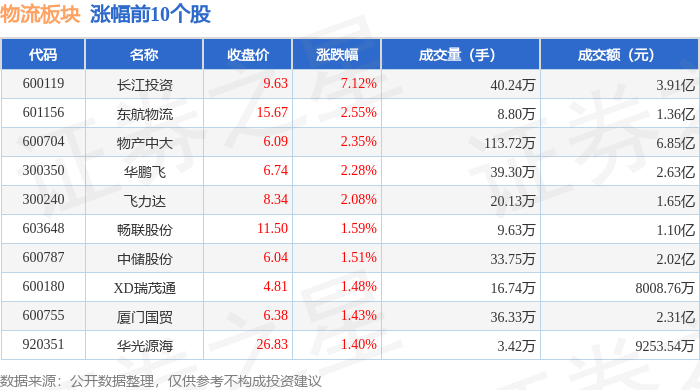
Market Overview - On October 23, the logistics sector rose by 0.28% compared to the previous trading day, with Changjiang Investment leading the gains [1] - The Shanghai Composite Index closed at 3922.41, up 0.22%, while the Shenzhen Component Index closed at 13025.45, also up 0.22% [1] Stock Performance - Changjiang Investment (600119) closed at 9.63, with a gain of 7.12% and a trading volume of 402,400 shares, amounting to a transaction value of 391 million [1] - Other notable performers included Eastern Airlines Logistics (601156) with a 2.55% increase, and Wuchan Zhongda (600704) with a 2.35% increase [1] Fund Flow Analysis - The logistics sector experienced a net outflow of 20.51 million from institutional investors, while retail investors saw a net inflow of 116 million [2] - Major stocks like Changjiang Investment and Wuchan Zhongda had significant net inflows from retail investors, despite overall outflows from institutional and speculative funds [3] Individual Stock Insights - Changjiang Investment had a net inflow of 83.66 million from institutional investors, but a net outflow of 39.65 million from speculative funds [3] - Wuchan Zhongda also saw a net inflow of 70.94 million from institutional investors, with a net outflow of 25.73 million from speculative funds [3]


恒基达鑫涨2.07%,成交额3409.97万元,主力资金净流入4.11万元
Xin Lang Cai Jing· 2025-10-21 05:17
Core Viewpoint - Hengji Daxin's stock price has shown significant growth this year, with a year-to-date increase of 64.72%, despite a slight decline in the last five trading days [1] Group 1: Stock Performance - As of October 21, Hengji Daxin's stock price rose by 2.07% to 7.89 CNY per share, with a trading volume of 34.1 million CNY and a turnover rate of 1.11%, resulting in a total market capitalization of 3.195 billion CNY [1] - The stock has experienced a decline of 1.99% over the last five trading days, but has increased by 2.60% over the last 20 days and 22.71% over the last 60 days [1] Group 2: Financial Performance - For the first half of 2025, Hengji Daxin reported operating revenue of 172 million CNY, a year-on-year decrease of 3.15%, while the net profit attributable to shareholders was 44.44 million CNY, reflecting a year-on-year increase of 14.08% [2] Group 3: Shareholder Information - As of June 30, 2025, the number of shareholders for Hengji Daxin increased by 19.40% to 22,000, while the average circulating shares per person decreased by 16.25% to 18,115 shares [2] - Since its A-share listing, Hengji Daxin has distributed a total of 263 million CNY in dividends, with 89.07 million CNY distributed over the past three years [3]
物流板块10月16日跌1.07%,申通快递领跌,主力资金净流出1.61亿元
Zheng Xing Xing Ye Ri Bao· 2025-10-16 08:20
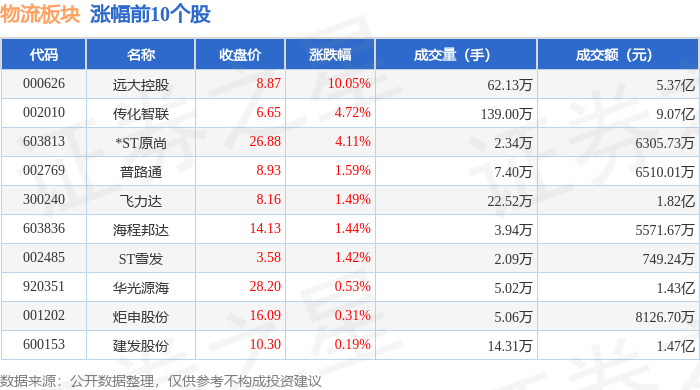
Market Overview - The logistics sector experienced a decline of 1.07% on October 16, with Shentong Express leading the drop [1] - The Shanghai Composite Index closed at 3916.23, up 0.1%, while the Shenzhen Component Index closed at 13086.41, down 0.25% [1] Individual Stock Performance - Notable gainers included: - Yuanda Holdings (Code: 000626) with a closing price of 8.87, up 10.05% and a trading volume of 621,300 shares, totaling 537 million yuan [1] - Chuanhua Zhili (Code: 002010) closed at 6.65, up 4.72% with a trading volume of 1,390,000 shares, totaling 907 million yuan [1] - Major decliners included: - Shentong Express (Code: 002468) closed at 16.60, down 7.00% with a trading volume of 562,500 shares, totaling 952 million yuan [2] - YTO Express (Code: 600233) closed at 17.12, down 3.71% with a trading volume of 382,100 shares, totaling 660 million yuan [2] Capital Flow Analysis - The logistics sector saw a net outflow of 161 million yuan from institutional investors, while retail investors contributed a net inflow of 151 million yuan [2][3] - Key stocks with significant capital flow included: - Chuanhua Zhili with a net inflow of 12.4 million yuan from institutional investors [3] - Shentong Express experienced a net outflow of 33.91 million yuan from retail investors [3]


物流板块10月14日跌0.42%,福然德领跌,主力资金净流出2.55亿元
Zheng Xing Xing Ye Ri Bao· 2025-10-14 08:41
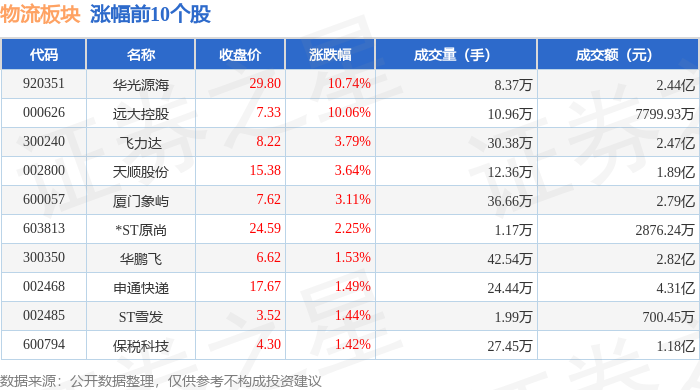
Market Overview - On October 14, the logistics sector declined by 0.42% compared to the previous trading day, with Furan De leading the decline [1] - The Shanghai Composite Index closed at 3865.23, down 0.62%, while the Shenzhen Component Index closed at 12895.11, down 2.54% [1] Stock Performance - Notable gainers in the logistics sector included: - Gongxi Duhai (code: 920351) with a closing price of 29.80, up 10.74% and a trading volume of 83,700 shares, totaling 244 million yuan [1] - Yuanda Holdings (code: 000626) with a closing price of 7.33, up 10.06% and a trading volume of 109,600 shares, totaling 77.99 million yuan [1] - Other gainers included Feilida (code: 300240) up 3.79%, and Tiensun Co. (code: 002800) up 3.64% [1] Fund Flow Analysis - The logistics sector experienced a net outflow of 255 million yuan from institutional investors, while retail investors saw a net inflow of 265 million yuan [2] - Key stocks with significant fund flows included: - Yuanda Holdings with a net inflow of 31.93 million yuan from institutional investors [3] - Feilida with a net inflow of 26.53 million yuan from institutional investors [3] - Notably, Yunda Holdings had a net outflow of 47.03 million yuan from speculative funds [3]