
ZRCBANK(002839)

Search documents
农商行板块11月19日涨0.46%,沪农商行领涨,主力资金净流入671.95万元
Zheng Xing Xing Ye Ri Bao· 2025-11-19 08:52
Core Insights - The agricultural commercial bank sector experienced a 0.46% increase on November 19, with Shanghai Agricultural Commercial Bank leading the gains [1] - The Shanghai Composite Index closed at 3946.74, up 0.18%, while the Shenzhen Component Index closed at 13080.09, unchanged [1] Stock Performance - Shanghai Agricultural Commercial Bank (601825) closed at 8.96, up 0.79% with a trading volume of 183,500 shares and a turnover of 165 million yuan [1] - Chongqing Agricultural Commercial Bank (601077) closed at 6.72, up 0.60% with a trading volume of 379,500 shares and a turnover of 256 million yuan [1] - Wuxi Bank (600908) closed at 6.19, up 0.49% with a trading volume of 128,300 shares and a turnover of 79.31 million yuan [1] - Other notable performances include Changshu Bank (601128) at 7.10 (+0.28%) and Suzhou Agricultural Bank (603323) at 5.26 (+0.19%) [1] Capital Flow - The agricultural commercial bank sector saw a net inflow of 6.72 million yuan from institutional investors, while retail investors experienced a net outflow of 10.77 million yuan [1] - Jiangyin Bank (002807) had a net inflow of 21.05 million yuan from institutional investors, but a net outflow of 22.96 million yuan from retail investors [2] - Changshu Bank (601128) also saw a net inflow of 10.40 million yuan from institutional investors, with a net outflow of 14.21 million yuan from retail investors [2]


农商行板块11月18日跌0.94%,渝农商行领跌,主力资金净流出8451.75万元
Zheng Xing Xing Ye Ri Bao· 2025-11-18 08:11
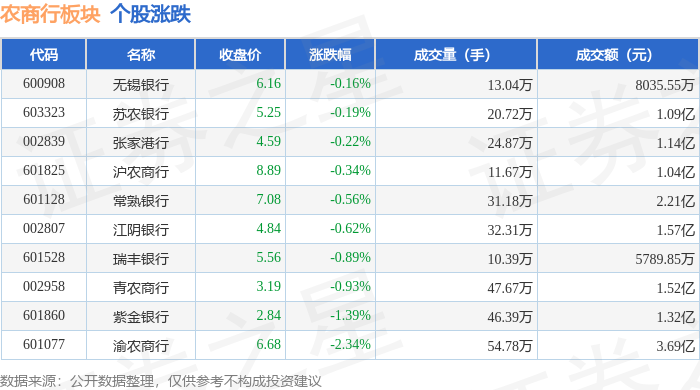
Core Insights - The agricultural commercial bank sector experienced a decline of 0.94% on November 18, with Yunnan Agricultural Commercial Bank leading the drop [1] - The Shanghai Composite Index closed at 3939.81, down 0.81%, while the Shenzhen Component Index closed at 13080.49, down 0.92% [1] Stock Performance - The closing prices and changes for key agricultural banks are as follows: - Wuxi Bank (600908): Closed at 6.16, down 0.16% - Su Nong Bank (603323): Closed at 5.25, down 0.19% - Zhangjiagang Bank (002839): Closed at 4.59, down 0.22% - Shanghai Agricultural Bank (601825): Closed at 8.89, down 0.34% - Changshu Bank (601128): Closed at 7.08, down 0.56% - Jiangyin Bank (002807): Closed at 4.84, down 0.62% - Ruifeng Bank (601528): Closed at 5.56, down 0.89% - Qingnong Bank (002958): Closed at 3.19, down 0.93% - Zijin Bank (601860): Closed at 2.84, down 1.39% - Yunnan Agricultural Bank (601077): Closed at 6.68, down 2.34% [1] Capital Flow - The agricultural commercial bank sector saw a net outflow of 84.52 million yuan from main funds, while retail funds experienced a net inflow of 42.45 million yuan [1] - The detailed capital flow for selected banks includes: - Su Nong Bank: Main funds net inflow of 11.60 million yuan, retail net outflow of 6.05 million yuan - Qingnong Bank: Main funds net inflow of 5.36 million yuan, retail net outflow of 4.42 million yuan - Ruifeng Bank: Main funds net inflow of 3.82 million yuan, retail net outflow of 1.59 million yuan - Zijin Bank: Main funds net inflow of 3.54 million yuan, retail net outflow of 1.21 million yuan - Wuxi Bank: Main funds net inflow of 3.32 million yuan, retail net inflow of 2.90 million yuan - Yunnan Agricultural Bank: Main funds net outflow of 60.81 million yuan, retail net inflow of 39.29 million yuan [2]
张家港行:接受华西证券等投资者调研
Mei Ri Jing Ji Xin Wen· 2025-11-17 09:44
Group 1 - Zhangjiagang Bank (SZ 002839) announced that it will accept investor research on November 14, 2025, with participation from the board office head Tao Ying and others [1] - For the first half of 2025, the bank's revenue composition shows that interest income accounted for 75.14%, while non-interest income accounted for 2.73% [1] - As of the report date, Zhangjiagang Bank's market capitalization is 11.2 billion yuan [2]
张家港行(002839) - 2025年11月17日投资者关系活动记录表
2025-11-17 09:34
Group 1: Investor Relations Activities - The investor relations activity was conducted on November 14, 2025, from 15:00 to 16:00 at the Zhangjiagang Bank headquarters [2] - Participants included representatives from various funds such as Huaxi Securities, Yinhua Fund, and ICBC Credit Suisse Fund [2] Group 2: Shareholder Capital Increase and Dividends - The bank issued 2.5 billion CNY in A-share convertible bonds, maturing in November 2024, with local government and quality state-owned enterprises purchasing these bonds [3] - Major shareholders include Zhangjiagang Jin Xin Capital Investment Management Co., Ltd. and Zhangjiagang High-tech Zone Investment Holding Co., Ltd., who became long-term strategic shareholders through bond conversion [3] - The bank has a stable dividend distribution policy, planning to distribute 0.2 CNY per 10 shares for the 2024 fiscal year and has initiated a mid-term dividend of 0.1 CNY per 10 shares for the first half of the year [3]
农商行板块11月17日跌1.94%,江阴银行领跌,主力资金净流入709.93万元
Zheng Xing Xing Ye Ri Bao· 2025-11-17 08:49
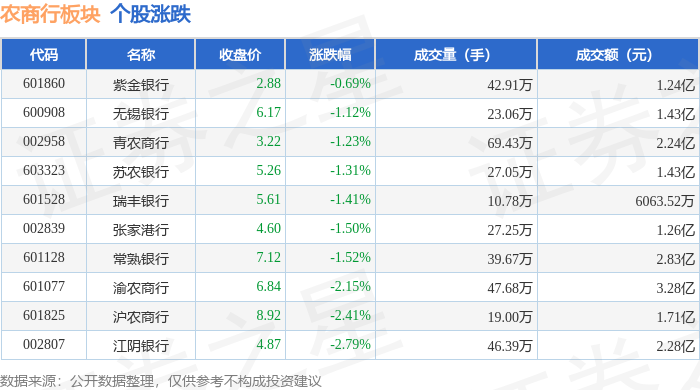
Market Overview - The rural commercial bank sector experienced a decline of 1.94% on November 17, with Jiangyin Bank leading the drop [1] - The Shanghai Composite Index closed at 3972.03, down 0.46%, while the Shenzhen Component Index closed at 13202.0, down 0.11% [1] Individual Stock Performance - Key stocks in the rural commercial bank sector showed the following closing prices and changes: - Zijin Bank: 2.88, down 0.69% - Wuxi Bank: 6.17, down 1.12% - Qingnong Bank: 3.22, down 1.23% - Sunong Bank: 5.26, down 1.31% - Ruifeng Bank: 5.61, down 1.41% - Zhangjiagang Bank: 4.60, down 1.50% - Changshu Bank: 7.12, down 1.52% - Yunnan Rural Commercial Bank: 6.84, down 2.15% - Hunan Rural Commercial Bank: 8.92, down 2.41% - Jiangyin Bank: 4.87, down 2.79% [1] Capital Flow Analysis - The rural commercial bank sector saw a net inflow of 7.09 million yuan from institutional investors, while retail investors experienced a net outflow of 69.16 million yuan [1] - The following table summarizes the capital flow for individual stocks: - Su Nong Bank: Institutional net outflow of 37.41 million yuan, retail net outflow of 23.52 million yuan - Wuxi Bank: Institutional net inflow of 20.36 million yuan, retail net outflow of 16.42 million yuan - Qingnong Bank: Institutional net inflow of 8.88 million yuan, retail net outflow of 4.44 million yuan - Zhangjiagang Bank: Institutional net inflow of 0.09 million yuan, retail net outflow of 4.14 million yuan - Zijin Bank: Institutional net outflow of 2.25 million yuan, retail net inflow of 1.99 million yuan - Hunan Rural Commercial Bank: Institutional net outflow of 3.01 million yuan, retail net outflow of 5.89 million yuan - Yunnan Rural Commercial Bank: Institutional net outflow of 3.03 million yuan, retail net outflow of 3.84 million yuan - Jiangyin Bank: Institutional net outflow of 4.77 million yuan, retail net outflow of 10.49 million yuan - Ruifeng Bank: Institutional net outflow of 7.96 million yuan, retail net inflow of 3.60 million yuan - Changshu Bank: Institutional net outflow of 38.61 million yuan, retail net inflow of 44.61 million yuan [2]


上市银行中期分红热潮持续:国有大行领衔 中小银行加速跟进
Huan Qiu Wang· 2025-11-16 01:37
Core Insights - A total of 8 A-share listed banks have completed their mid-term dividend distributions for 2025, with notable first-time distributions from banks like Changshu Bank, Changsha Bank, and Su Nong Bank [1][3] - Minsheng Bank leads in dividend payout with a total of 5.954 billion yuan, while other banks like Suzhou Bank, Hangzhou Bank, and CITIC Bank are set to distribute dividends next week [1][3] - The trend of mid-term dividends is shifting from an optional practice to a positive factor for smaller banks, as evidenced by Hangzhou Bank's 24.10% year-on-year increase in its dividend payout [3] Summary by Category Dividend Distribution - As of this week, 23 A-share listed banks have disclosed their mid-term dividend plans, accounting for 56.10% of the total, with a cumulative payout of 257.586 billion yuan [3] - The six major state-owned banks collectively account for nearly 80% of the total mid-term dividend payouts, with Industrial and Commercial Bank of China leading at 50.396 billion yuan [3] First-time Dividend Payouts - Seven banks, including Changshu Bank, Ningbo Bank, and Zhangjiagang Bank, have initiated mid-term dividends for the first time, with Changshu Bank distributing 0.15 yuan per share, totaling 0.497 billion yuan [3][4] - Changsha Bank's payout is 0.20 yuan per share, amounting to 0.804 billion yuan, while Su Nong Bank and Zhangjiagang Bank's first-time payouts are 0.182 billion yuan and 0.244 billion yuan, respectively [3] Future Dividend Plans - Jiangyin Bank has announced a proposed dividend of 0.10 yuan per share, pending shareholder approval [4] - Zheshang Bank's vice president indicated that the bank has distributed over 13.2 billion yuan in dividends over the past three years and is considering future dividend arrangements based on policies and industry practices [4]




银行研思录25:银行股息率排名与中期分红进度梳理-20251114
CMS· 2025-11-14 03:02
Investment Rating - The report does not explicitly state an investment rating for the banking sector, but it provides detailed insights into dividend yields and distribution processes, which can inform investment decisions. Core Insights - The report outlines the latest dividend yields and mid-term dividend processes for A and H shares of listed banks, emphasizing the importance of accurately calculating dynamic dividend yields to avoid discrepancies across periods [1][2]. - It details the two processes for mid-term dividends following the 2023 revision of the regulatory guidelines, highlighting the conventional and simplified processes for implementing mid-term dividends [2]. - The report provides a comprehensive overview of key dates related to dividend distribution for both A and H shares, including the importance of purchasing shares before the ex-dividend date to qualify for dividends [3][4]. Summary by Sections Dynamic Dividend Yield Calculation - A simplified yet accurate method for calculating dynamic dividend yield is introduced, defined as "rolling 12-month EPS * cash dividend rate / share price," which helps avoid issues related to overlapping or missing annual and mid-term dividends [1]. - The report calculates the cash dividend rate using a standardized approach across different banks, resulting in a clear comparison of dividend yields as of November 13, 2025 [1]. Mid-Term Dividend Processes - The report explains the two processes for mid-term dividends: the conventional process requiring shareholder approval and a simplified process allowing for quicker implementation [2]. - The simplified process is designed to enhance flexibility for companies in distributing mid-term dividends, thereby improving shareholder returns [2]. Dividend Distribution Key Dates - For A shares, investors must purchase shares before the ex-dividend date to receive dividends on the same day, while H shares typically see a delay of about one month for dividend payments [3][4]. - The report outlines the differences in the dividend distribution timeline between A and H shares, emphasizing the need for investors to be aware of these timelines to maximize their returns [3][4]. Mid-Term Dividend Progress - As of November 13, 2025, 31 A-share banks have confirmed mid-term dividends, while 11 H-share banks have also confirmed their dividend distributions [9][11]. - The report categorizes banks based on their dividend status, detailing those that have implemented dividends, those that are pending, and those that have opted not to distribute dividends [9][10][11]. - It highlights that the end of 2025 and early 2026 is expected to be a peak period for mid-term dividend distributions, suggesting potential investment opportunities for dividend-seeking investors [11].





下半年以来23家上市银行共获748家机构调研
Zheng Quan Ri Bao· 2025-11-13 23:12
Core Insights - In the second half of this year, institutions have actively researched and tracked the operational status of listed banks, with 748 institutions conducting 133 investigations into 23 listed banks as of November 13 [1][2] - The focus of these investigations has been primarily on city commercial banks and rural commercial banks, with key areas of interest including net interest margin trends, non-interest income trends, and capital replenishment [1][2] Group 1: Institutional Research - The majority of institutions conducting research on listed banks are fund companies and securities firms, accounting for 53% of the total [2] - Jiangsu Bank emerged as the most popular among institutions, receiving 83 investigations, followed by Chongqing Rural Commercial Bank and Ningbo Bank with 76 and 75 investigations respectively [2] - Ruifeng Bank had the highest number of total investigations at 22 [2] Group 2: Net Interest Margin Trends - Net interest margin has been a focal point for institutions, with some listed banks showing signs of stabilization or slight recovery compared to the previous year [2] - Several banks reported successful measures to reduce funding costs, such as exiting high-cost deposits and enhancing the absorption of low-cost current deposits [3] - Xiamen Bank reported a 4 basis point increase in net interest margin to 1.08% in the first half of the year, with continued stabilization in the third quarter [3] Group 3: Debt Market Analysis - The bond market has shown a volatile trend this year, impacting the investment income of some listed banks, particularly city and rural commercial banks [4] - Banks are focusing on their investment strategies in the bond market, with a cautious approach to market trends and adjustments in trading positions [4] - Shanghai Bank plans to enhance its market analysis capabilities and maintain flexibility in its investment strategies to mitigate risks from market interest rate fluctuations [4] Group 4: Non-Interest Income and Capital Replenishment - Many banks noted changes in non-interest income, particularly in net income from fees and commissions, which have been affected by regulatory requirements on self-managed wealth management [6] - Banks are exploring various methods for capital replenishment, combining internal capital accumulation with external sources to strengthen their capital base [6]


下半年以来23家上市银行共获748家机构调研 净息差走势、非息收入趋势、资本补充等被重点关注
Zheng Quan Ri Bao· 2025-11-13 16:49
Core Insights - Institutions are actively researching the operational status of listed banks in the second half of the year, with 748 institutions conducting 133 investigations into 23 listed banks, primarily focusing on city commercial banks and rural commercial banks [1][2] Group 1: Institutional Research - The majority of institutions conducting research are fund companies and securities firms, accounting for 53% of the total [2] - Jiangsu Bank is the most popular among institutions, receiving 83 investigations, followed by Chongqing Rural Commercial Bank and Ningbo Bank with 76 and 75 investigations respectively [2] - Ruifeng Bank leads in total investigation counts with 22 [2] Group 2: Net Interest Margin Trends - Net interest margin (NIM) has stabilized for some listed banks, with a slight year-on-year recovery noted [2] - Several banks have reported success in reducing funding costs, which alleviates downward pressure on NIM by exiting high-cost deposits and enhancing low-cost deposit absorption [2][3] - Xiamen Bank reported a 4 basis point increase in NIM to 1.08% in the first half of the year, with continued stabilization in the third quarter [3] Group 3: Debt Market Analysis - The bond market has shown volatility this year, impacting investment income for some banks, particularly city and rural commercial banks [4] - Banks are adjusting their investment strategies in response to market conditions, with a focus on defensive strategies and selective trading opportunities [4] - Shanghai Bank aims to enhance market analysis and maintain flexibility in its investment strategies while managing interest rate risks [4] Group 4: Non-Interest Income and Capital Supplementation - Non-interest income, particularly from fees and commissions, has been affected by regulatory requirements on self-managed wealth management products [5] - Banks are exploring ways to supplement capital through internal accumulation and external sources to strengthen their capital base [5] - Qingdao Bank focuses on standardized fixed-income securities and emphasizes duration management to ensure steady growth in bond investment income [5]
张家港农商银行宿豫支行为商户注入金融动能
Jiang Nan Shi Bao· 2025-11-13 13:45
Core Insights - The opening of the Suqian Agricultural Wholesale Market in China signifies a robust foundation for the region's food supply and price stability [1] - Zhangjiagang Rural Commercial Bank's Suyu Branch celebrates its 16th anniversary by integrating business marketing with customer engagement, focusing on tailored financial solutions for merchants [1] Group 1: Market Development - The Suqian Agricultural Wholesale Market features numerous stalls and heavy traffic, indicating a thriving environment for agricultural trade [1] - The market aims to support the region's "vegetable basket" and "rice bag" initiatives, ensuring stable supply and pricing for essential goods [1] Group 2: Financial Services Initiative - The Suyu Branch has deployed over 30 customer managers in five service teams to engage directly with merchants and buyers at the market [1] - The bank is providing promotional materials that explain agricultural credit policies and settlement discounts, enhancing financial literacy among market participants [1] - The initiative includes distributing essential goods like rice and flour to merchants, fostering closer relationships through a combination of financial services and thoughtful gifts [1] Group 3: Future Plans - The bank plans to continue optimizing financial services for agricultural wholesale market merchants and will conduct regular financial education and policy briefing sessions [1] - The goal is to create a win-win ecosystem between banks and enterprises, contributing to the high-quality development of the regional agricultural product circulation industry [1]