ZRCBANK(002839)

Search documents
农商行板块10月22日涨1.07%,江阴银行领涨,主力资金净流出1.6亿元
Zheng Xing Xing Ye Ri Bao· 2025-10-22 08:19
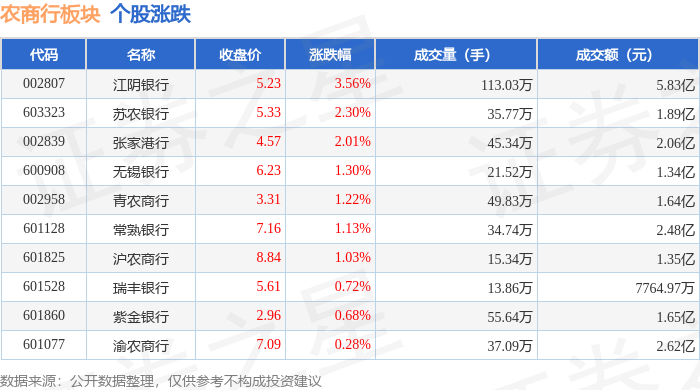
Core Viewpoint - The rural commercial bank sector experienced a 1.07% increase on October 22, with Jiangyin Bank leading the gains, while the overall stock indices showed slight declines [1] Group 1: Market Performance - Jiangyin Bank closed at 5.23, up 3.56%, with a trading volume of 1.13 million shares and a transaction value of 583 million [1] - Su Nong Bank and Zhangjiagang Bank also saw increases of 2.30% and 2.01%, respectively, with closing prices of 5.33 and 4.57 [1] - The Shanghai Composite Index closed at 3913.76, down 0.07%, and the Shenzhen Component Index closed at 12996.61, down 0.62% [1] Group 2: Capital Flow - The rural commercial bank sector had a net outflow of 160 million from institutional investors, while retail investors contributed a net inflow of 140 million [1] - Jiangyin Bank experienced a significant net outflow of 104 million from institutional investors, despite a retail net inflow of 78.44 million [2] - The overall capital flow showed that retail investors were more active in the sector, with notable inflows into several banks despite the institutional outflows [2]






银行股涨幅扩大!
Ge Long Hui A P P· 2025-10-22 06:59
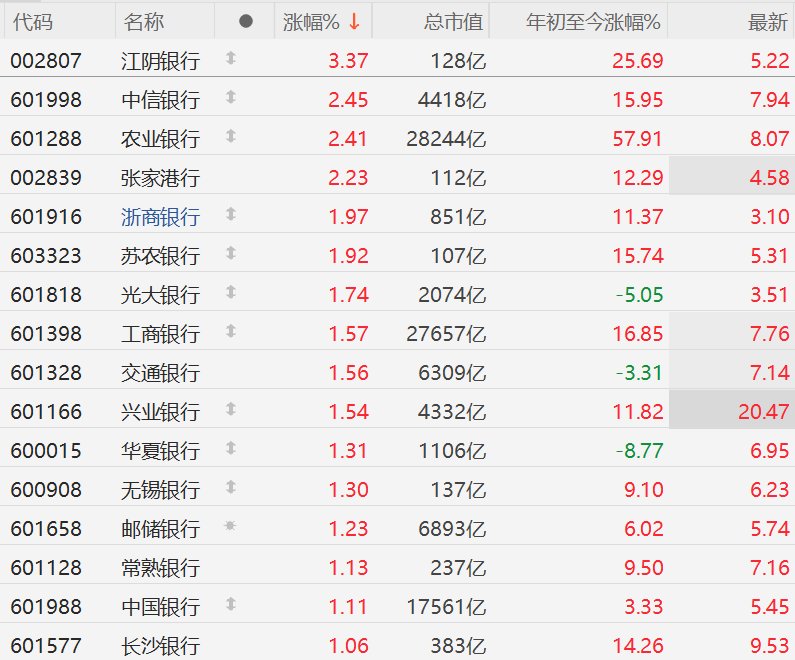
Core Insights - A-shares of bank stocks have seen significant gains, with Jiangyin Bank rising over 3%, and Agricultural Bank achieving a historical high with a 14-day consecutive increase, up nearly 58% year-to-date [1][2] Summary by Category Stock Performance - Jiangyin Bank: Increased by 3.37%, market cap at 12.8 billion, year-to-date gain of 25.69% [2] - CITIC Bank: Increased by 2.45%, market cap at 441.8 billion, year-to-date gain of 15.95% [2] - Agricultural Bank: Increased by 2.41%, market cap at 282.44 billion, year-to-date gain of 57.91% [2] - Zhangjiagang Bank: Increased by 2.23%, market cap at 11.2 billion, year-to-date gain of 12.29% [2] - Other notable banks include: - Zhejiang Commercial Bank: Increased by 1.97%, market cap at 85.1 billion, year-to-date gain of 11.37% [2] - Su Nong Bank: Increased by 1.92%, market cap at 10.7 billion, year-to-date gain of 15.74% [2] Market Trends - The overall trend indicates a strong bullish sentiment in the banking sector, with MACD golden cross signals suggesting continued upward momentum for these stocks [1]



张家港行涨2.01%,成交额1.26亿元,主力资金净流出709.40万元
Xin Lang Cai Jing· 2025-10-22 05:57
Core Viewpoint - Zhangjiagang Bank's stock price has shown a positive trend, with a year-to-date increase of 12.29% and a recent 5-day increase of 5.06% [1] Financial Performance - As of September 30, Zhangjiagang Bank reported a net profit attributable to shareholders of 999.5 million yuan, representing a year-on-year growth of 5.11% [2] - The bank's cumulative cash distribution since its A-share listing amounts to 3.083 billion yuan, with 1.601 billion yuan distributed over the past three years [3] Shareholder Information - The number of shareholders increased to 53,300, up by 1.29% from the previous period, while the average circulating shares per person decreased by 1.27% to 45,847 shares [2] - As of June 30, 2025, Hong Kong Central Clearing Limited is the fifth-largest circulating shareholder, holding 106 million shares, a decrease of 8.6107 million shares from the previous period [3] Market Activity - On October 22, Zhangjiagang Bank's stock rose by 2.01%, reaching 4.57 yuan per share, with a trading volume of 126 million yuan and a turnover rate of 1.14% [1] - The main capital flow showed a net outflow of 7.094 million yuan, with large orders accounting for 18.05% of purchases and 22.18% of sales [1]
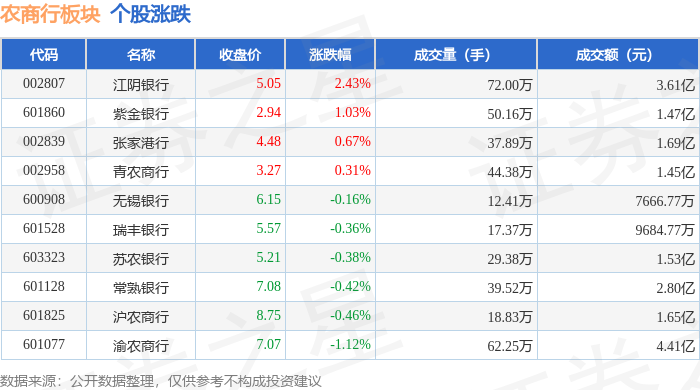
农商行板块10月21日跌0.3%,渝农商行领跌,主力资金净流出1.11亿元
Zheng Xing Xing Ye Ri Bao· 2025-10-21 08:29
Core Points - The agricultural commercial bank sector experienced a decline of 0.3% on October 21, with Yuhuang Commercial Bank leading the drop [1] - The Shanghai Composite Index closed at 3916.33, up 1.36%, while the Shenzhen Component Index closed at 13077.32, up 2.06% [1] Summary by Category Stock Performance - Jiangyin Bank (002807) closed at 5.05, up 2.43% with a trading volume of 720,000 shares and a transaction value of 361 million yuan [1] - Zijin Bank (601860) closed at 2.94, up 1.03% with a trading volume of 501,600 shares and a transaction value of 147 million yuan [1] - Zhangjiagang Bank (002839) closed at 4.48, up 0.67% with a trading volume of 378,900 shares and a transaction value of 169 million yuan [1] - Qingnong Commercial Bank (002958) closed at 3.27, up 0.31% with a trading volume of 443,800 shares and a transaction value of 145 million yuan [1] - Wuxi Bank (600908) closed at 6.15, down 0.16% with a trading volume of 124,100 shares and a transaction value of 76.67 million yuan [1] - Ruifeng Bank (601528) closed at 5.57, down 0.36% with a trading volume of 173,700 shares and a transaction value of 96.85 million yuan [1] - Sunong Bank (603323) closed at 5.21, down 0.38% with a trading volume of 293,800 shares and a transaction value of 153 million yuan [1] - Changshu Bank (601128) closed at 7.08, down 0.42% with a trading volume of 395,200 shares and a transaction value of 280 million yuan [1] - Hunan Agricultural Commercial Bank (601825) closed at 8.75, down 0.46% with a trading volume of 188,300 shares and a transaction value of 165 million yuan [1] - Yuhuang Commercial Bank (601077) closed at 7.07, down 1.12% with a trading volume of 622,500 shares and a transaction value of 441 million yuan [1] Fund Flow - The agricultural commercial bank sector saw a net outflow of 111 million yuan from main funds, while retail investors contributed a net inflow of 211 million yuan [2]


理财公司与中小银行共拓代销新蓝海
Zhong Guo Zheng Quan Bao· 2025-10-20 20:18
Core Insights - Multiple wealth management companies have recently signed distribution agreements with small and medium-sized banks, indicating a growing trend in the number of banks participating in wealth management distribution [1][2] - Small and medium-sized banks are increasingly looking to enhance their intermediary income through distribution partnerships due to pressure on net interest margins and limited space for self-conducted wealth management [1][2] - The collaboration between wealth management companies and small banks is expected to deepen in the future, driven by mutual benefits [2][3] Group 1: Distribution Partnerships - Several wealth management companies, including Su Yin Wealth Management and Ning Yin Wealth Management, have announced new distribution agreements with small banks such as Weihai Bank and Jiangnan Rural Commercial Bank [1] - Since the beginning of October, nearly ten wealth management companies have added new distribution partners, including Wenzhou Bank and High Postal Rural Commercial Bank [1][2] - A wealth management company under a joint-stock bank has expanded its distribution channels to include nearly 30 new small banks this year, focusing on rural commercial banks [2] Group 2: Strategic Shift of Small Banks - Regional small banks are facing pressure from narrowing net interest margins and limited self-investment income, prompting them to explore wealth management distribution as a strategic pivot [2][3] - Regulatory constraints on self-conducted wealth management have further limited small banks' ability to grow their own wealth management businesses [2] - The shift towards distribution partnerships allows small banks to adopt a "light capital, light asset" operational model, which is seen as a necessary strategic path [2][3] Group 3: Performance Metrics - In the first half of 2025, several small banks reported significant growth in intermediary income, with Changshu Bank's net income from fees and commissions reaching 142 million, a year-on-year increase of over 600% [3] - Changshu Bank's wealth management distribution scale reached 7.277 billion by mid-2025, up from 4.954 billion at the end of 2024 [3] Group 4: Market Expansion Strategies - Wealth management companies are actively expanding their distribution networks beyond their parent banks to include small and medium-sized banks, aiming to tap into broader market opportunities [5] - The strategy includes covering state-owned and joint-stock banks, as well as deepening partnerships with city and rural commercial banks to reach lower-tier markets [5] - The diversification of distribution channels is expected to enhance the long-term development of wealth management companies, reducing the impact of market fluctuations on their investment behavior [5][6]

理财公司代销扩容,中小银行成新增长点
Zhong Guo Zheng Quan Bao· 2025-10-20 14:33
Core Insights - Recent agreements between wealth management companies and small to medium-sized banks indicate a growing trend in distribution partnerships aimed at enhancing revenue streams for both parties [1][2][3] Group 1: Collaboration Trends - Multiple wealth management firms have announced new distribution agreements with small to medium-sized banks, including notable institutions like Weifang Bank and Jiangnan Rural Commercial Bank [2] - The number of banks participating in wealth management product distribution is on the rise, with nearly ten firms announcing new partnerships in October alone [2][3] - The collaboration is characterized as a "mutual pursuit," where both small banks and wealth management companies aim to tap into the potential for increased intermediary income [3] Group 2: Market Dynamics - Small banks are facing pressure from narrowing net interest margins and regulatory constraints on self-managed wealth management products, prompting a shift towards distribution partnerships [3][5] - Regulatory changes, such as the new management measures for agency sales, are shaping the landscape for these partnerships, emphasizing the need for compliance and structured collaboration [5][6] - Wealth management companies are diversifying their distribution channels to overcome limitations of direct sales, particularly by leveraging the strong sales capabilities of smaller banks [6][7] Group 3: Strategic Implications - The expansion of distribution channels is seen as a long-term growth strategy for wealth management firms, allowing them to mitigate risks associated with market fluctuations and enhance brand recognition [7] - The focus on multi-channel sales strategies is expected to improve market competitiveness and foster product innovation, aligning with customer preferences [7] - Wealth management companies are advised to carefully select distribution partners based on strategic alignment, product characteristics, and risk management considerations [7]
张家港行(002839) - 2025年10月17日投资者关系活动记录表
2025-10-20 08:30
编号:2025-05 | | √特定对象调研 □分析师会议 | | --- | --- | | | □媒体采访 □业绩说明会 | | 投资者关系活动 类别 | □新闻发布会 □路演活动 | | | □现场参观 | | | □其他 (请文字说明其他活动内容) | | 参与单位名称及 | 国信证券 田维韦 | | 人员姓名 | 南方基金 朱伟豪、赵承浚 | | | 长信基金 朱辰菲 | | 时间 | 2025 年 10 月 17 日下午 16:00-17:00 | | 地点 | 张家港行总行 1605 楼会议室 | | | 董事会秘书 戚飞燕女士 | | 上市公司接待人 | 董事会办公室负责人 陶鹰女士 | | 员姓名 | 证券事务代表 张伊琦女士 | | | 以及相关业务部门负责人 | | | 主要就张家港行近期相关经营情况进行了交流,以下为 | | 投资者关系活动 | 投资者问询及简要回复情况记录: | | | Q:请贵行介绍一下今年上半年业绩保持稳健增长的管理 | | | 举措有哪些? | | 主要内容介绍 | A:今年以来,全行员工围绕"夯基础、控风险、强队伍" | | | 总基调,聚力攻坚"抓投放、控付 ...
银行研思录23:AH股银行资产质量评估(2025H1):基于“广义不良”和“超额拨备”的分析
CMS· 2025-10-17 09:03
Investment Rating - The report maintains a positive outlook on the banking sector, suggesting that several banks are undervalued based on their asset quality and excess provisioning metrics [4][3]. Core Insights - The valuation premium of banks typically arises from their middle-income and liability advantages, while valuation discounts are often due to concerns over asset quality [2][10]. - The report introduces two key indicators: "broad non-performing asset ratio" and "excess provisioning profit multiple" to objectively assess and compare the current asset quality status of banks [2][10]. - A total of 56 AH-listed banks are analyzed, expanding from the previous report's focus on 42 A-share listed banks, to provide a comprehensive overview of excess provisioning levels and trends [2][10]. Summary by Sections 1. Introduction: Significance of Asset Quality - The report emphasizes the importance of objectively assessing asset quality, as it significantly impacts bank valuations and performance [10]. 2. How to Objectively Assess Bank Non-Performing Assets - Traditional asset quality indicators may not accurately reflect the true provisioning situation due to inconsistent standards and incomplete coverage of assets [14]. - The report proposes a "broad non-performing asset ratio" to better capture the credit risk within banks [14][15]. 3. Construction of Excess Provisioning Profit Multiple Indicator - The excess provisioning profit multiple is constructed to measure the performance elasticity of banks, indicating their potential for future earnings recovery [7][14]. - The report highlights that banks with higher excess provisioning ratios, such as Hangzhou Bank, show strong risk mitigation capabilities [7][14]. 4. Valuation from the Perspective of Broad Excess Provisioning - The long-term correlation between bank valuation levels and ROE is noted, with excess provisioning contributing to performance and valuation improvements [3][4]. - Several banks, including Wuxi Bank and Agricultural Bank (H), are identified as being significantly above the PB-excess provisioning profit multiple regression line, indicating potential investment opportunities [3][4].


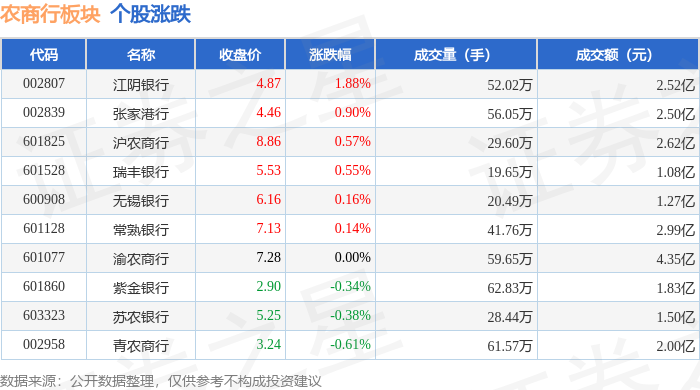
农商行板块10月17日涨0.28%,江阴银行领涨,主力资金净流出1.82亿元
Zheng Xing Xing Ye Ri Bao· 2025-10-17 08:35
Core Insights - The rural commercial bank sector experienced a slight increase of 0.28% on October 17, with Jiangyin Bank leading the gains [1] - The Shanghai Composite Index closed at 3839.76, down 1.95%, while the Shenzhen Component Index closed at 12688.94, down 3.04% [1] Stock Performance - Jiangyin Bank (002807) closed at 4.87, up 1.88% with a trading volume of 520,200 shares and a transaction value of 252 million [1] - Zhangjiagang Bank (002839) closed at 4.46, up 0.90% with a trading volume of 560,500 shares and a transaction value of 250 million [1] - Other notable performances include: - Hunan Rural Commercial Bank (601825) at 8.86, up 0.57% [1] - Ruifeng Bank (601528) at 5.53, up 0.55% [1] - Yuanxi Bank (600908) at 6.16, up 0.16% [1] - Changshu Bank (601128) at 7.13, up 0.14% [1] - Yunnan Rural Commercial Bank (601077) at 7.28, unchanged [1] - Zijin Bank (601860) at 2.90, down 0.34% [1] - Sunong Bank (603323) at 5.25, down 0.38% [1] - Qingnong Bank (002958) at 3.24, down 0.61% [1] Capital Flow - The rural commercial bank sector saw a net outflow of 182 million from main funds, while retail investors contributed a net inflow of 240 million [1] - Detailed capital flow for selected banks includes: - Changshu Bank (601128) had a main fund net inflow of 24.33 million, with a retail net inflow of 16.99 million [2] - Ruifeng Bank (601528) had a main fund net inflow of 11.44 million, with a retail net inflow of 1.54 million [2] - Jiangyin Bank (002807) experienced a main fund net outflow of 18.85 million, but a retail net inflow of 35.68 million [2] - Zhangjiagang Bank (002839) had a significant main fund net outflow of 53.27 million, with a retail net inflow of 37.39 million [2] - Hunan Rural Commercial Bank (601825) also faced a main fund net outflow of 55.29 million, with a retail net inflow of 36.06 million [2]
农商行板块10月16日涨1.54%,江阴银行领涨,主力资金净流出1.14亿元
Zheng Xing Xing Ye Ri Bao· 2025-10-16 08:27
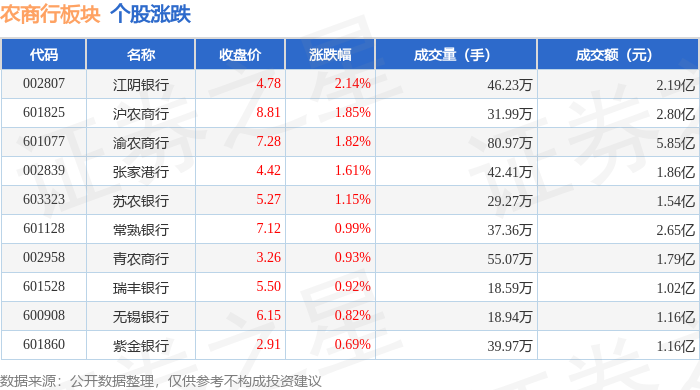
Market Performance - The rural commercial bank sector increased by 1.54% on October 16, with Jiangyin Bank leading the gains [1] - The Shanghai Composite Index closed at 3916.23, up 0.1%, while the Shenzhen Component Index closed at 13086.41, down 0.25% [1] Individual Stock Performance - Jiangyin Bank (002807) closed at 4.78, up 2.14% with a trading volume of 462,300 shares and a transaction value of 2.19 billion [1] - Other notable performers include: - Shanghai Rural Commercial Bank (601825) at 8.81, up 1.85% [1] - Chongqing Rural Commercial Bank (601077) at 7.28, up 1.82% [1] - Zhangjiagang Bank (002839) at 4.42, up 1.61% [1] - Suzhou Rural Bank (603323) at 5.27, up 1.15% [1] Capital Flow Analysis - The rural commercial bank sector experienced a net outflow of 114 million from institutional investors, while retail investors saw a net inflow of 117 million [1] - Detailed capital flow for individual stocks shows: - Changshu Bank (601128) had a net inflow of 20.74 million from institutional investors [2] - Jiangyin Bank (002807) had a net outflow of 7.53 million from institutional investors [2] - Suzhou Rural Bank (603323) had a significant net outflow of 26.89 million from institutional investors [2]