Pharscin Pharma(002907)

Search documents
华森制药(002907) - 关于公司产品完成境内生产药品备案的公告
2025-08-25 10:47
证券代码:002907 证券简称:华森制药 公告编号:2025-070 重庆华森制药股份有限公司 关于公司产品完成境内生产药品备案的公告 (一)延长药品有效期申请 1.阿戈美拉汀片 药 品 通 用 名 称:阿戈美拉汀片 备 案 号:渝备 2025029865 本公司及董事会全体成员保证信息披露的内容真实、准确、完整, 没有虚假记载、误导性陈述或重大遗漏。 重庆华森制药股份有限公司(以下简称"公司")于近日从国家药品监督管 理局(以下简称"国家药监局")网站查询获知公司产品阿戈美拉汀片完成境内 生产药品备案(延长药品有效期申请),并于国家药监局网站公示备案信息。现 将相关情况公告如下: 一、药品基本信息 药 品 批 准 文 号 / 原 料 药 登 记 号 :国药准字 Z20249539 上 市 许 可 持 有 人:重庆华森制药股份有限公司 上市许可持有人地址:重庆市荣昌区工业园区 阿戈美拉汀项目为公司原料药制剂一体化项目。根据药智网数据,2024 年 阿戈美拉汀片整体市场份额为 7.9 亿元。该药品是一种新型抗抑郁药物,其作用 机制突破了传统单胺类递质系统,通过激活褪黑素受体(MT1 和 MT2)以及拮抗 5- ...
华森制药2025年中报简析:营收净利润同比双双增长,盈利能力上升
Zheng Quan Zhi Xing· 2025-08-22 23:18
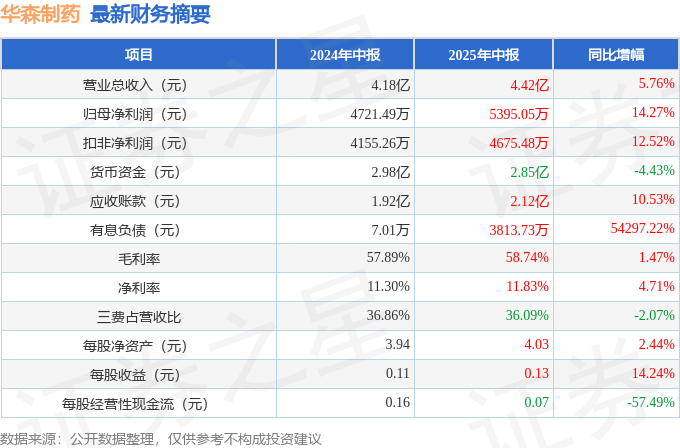
Core Viewpoint - Huason Pharmaceutical (002907) reported a solid performance in its 2025 mid-year financial results, with revenue and net profit showing significant year-on-year growth, indicating improved profitability and operational efficiency [1] Financial Performance - Total revenue for the first half of 2025 reached 442 million yuan, a year-on-year increase of 5.76% [1] - Net profit attributable to shareholders was 53.95 million yuan, up 14.27% from the previous year [1] - In Q2 2025, total revenue was 203 million yuan, reflecting a 7.13% increase year-on-year, while net profit surged by 98.08% to 13.60 million yuan [1] - Gross margin improved to 58.74%, an increase of 1.47% year-on-year, and net margin rose to 11.83%, up 4.71% [1] - Total expenses (selling, administrative, and financial) amounted to 160 million yuan, accounting for 36.09% of revenue, a decrease of 2.07% year-on-year [1] Key Financial Metrics - Earnings per share (EPS) increased to 0.13 yuan, a rise of 14.24% year-on-year [1] - Cash flow from operating activities per share decreased to 0.07 yuan, down 57.49% year-on-year [1] - The company's net asset value per share was 4.03 yuan, up 2.44% from the previous year [1] Significant Changes in Financial Items - Cash and cash equivalents decreased by 37.67% due to increased investments in financial products [3] - Long-term equity investments dropped by 100% as the company gained control over a previously associated enterprise [4] - Other current assets increased by 171.49% due to the purchase of financial products [5] - Employee compensation liabilities decreased by 61.8% as year-end bonuses were paid out [6] Business Model and Operational Insights - The company's performance is primarily driven by research and marketing efforts, necessitating a thorough examination of these underlying drivers [7] - The accounts receivable situation is concerning, with accounts receivable to profit ratio reaching 276.43% [7]

华森制药(002907.SZ):2025年中报净利润为5395.05万元、较去年同期上涨14.27%
Xin Lang Cai Jing· 2025-08-22 02:14
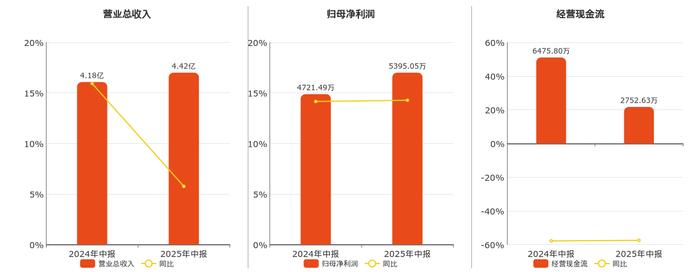
Core Insights - Huason Pharmaceutical (002907.SZ) reported a total operating revenue of 442 million yuan for the first half of 2025, an increase of 24.06 million yuan compared to the same period last year, marking a year-on-year growth of 5.76% [1] - The net profit attributable to shareholders reached 53.95 million yuan, up by 6.74 million yuan from the previous year, reflecting a year-on-year increase of 14.27% [1] - The company achieved a net cash inflow from operating activities of 27.53 million yuan [1] Financial Metrics - The latest debt-to-asset ratio stands at 15.43% [3] - The gross profit margin is 58.74%, which is an increase of 0.85 percentage points from the same period last year [3] - Return on equity (ROE) is reported at 3.20%, up by 0.33 percentage points year-on-year [3] - The diluted earnings per share (EPS) is 0.13 yuan, an increase of 0.02 yuan compared to the same period last year, representing a year-on-year growth of 14.24% [3] - The total asset turnover ratio is 0.22 times, remaining stable compared to the previous year [3] - The inventory turnover ratio is 1.40 times, an increase of 0.17 times year-on-year, reflecting a growth of 14.09% [3] Shareholder Structure - The number of shareholders is reported at 32,800, with the top ten shareholders holding a total of 326 million shares, accounting for 78.09% of the total share capital [3] - The largest shareholder is Chengdu Local Construction Machinery Engineering Co., Ltd., holding 40.49% of the shares [3] - Other significant shareholders include You Hongtao (17.34%), Wang Ying (8.76%), and Liu Xiaoying (8.60%) [3]
重庆华森制药股份有限公司2025年半年度报告摘要
Shang Hai Zheng Quan Bao· 2025-08-21 21:00
所有董事均已出席了审议本报告的董事会会议。 非标准审计意见提示 □适用 √不适用 登录新浪财经APP 搜索【信披】查看更多考评等级 一、重要提示 本半年度报告摘要来自半年度报告全文,为全面了解本公司的经营成果、财务状况及未来发展规划,投 资者应当到证监会指定媒体仔细阅读半年度报告全文。 董事会审议的报告期利润分配预案或公积金转增股本预案 √适用 □不适用 是否以公积金转增股本 □是 √否 公司经本次董事会审议通过的利润分配预案为:以2025年6月30日登记的总股本417,596,314股为基数, 向全体股东每10股派发现金红利0.35元(含税),送红股0股(含税),不以公积金转增股本。 董事会决议通过的本报告期优先股利润分配预案 □适用 √不适用 二、公司基本情况 1、公司简介 ■ 2、主要会计数据和财务指标 公司是否需追溯调整或重述以前年度会计数据 □是 √否 ■ 3、公司股东数量及持股情况 单位:股 ■ 持股5%以上股东、前10名股东及前10名无限售流通股股东参与转融通业务出借股份情况 □适用 √不适用 前10名股东及前10名无限售流通股股东因转融通出借/归还原因导致较上期发生变化 □适用 √不适用 □适 ...
创新驱动发展战略成效显著 华森制药上半年营收利润双增
Zheng Quan Shi Bao Wang· 2025-08-21 15:00
Core Insights - The company reported a revenue of 442 million yuan for the first half of 2025, representing a year-on-year growth of 5.76% [1] - The net profit attributable to shareholders reached 53.95 million yuan, up 14.27% year-on-year, with a basic earnings per share of 0.13 yuan, also reflecting a growth of 14.24% [1] Financial Performance - Revenue growth was supported by a 29.45% increase in the chemical generic drug segment, which performed well in the market [1] - The five core traditional Chinese medicine products maintained stable revenue growth of 3.52% year-on-year, with significant sales growth in unique products like Pain and Diarrhea Ning Granules and Liuwei Anshen Capsules [1] Innovation and R&D - The company invested 40.50 million yuan in R&D, a 29.33% increase, accounting for over 9% of total revenue [1] - R&D expenses reached 37.04 million yuan, up 43.33% year-on-year, indicating a strong commitment to innovation [1] - The company is advancing seven innovative drug pipelines, focusing on oncology and autoimmune inflammatory diseases, with ORIC-1940 being a leading candidate for a first-in-class innovative drug in China [2] Shareholder Returns - The company announced a mid-term profit distribution plan, proposing a cash dividend of 0.35 yuan per 10 shares, totaling 14.62 million yuan, reflecting its commitment to shareholder returns [2]
华森制药公布2025半年度分配预案 拟10派0.35元
Zheng Quan Shi Bao Wang· 2025-08-21 14:44
(原标题:华森制药公布2025半年度分配预案 拟10派0.35元) 8月21日华森制药发布2025半年度分配预案,拟10派0.35元(含税),预计派现金额合计为1461.59万 元。派现额占净利润比例为27.09%,这是公司上市以来,累计第10次派现。 公司上市以来历次分配方案一览 | 日期 | 分配方案 | 派现金额合计(亿元) | 股息率(%) | | --- | --- | --- | --- | | 2025.06.30 | 10派0.35元(含税) | 0.15 | 0.22 | | 2024.12.31 | 10派0.5元(含税) | 0.21 | 0.36 | | 2024.06.30 | 10派0.35元(含税) | 0.15 | 0.24 | | 2023.12.31 | 10派0.5元(含税) | 0.21 | 0.28 | | 2022.12.31 | 10派0.7元(含税) | 0.29 | 0.34 | | 2021.12.31 | 10派0.5元(含税) | 0.20 | 0.38 | | 2020.12.31 | 10派0.28元(含税) | 0.11 | 0.15 | | 20 ...
华森制药:不存在逾期债务对应的担保
Zheng Quan Ri Bao Zhi Sheng· 2025-08-21 14:13
Core Viewpoint - Huason Pharmaceutical announced that as of the date of the announcement, neither the company nor its wholly-owned subsidiaries have provided guarantees to entities outside the consolidated financial statements, nor do they have overdue debts related to guarantees, litigation guarantees, or losses due to guarantees resulting from court judgments [1] Summary by Relevant Categories - **Company Guarantees** - The company and its wholly-owned subsidiaries do not have any guarantees provided to entities outside the consolidated financial statements [1] - **Debt Status** - There are no overdue debts corresponding to guarantees [1] - **Litigation and Losses** - The company does not have any guarantees related to litigation or any losses incurred due to being ruled against in court [1]
华森制药:关于公司2025年半年度利润分配预案的公告
Zheng Quan Ri Bao Zhi Sheng· 2025-08-21 13:45
Core Viewpoint - Huason Pharmaceutical announced a profit distribution plan for the first half of 2025, proposing a cash dividend of RMB 0.35 per 10 shares to all shareholders, totaling RMB 14,615,870.99 [1] Group 1 - The total number of shares for the dividend distribution is 417,596,314 [1] - The cash dividend is inclusive of tax [1] - The announcement was made on the evening of August 21 [1]
华森制药上半年净利润同比增长14.27%
Zheng Quan Ri Bao Zhi Sheng· 2025-08-21 13:45
Core Insights - Chongqing Huason Pharmaceutical Co., Ltd. reported a revenue of 442 million yuan for the first half of 2025, representing a year-on-year growth of 5.76% [1] - The net profit attributable to shareholders was 53.95 million yuan, showing a year-on-year increase of 14.27% [1] Revenue Growth Factors - The increase in revenue is primarily attributed to the successful approval and bidding of chemical generic drugs, with a 29.45% growth in revenue from these products compared to the same period last year [1] - Steady growth in revenue from key traditional Chinese medicine products, with a 3.52% increase in revenue from five major products [1] Profit Growth Drivers - Profit growth is driven by revenue scale expansion, a decrease in raw material prices for key traditional Chinese medicine products, and effective cost control measures [1] R&D Investment - The company maintained a strong focus on R&D innovation, with R&D investment reaching 40.50 million yuan, a 29.33% increase, accounting for 9.17% of total revenue [1] - R&D expenses amounted to 37.04 million yuan, reflecting a 43.33% year-on-year increase [1] Innovation Drug Development - The company is advancing seven innovative drug pipelines targeting various cancers and autoimmune diseases, with eight new compound patent applications filed during the reporting period [2] - As of the end of the reporting period, a total of 47 innovative drug compound patents have been applied for [2] Market Expansion - The company is expanding its market presence by increasing the number of public hospitals and grassroots medical institutions served, now covering nearly 11,000 public hospitals and 14,000 grassroots medical institutions nationwide [2] - In addition to public and grassroots channels, the company is also diversifying its distribution network to include private hospitals, retail, and e-commerce platforms [2] Strategic Focus - In the context of normalized centralized procurement, the company is actively positioning itself in the generic drug, traditional Chinese medicine, and special medical food development pipelines, aiming for rapid R&D, low manufacturing costs, and high technical barriers [2]
华森制药:2025年半年度净利润同比增长14.27%
Zheng Quan Ri Bao· 2025-08-21 13:42
证券日报网讯 8月21日晚间,华森制药发布2025年半年度报告摘要称,2025年半年度公司实现营业收入 441,913,009.17元,同比增长5.76%;归属于上市公司股东的净利润为53,950,516.43元,同比增长 14.27%。 (文章来源:证券日报) ...