BANK OF QINGDAO(002948)

Search documents
青岛银行(002948) - 关于大股东增持股份计划实施结果的公告
2025-11-07 12:18
1.青岛国信产融控股(集团)有限公司(以下简称"国信产融控股")计划通 过二级市场交易的方式增持青岛银行股份有限公司(以下简称"本行")股份,增 持后国信产融控股及其一致行动人青岛国信金融控股有限公司、青岛国信资本投 资有限公司的合计持股比例将达到19.00%至19.99%之间(以下简称"增持计划"), 增持计划的实施期限为自增持计划披露之日起6个月内,增持计划将避免在本行 定期报告静默期、重大事项敏感期等期间实施。增持计划实施期间,本行股票存 在停牌情形的,增持期限将予以顺延实施。同时,根据金融监管相关法律法规规 定,本次增持还将在取得金融监管批复之日起6个月内完成。具体情况请见本行 在《中国证券报》《上海证券报》《证券时报》《证券日报》和巨潮资讯网 (http://www.cninfo.com.cn/)发布的日期为2025年9月2日的《关于大股东增持股 份计划的公告》(公告编号:2025-032)。 2.2025年9月15日至2025年11月5日(包括首尾两日),国信产融控股通过港 股通渠道累计增持本行H股股份243,000,000股,占本行股份总数的4.18%,增持 金额合计人民币95,679.37万元 ...
青岛银行(002948) - 详式权益变动报告书
2025-11-07 12:18
青岛银行股份有限公司 详式权益变动报告书 上市公司名称:青岛银行股份有限公司 股票上市地点:深圳证券交易所、香港联合交易所有限公司 股票简称:青岛银行 股票代码:002948(A 股)、03866(H 股) 信息披露义务人: 名称:青岛国信资本投资有限公司 住所:山东省青岛市崂山区仙霞岭路 31 号 1 号楼 通讯地址:山东省青岛市市南区香港西路 48 号海天中心 T2 写字楼 权益变动性质:信息披露义务人增持股份 签署日期:二〇二五年十一月六日 1 信息披露义务人声明 一、信息披露义务人依据《中华人民共和国公司法》《中华人民共和国证券 法》《上市公司收购管理办法》《公开发行证券的公司信息披露内容与格式准则 第 15 号——权益变动报告书》《公开发行证券公司信息披露内容与格式准则第 16 号——上市公司收购报告书》及其他相关法律法规、部门规章和规范性文件 的有关规定编写。 名称:青岛国信产融控股(集团)有限公司 住所:山东省青岛市市南区香港西路 48 号海天中心 T2 写字楼 通讯地址:山东省青岛市市南区香港西路 48 号海天中心 T2 写字楼 一致行动人 1: 名称:青岛国信金融控股有限公司 住所:山东省青 ...
青岛银行(002948) - 关于股东及其一致行动人权益变动的提示性公告
2025-11-07 12:18
4.国信产融控股增持本行股份事宜,已事前经银行业监督管理机构即国家金融 监督管理总局青岛监管局审批。 证券代码:002948 证券简称:青岛银行 公告编号:2025-045 青岛银行股份有限公司 关于股东及其一致行动人权益变动的提示性公告 本行股东青岛国信产融控股(集团)有限公司保证向本行提供的信息内容真实、准确、 完整,没有虚假记载、误导性陈述或重大遗漏。 本行及董事会全体成员保证公告内容与信息披露义务人提供的信息一致。 特别提示: 2.本次权益变动完成后,青岛国信产融控股(集团)有限公司(以下简称"国信 产融控股")及其一致行动人合计持有青岛银行股份有限公司(以下简称"本行") 1,115,471,173 股股份,合计持股占本行股份总数的 19.17%,青岛国信发展(集团) 有限责任公司通过国信产融控股及其一致行动人合并持股成为本行第一大股东。 3.本次权益变动不会导致本行无控股股东、无实际控制人的情况发生变化,不 会对本行的公司治理及持续经营产生重大影响。 1.本次权益变动不触及要约收购。 本行于2025年11月6日收到国信产融控股出具的《关于增持青岛银行股份有限 公司股份的告知函》《详式权益变动报告书 ...
城商行板块11月7日跌0.21%,齐鲁银行领跌,主力资金净流出1.48亿元
Zheng Xing Xing Ye Ri Bao· 2025-11-07 08:37
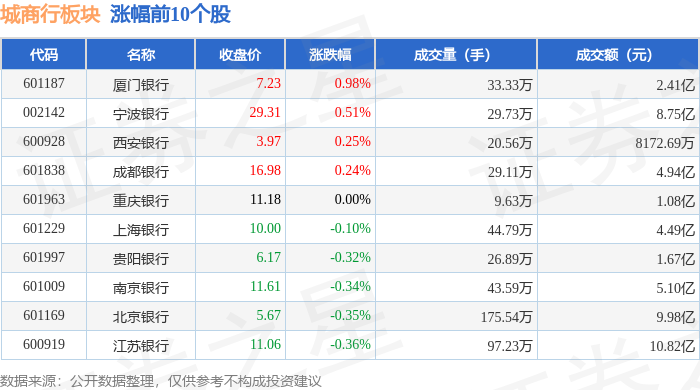
Market Overview - The city commercial bank sector experienced a decline of 0.21% on November 7, with Qilu Bank leading the drop [1] - The Shanghai Composite Index closed at 3997.56, down 0.25%, while the Shenzhen Component Index closed at 13404.06, down 0.36% [1] Individual Bank Performance - Xiamen Bank closed at 7.23, up 0.98% with a trading volume of 333,300 shares and a transaction value of 241 million [1] - Ningbo Bank closed at 29.31, up 0.51% with a trading volume of 297,300 shares and a transaction value of 875 million [1] - Qilu Bank closed at 6.08, down 1.46% with a trading volume of 648,100 shares and a transaction value of 39.86 million [2] - Suzhou Bank closed at 8.33, down 1.07% with a trading volume of 373,400 shares and a transaction value of 314 million [2] Capital Flow Analysis - The city commercial bank sector saw a net outflow of 148 million from institutional investors, while retail investors had a net inflow of 163 million [2] - Jiangsu Bank had a net inflow of 63.24 million from institutional investors, but a net outflow of 39.08 million from speculative funds [3] - Nanjing Bank experienced a net inflow of 24.45 million from institutional investors, with a net outflow of 30.58 million from speculative funds [3]



厦门银行浦发银行青岛银行跌幅居银行板块前三
Zhong Guo Jing Ji Wang· 2025-11-06 09:00
Group 1 - Xiamen Bank's stock price fell to 7.16 yuan, a decrease of 2.59% [1] - Shanghai Pudong Development Bank's stock closed at 11.66 yuan, down by 1.69% [1] - Qingdao Bank's stock price decreased to 5.06 yuan, with a drop of 1.36% [1] Group 2 - The banking sector overall declined by 0.26% today [1] - Xiamen Bank, Shanghai Pudong Development Bank, and Qingdao Bank were the largest decliners in the banking sector [1]

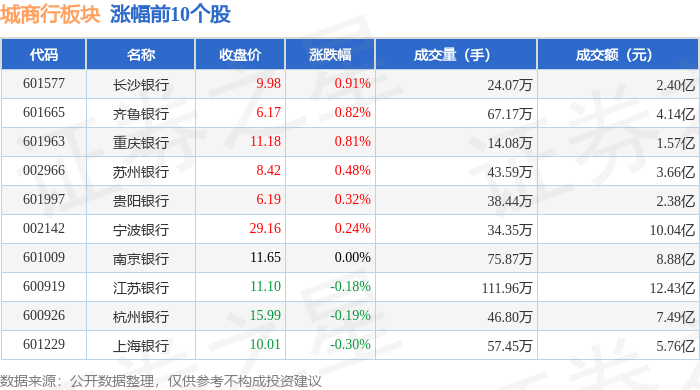
城商行板块11月6日跌0.11%,厦门银行领跌,主力资金净流出6.08亿元
Zheng Xing Xing Ye Ri Bao· 2025-11-06 08:51
Core Viewpoint - The city commercial bank sector experienced a slight decline of 0.11% on November 6, with Xiamen Bank leading the drop, while the overall market indices showed positive movements with the Shanghai Composite Index up by 0.97% and the Shenzhen Component Index up by 1.73% [1][2]. Group 1: Market Performance - The closing price of Xiamen Bank was 7.16, reflecting a decrease of 2.59% with a trading volume of 539,700 shares and a transaction value of 387 million yuan [2]. - Other notable banks included Changsha Bank, which closed at 9.98 with a rise of 0.91%, and Qilu Bank, which closed at 6.17 with an increase of 0.82% [1]. - The city commercial bank sector saw a net outflow of 608 million yuan from major funds, while retail investors contributed a net inflow of 473 million yuan [2][3]. Group 2: Individual Bank Performance - Beijing Bank had a net inflow from major funds of 20.80 million yuan, while it experienced a net outflow from retail investors of 30.79 million yuan [3]. - Chongqing Bank recorded a net inflow of 11.91 million yuan from major funds but faced a net outflow of 12.20 million yuan from retail investors [3]. - Jiangsu Bank had a net inflow of 202.55 million yuan from major funds, while retail investors contributed a net inflow of 3.33 million yuan [3].

Q3单季营收却“掉链子”?青岛银行营利双增背后藏隐忧
智通财经网· 2025-11-06 08:21
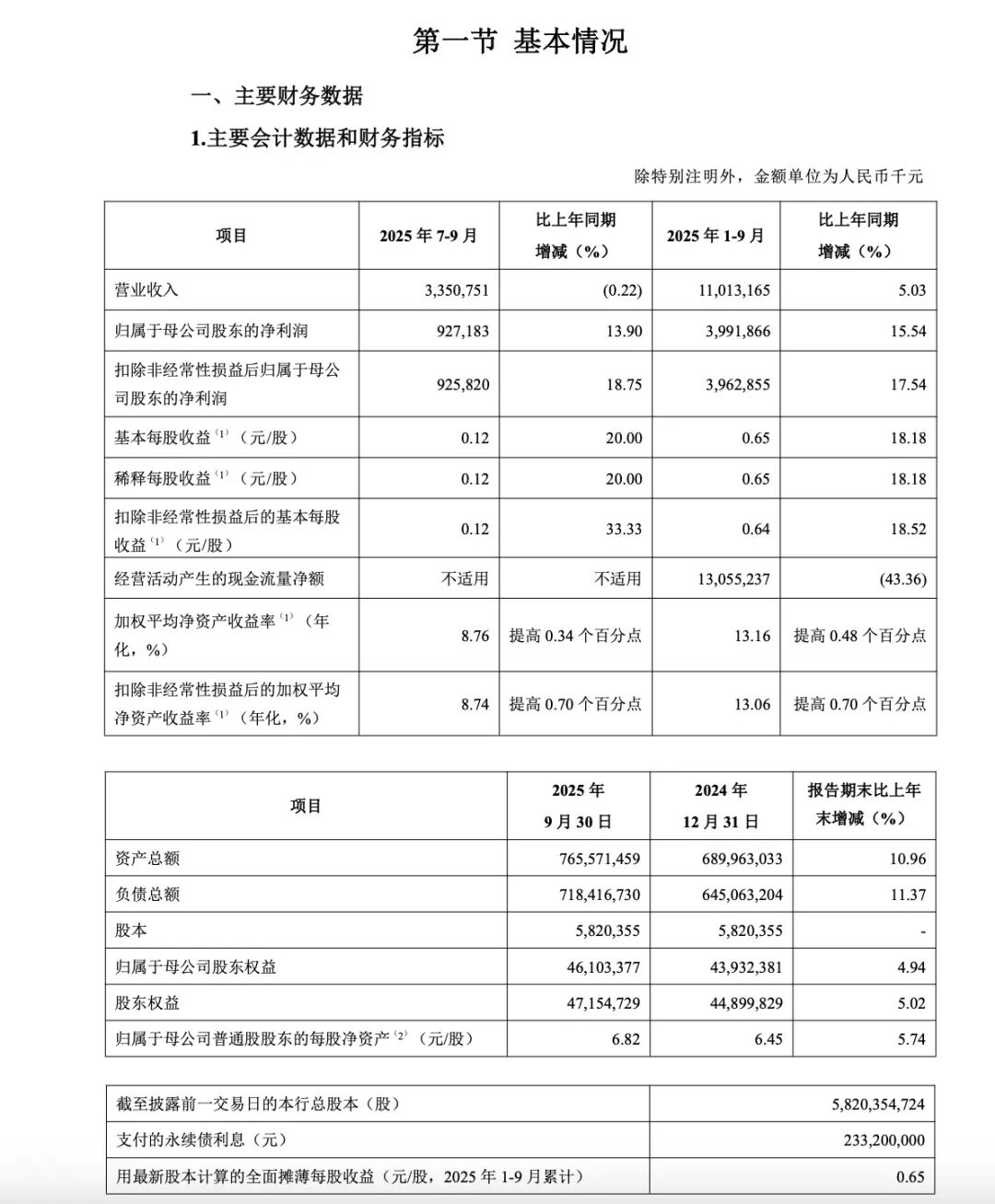
Core Viewpoint - Qingdao Bank's Q3 2025 report shows a slight decline in quarterly revenue, contrasting with overall growth in the first three quarters, highlighting challenges in non-interest income and management adjustments [1][2][5]. Financial Performance - For Q3 2025, Qingdao Bank reported revenue of 3.35 billion yuan, a minor decrease of 0.22% year-on-year, while total revenue for the first three quarters reached 11.01 billion yuan, up 5.03% [4][5]. - Net profit attributable to shareholders for Q3 was 927.18 million yuan, reflecting a 13.90% increase, and for the first three quarters, it was 3.99 billion yuan, up 15.54% [4][6]. - The bank's interest income for the first three quarters was 17.22 billion yuan, a year-on-year increase of 5.89%, while interest expenses decreased by 2.83 billion yuan [6]. Non-Interest Income Challenges - Non-interest income for the first three quarters was 2.87 billion yuan, down 10.72% year-on-year, primarily due to declines in investment income and fees from wealth management [5][6]. - The bank's reliance on non-interest income from the bond market and wealth management services exposes it to market fluctuations, indicating a lack of diversification in revenue sources [5][6]. Asset Quality and Capital Adequacy - As of September 30, 2025, the non-performing loan ratio was 1.10%, a decrease of 0.04 percentage points from the end of the previous year, with a provision coverage ratio of 269.97% [7][8]. - The capital adequacy ratio stood at 13.14%, below the industry average of approximately 15.8%, indicating a need for improved capital strength [8][9]. Management and Governance Changes - Qingdao Guoxin Group plans to increase its stake in Qingdao Bank to 19.99%, enhancing state-owned capital's influence in governance [9][10]. - Recent management changes include key personnel shifts across the bank's headquarters and branches, aimed at revitalizing operations and addressing challenges in non-interest income [10][11]. Wealth Management Performance - Qingyin Wealth Management has faced declining performance, with assets under management dropping from 2 trillion yuan in 2024 to 1.89 trillion yuan by mid-2025, alongside significant decreases in revenue and net profit [12][13].
Q3单季营收却“掉链子”?青岛银行(002948.SZ)营利双增背后藏隐忧
智通财经网· 2025-11-06 08:15
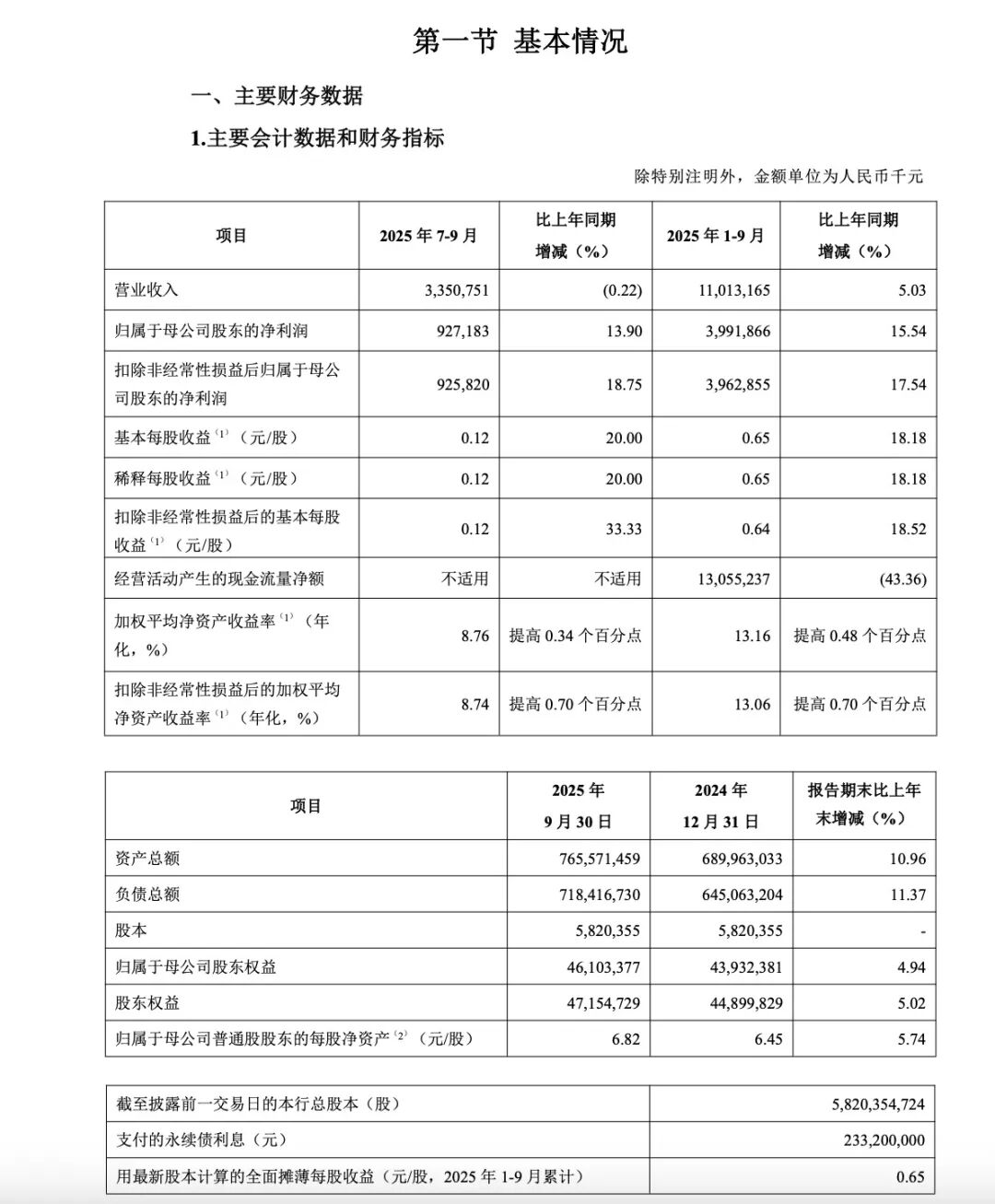
Core Viewpoint - Qingdao Bank's Q3 2025 report shows a slight decline in quarterly revenue, contrasting with overall growth in the first three quarters, highlighting challenges in non-interest income and management adjustments [1][2][6]. Financial Performance - In Q3 2025, Qingdao Bank reported revenue of 3.35 billion yuan, a minor decrease of 0.22% year-on-year, while the first three quarters saw total revenue of 11.01 billion yuan, up 5.03% [4][6]. - Net profit attributable to shareholders for Q3 was 927.18 million yuan, an increase of 13.90%, with a year-to-date net profit of 3.99 billion yuan, reflecting a 15.54% rise [4][8]. - The bank's interest income reached 17.22 billion yuan in the first three quarters, up 5.89%, while interest expenses decreased by 2.83 billion yuan [8]. Non-Interest Income Challenges - Non-interest income for the first three quarters was 2.87 billion yuan, down 10.72% year-on-year, primarily due to declines in investment income and fees from wealth management [7][8]. - The bank's reliance on non-interest income from bond markets and wealth management exposes it to market fluctuations, indicating a need for diversification in revenue sources [7][8]. Asset Quality and Capital Adequacy - As of September 30, 2025, the non-performing loan ratio was 1.10%, down 0.04 percentage points from the previous year, with a provision coverage ratio of 269.97%, up 28.65 percentage points [9][10]. - The capital adequacy ratio stood at 13.14%, below the industry average of approximately 15.8%, indicating a need for capital strengthening [12][13]. Shareholder and Management Changes - Qingdao Guoxin Group plans to increase its stake in Qingdao Bank to 19.99%, enhancing state-owned capital's influence in governance [13][14]. - Recent management changes include key personnel shifts across the bank's headquarters and branches, aimed at revitalizing operations and addressing challenges in non-interest income [13][14][15]. Wealth Management Performance - Qingyin Wealth Management has faced declining performance, with assets under management dropping from 2,081.22 billion yuan in 2023 to below 2,000 billion yuan in 2024, and a significant decrease in revenue and net profit [16].
债市成拖累?多家银行非息收入承压,央行重启国债买卖有何利好
Xin Lang Cai Jing· 2025-11-06 00:38
Core Viewpoint - The bond market's volatility has significantly impacted the non-interest income and overall revenue growth of listed banks in China during the first three quarters of the year [1][3][7]. Group 1: Non-Interest Income Decline - Among 42 A-share listed banks, 24 reported a year-on-year decline in non-interest income, with 8 banks experiencing a drop in net investment income [1][2]. - For instance, China Merchants Bank reported a 4.23% decrease in non-interest net income, primarily due to reduced bond and fund investment returns [3][4]. - Ping An Bank's revenue fell by 9.8%, influenced by declining loan rates and market volatility affecting non-interest income [3]. Group 2: Fair Value Changes - The significant drop in fair value changes has also been a major factor in revenue growth decline, with China Merchants Bank reporting a cumulative loss of 8.827 billion yuan in fair value changes for the first three quarters [4]. - Other banks like Everbright Bank and Huaxia Bank also reported losses in fair value changes, amounting to 4.982 billion yuan and 4.505 billion yuan, respectively [4]. - Analysts noted that fair value changes are highly influenced by bond market fluctuations, with smaller banks being more affected due to a higher proportion of FVTPL assets [4]. Group 3: Future Outlook and Central Bank Actions - The People's Bank of China announced the resumption of government bond trading operations, which is expected to help lower bond yields and benefit banks' non-interest income [11][12]. - Some bank executives expressed uncertainty about future non-interest income growth due to ongoing market volatility, suggesting that the bond market may remain in a fluctuating state [9][10]. - Analysts believe that the resumption of government bond trading will provide a safety net for the bond market, potentially stabilizing yields and supporting both bond and equity markets in the long term [12][13].




五家银行跻身绿色信贷“万亿俱乐部” 绿色债券存量规模近2万亿
2 1 Shi Ji Jing Ji Bao Dao· 2025-11-05 23:42
Core Insights - Green finance has transitioned from an optional choice to a mandatory requirement for the banking industry, serving as a new engine for strategic transformation and a blue ocean market for future growth [1] - The balance of green financing at Industrial Bank has reached nearly 2.5 trillion yuan, with green loans exceeding 1 trillion yuan and a non-performing loan rate of only 0.57% [1] - The People's Bank of China and other departments have issued a unified policy framework for green finance, effective from October 1, 2025, to standardize various financial products [2] Group 1: Green Credit Growth - As of the end of 2024, the total balance of green credit among 42 A-share listed banks exceeded 27 trillion yuan, reflecting a year-on-year growth of approximately 20% [3] - State-owned banks dominate the green credit market, with the six major state-owned banks accounting for over 21 trillion yuan, representing 77.6% of the total [3] - Industrial Bank's green loan balance has risen to 1.08 trillion yuan, joining the "trillion club" [3] Group 2: Performance and Sector Focus - The average growth rate of green credit for A-share listed banks in 2024 was 20.6%, a slowdown from approximately 28% in 2023, yet leading institutions maintained strong growth [4] - The focus of green credit issuance is concentrated in four key areas: clean energy, green transportation, energy conservation and environmental protection, and green buildings [4] - The Yangtze River Delta, Guangdong-Hong Kong-Macau Greater Bay Area, and Chengdu-Chongqing Economic Circle are identified as core regions for green credit [4] Group 3: Product Innovation - A-share listed banks are deepening innovation in green financial products, creating a multi-dimensional product system that includes loans, bonds, asset securitization, insurance, and carbon finance [5] - Sustainable Development Linked Loans (SLL), carbon emission rights pledge financing, and environmental rights collateral loans are gaining traction [5] - Industrial Bank has launched the first green loan with biodiversity protection insurance, while Bohai Bank introduced a green loan linked to data center energy efficiency [6] Group 4: Broader Financial Tools - The issuance of green bonds has expanded, with the cumulative issuance of labeled green bonds in 2024 surpassing 4 trillion yuan [6] - Banks are actively participating in green wealth management and fund products, enhancing investor engagement through innovative offerings [6] - Carbon finance tools are transitioning from pilot programs to broader applications, with various banks introducing carbon emission rights pledge financing products [6] Group 5: Future Directions - The banking industry is expected to continue innovating green financial products to support sustainable economic development, moving beyond traditional green credit [7] - The development of ESG-linked loans and financing models using carbon emission rights as collateral will be explored [7] - These innovations will not only assist in achieving national carbon reduction goals but also cultivate new growth momentum for banks [7]