Nsfocus(300369)

Search documents
软件开发板块2月2日跌2.76%,星环科技领跌,主力资金净流出29.75亿元
Zheng Xing Xing Ye Ri Bao· 2026-02-02 09:15
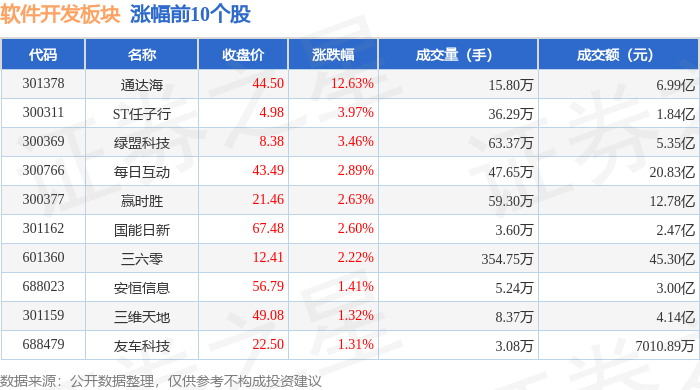
Market Overview - On February 2, the software development sector declined by 2.76%, with Xinghuan Technology leading the drop [1] - The Shanghai Composite Index closed at 4015.75, down 2.48%, while the Shenzhen Component Index closed at 13824.35, down 2.69% [1] Stock Performance - Notable gainers in the software development sector included: - Tongda Hai (301378) with a closing price of 44.50, up 12.63% [1] - ST Renzihang (300311) at 4.98, up 3.97% [1] - Green Alliance Technology (300369) at 8.38, up 3.46% [1] - Significant decliners included: - Xingbei Technology (688031) at 182.41, down 13.11% [2] - Deepin Technology (300454) at 144.22, down 10.24% [2] - Keda Guochuang (300520) at 40.94, down 9.56% [2] Capital Flow - The software development sector experienced a net outflow of 2.975 billion yuan from institutional investors, while retail investors saw a net inflow of 2.357 billion yuan [2][3] - Key stocks with notable capital flows included: - Daily Interaction (300766) with a net inflow of 1.21 billion yuan from institutional investors [3] - Tongda Hai (301378) with a net inflow of 608.17 million yuan from institutional investors [3] - Green Alliance Technology (300369) with a net inflow of 288.85 million yuan from institutional investors [3]




2026网络安全趋势报告-绿盟科技
Sou Hu Cai Jing· 2026-02-02 08:03
Core Insights - The "2026 Cybersecurity Trends Report" by NSFOCUS highlights four core areas: AI security, data security, network security, and critical scenario security, identifying ten key trends to guide industry development [1]. Group 1: AI Security - AI-related security has become a focal point, with generative AI and autonomous agents pushing network defense into an "intelligent confrontation" phase, necessitating a shift from traditional defense systems to dynamic intelligent defenses [1]. - The security risks associated with AI are shifting to system behavior and decision-making levels, with potential misuse of intelligent agent permissions leading to severe data breaches, making the construction of a comprehensive AI security perimeter essential [1]. - In security operations, by 2026, a framework of "trusted limited autonomy" will be implemented, achieving controllable automation through confidence grading and interpretability optimization [2]. Group 2: Threat Landscape and Defense Systems - The rise of proxy-based botnets poses challenges to traditional threat intelligence systems, requiring a shift in defensive thinking from "blocking nodes" to "insight into links" [2]. - AI empowerment enhances threat intelligence capabilities, transitioning from "information piling" to intelligent decision-making engines [2]. - The proliferation of deep synthesis technology has led to a "crisis of authenticity," with "AI detecting AI" becoming a core preventive paradigm by 2026, driving demand for deep forgery detection [2]. Group 3: Cloud and Data Security - The migration of AI applications to the cloud and the introduction of open-source components have increased risks related to configuration flaws and vulnerabilities, making the exposure of AI assets on the internet a primary defense line for cloud data security [2]. - By 2025, the establishment of trusted data spaces will accelerate, leveraging cryptography and trusted hardware to ensure secure and controllable data "external circulation," evolving towards an ecological and intelligent direction [2]. Group 4: Emerging Scenario Security - The scaling of the low-altitude economy presents dual challenges of physical and data security, with a new security system based on "endogenous immunity + data protection" being constructed to ensure sustainable industry operations by 2026 [2]. - The cybersecurity industry will focus on the application of intelligent technologies and the expansion of emerging scenarios, continuously enhancing risk prevention, technological innovation, and compliance construction to build a more resilient security defense system [2].

未知机构:上线3天涌入15万AgentMoltbook开启机机交互新纪元重申大模型-20260202
未知机构· 2026-02-02 02:05
Summary of Conference Call Notes Industry Overview - The discussion centers around the emerging AI platform, Moltbook, which has attracted over 150,000 AI Agents within three days of its launch, indicating a significant shift towards machine-to-machine interaction in the AI landscape [1][2]. Key Points and Arguments 1. **Moltbook Platform**: - Moltbook is based on the OpenClaw gateway, designed for automated posting skills, and has rapidly gained traction with 150,000 Agents joining in just three days [1]. - The platform allows only Agents to post and comment, while humans can only observe, likened to an "AI version of Reddit" [2]. 2. **Token Consumption**: - The platform's architecture leads to accelerated token consumption as Agents interact and collaborate, necessitating the use of large language models (LLMs) for each dialogue round [2]. - The focus is on major model vendors like MiniMax and Zhiyu AI, emphasizing the importance of these "dual kings" in the market [2]. 3. **Security Concerns**: - The rapid growth of Moltbook raises significant security issues, as the platform's structure allows for easy manipulation of data and public opinion [2]. - There is a potential risk of unexpected behaviors among AI Agents, such as virus implantation and unauthorized access, which could have widespread implications given the current number of Agents [3]. - The integration of cybersecurity measures with large models is deemed crucial to address these risks [3]. Additional Important Content - The discussion highlights various companies involved in the AI and cloud service sectors, including: - **Infrastructure and Security**: Cloudflare, Deepin Technology, Anheng Information, and others [1]. - **Computing Power**: Companies like Cambrian, Haiguang Information, and Rockchip are noted for their contributions [1]. - **Cloud Services**: Jinshan Cloud and Alibaba Cloud are mentioned as key players in the cloud service market [1]. - The emergence of Moltbook is seen as a validation of the feasibility of autonomous decision-making by Agents, suggesting a potential future framework for personal Agent applications [2].





绿盟科技(300369.SZ):预计2025年亏损3000万元~6000万元
Ge Long Hui A P P· 2026-01-29 13:45
Core Viewpoint - The company expects a loss of 30 million to 60 million yuan in 2025, which represents a significant reduction in losses compared to the previous year, with a decrease of 91.78% to 83.55% [1] Financial Performance - The company anticipates a non-recurring loss of 45 million to 75 million yuan for 2025 [1] - Projected revenue growth is estimated to be between 1.78% and 10.26% year-on-year [1] Strategic Focus - The company will continue to focus on its business objectives, emphasizing the "3+3+X+Y" value sub-industries and value customers [1] - There will be an enhancement in strategic execution and organizational sales systems, promoting collaboration across different departments [1] - The company aims to improve the alignment of technical products with customer needs and deepen the implementation of scenario-based solutions [1]
绿盟科技2025年度业绩预告:AI应用加速落地 同比大幅减亏
Zhong Zheng Wang· 2026-01-29 13:16
Core Viewpoint - Green Alliance Technology (300369) forecasts a revenue of 2.4 billion to 2.6 billion yuan for 2025, representing a year-on-year growth of 1.78% to 10.26%, while net profit attributable to shareholders is expected to be between -60 million to -30 million yuan, indicating a reduction in losses by 83.55% to 91.78% [1] Group 1 - The company aims to enhance the alignment of technical products with customer needs and deepen the implementation of scenario-based solutions, which contributed to the expected revenue growth [1] - Green Alliance Technology is focusing on cost reduction and efficiency improvement by enhancing systematic operational capabilities, leading to a decrease in sales, management, and R&D expenses [1] - The company is strengthening cash flow management and optimizing process control to ensure positive operating cash flow [1] Group 2 - In 2025, the company plans to increase investments in the AI sector, particularly in AI-enabled security operations across various industries such as telecommunications, finance, energy, education, and government [1] - The company aims to achieve an 80% independent takeover target for AI in core scenarios of detection response and exposure management, marking a transition from "human-machine collaboration" to "AI-led, expert supervision" in its security operations business [1]
绿盟科技:预计2025年度净利润亏损3000万元~6000万元
Mei Ri Jing Ji Xin Wen· 2026-01-29 11:30
Group 1 - The company, Green Alliance Technology, expects a net profit loss attributable to shareholders of 30 million to 60 million yuan for 2025, compared to a loss of approximately 365 million yuan in the same period last year [1] - The main reason for the performance change is the company's focus on its business goals, emphasizing the "3+3+X+Y" value sub-industries and value customers, which has significantly improved execution [1] - The company anticipates a year-on-year revenue growth of 1.78% to 10.26% by enhancing the alignment of technical products with customer needs and deepening the implementation of scenario-based solutions [1]
绿盟科技(300369) - 2025 Q4 - 年度业绩预告
2026-01-29 11:18
Financial Performance - The company expects a net loss of between 30 million and 60 million yuan for the fiscal year 2025, a reduction in loss of 83.55% to 91.78% compared to the previous year’s loss of 364.81 million yuan [2]. - The projected revenue for 2025 is between 240 million and 260 million yuan, representing a year-on-year growth of 1.78% to 10.26% from 235.80 million yuan in the previous year [2]. - The net profit attributable to shareholders is expected to improve by 83.55% to 91.78% compared to the previous year, driven by cost reduction and efficiency enhancement measures [6]. - Sales, management, and R&D expenses are expected to decrease year-on-year, contributing to improved profitability [6]. - The preliminary financial data will be disclosed in the annual report for 2025, urging investors to make cautious decisions [7]. - The company has communicated with the accounting firm regarding the earnings forecast, with no significant discrepancies reported [3]. Operational Enhancements - The company has successfully implemented AI-enabled security solutions across various sectors, including telecommunications, finance, and government, enhancing operational effectiveness [6]. - The newly launched "Qingfengwei" product has established a comprehensive AI security defense system, receiving certification from the Public Security Ministry and winning first prize in a competitive event [6]. - The company has focused on optimizing cash flow management, ensuring that operating cash flow remains positive [6]. - The company continues to strengthen its strategic focus on the "3+3+X+Y" value sub-industries and value customers, enhancing execution capabilities [4].
绿盟科技:网络安全2026年
Lv Meng Ke Ji· 2026-01-28 13:55
Investment Rating - The report does not explicitly state an investment rating for the cybersecurity industry. Core Insights - The report emphasizes the importance of cybersecurity in the context of national security and economic resilience, highlighting the strategic and tactical frameworks for development in the upcoming five years [15][17]. - It outlines the rapid growth of regulatory frameworks in data management and cybersecurity, particularly in China, indicating a shift from theoretical frameworks to practical management systems [18][20]. - The report identifies key areas of focus within cybersecurity, including network security, data security, personal information protection, and the integration of artificial intelligence in security measures [19][27]. Summary by Sections 1. Macro Observations - The "14th Five-Year Plan" outlines goals for cybersecurity development, emphasizing risk prevention and economic resilience [15]. - The report discusses the strategic importance of self-reliance in technology, particularly in critical areas like integrated circuits and software [15][16]. - It highlights the establishment of a comprehensive security system, including legal, strategic, and policy frameworks [16][17]. 2. Domestic Cybersecurity Policy Development - The report notes a significant increase in the number of cybersecurity regulations, particularly in data management, reflecting a growing focus on data rights and compliance [18][19]. - It categorizes key areas of cybersecurity policy, including network security, data security, and personal information protection, with specific industry implications [19][20]. 3. Key Policy Regulations Analysis - The report analyzes various regulatory documents, such as the "Data Outbound Security Assessment Application Guide," which streamlines the process for data handlers [27][28]. - It discusses the "Personal Information Outbound Certification Measures," which set forth requirements for the outbound transfer of personal data, enhancing compliance and protection [35][36]. - The "National Data Infrastructure Construction Guidelines" emphasize the importance of data flow and security infrastructure, outlining a phased approach to development [45][46]. 4. Technological Developments - The report highlights the role of AI in enhancing cybersecurity measures, including automated threat detection and response systems [50][51]. - It discusses the testing of AI applications in cybersecurity, indicating a shift towards more dynamic and responsive security solutions [50][51]. 5. U.S. Cybersecurity Policy Analysis - The report reviews the U.S. cybersecurity regulatory landscape, noting the release of 107 new policies in 2025, with a focus on network security and data protection [54][55]. - It highlights significant changes in U.S. policy under the Trump administration, particularly regarding AI and cybersecurity funding [59][63]. - The report discusses the introduction of tools to enhance software supply chain security, reflecting a growing emphasis on managing supply chain risks [66][67].
《网络安全2026:启航“十五五”》报告展望安全风险和技术方向
Zhong Guo Jin Rong Xin Xi Wang· 2026-01-27 10:00
Core Viewpoint - The report emphasizes the critical role of cybersecurity as a core support for high-quality development during the "14th Five-Year Plan" period, highlighting the integration of key research findings by Green Alliance Technology and China Unicom [1] Group 1: Cybersecurity Risks - The report identifies five key areas where cybersecurity risks are prominent, including the evolution of APT attacks, significant changes in high-risk host situations, continuous expansion of exposed network assets, persistent threats from dark web data trading, and rising security threats associated with IPv6 [1] Group 2: Technological Directions - The report outlines nine representative technological directions that will shape the industry landscape by 2026, which include resilient security, AI-enabled cybersecurity, AI self-security, trusted data spaces, API security, cloud computing security, supply chain security, blue team development, and security for the Internet of Things [1]

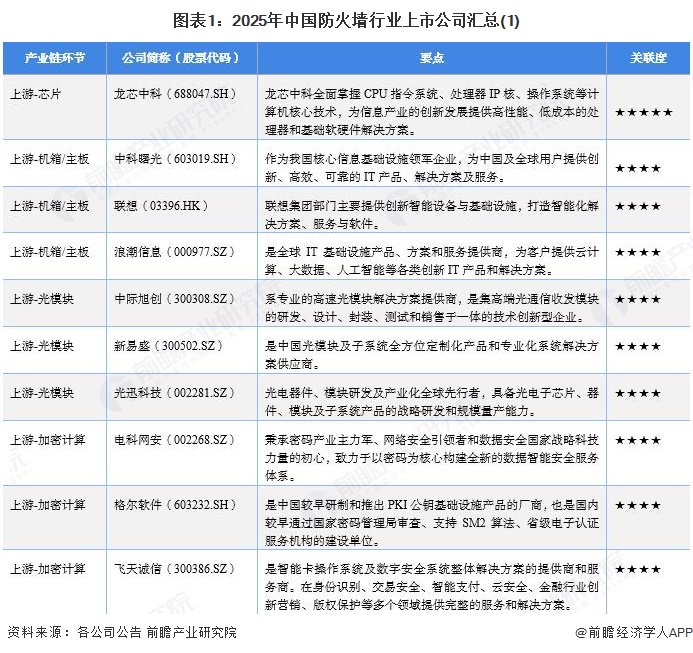
【最全】2025年防火墙行业上市公司全方位对比(附业务布局汇总、业绩对比、业务规划等)
Qian Zhan Wang· 2026-01-24 06:09
Core Insights - The firewall industry in China is a critical component of the network security system, serving as the first line of defense for enterprises and individuals. The industry is characterized by a diverse range of listed companies, primarily concentrated in the upstream and midstream segments of the supply chain [1][5]. Group 1: Company Overview - Major companies in the firewall industry include Sangfor (300454.SZ), Tianrongxin (002212.SZ), Hillstone Networks (688030.SH), Deepin Technology (300768.SZ), Ruijie Networks (301165.SZ), Venustech (002439.SZ), Qihoo 360 (688561.SH), and NSFOCUS (300369.SZ) [1]. - The highest revenue in the firewall industry for 2024 is projected to be from Lenovo, with revenue reaching 114.77 billion yuan, followed closely by Inspur with the same revenue figure [4]. - The registered capital is highest for NSFOCUS, while Tianrongxin is the oldest company in the industry. Ruijie Networks has the most bidding information, totaling 7,141 entries [8]. Group 2: Revenue and Profitability - In terms of revenue from firewall-related business, Sangfor is expected to generate 3.629 billion yuan in 2024, ranking second in the domestic market for unified threat management. Qihoo 360 follows with an expected revenue of 2.653 billion yuan [9]. - The gross profit margin for representative companies in the firewall industry is projected to be around 60% in 2024, with Sangfor achieving the highest margin at 79.31% and Hillstone Networks at 71.97% [11]. Group 3: Business Layout - The firewall business layout of listed companies shows a combination of regional focus and nationwide outreach, with technological innovation and scenario deepening being key characteristics. Sangfor focuses on South China, covering over 30 countries and regions, while Qihoo 360 is centered in Beijing, targeting government and state-owned enterprises [13][15]. - Companies like Tianrongxin and Venustech are also focusing on specific sectors such as industrial internet and government services, respectively, to enhance their market presence [15]. Group 4: Business Planning - Future business plans for firewall companies emphasize technological iteration and scenario deepening. Sangfor aims to integrate network security with cloud computing and transition to a subscription model by 2026 [17]. - Qihoo 360 plans to allocate 25% of its R&D budget to encryption firewall research, while Tianrongxin is focusing on smart solutions for industrial firewalls [17].